
For better exam readiness, students can include Class 7 Science MCQ and Curiosity Chapter 3 Electricity: Circuits and Their Components MCQ in their daily study routine.
Class 7 Science Chapter 3 Electricity: Circuits and Their Components MCQ
Electricity: Circuits and Their Components MCQ Class 7
MCQ On Electricity: Circuits and Their Components Class 7
Question 1.
Why are multiple cells used in a torch?
(a) To increase the size of the torch
(b) To make it heavier
(c) To provide more energy for longer operation
(d) To make it look modern
Answer:
(c) To provide more energy for longer operation
Question 2.
In a typical electric cell, the metal cap acts as ………(i)………, and the metal disc at the base acts as ……….(ii)………..?
(a) (i) – negative terminal; (ii) – positive terminal
(b) (i) – positive terminal; (ii) – negative terminal
(c) (i) – insulator; (ii) – conductor
(d) (i) – filament; (ii) – terminal
Answer:
(b) In a typical electric cell, the metal cap is the positive terminal, and the metal disc at the base is the negative terminal.

Question 3.
Which of these is the correct arrangement of electric cells in a battery?
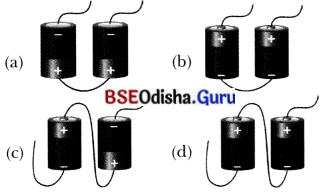
Answer:
(d)
Question 4.
In the given figure, the LED has two terminals: a longer leg and a shorter leg. To ensure proper functioning of the LED, the longer leg should be connected to…………….

(a) positive terminal of the battery.
(b) negative terminal of the battery.
(c) any terminal of the battery.
(d) both the terminals of the battery.
Answer:
(a) positive terminal of the battery.
Question 5.
The main difference between an LED and an incandescent bulb is that
(a) LEDs use filaments; incandescent bulbs do not.
(b) Incandescent bulbs use filaments; LEDs do not.
(c) Both use filaments, but in different materials.
(d) LEDs always need AC current.
Answer:
(b) An incandescent bulb glows because its filament gets heated, whereas an LED produces light without a filament.
Question 6.
A wildlife volunteer observes that a pigeon sitting on a high-voltage wire remains unharmed, but another bird gets electrocuted when it lands on a nearby pole and touches a wire at the same time. Which statement best explains this observation?
(a) Larger birds attract more current than smaller birds.
(b) A bird is safe on a single live wire, but birds get electrocuted when they touch two different wires or a wire and another conductor at the same time, creating a complete path for current.
(c) The feet of some species of birds are insulated, while others are not.
(d) Power lines carry current only during the day; the electrocution happened because the line was active at that moment.
Answer:
(b) A bird on one live wire is safe because no complete circuit forms. If it touches a wire and the pole (or two wires) together, a complete path forms and current flows through its body.
Question 7.
What will be the order in which the bulbs A, B, and C will glow when the switch is moved to the ON position?
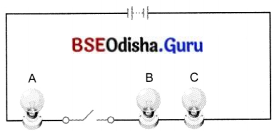
(a) First A, then B, and then C
(b) First B, then C, and then A
(c) First A, then B and C together
(d) All the bulbs will glow together
Answer:
(d) When the switch is turned ON, the circuit becomes closed, so current flows through the whole circuit at the same time. Hence A, B, and C glow together.
Question 8.
Select the option that shows the correct direction of electric current in the circuit.
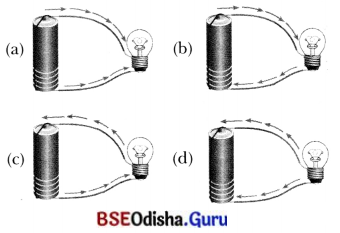
Answer:
(b) In a simple circuit, conventional current flows from the positive terminal of the cell (metal cap), passes through the wire and the bulb, and returns to the negative terminal (metal disc/base).
Question 9.
Which of the following precautions need not be taken while using electric gadgets/appliances/ circuits?
(a) We should never touch a lighted electric bulb connected to the mains.
(b) We should never experiment with the electric supply from the mains or a generator or an inverter.
(c) We should never use just any wire or strip of metal in place of a fuse.
(d) We should never turn the switch in ON position.
Answer:
(d) This is not a safety precaution. Turning the switch to the ON position is perfectly safe and necessary to operate electric appliances.
Question 10.
In the given circuit, four identical bulbs P, Q, R and S are connected to a battery as shown. Choose the correct statement.
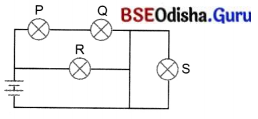
(a) If bulb R fuses, bulbs P and Q go off.
(b) If bulb P fuses, bulb R goes off while bulb S stays lit.
(c) If bulb Q fuses, bulb R goes off while bulb S stays lit.
(d) If bulb S fuses, then the rest of the bulbs stay lit.
Answer:
(d) If bulb S fuses, the other bulbs P, Q and R still have complete paths in the circuit, so they remain lit.
Question 11.
In the LED symbol, the triangle points in the direction in which current can flow. What do the two small arrows near the LED symbol indicate?
(a) The LED stores electricity.
(b) The LED emits light.
(c) The LED has a filament.
(d) The LED is an insulator.
Answer:
(d) The LED is an insulator.
Question 12.
Which of the following terminal arrangements will never make a battery?

Answer:
(c)
Question 13.
A student made an incomplete circuit with a small gap as shown in the image. He placed a few different materials in the gap and noted the intensity of the light produced by the bulb.
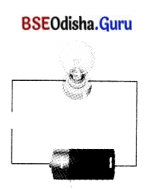
| Material | Intensity of Light |
| Glass | Lamp does not glow |
| I.ead | Dim |
| Steel | Bright |
| Copper | Very bright |
What can be concluded based on the activity?
(a) Steel should be used to make insulating cover for electric wires
(b) Copper is the best material to conduct electricity
(c) Lead is the best material for making wires
(d) Glass can be used to store electricity
Answer:
(b) Copper is the best material to conduct electricity
Question 14.
Electrical wires, switches, connectors of plugs, and sockets are made of ………….(i)…….., while materials like rubber, plastics, and ceramics are used as ……..(ii)………. to prevent electric shocks.
(a) (i) – Insulators, (ii) – Conductors
(b) (i) – Conductors, (ii) – Insulators
(c) (i) – Conductors, (ii) – Conductors
(d) (i) – Insulators, (ii) – Non-conductors
Answer:
(b) (i) – Conductors, (ii) – Insulators
Question 15.
A simple circuit has a cell, a bulb, and two wires. The bulb is not glowing. Four students suggest the following possible reasons:
(i) There is a small gap between one wire and the bulb holder.
(ii) The bulb filament inside is broken, even though the glass looks fine.
(iii) The plastic covering of the wire is not painted, so current cannot flow.
(iv) The wires are connected without removing insulation.
Which of the above statements correctly describe situations that can break a circuit?
(a) (i), (ii), and (iv)
(b) (i) and (iii) only
(c) (ii) and (iii) only
(d) (iii) and (iv) only
Answer:
(a) The plastic covering is an insulator; whether it is painted or not does not affect current flow. Current flows through the metal wire inside.
Question 16.
A student performs two activities using an incandescent bulb and an LED.
- Activity I: An incandescent bulb is connected to a single cell.
- Activity II: An LED is connected to a single cell.
(i) For an incandescent bulb to glow, the circuit only needs to be closed; its terminals can be connected in either direction.
(ii) For an LED to glow, the direction of connection matters; it allows current only in one direction.
(iii) In Activity I, reversing the connections breaks the circuit, so the bulb should not glow.
(iv) These activities show that all electrical components work only in one fixed direction.
Which of the given statements are correct?
(a) (i) and (ii) only
(b) (i) and (iii) only
(c) (ii), (iii), and (iv)
(d) (i), (ii), and (iv)
Answer:
(a) In Activity I, even if the connections are reversed, the incandescent bulb will still glow as long as the circuit is closed. Only some components like an LED work in a fixed direction of current.
Question 17.
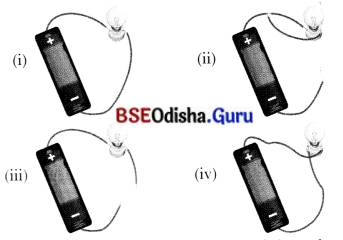
In which of the following setups, the bulb will glow?
(a) (i) and (ii) only
(b) (i) and (iv) only
(c) (ii) and (iv) only
(d) (i), (ii) and (iv)
Answer:
(b) Circuit is complete in circuits shown in options (i) and (iv).
Question 18.
Which of the following statements are correct?
(i) A switch can be placed anywhere in a circuit.
(ii) The positive terminal of an incandescent lamp must be connected to the positive terminal of the cell.
(iii) The longer leg of the LED is the positive terminal.
(a) (i) only
(b) (iii) only
(c) (i) and (iii)
(d) (ii) and (iii)
Answer:
(c) In incandescent lamps, it does not matter which of its terminals connects to the positive or negative terminal of the cell.
Question 19.
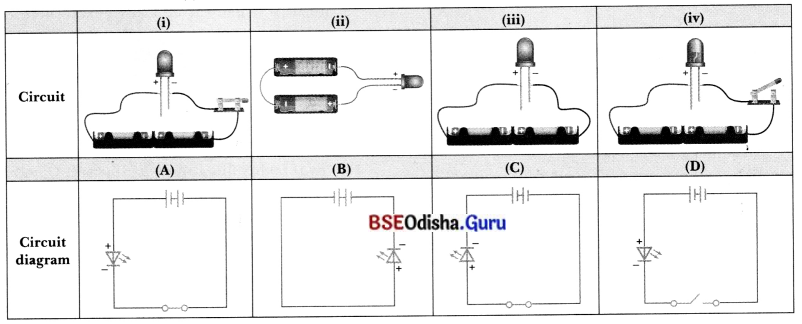
Smita was trying to connect the circuit in different ways practically, and she was also drawing the circuit diagrams to try out other possible connections. Some circuits tried out by Smita are listed in table below. Identify the correct pair(s) of the circuit and its corresponding circuit diagram.
(a) (i)-(A), (ii)-(B)
(b) (ii)-(B), (iii)-(C)
(c) (i)-(A), (iv)-(D)
(d) (iv)-(D) only
Answer:
(c) (i)-(A), (iv)-(D)
Electricity: Circuits and Their Components Class 7 Assertion and Reason Questions
The following questions consist of two statements – Assertion (A) and Reason (R). Answer these questions by selecting the correct option:
(a) Both A and R are true and R is the correct explanation of A.
(b) Both A and R are true but R is not the correct explanation of A.
(c) A is true but R is false.
(d) A is false but R is true.
1. (A): A cell has two terminals, one positive and the other negative.
(R): The metal cap of the cell represents the negative terminal.
Answer:
(c) The metal cap of the cell represents the positive terminal.
2. (A): Two cells will always form a working battery.
(R): The positive terminal of one cell should be connected to the negative terminal of the other to form a battery.
Answer:
(d) Two cells will not always work as a battery; they must be connected properly, i.e., the positive terminal of one cell should be connected to the negative terminal of the other.
3. (A): A bulb glows brighter if more cells are added.
(R): More cells provide more electricity for the circuit.
Answer:
(a) Both A and R are true and R is the correct explanation of A.
4. (A): An incandescent bulb glows because of its filament.
(R): The filament of an incandescent lamp is connected to two thick wires.
Answer:
(b) Both statements are true, but the reason does not explain the assertion. The incandescent bulb glows because its filament becomes hot and glows when current passes through it.
5. (A): When the switch is in the OFF position, the lamp does not glow.
(R): In the OFF position, the switch creates a closed path in the circuit.
Answer:
(c) In OFF position, the switch breaks the circuit (creates an open circuit), so no current flows and the lamp does not glow.
6. (A): Plastic can replace a metal pin in a circuit.
(R): Plastic is an insulator and does not allow the current to pass through it.
Answer:
(d) Plastic cannot replace a metal pin in a circuit because plastic does not conduct electricity, so the circuit would remain open.
Electricity: Circuits and Their Components Class 7 Fill in the Blanks
1. An electric cell is a portable source of ………….
Answer:
electrical energy
2. In incandescent lamps, the ………… gets hot and glows to produce light.
Answer:
filament
3. LEDs have two terminals; the ………… terminal is attached to the longer wire, while the ………… terminal is attached to the shorter wire.
Answer:
positive, negative
4. The direction of electric current in a closed electrical circuit is taken to be from the ………… to the ………… terminal of the electric cell.
Answer:
positive, negative
5. An electric ………… is a device used to either break an electric circuit or complete it at our will.
Answer:
switch
6. A representation of an electrical circuit using symbols is called its ………….
Answer:
circuit diagram
7. Batteries generally provide …………, whereas the electricity from power plants is ………….
Answer:
direct current (DC), alternating current (AC)
8. The human body behaves like a ………… of electricity because body fluids can allow current to pass through.
Answer:
conductor
Electricity: Circuits and Their Components Class 7 True or False
Question 1.
The positive terminal of a cell is connected to the positive terminal of another cell in a battery.
Answer: False In a battery, the positive terminal of one cell is connected to the negative terminal of the next cell.
Question 2.
The current generated through a battery is known as alternating current (AC).
Answer: False A battery provides direct current (DC).
Question 3.
An incandescent lamp will only glow if its positive terminal is connected to the positive terminal of the cell.
Answer: False An incandescent lamp glows as long as the circuit is complete, irrespective of which lamp terminal is connected to the positive terminal of the battery.
Question 4.
In a circuit diagram, an incandescent lamp and an LED are represented by the same symbol.
Answer: False In a circuit diagram, an incandescent lamp and an LED are represented by different symbols.
Question 5.
Ceramics are poor conductors (insulators) of electricity.
Answer: True
Question 6.
Rubber and plastic are used as covering on wires because they are good conductors of electricity.
Answer: False Rubber and plastic are used as coverings because they are insulators (poor conductors) of electricity.
Electricity: Circuits and Their Components Class 7 Match the Following
Question 1.
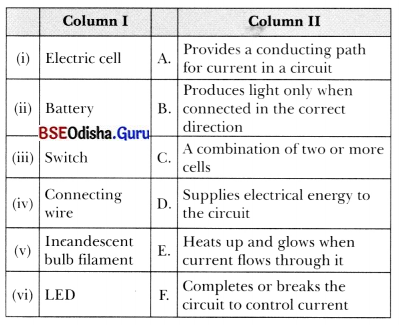
Match column I with column II.
Answer:
| Column I | Column II |
| (i) Electric cell | D. Supplies electrical energy to the circuit |
| (ii) Battery | C. A combination of two or more cells |
| (iii) Switch | F. Completes or breaks the circuit to control current |
| (iv) Connecting wire | A. Provides a conducting path for current in a circuit |
| (v) Incandescent bulb filament | E. Heats up and glows when current flows through it |
| (vi) LED | B. Produces light only when connected in the correct direction |
Question 2.
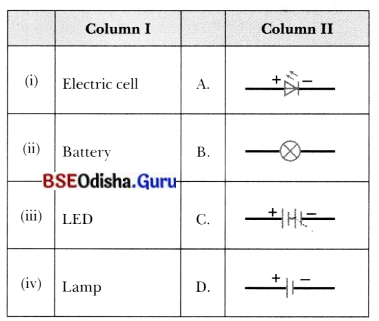
Answer:
(i)-D, (ii)-C, (iii)-A, (iv)-B