Prime Time Class 6 MCQ Maths Chapter 5

Regular revision with Class 6 Maths MCQ with Answers and Ganita Prakash Class 6 Maths Chapter 5 Prime Time MCQ improves accuracy in objective exams.

MCQ on Prime Time Class 6

Prime Time MCQ Class 6

Class 6 Maths Prime Time MCQ

Question 1.
Which of the following is a factor of 36?
(a) 5
(b) 14
(c) 9
(d) 15
Solution:
(c) 9
We can write 36 = 1 × 36 = 2 × 18 = 3 × 12 = 4 × 9 = 6 × 6
Hence, the factors of 36 are 1, 2, 3, 4, 6, 9, 12, 18 and 36.

Question 2.
Which of the following is a multiple of 15?
(a) 125
(b) 135
(c) 145
(d) 155
Solution:
(b) 135
We can write 135 = 15 × 9.
Hence, 135 is a multiple of 15.

Question 3.
Which of the following is a perfect number?
(a) 4
(b) 5
(c) 6
(d) 8
Solution:
(c) 6
We know that a number for which the sum of all its factors is equal to twice of itself, is called a perfect number.
Factors of 6 are 1, 2, 3 and 6.
Sum of factors of 6 = 1 + 2 + 3 + 6= 12, which is double of number 6.
Hence, 6 is a perfect number.

Prime Time Class 6 MCQ Maths Chapter 5

Question 4.
Which of the following is not a multiple of 24?
(a) 72
(b) 120
(c) 168
(d) 206
Solution:
(d) 206
Clearly, 72 = 24 × 3, 120 = 24 × 5 and 168 = 24 × 7
Hence, 72, 120 and 168 are multiples of 24. But 206 is not a multiple of 24.

Question 5.
Which of the following is not a common multiple of 2 and 5?
(a) 30
(b) 40
(c) 45
(d) 50
Solution:
(c) 45
Clearly, 30 = 2 × 15 = 5 × 6, 40 = 2 × 20 = 5 × 8 and 50 = 2 × 25 = 5 × 10
∴ 30, 40 and 50 are common multiples of 2 and 5.
Since 45 = 5 × 9, 45 is a multiple of 5 but not of 2.
Thus, 45 is not a common multiple of 2 and 5.

Question 6.
Which of the following is a composite number?
(a) 47
(b) 67
(c) 57
(d) 89
Solution:
(c) 57
Factors of 47 are 1 and 47.
Factors of 67 are 1 and 67.
Factors of 57 are 1, 3, 19 and 57.
Factors of 89 are 1 and 89.
Since 57 has more than two factors, 57 is a composite number.

Prime Time Class 6 MCQ Maths Chapter 5

Question 7.
Which of the following numbers is the product of exactly three distinct prime numbers?
(a) 135
(b) 145
(c) 155
(d) 165
Solution:
(d) 165
Every number can be expressed as a product of primes.
135 = 3 × 3 × 3 × 5 (only two prime numbers 3 and 5)
145 = 5 × 29 (only two prime numbers 5 and 29)
155 = 5 × 31 (only two prime numbers 5 and 31)
165 = 3 × 5 × 11 (three distinct prime numbers 3, 5 and 11)

Question 8.
The difference between the prime numbers between 80 and 90 is:
(a) 6
(b) 7
(c) 8
(d) 9
Solution:
(a) 6
The prime numbers between 80 and 90 are 83 and 89.
Hence, the required difference = 89 – 83 = 6

Question 9.
Which of the following are co-prime?
(a) 8 and 14
(b) 12 and 15
(c) 14 and 15
(d) 18 and 21
Solution:
(c) 14 and 15
Factors of 14 are 1, 2, 7 and 14.
Factors of 15 are 1, 3, 5 and 15.
Since 1 is the only common factor of 14 and 15, they are co-prime.

Prime Time Class 6 MCQ Maths Chapter 5

Question 10.
Which of the following are twin primes?
(a) 3 and 7
(b) 11 and 13
(c) 13 and 19
(d) 17 and 23
Solution:
(b) 11 and 13
Twin primes are pairs of primes having a difference of 2.
13 – 11 = 2
Hence, 11 and 13 are twin primes.

Question 11.
The smallest number having four different prime factors is:
(a) 210
(b) 215
(c) 230
(d) 240
Solution:
(a) 210
The smallest number, having four different prime factors, will be obtained as the product of the first four prime numbers.
The first four smallest prime numbers are 2, 3, 5 and 7.
Thus, the required number = 2 × 3 × 5 × 7 = 210

Question 12.
The prime factorisation of 44100 is:
(a) 2 × 2 × 2 × 3 × 3 × 5 × 5 × 7
(b) 2 × 2 × 3 × 3 × 5 × 5 × 7 × 7
(c) 2 × 3 × 5 × 5 × 5 × 7 × 7
(d) 2 × 3 × 3 × 5 × 7 × 7 × 7
Solution:
(b) 2 × 2 × 3 × 3 × 5 × 5 × 7 × 7
The prime factorisation of 44100 is
44100 = 2 × 2 × 3 × 3 × 5 × 5 × 7 × 7
Prime Time Class 6 MCQ Maths Chapter 5-1

Prime Time Class 6 MCQ Maths Chapter 5

Question 13.
In prime factorisation of 2250, number 5 appears:
(a) 1 time
(b) 2 times
(c) 3 times
(d) 4 times
Solution:
(c) 3 times
The prime factorisation of 2250 is 2250 = 2 × 3 × 3 × 5 × 5 × 5.
Prime Time Class 6 MCQ Maths Chapter 5-2
Here, 2 appears once, 3 appears 2 times and 5 appears 3 times.

Question 14.
Which one of the following numbers is divisible by 8?
(a) 7634452
(b) 4078376
(c) 7232854
(d) 5736500
Solution:
(b) 4078376
For a number to be divisible by 8, the number formed by its last three digits should be divisible by 8.
The number formed by the last three digits of 4078376 is 376.
Since 376 = 8 x 47, it is divisible by 8.
Thus, 4078376 is divisible by 8.

Question 15.
Which one of the following numbers is divisible by all of 2, 4, 5, 8 and 10?
(a) 72460
(b) 73360
(c) 78945
(d) 76390
Solution:
(b) 73360
We know that if a number is divisible by 5 and
8, then it is also divisible by 2, 4 and 10.
All four numbers end with either ‘0’ or ‘5’, therefore they are divisible by 5.
The number formed by the last three digits of 73360 is 360.
Since 360 = 8 × 45, it is divisible by 8.
Thus, 73360 is divisible by 8.
So, 73360 is divisible by all of 2, 4, 5, 8 and 10.

Prime Time Class 6 MCQ Maths Chapter 5

Question 16.
Which digit should replace * so that the number 80405*6 is divisible by 4?
(a) 2
(b) 0
(c) 5
(d) 8
Solution:
(c) 5
For a number to be divisible by 4, the number formed by its last two digits should be divisible by 4.
Digits 1, 3, 5, 7 or 9 can replace * because 16, 36, 76 and 96 are divisible by 4.
Thus, 8040516, 8040536, 8040556, 8040576 and 8040596 are divisible by 4.

Question 17.
Which one of the following numbers is divisible by 10?
(a) 101010
(b) 232323
(c) 656565
(d) 727272
Solution:
(a) 101010
Since 101010 ends with digit 0, it is divisible by 10.

Question 18.
Which of the following statements are true?
(i) A number which is divisible by 10 will always be divisible by 2 also.
(ii) Every multiple of 5 ends with 5 only.
(iii) A factor of a number is always equal to or smaller than the number.
(iv) A composite number has more than 2 factors.
Choose the correct option from the following:
(a) (i) and (iii) only
(b) (ii) and (iii) only
(c) (i), (iii) and (iv)
(d) (iii) and (iv) only
Solution:
(c) (ii) and (iv)
We know that a number is divisible by 10 if it ends with 0.
And, if a number ends with 0, it is also even and hence divisible by 2.
So, any number that is divisible by 10 is divisible by 2.
Alternative explanation:
10 = 2 × 5, which means if a number is divisible by 10, it must also be divisible by both 2 and 5, since they are the factors of 10. Thus, statemen (i) is true.
We know that a number is divisible by 5 or a multiple of 5 if it ends with either 0 or 5.
Thus, statement (ii) is false.
We know that a factor divides a number exactly, without leaving any remainder. So, it cannot be greater than the number itself. The largest factor a number can have is the number itself. Thus, statement (iii) is true.
We know that a number is said to be composite if it has more than 2 factors.

Prime Time Class 6 MCQ Maths Chapter 5

Question 19.
Which of the following is/are not the correct prime factorisation?
(i) 144 = 2 × 2 × 2 × 3 × 3
(ii) 225 = 3 × 3 × 5 × 5
(iii) 100 = 2 × 5 × 10
(iv) 160 = 2 × 2 × 2 × 2 × 2 × 5
Choose the correct option from the following:
(a) (i) and (iii)
(b) (ii) and (iii)
(c) (ii) and (iv)
(d) (iii) and (iv)
Solution:
(a) (i) and (iii)
Prime facionsation of 1 44 = 2 × 2 × 2 × 2 × 3 × 3
Prime factorisation of 225 = 3 × 3 × 5 × 5
Prime factorisation of 100 = 2 × 2 × 5 × 5
Prime factorisation of 160 = 2 × 2 × 2 × 2 × 2 × 5
Prime Time Class 6 MCQ Maths Chapter 5-3
Thus, in the given prime factorisations, prime factorisation of 144 and 100 are incorrect.

Question 20.
Which of the following numbets can be expressed as the product of 4 distinct primes?
(i) 462
(ii) 315
(iii) 1155
(iv) 1925
Choose the correct option from the following:
(a) (i) and (ii)
(b) (i) and (iii)
(c) (ii) and (iv)
(d) (iii) and (iv)
Solution:
(b) (i) and (iii)
Prime factorisation of 462 = 2 × 3 × 7 × 11 (Product of 4 distinct primes)
Prime factorisation of 315 = 3 × 3 × 5 × 7 (Product of only 3 distinct primes)
Prime factorisation of 1155 = 3 × 5 × 7 × 11 (Product of 4 distinct primes)
Prime factorisation of 1925 = 5 × 5 × 7 × 11 (Product of only 3 distinct primes)
Prime Time Class 6 MCQ Maths Chapter 5-4
Thus, the prime factorisation of 462 and 1155 have four distinct primes.

Prime Time Class 6 Assertion and Reason Questions

The following questions are Assertion and Reason based questions. Two statements are given, one labelled as Assertion (A) and the other is labelled as Reason (R). Select the correct answer to these questions from the codes (a), (b), (c) and (d) as given below.
(a) Both A and R are true and R is the correct explanation of A.
(b) Both A and R are true but R is not the correct explanation of A.
(c) A is true but R is false.
(d) A is false but R is true.

Question 1.
(A): The common factors of two numbers can never be greater than the smaller number.
(R): If a number is divisible by another, the second number is called a factor of the first.
Solution:
(a) (a) Both A and R are true and R is the correct explanation of A.
When a number is divisible by another, the second number is called a factor of the first number. Since second number can never be greater than the first number, the factors of a number are always smaller than or equal to the number. Therefore, the common factors of two numbers can never be greater than the smaller number.
Hence, both Assertion (A) and Reason (R) are true, and Reason (R) is the correct explanation of Assertion (A).

Prime Time Class 6 MCQ Maths Chapter 5

Question 2.
(A): 8 is one of the factors of 36.
(R): Every factor of a number N is always smaller than or equal to N.
Solution:
(d) A is false but R is true.
We can write 36 = 1 × 36 = 2 × 18 = 3 × 12 = 4 × 9 = 6 × 6.
∴ 1,2, 3,4,6, 9,12, 18 and 36 are factors of 36.
Thus, 8 is not a factor of 36.
Every factor of a number is always smaller than or equal to the number.
Hence, Assertion (A) is false, but Reason (R) is true.

Question 3.
(A): 4 is one of the factors of 44.
(R): Every factor of a number N is always smaller than N.
Solution:
(c) A is true but R is false.
We can write 44 = 1 × 44 = 2 × 22 = 4 × 11.
∴ 1,2, 4, 11, 22 and 44 are factors of 44.
Thus, 4 is one of the factors of 44.
44 also is a factor of 44, but 44 is not smaller than 44.
Every factor of a number is either smaller than or equal to the number.
Hence, Assertion (A) is true, but Reason (R) is false.

Question 4.
(A): 148725 is divisible by 5.
(R): If a number ends with either digit ‘O’ or ‘5’, then the number is divisible by 5.
Solution:
(a) Both A and R are true and R is the correct explanation of A.
We know, if a number ends with either digit ‘0’ or ‘5’, then the number is divisible by 5.
Thus, 148725 is divisible by 5.
Hence, both Assertion (A) and Reason (R) are true, and Reason (R) is the correct explanation of Assertion (A).

Prime Time Class 6 MCQ Maths Chapter 5

Question 5.
(A): 425783 is divisible by 2.
(R): If a number ends with either digit ‘0’ or ‘5’, then the number is divisible by 5.
Solution:
(d) A is false but R is true.
We know, if a number ends with digit 0, 2, 4, 6 or 8, then the number is divisible by 2.
But 425783 ends with the digit 3, therefore it is not divisible by 2.
And, if a number ends with either digit ‘0’ or ‘5’, then the number is divisible by 5.
Hence, Assertion (A) is false, but Reason (R) is true.

Prime Time Class 6 Fill in the Blanks

Question 1.
21 is a multiple of _________ and _______ .
Solution: 3, 7
We can write 21 = 3 × 7.
21 is a multiple of 3 and 7.

Question 2.
The smallest number that is a multiple of all the numbers from 1 to 10 is ______.
Solution: 2520
We know that, 8 is a multiple of 1, 2, 4 and 8.
9 is a multiple of 1, 3 and 9.
8 × 9 is a multiple of 6.
5 × 8 × 9 is a multiple of 5 and 10. [As 5 x 8 = 40 is a multiple of 5 and 10.]
5 × 7 × 8 × 9 is a multiple of 7.
∴ The required smallest number is 5 × 7 × 8 × 9 = 2520.
Hence, the smallest number that is a multiple of all the numbers from 1 to 10 is 2520.

Prime Time Class 6 MCQ Maths Chapter 5

Question 3.
The smallest 2-digit composite number is ________.
Solution: 10
The smallest 2-digit composite number is 10.

Question 4.
The number 1 is _______ a prime _______ a composite number.
Solution: neither, nor
The number 1 is neither a prime nor a composite number.

Question 5.
The largest 2-digit prime number is _________.
Solution: 97
The largest 2-digit prime number is 97.

Question 6.
The total number of even prime numbers is ________.
Solution: 1
2 is the only even prime number.
Thus, the total number of even prime numbers is 1.

Prime Time Class 6 MCQ Maths Chapter 5

Question 7.
The smallest number whose prime factorisation has three different prime numbers is _________.
Solution: 30 (2 × 3 × 5)
A smallest number, having three different prime factors, will be obtained as the product of the first three prime numbers. The first three smallest prime numbers are 2, 3 and 5.
Thus, the smallest number whose prime factorisation has three different prime numbers is 30 (2 × 3 × 5).

Question 8.
The prime factorisation of the smallest 4-digit number is ________.
Solution: 2 × 2 × 2 × 5 × 5 × 5
The smallest 4-digit number is 1000.
Prime factorisation of 1000 is 1000 = 10 × 10 × 10
= (2 × 5) × (2 × 5) × (2 × 5)
= 2 × 2 × 2 × 5 × 5 × 5
Hence, the prime factorisation of the smallest 4-digit number is 2 × 2 × 2 × 5 × 5 × 5.

Question 9.
The largest prime number in prime factorisation of the largest 4-digit number is _______.
Solution: 101
The largest 4-digit number is 9999.
Prime factorisation of 9999 is 9999 = 9 × 1111
= (3 × 3) × 11 × 101 = 3 × 3 × 11 × 101
Thus, the largest prime number in prime factorisation of the largest 4-digit number is 101.

Prime Time Class 6 MCQ Maths Chapter 5

Question 10.
The largest 4-digit palindromic number divisible by 4 is __________ .
Solution: 8888
The largest 4-digit palindromic number divisible by 4 is 8888.

Question 11.
The largest 6-digit number divisible by 8 is ________.
Solution: 999992
The largest 6-digit number divisible by 8 is 999992.

Question 12.
Smallest digit to replace * so that the number 2317*4 is divisible by 11 is ________.
Solution: 0
Given, 2317*4 is divisible by 11.
Sum of its digits in odd places = 4 + 7 + 3= 14
Sum of its digits in even places = * + 1 + 2 = * + 3
Difference between the two sums = 14 – (* + 3) = 11 -*
So, smallest digit to replace * is 0.

Data Handling and Presentation Class 6 MCQ Maths Chapter 4

Regular revision with Class 6 Maths MCQ with Answers and Ganita Prakash Class 6 Maths Chapter 4 Data Handling and Presentation MCQ improves accuracy in objective exams.

MCQ on Data Handling and Presentation Class 6

Data Handling and Presentation MCQ Class 6

Class 6 Maths Data Handling and Presentation MCQ

Question 1.
The marks (out of 10) obtained by 28 students in a Mathematics test are listed as below:
8, 1, 2, 6, 5, 5, 5, 0, 1, 9, 7, 8, 0, 5, 8, 3, 0, 8, 10, 10, 3, 4, 8, 7, 8, 9, 2, 0
The number of students who obtained marks more than or equal to 5 is:
(a) 3
(b) 15
(c) 16
(d) 17
Solution:
(d) 17
The given marks can be arranged in ascending order as follows:
0, 0, 0, 0, 1,1,2, 2, 3, 3, 4, 5, 5, 5, 5, 6, 7, 7, 8, 8, 8, 8, 8, 8, 9, 9, 10, 10
Hence, the number of students who obtained marks more than or equal to 5 is 17.

Question 2.
The table below shows the marks obtained by 5 students in Science exam.

Name of Student Attendance Marks Assignment Marks Theory (Marks) Total marks
Abhijeet 5 10 45 60
Rajeev 4 8 58 70
Simran 5 6 38 49
Karuna 5 9 57 71
Jatin 4 10 65 79

Which student scored the highest marks in theory?
(a) Karima
(b) Jatin
(c) Abhijeet
(d) Simran
Solution:
(b) Jatin
From the table, we can see that the theory
column contains the highest marks of 65, which corresponds to Jatin. Hence, Jatin scored the highest marks in theory.

Data Handling and Presentation Class 6 MCQ Maths Chapter 4

Question 3.
A dice is rolled 20 times. Following tally table shows which number comes up how many times.
Data Handling and Presentation Class 6 MCQ Maths Chapter 4-1
Which of the number appeared maximum number of times?
(a) 1
(b) 2
(c) 3
(d) 6
Solution:
(a) 1
1 appears 7 times, which is maximum.

Question 4.
The following bar graph shows number of toys produced by a company during certain week:
Data Handling and Presentation Class 6 MCQ Maths Chapter 4-2
The minimum number of toys produced on:
(a) Tuesday
(b) Monday
(c) Friday
(d) Saturday
Solution:
(d) Saturday
The bar graph shows that the minimum number of toys were produced on Saturday, with a total of 40.

Question 5.
The pictograph shows the number of bouquets sold by a flower shop in the past 4 days.
Data Handling and Presentation Class 6 MCQ Maths Chapter 4-3
Data Handling and Presentation Class 6 MCQ Maths Chapter 4-4
What is the difference between the maximum number of bouquets sold and the least number of bouquets sold?
(a) 5
(b) 21
(c) 15
(d) 33
Solution:
(b) 21
Maximum number of bouquets sold on thursday = 10 × 3 = 30
Least number of bouquets sold on Wednesday = 3 × 3 = 9
The difference between the maximum and least number of bouquets sold = 30 – 9 = 21

Data Handling and Presentation Class 6 MCQ Maths Chapter 4

Question 6.
The following bar graph shows the number of sections in a class from class VI to class X:
Data Handling and Presentation Class 6 MCQ Maths Chapter 4-5
The pair of classes in which the number of sections is same, is:
(a) VIII and X
(b) VIII and IX
(c) VII and IX
(d) IX and X
Solution:
(b) VIII and IX
The given bar graph shows that the number of sections is same in classes VIII and IX, equal to 4.

Question 7.
From the bar graph given in previous question, the total number of sections from class VI to class X, is:
(a) 19
(b) 20
(c) 22
(d) 25
Solution:
(c) 22
From the given bar graph,
Number of sections in class VI = 6
Number of sections in class VII = 5
Number of sections in class VIII = 4
Number of sections in class IX = 4
Number of sections in class X = 3
So, total number of sections from classes VI to X = 6 + 5 + 4 + 4 + 3 = 22

Question 8.
What are the advantages of using a bar graph over a pictograph?
(i) Bar graphs are more accurate for large values.
(ii) Bar graphs can be made fancy with pictures.
(iii) It is easier to compare different categories with bar graphs.
(iv) It can be more challenging to prepare a pictograph than a bar graph when the frequencies are not exact multiples of the scale
Choose the correct option from the following:
(a) Only (i) and (iv)
(b) Only (i) and (ii)
(c) (i), (ii) and (iii)
(d) (i), (iii) and (iv)
Solution:
(d) (i), (iii) and (iv)
Pictographs are a nice visual and suggestive way to represent data. They represent data through pictures of objects. It can be more challenging to prepare a pictograph when the amount of data is large or when the frequencies are not exact multiples of the scale or key. It is also easier to compare different categories of data with bar graphs.

Data Handling and Presentation Class 6 MCQ Maths Chapter 4

Question 9.
A class has these shoe sizes (already in order):
3, 3, 3, 4, 4, 4, 4, 4, 4, 4, 4, 5, 5, 5, 5, 5, 5, 5, 5, 5, 5, 6, 6, 6, 6, 7
(i) The shoe size range is 4.
(ii) There are 10 students with size 4.
(iii) Shoe size 4 is worn by more students than size 3.
(iv) Size 6 is the most common.
Choose the correct option from the following:
(a) Only (i) and (iv)
(b) Only (i) and (iii)
(c) (i), (ii) and (iii)
(d) (i), (iii) and (iv)
Solution:
(b) Only (i) and (iii)
We have, size range = largest size – smallest size
= 7 – 3 = 4.
From the given list of shoe size, there are 8 students who wore shoes of size 4 while, and there are 3 students who wore shoes of size 3. Therefore, shoe size 4 is worn by more students than size 3.

Also, there are 10 students who wore shoes of size 5, while there are only 4 students who wore shoes of size 6. So, size 5 is the most common.

Question 10.
In which of the following situations data needs to be collected?
(i) Finding out the favourite fruit of 10 people.
(ii) Finding out the capital city of a state.
(iii) Counting the number of pets that the students own.
(iv) Finding out the total runs scored by Sachin Tendulkar in test cricket. ,
Choose the correct option from the following:
(a) Only (i) and (iii)
(b) Only (ii) and (iv)
(c) (i), (ii) and (iii)
(d) (i), (iii) and (iv)
Solution:
(a) Only (i) and (iii)
We would need to ask each of the 10 people about their favourite fruit. So, this is an example of data collection.
The capital city of a particular state is a known fact, so there is no need to collect data.
We would need to ask each student about the number of pets they have, so this is an example of data collection.
Again, the total runs scored by Sachin Tendulkar in test cricket is a known fact, so there is no need to collect data.

Data Handling and Presentation Class 6 Assertion and Reason Questions

The following questions are Assertion and Reason based questions. Two statements are given, one labelled as Assertion (A) and the other is labelled as Reason (R). Select the correct answer to these questions from the codes (a), (b), (c) and (d) as given below.
(a) Both A and R are true and R is the correct explanation of A.
(b) Both A and R are true but R is not the correct explanation of A.
(c) A is true but R is false.
(d) A is false but R is true.

Question 1.
(A): In a bar graph, all bars must be of equal width.
(R): Equal width ensures that the comparison is based only on the height of the bars.
Solution:
(a) Both A and R are true and R is the correct explanation of A.
Uniform width of bars is essential to not confuse width with quantity. Only height (or length) of the bar should represent value (frequency). Having equal widths supports accurate comparison.
Thus, both Assertion (A) and Reason (R) are true, and Reason (R) is the correct explanation of Assertion (A).

Data Handling and Presentation Class 6 MCQ Maths Chapter 4

Question 2.
(A): Bar graph with vertical bars is better to represent height of mountains.
(R): Vertical bars help us visually interpret increasing values as ‘growing upward’, like heights.
Solution:
(a) Both A and R are true and R is the correct explanation of A.
Heights naturally grow upwards. The vertical bars give an intuitive and realistic feel when comparing heights (like of mountains or buildings). The reason explains the assertion.
Thus, both Assertion (A) and Reason (R) are true, and Reason (R) is the correct explanation of Assertion (A).

Data Handling and Presentation Class 6 Fill in the Blanks

Question 1.
Organising the data by arranging it in ________ or ______ order is called an array.
Solution: ascending, descending
Organising the data by arranging it in ascending or descending order is called an array.

Data Handling and Presentation Class 6 MCQ Maths Chapter 4

Question 2.
Data obtained in the _____ form is called raw data.
Solution: original
Data obtained in the original form is called raw data.

Number Play Class 6 MCQ Maths Chapter 3

Regular revision with Class 6 Maths MCQ with Answers and Ganita Prakash Class 6 Maths Chapter 3 Number Play MCQ improves accuracy in objective exams.

MCQ on Number Play Class 6

Number Play MCQ Class 6

Class 6 Maths Number Play MCQ

Question 1.
How many supercells are there in the table below?

4532 1234 3165 3995
6721 8751 4987 1087
5421 3456 6134 5601
2136 4500 2180 3579

(a) 4
(b) 6
(c) 7
(d) 9
Solution:
(a) 4
We know, a cell is a supercell if the number in it is greater than the numbers in its neighbouring cells that are immediately to the left, right, top and bottom.

4532

1234

3165

3995

6721

8751

4987

1087

5421

3456

6134

5601

2136

4500

2180

3579

Thus, cell containing 3995 is a supercell as 3995 is greater than the numbers in its neighbouring cells i.e. 3165 and 1087.

Cell containing 8751 is a supercell as 8751 is greater than the numbers in its neighbouring cells i.e. 1234, 6721, 3456 and 4987.

Cell containing 6134 is a supercell as 6134 is greater than the numbers in its neighbouring cells i.e. 4987, 3456, 2180 and 5601.

Cell containing 4500 is a supercell as 4500 is greater than the numbers in its neighbouring cells i.e. 3456, 2136 and 2180. So, there are 4 supercells.

Question 2.
If there are 7 cells in a row, then the maximum number of supercells possible is:
(a) 3
(b) 4
(c) 5
(d) 6
Solution:
(b) 4
Given, number of cells in a row, n = 7 (Odd number)
So, maximum number of supercells = \(\frac{n+1}{2}\)
= \(\frac{7+1}{2}=\frac{8}{2}\) = 4

Question 3.
Which of the following numbers should be filled in the empty cell such that there are 4 supercells in the table given below?

162

393

297

236

453

193

503

384

(a) 256
(b) 128
(c) 7
(d) 9
Solution:
(b) 128
In a grid, a cell is a supercell if the number in it is greater than the numbers in the neighbouring cells that are immediately to the left, right, top and bottom.
If 256 is filled in the empty cell, then there would be 3 supercells only.

162

393

297

236

256

453

193

503

384

If 128 is filled in the empty cell, then there would be 4 supercells.

162

393

297

236

128

453

193

503

384

If 421 is filled in the empty cell, then there would be 2 supercells only.

162

393

297

236

421

453

193

503

384

If 625 is filled in the empty cell, then there would be 1 supercell only.

162

393

297

236

625

453

193

503

384

Number Play Class 6 MCQ Maths Chapter 3

Question 4.
Identify the numbers marked on the number line below.
Number Play Class 6 MCQ Maths Chapter 3-1
What is the value of (x + y)?
(a) 10475
(b) 10480
(c) 10485
(d) 10490
Solution:
(d) 10490
There are 3 sub-divisions between 5240 and 5255.
Therefore, each sub-division represents
\(\frac{5255-5240}{3}=\frac{15}{3}\) = 5 numbers.
Thus, the labelled number line is shown below.
Number Play Class 6 MCQ Maths Chapter 3-2
So, x = 5230 and y = 5260
Now, x + y = 5230 + 5260 = 10490

Question 5.
What is the highest sum of digits of a number between 35 and 45?
(a) 12
(b) 11
(c) 13
(d) 9
Solution:
(a) 12
Numbers between 35 and 45 are: 36, 37, 38, 39, 40, 41, 42, 43 and 44.

Numbers

Sum of digits

36

3 + 6 = 9

37

3 + 7 = 10

38

3 + 8 =11

39

3 + 9 = 12 (Highest)

40

4 + 0 = 4

41

4 + 1 = 5

42

4 + 2 = 6

43

4 + 3 = 7

44

4 + 4 = 8

Question 6.
In the number line pattern, if you are moving from 105 to 125 and then from 125 to 145, what will be the number after moving from 145 with the same pattern?
(a) 160
(b) 165
(c) 170
(d) 175
Solution:
(b) 165
First movement: From 105 to 125
Second movement: From 125 to 145
Next movement: From 145 to 145 + 20 = 165
So, the required number is 165.
Number Play Class 6 MCQ Maths Chapter 3-3

Number Play Class 6 MCQ Maths Chapter 3

Question 7.
Among the numbers 1 – 100, how many times will the digit ‘5’ occur?
(a) 19
(b) 20
(c) 21
(d) 22
Solution:
(b) 20
Numbers that contain digit ‘5’ are:
5, 15, 25, 35, 45, 50, 51, 52, 53, 54, 55(it has two 5s), 56, 57, 58, 59, 65, 75, 85 and 95
Thus, digit ‘5’ occurs 20 times.

Question 8.
Which of the following is a palindromic number?
(a) 1212
(b) 1331
(c) 4141
(d) 1009
Solution:
(b) 1331
We know, palindromic numbers read the same from left to right and right to left.
Thus, 1331 is a palindromic number.

Question 9.
What is the smallest sum of digits of a number from 116 to 125?
(a) 2
(b) 3
(c) 6
(d) 7
Solution:
(b) 3
Numbers from 116 to 125 are: 116, 117, 118, 119, 120, 121, 122, 123, 124 and 125.

Numbers

Sum of digits

116

1 + 1 + 6 = 8

117

1 + 1 + 7 = 9

118

1 + 1 + 8 = 10

119

1 + 1+ 9 =11

120

1 + 2 + 0 = 3 (smallest)

121

1 + 2 + 1 = 4

122

1 + 2 + 2 = 5

123

1 + 2 + 3 = 6

124

1 + 2 + 4 = 7

125

1 + 2 + 5 = 8

Number Play Class 6 MCQ Maths Chapter 3

Question 10.
What is the sum of the smallest and largest 2-digit numbers with unique digits?
(a) 108
(b) 110
(c) 100
(d) 121
Solution:
(a) 108
Smallest 2-digit number with unique digits = 10
Largest 2-digit number with unique digits = 98
Required sum = 10 + 98 = 108

Question 11.
If you subtract the smallest 2-digit even number from smallest 3-digit odd number, what is the result?
(a) 91
(b) 81
(c) 101
(d) 110
Solution:
(a) 91
Smallest 2-digit even number = 10
Smallest 3-digit odd number = 101
Now, 101 – 10 = 91

Question 12.
A 24-hour digital clock is showing 14:41 now. How many minutes until the clock shows the next palindromic time?
(a) 60 minutes
(b) 70 minutes
(c) 80 minutes
(d) 90 minutes
Solution:
(b) 70 minutes
Time now = 14:41 and next palindrome time = 15:51
Thus, 15:51 – 14:41 = 1 hr 10 mins
=70 minutes
Hence, the clock shows the next palindromic time after 70 minutes.

Number Play Class 6 MCQ Maths Chapter 3

Question 13.
The 5th term in the Collatz sequence starting with 21 is:
(a) 8
(b) 16
(c) 10
(d) 17
Solution:
(a) 8
The rule followed by a Collatz sequence is: Start with any number; if the number is even, take half of it; if the number is odd, multiply it by 3 and add 1; repeat till 1 is obtained.
First term: 21
Second term: 3 × 21 + 1 = 64
[As 21 is an odd number.]
Third term: \(\frac{64}{2}\) = 32 [As 64 is an even number.]
Fourth term: \(\frac{32}{2}\) = 16
[As 32 is an even number.]
Fifth term: \(\frac{16}{2}\) = 8 [As 16 is an even number.]
Hence, the required term is 8.

Question 14.
The sum of 3rd and 5th terms in the Collatz sequence starting with 100 is:
(a) 28
(b) 63
(c) 34
(d) 41
Solution:
(b) 63
First term: 100
Second term: \(\frac{100}{2}\) = 50
[As 100 is an even number.]
Third term: \(\frac{50}{2}\) = 25
[As 50 is an even number.]
Fourth term: 3 × 25 + 1 = 76
[As 25 is an odd number.]
Fifth term: y = \(\frac{76}{2}\) [As 76 is an even number.]
Hence, the sum of 3rd and 5th terms = 25 + 38
= 63

Question 15.
Which of the following numbers are numbers in the collatz sequence starting with 18?
(i) 19
(ii) 52
(iii) 17
(iv) 35
Choose the correct option from the following:
(a) (i) and (ii)
(b) (ii) and (iii)
(c) (iii) and (iv)
(d) (i) and (iv)
Solution:
(b) (ii) and (iii)
Rule: If the number is even, divide by 2.
If the number is odd, multiply by 3 and add 1.
18 → 9 → 28 → 14 → 7 → 22 → 11 → 34 → 17 → 52 → 26 → 13 → 40 → 20 → 10 → 5 → 16 → 8 → 4 → 2 → 1
From the given numbers, 17 and 52 are present in the Collatz sequence starting with 18.

Number Play Class 6 MCQ Maths Chapter 3

Question 16.
Which of the following numbers are Supercells in the given grid?

109

62

573

432

101

673

809

84

572

961

274

340

209

173

114

200

381

524

468

93

(i) 673
(ii) 468
(iii) 809
(iv) 109
Choose the correct option from the following:
(a) (i) and (ii)
(b) (ii) and (iii)
(c) (iii) and (iv)
(d) (i) and (iv)
Solution:
(c) (iii) and (iv)
809 and 961 are greater than 673 in its neighbourh ood.
So, 673 is not a supercell.
524 is greater than 468 in its neighbourhood. So, 468 is not a supercell

There is no number greater than 809 in its neighbourhood, i.e. 573, 673, 84 and 274.
So, 809 is a supercell.
There is no number greater than 109 in its neighbourhood, i.e. 62 and 101.
So, 109 is a supercell.

Question 17.
Which of the following numbers are palindrome and have digit sum equal to 14?
(i) 545
(ii) 2552
(iii) 3434
(iv) 1771
Choose the correct option from the following:
(a) (i) and (ii)
(b) (ii) and (iii)
(c) (iii) and (iv)
(d) (i) and (iv)
Solution:
(a) (i) and (ii)
545, 2552 and 1771 are palindromes but digit sum of 1771 is not 14.
1 + 7 + 7 + 1 = 16
3434 is not a palindrome as we get 4343 on reversing the digits, which is not same as 3434.

Number Play Class 6 Assertion and Reason Questions

The following questions are Assertion and Reason based questions. Two statements are given, one labelled as Assertion (A) and the other is labelled as Reason (R). Select the correct answer to these questions from the codes (a), (b), (c) and (d) as given below.
(a) Both A and R are true and R is the correct explanation of A.
(b) Both A and R are true but R is not the correct explanation of A.
(c) A is true but R is false.
(d) A is false but R is true.

Question 1.
(A): The coloured cell is die supercell in the given table.

15000

15500

16000

16500

(R): In a row, a cell is a supercell if the number in it is greater than the numbers in the neighbouring cells that are immediately to the left and right.
Solution:
(d) A is false but R is true.
We know, a cell is a supercell if the number in it is greater than the numbers in its neighbouring cells that are immediately to the left and right. Here, 16000 is greater than 15500 but smaller than 16500.
Thus, Assertion (A) is lalse, but Reason (R) is true.

Number Play Class 6 MCQ Maths Chapter 3

Question 2.
(A): If 120 is the largest number in a grid, then cell containing 120 is a supercell.
(R): The cell having the largest number in a grid is always a supercell.
Solution:
(a) Both A and R are true and R is the correct explanation of A.
If a number is the largest number in a grid, then it will be greater than all the numbers in its neighbouring cells.
Thus, the cell having the largest number in a grid is always a supercell.
Thus, both Assertion (A) and Reason (R) are true, and Reason (R) is the correct explanation of Assertion (A).

Question 3.
(A): The cell containing 4500 is a supercell in the given table.

5100

4900

4600

4700

4500

5000

3900

4800

5300

(R): 4500 is smaller than 4900, 4700, 4800 and 5000.
Solution:
(d) A is false but R is true.
We know, a cell is a supercell if the number in it is greater than the numbers in the neighbouring cells that are immediately to the left, right, top and bottom.

As 4500 is smaller than 4900, 4700, 4800 and 5000, the cell containing 4500 is not a supercell. Thus, Assertion (A) is false, but Reason (R) is true.

Number Play Class 6 Fill in the Blanks

Question 1.
Two adjacent cells _______ be supercells.
Solution: cannot
Two adjacent cells cannot be supercells.

Number Play Class 6 MCQ Maths Chapter 3

Question 2.
The cell having the ____ number in a grid is always a supercell.
Solution: largest
The cell having the largest number in a grid is always a supercell.

Question 3.
On the number line, a smaller number is always to the ______of a larger number.
Solution: left
On the number line, a smaller number is always to the left of a larger number.

Question 4.
The digits of number 7203 adds up to _______ .
Solution: 12
Sum of digits of 7203 is 7 + 2 + 0 + 3 = 12.

Number Play Class 6 MCQ Maths Chapter 3

Question 5.
The total number of 4-digit numbers is __________ .
Solution: 9000
Smallest 4-digit number = 1000
Largest 4-digit number = 9999
The total number of 4-digit numbers = 9999 – 1000 + 1 = 9000

Question 6.
The largest palindromic number between 700 and 800 is _______ .
Solution: 797
The largest palindromic number between 700 and 800 is 797.

Question 7.
The next number in the Collatz sequence after 24 is __________ .
Solution: 12
Since 24 is an even number, the next number is \(\frac{24}{2}\) = 12.

The Other Side of Zero Class 6 Solutions Maths Ganita Prakash Chapter 10

Students can refer to BSE Odisha Class 6 Math Solution and Ganita Prakash Chapter 10 The Other Side of Zero Class 6 Question Answer to understand textbook questions step by step.

Class 6 Maths Chapter 10 The Other Side of Zero Solutions

Ganita Prakash Class 6 Chapter 10 Solutions

Class 6 Maths Ganita Prakash Chapter 10 Solutions The Other Side of Zero

Question 1.
Evaluate these expressions:
(a) (+ 1) + (+ 4) = _______
(b) (+ 4) + (+ 1) = _______
(c) (+ 4) + (- 3) = _______
(d) (- 1) + (+ 2) = _______
(e) (- 1) + (+ 1) = _______
(f) 0 + (+ 2) = _______
(g) 0 + (- 2) = _______
Solutions:
(a) (+ 1) + (+ 4) = + 5
(b) (+ 4) + (+ 1) = + 5
(c) (+ 4) + (- 3) = + 1
(d) (- 1) + (+ 2) = + 1
(e) (- 1) + (+ 1) = 0
(f) 0 + (+ 2) = + 2
(g) 0 + (- 2) = – 2

The Other Side of Zero Class 6 Solutions Maths Ganita Prakash Chapter 10

Question 2.
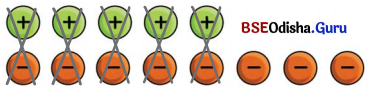
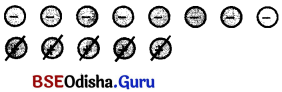
Try to subtract: – 3 – (+ 5). How many zero pairs will you have to put in? What is the result?
Solution:
– 3 – (+ 5) = – 8
We want to take away 5 positive tokens when we have 3 negative tokens. So, we add 5 zero pairs. After removing the 5 positive tokens, we have 8 negative tokens left.
The Other Side of Zero Class 6 Solutions Maths Ganita Prakash Chapter 10 1

Question 3.
Suppose you start with 0 rupees in your bank account and then you have debits of ₹ 1, ₹ 2, ₹ 4, ₹ 8, ₹ 16, ₹ 32, ₹ 64 and ₹ 128 and then a single credit of ₹ 256. What is your bank account balance now?
Solution:
Total debits = ₹ 1 + ₹ 2 + ₹ 4 + ₹ 8 + ₹ 16 + ₹ 32 + ₹ 64 + ₹ 128 = ₹ 255
There is a single credit of ₹ 256.
∴ Final balance = Total credit – Total debit = ₹ 256 – ₹ 255 = ₹ 1

Question 4.
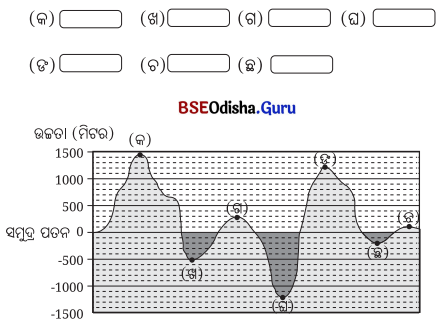
Looking at the geographical cross section, fill in the respective heights:
The Other Side of Zero Class 6 Solutions Maths Ganita Prakash Chapter 10 2
Solution:
A = + 1500 m
B = – 500 m
C = + 300 m
D = – 1200 m
E = + 1200 m
F = – 200 m
G = + 100 m

The Other Side of Zero Class 6 Solutions Maths Ganita Prakash Chapter 10

Question 5.
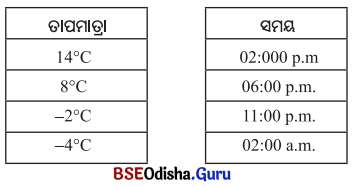
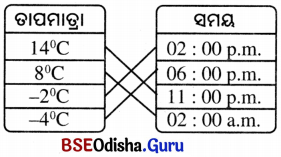
Leh in Ladakh gets very cold during winter. The following is a table of temperature readings taken during different times of the day and night in Leh on a day in November. Match the temperature with the appropriate time of the day and night.
The Other Side of Zero Class 6 Solutions Maths Ganita Prakash Chapter 10 3
Solution:
Usually, the coldest time of the day is very early in the morning, before the sun rises, and it starts to get warmer after sunrise, reaching the warmest in the afternoon. At night, the temperature starts to drop again.
So, we can match the temperatures like this:
– 4°C → 2:00 a.m. (This is the coldest time when it is still dark and freezing.)
– 2°C → 11:00 p.m. (It is night time, so it is also very cold, but not as cold as early morning.)
8°C → 11:00 a.m. (It is late morning, the sun is up and it is getting warmer.)
14°C → 2:00 p.m. (This is the afternoon and the warmest time of the day.)
This shows us how the temperature rises as the sun comes up and falls again after sunset.

Question 6.
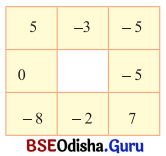
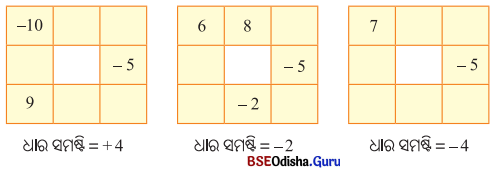
Complete the grids to make the required border sum
The Other Side of Zero Class 6 Solutions Maths Ganita Prakash Chapter 10 4
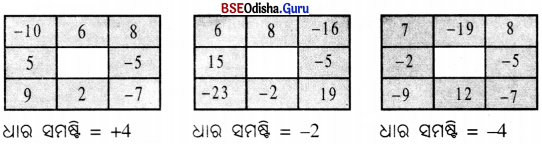
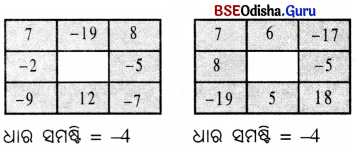
Solution:
The Other Side of Zero Class 6 Solutions Maths Ganita Prakash Chapter 10 46

The Other Side of Zero Class 6 Solutions Maths Ganita Prakash Chapter 10

Question 7.
There are two dice whose faces have these numbers: – 1, 2, – 3, 4, – 5, 6. The smallest possible sum upon rolling these dice is – 10 = (- 5) + (- 5) and the largest possible sum is 12 = (6) + (6). Some numbers between (- 10) and (+ 12) are not possible to get by adding numbers on these two dice. Find those numbers.
Solution:
Let’s find the sums that are not possible when rolling these two dice.
The faces of the dice are:
– 1, 2, -3, 4, -5, and 6.
First, let’s list all possible sums:
The sum of two negative numbers:
(- 1) + (- 1) = -2; (- 1) + (- 3) = – 4; (- 1) + (- 5) = – 6
(- 3) + (- 3) = – 6; (- 3) + (- 5) = – 8 (- 5) + (- 5) = – 10
The sum of one negative and one positive number:
(-1) + 2 = 1; (-1)+ 4 = 3; (-1) + 6 = 5; (-3) + 2 = – 1; (-3)+ 4=1;
(- 3) + 6 = 3; (- 5) + 2 = – 3; (- 5) + 4 = – 1; (- 5) + 6 = 1
The sum of two positive numbers:
2 + 2 = 4; 2 + 4 = 6; 2 + 6 = 8; 4 + 4 = 8; 4 + 6=10; 6 + 6=12
Now, let’s list all the possible sums in ascending order:
– 10, -8, -6, -4, -3,-2,- 1, 1, 3, 4, 5, 6, 8, 10, 12
The sum of numbers between – 10 and 12 that are not possible to get are: – 9, – 7, – 5, 0, 2, 7, 9, 11 .

The Other Side of Zero Class 6 Solutions Maths Ganita Prakash Chapter 10

Question 8.
This string has a total of 100 tokens arranged in a particular pattern. What is the value of the string?
The Other Side of Zero Class 6 Solutions Maths Ganita Prakash Chapter 10 5
Solution:
Total tokens =100
Total sets of 5 tokens = \(\frac{100}{5}\) = 20
Value of one set of 5 tokens = 3 + (- 2) = 1
Hence, total value of string = 1 × 20 = 20

InText Questions

Question 1.
Can there be a number less than 0? Can you think of any ways to have less than 0 of something?
Solution:
Yes, there can be numbers less than 0.
They are called negative numbers and written with a minus sign, like – 1, – 2, – 3, etc.
Temperature: In cold places, temperature can go below 0 °C, like – 5 °C or – 10 °C.
Money: If you have ₹ 10 and will have – ₹ 10. you spend ₹ 20, you

The Other Side of Zero Class 6 Solutions Maths Ganita Prakash Chapter 10

Question 2.
Connect the inverses by drawing lines.
The Other Side of Zero Class 6 Solutions Maths Ganita Prakash Chapter 10 6
Solution:
The inverses of + 5, – 7, – 8 and + 9 are – 5, + 7, + 8 and – 9 respectively.
The Other Side of Zero Class 6 Solutions Maths Ganita Prakash Chapter 10 7

Question 3.
Should we write – 3 <-4or-4 <-3?
Solution:
We should write – 4 < – 3, because on the number line, – 4 is to the left of – 3, which makes it smaller.
So, – 4 < -3 or -3 > -4.

Question 4.
Evaluate 15 – 5, 100 – 10 and 74 – 34.
Solution:
(i) What should we add to 5 to make 15? i.e.
5 + _______ = 15.
The missing number is 10. So, 15 – 5 = 10.

(ii) What should we add to 10 to make 100? i.e.
10 + ______ = 100.
The missing number is 90. So, 100 – 10 = 90.

(iii) What should we add to 34 to make 74? i.e.
34 + _______ = 74.
The missing number is 40. So, 74 – 34 = 40.

The Other Side of Zero Class 6 Solutions Maths Ganita Prakash Chapter 10

Question 5.
Use unmarked number lines to evaluate these expressions:
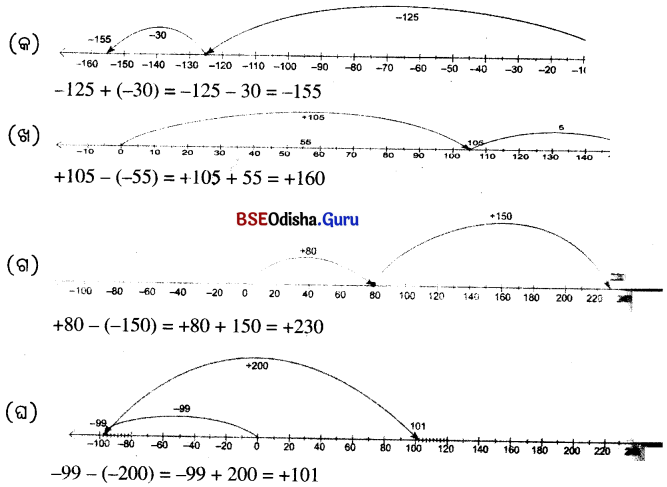
(a) _______ – 125 + (- 30) = _______
(b) _______ + 105 – (- 55) = _______
(c) _______ + 80 – (- 150) = _______
(d) _______ – 99 – (- 200) = _______
Solution:
(a) – 125 + (- 30) = – 155
We start at – 125 and move 30 steps left on the number line.
The Other Side of Zero Class 6 Solutions Maths Ganita Prakash Chapter 10 8

(b) + 105 – (- 55) = + 105 + ( + 55) = + 160
We start at + 105 and move 55 steps right on the number line.
The Other Side of Zero Class 6 Solutions Maths Ganita Prakash Chapter 10 9

(c) + 80 – (- 150) = + 80 + (+ 150) = + 230
We start at + 80 and move 150 steps right on the number line.
The Other Side of Zero Class 6 Solutions Maths Ganita Prakash Chapter 10 10

(d) -99-(-200) = -99 + 200 = + 101
We start at – 99 and move 200 steps right on the number line.
The Other Side of Zero Class 6 Solutions Maths Ganita Prakash Chapter 10 11

The Other Side of Zero Class 6 Solutions Maths Ganita Prakash Chapter 10

The Other Side of Zero Class 6 Extra Questions

The Other Side of Zero Class 6 Very Short Question Answer

Question 1.
In a game, Rishi scored + 10,-5, + 3,-8 and + 4 in five rounds. What is his total score?
Solution:
Given, the scores of Rishi in five rounds are +10, – 5, + 3, – 8 and + 4.
Total score of Rishi
= + 10 + (- 5) + (+ 3) + (- 8) + (+ 4)
= (+ 10 + 3 + 4) + (-5-8)
[Grouping positive and negative integers]
= (+ 17) + (- 13)
= (+ 17)-(+ 13)
[The number that is being added can be replaced by . its additive inverse and then subtracted.]
= + 4
∴ The total score of Rishi is + 4.

Question 2.
Arrange the following integers in ascending order:
9, -7, -4, 0, 3
Solution:
Given integers are: 9, – 7, – 4, 0, 3
For positive integers 3 and 9, we have 3 < 9.
For negative integers – 7 and – 4, we have – 7 < – 4.
We know that on the number line, the numbers right to 0 are greater than 0 and the numbers left to 0 are less than 0. Also, every positive integer is greater than every negative integer.
Hence, the given integers in ascending order: – 7, -4, 0, 3, 9

The Other Side of Zero Class 6 Solutions Maths Ganita Prakash Chapter 10

Question 3.
A boat sailed 40 km to the east of a harbour and then 70 km to the west from there. How far from the harbour is the boat finally?
Solution:
The boat starts from point A at harbour. It sailed 40 km to the east to reach point B. From point B, it sailed 70 km to the west to reach point C, as shown in figure.
The Other Side of Zero Class 6 Solutions Maths Ganita Prakash Chapter 10 12
Now, the position of boat = (+ 40) + (- 70) = – 30
Hence, the boat is 30 km to the west of the harbour.

Question 4.
Write 5 distinct integers whose sum is 6.
Solution:
We know that the sum of an integer with its additive inverse is zero.
The additive inverse of – 1 is 1 and the additive inverse of – 2 is 2.
∴ 1 + (- 1) = 0 and 2 + (- 2) = 0
Now, [1 + (- 1)] + [2 + (- 2)] + 6 = 0 + 0 + 6 = 6
∴ 5 distinct integers whose sum is 6 are – 1, 1, -2, 2, 6.

The Other Side of Zero Class 6 Solutions Maths Ganita Prakash Chapter 10

Question 5.
Arrange the following integers in descending order:
-8, -3, 5, 1, -1
Solution:
Given integers are – 8, – 3, 5, 1 and – 1.
We know that a number is greater than every number that is to its left on the number line.
For positive integers 1 and 5, we have 5 > 1.
For negative integers -1,-3 and – 8, we have
– 1 > – 3 > – 8.
Also, every positive integer is greater than every negative integer.
Hence, the given integers in descending order:
5, 1, – 1, -3, -8

The Other Side of Zero Class 6 Short Question Answer

Question 1.
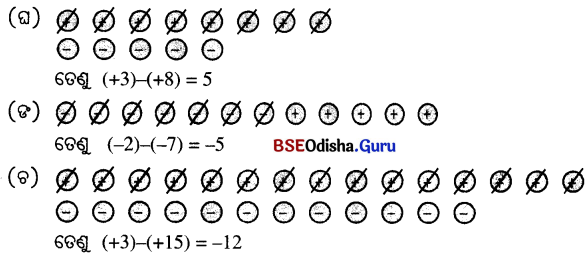
Complete the additions using tokens:
(i) (+ 4) + (- 8)
(ii) (- 3) + (+ 4)
(iii) (- 10) + ( + 6)
(iv) (+ 7) + (- 5)
Solution:
(i) (+ 4) + (- 8) = – 4
The Other Side of Zero Class 6 Solutions Maths Ganita Prakash Chapter 10 13

(ii) (- 3) + (+ 4) = + 1
The Other Side of Zero Class 6 Solutions Maths Ganita Prakash Chapter 10 14

(iii) (- 10) + (+ 6) = – 4
The Other Side of Zero Class 6 Solutions Maths Ganita Prakash Chapter 10 15

(iv) (+ 7) + (- 5) = + 2
The Other Side of Zero Class 6 Solutions Maths Ganita Prakash Chapter 10 16

The Other Side of Zero Class 6 Solutions Maths Ganita Prakash Chapter 10

Question 2.
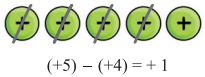
Complete the subtractions using tokens:
(i) (+ 6) – (+ 3)
(ii) (+ 8) – (+ 7)
(iii) (- 9) – (- 5)
(iv) (- 7) – (- 4)
Solution:
(i) (+ 6) – (+ 3) = + 3
The Other Side of Zero Class 6 Solutions Maths Ganita Prakash Chapter 10 17

(ii) (+ 8) – (+ 7) = + 1
The Other Side of Zero Class 6 Solutions Maths Ganita Prakash Chapter 10 18

(iii) (- 9) – (- 5) = – 4
The Other Side of Zero Class 6 Solutions Maths Ganita Prakash Chapter 10 19

(iv) (- 7) – (- 4) = – 3
The Other Side of Zero Class 6 Solutions Maths Ganita Prakash Chapter 10 20

The Other Side of Zero Class 6 Solutions Maths Ganita Prakash Chapter 10

Question 3.
Complete the following subtractions using tokens:
(i) (+ 9) – (+ 2)
(ii) (+ 5) – (4- 3)
(iii) (- 8) – (- 3)
(iv) (- 6) – (- 1)
Solution:
(i) (+ 9) – (+ 2) = + 7
The Other Side of Zero Class 6 Solutions Maths Ganita Prakash Chapter 10 21

(ii) (+ 5) – (+ 3) = + 2
The Other Side of Zero Class 6 Solutions Maths Ganita Prakash Chapter 10 22

(iii) (- 8) – (- 3) = – 5
The Other Side of Zero Class 6 Solutions Maths Ganita Prakash Chapter 10 23

(iv) (- 6) – (- 1) = – 5
The Other Side of Zero Class 6 Solutions Maths Ganita Prakash Chapter 10 24

Question 4.
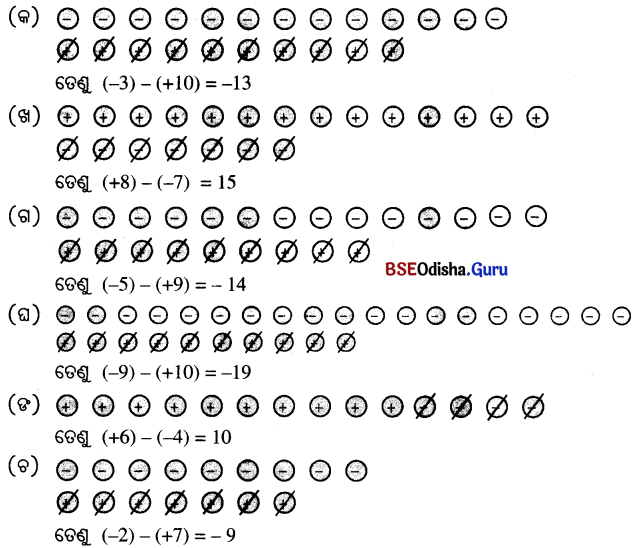
Complete the following subtractions using tokens:
(i) (+ 3) – (+ 8)
(ii) (+ 7) – (+ 9)
(iii) (+ 4) – (- 4)
(iv) (+ 6) – (- 5)
(v) (- 4) – (+ 3)
(vi) (- 6) – (+ 6)
Solution:
(i) (+ 3) – (+ 8) = – 5
The Other Side of Zero Class 6 Solutions Maths Ganita Prakash Chapter 10 25

(ii) (+ 7) – (+ 9)
The Other Side of Zero Class 6 Solutions Maths Ganita Prakash Chapter 10 26

(iii) (+ 4) – (- 4)
The Other Side of Zero Class 6 Solutions Maths Ganita Prakash Chapter 10 27

(iv) (+ 6) – (- 5)
The Other Side of Zero Class 6 Solutions Maths Ganita Prakash Chapter 10 28

(v) (- 4) – (+ 3)
The Other Side of Zero Class 6 Solutions Maths Ganita Prakash Chapter 10 29

(vi) (- 6) – (+ 6)
The Other Side of Zero Class 6 Solutions Maths Ganita Prakash Chapter 10 30

The Other Side of Zero Class 6 Solutions Maths Ganita Prakash Chapter 10

The Other Side of Zero Class 6 Long Question Answer

Question 1.
There are two dice whose faces have the numbers 1, – 2, 3, – 4, 5 and – 6. If these dice are rolled together, find the smallest possible sum of the numbers so obtained.
Solution:
Given, there are two dice whose faces have the numbers 1, – 2, 3, – 4, 5 and – 6.
To get the smallest possible sum, we need to add the smallest number from each die.
A number is always greater than any number to its left on the number line.
For positive integers 1, 3 and 5, we have 1 < 3 < 5.
For negative integers -2,-4 and – 6, we have -6 < -4 < -2.
We know that every positive integer is greater than every negative integer.
Hence, the given integers in ascending order: -6, -4, -2, 1, 3, 5
The smallest number on each die is – 6.
Hence, smallest possible sum = (- 6) + (- 6) = – 12

The Other Side of Zero Class 6 Solutions Maths Ganita Prakash Chapter 10

Question 2.
Using the number line write the integer which is
(i) 3 more than – 1
(ii) 4 less than – 1
(iii) 4 more than – 9
Solution:
(i) To find the integer which is 3 more than – 1, we start at – 1 on the number line and move 3 steps forward. We reach 2. Hence, the required integer is 2.
The Other Side of Zero Class 6 Solutions Maths Ganita Prakash Chapter 10 31

(ii) To find the integer which is 4 less than – 1, we start at – 1 on the number line and move 4 steps backward. We reach – 5. Hence, the required integer is -5.
The Other Side of Zero Class 6 Solutions Maths Ganita Prakash Chapter 10 32

(iii) To find the integer which is 4 more than – 9, we start at – 9 on the number line and move 4 steps forward. We reach – 5. Hence, the required integer is – 5.
The Other Side of Zero Class 6 Solutions Maths Ganita Prakash Chapter 10 33

Question 3.
There are two dice whose faces have the numbers – 8, – 3, – 1, 2, 4 and 6. If these dice are rolled together, find the largest possible sum of the numbers so obtained.
Solution:
Given, there are two dice whose faces have the numbers – 8, – 3, – 1, 2, 4 and 6.
To get the largest possible sum, we need to add the largest number from each die.
We know that a number is greater than every number that is to its left on the number line.
For positive integers 2, 4 and 6, we have 2 < 4 < 6.
For negative integers -1,-3 and – 8, we have – 8 < – 3 < – 1.
We know that every positive integer is greater than every negative integer.
Hence, the given integers in ascending order: – 8, -3, – 1, 2, 4, 6
The largest number on each die is 6.
So, largest possible sum = (6) + (6) = 12

The Other Side of Zero Class 6 Solutions Maths Ganita Prakash Chapter 10

Question 4.
Complete the subtractions using tokens:
(i) (+ 4) – (+ 7)
(ii) (+ 5) – (+ 8)
(iii) (+ 5) – (- 3)
(iv) (+ 6) – (- 2)
(v) (- 4) – (+ 2)
Solution:
(i) (+ 4) – (+ 7) = – 3
The Other Side of Zero Class 6 Solutions Maths Ganita Prakash Chapter 10 34
[Adding 3 zero pairs]

(ii) (+ 5) – (+ 8) = – 3
The Other Side of Zero Class 6 Solutions Maths Ganita Prakash Chapter 10 35
[Adding 3 zero pairs]

(iii) (+ 5) – (- 3) = + 8
The Other Side of Zero Class 6 Solutions Maths Ganita Prakash Chapter 10 36
[Adding 3 zero pairs]

(iv) (+ 6) – (- 2) = + 8
The Other Side of Zero Class 6 Solutions Maths Ganita Prakash Chapter 10 37
[Adding 2 zero pairs]

(v) (- 4) – (+ 2) = – 6
The Other Side of Zero Class 6 Solutions Maths Ganita Prakash Chapter 10 38
[Adding 2 zero pairs]

The Other Side of Zero Class 6 Solutions Maths Ganita Prakash Chapter 10

Question 5.
Complete the grids to make the required border
(i)

-7
4
-3

Border sum = + 5

(ii)

-12
-1
7

Border sum = – 4

(iii)

3 11
-2 -3

Border sum = 0

The Other Side of Zero Class 6 Solutions Maths Ganita Prakash Chapter 10

(iv)

-15 5
10
4

Border sum = 3
Solution:
We have to take that number which makes the sum of all the numbers in a row or column equal to the border sum. So, the complete grids are given below.
(i)

-7 3 9
-4 4
16 -3 -8

Border sum = + 5

(ii)

2 -12 6
-1 -17
-5 -6 7

Border sum = – 4

(iii)

3 -14 11
-1 -8
-2 5 -3

Border sum = 0

The Other Side of Zero Class 6 Solutions Maths Ganita Prakash Chapter 10

(iv)

-15 13 5
10 -6
8 -9 4

Border sum = 3

Question 6.
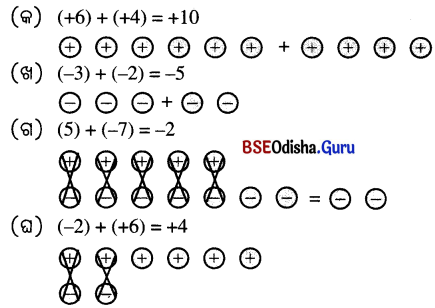
Complete the following additions using tokens:
(i) (+ 7) + (- 2)
(ii) (- 12) + (+ 4)
(iii) (- 9) + (+ 5)
(iv) (-7) + (+ 11)
(v) (- 3) + (+ 8)
(vi) (- 6) + (+ 12)
Solution:
(i) (+ 7) + (-2) = + 5
The Other Side of Zero Class 6 Solutions Maths Ganita Prakash Chapter 10 39

(ii) (- 12) + (+ 4) = – 8
The Other Side of Zero Class 6 Solutions Maths Ganita Prakash Chapter 10 40

(iii) (- 9) + (+ 5) = – 4
The Other Side of Zero Class 6 Solutions Maths Ganita Prakash Chapter 10 41

(iv) (-7) + (+ 11) = + 4
The Other Side of Zero Class 6 Solutions Maths Ganita Prakash Chapter 10 42

(v) (- 3) + (+ 8) = + 5
The Other Side of Zero Class 6 Solutions Maths Ganita Prakash Chapter 10 43

(vi) (- 6) + (+ 12) = + 6
The Other Side of Zero Class 6 Solutions Maths Ganita Prakash Chapter 10 44

The Other Side of Zero Class 6 Solutions Maths Ganita Prakash Chapter 10

Question 7.
Complete the grids to make the required border
(i)

0
5
-2
Border sum = – 2

(ii)

6
-5
-3
Border sum = + 3

(iii)

0
3 5
8
Border sum = 4

The Other Side of Zero Class 6 Solutions Maths Ganita Prakash Chapter 10

(iv)

3
-7 6
-8
Border sum = 5

Solution:
We have to take that number which makes the sum of all the numbers in a row or column equal to the border sum. So, the complete grids are given below.
(i)

1 0 -3
-1 5
-2 4 -4

(ii)

5 -8 6
-5 -6
3 -3 3

(iii)

3 0 1
3 5
-2 8 -2

(iv)

3 -5 7
-7 6
-2 4 -8

The Other Side of Zero Class 6 Solutions Maths Ganita Prakash Chapter 10

The Other Side of Zero Class 6 Case Based Questions

Question 1.
In Shimla, the temperature in the morning was – 2°C. By afternoon, it rose by 5°C. In another city, Manali, the temperature was – 5°C in the morning and increased by 3°C in the afternoon.
Based on the above information, answer the following questions:
(i) What was the afternoon temperature in Shimla?
(ii) What was the afternoon temperature in Manali?
(iii) What is the difference in afternoon temperatures of both cities?
Solution:
(i) Given, morning temperature in Shimla = – 2 °C
Increase in temperature by afternoon = + 5 °C
To find afternoon temperature, we add the change to the morning temperature.
∴ Afternoon temperature in Shimla = (- 2 °C) + (+ 5°C) = + 3°C

(ii) Given, morning temperature in Manali = – 5°C
Increase in temperature by afternoon = + 3 °C
To find afternoon temperature, we add the change to the morning temperature.
∴ Afternoon temperature in Manali = (- 5 °C) + (+ 3 °C)= – 2 °C

(iii) Afternoon temperature in Shimla = + 3 °C
Afternoon temperature in Manali = – 2 °C
Difference in afternoon temperatures of both cities
= + 3 °C – (- 2 °C)
= + 3 °C + (+ 2 °C) = 5 °C

The Other Side of Zero Class 6 Solutions Maths Ganita Prakash Chapter 10

Question 2.
In a geographical cross-section, some points appear above sea level (marked with positive height values) and others lie below sea level (represented by negative values), using sea level defined as zero as the reference point.
Based on the given information, answer the following questions:
The Other Side of Zero Class 6 Solutions Maths Ganita Prakash Chapter 10 45
(i) Write the highest and lowest points in the given geographical cross section?
(ii) What is the difference between heights of the highest and lowest points?
(iii) Write the points A, B, …, G in a sequence of increasing order of heights.
OR
(iii) Write the points A, B, …, G in a sequence of decreasing order of heights.
Solution:
(i) E(500 m) is the highest point and C (- 400 m) is the lowest point.

(ii) Difference between heights of E and C
= 500 – (- 400) = 500 + (+ 400) = 900 m

The Other Side of Zero Class 6 Solutions Maths Ganita Prakash Chapter 10

(iii) Points in increasing order are as:
C(- 400 m), B(- 300 m), G(- 200 m), D(0 m), A(200 m), F(300 m), E(500 m)
OR
(iii) Points in decreasing order, are as:
E(500 m), F(300 m), A(200 m), D(0 m), G(- 200 m), B(- 300 m), C(- 400 m)

Symmetry Class 6 Solutions Maths Ganita Prakash Chapter 9

Students can refer to BSE Odisha Class 6 Math Solution and Ganita Prakash Chapter 9 Symmetry Class 6 Question Answer to understand textbook questions step by step.

Class 6 Maths Chapter 9 Symmetry Solutions

Ganita Prakash Class 6 Chapter 9 Solutions

Class 6 Maths Ganita Prakash Chapter 9 Solutions Symmetry

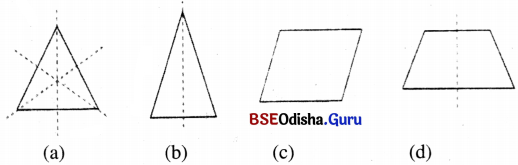
Question 1.
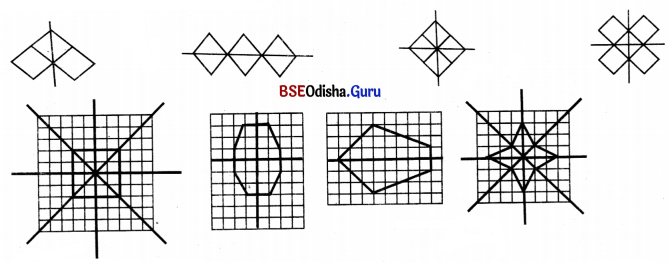
For each of the following figures, identify the line(s) of symmetry if it exists.
Symmetry Class 6 Solutions Maths Ganita Prakash Chapter 9 1
Solution:
Symmetry Class 6 Solutions Maths Ganita Prakash Chapter 9 2

Symmetry Class 6 Solutions Maths Ganita Prakash Chapter 9

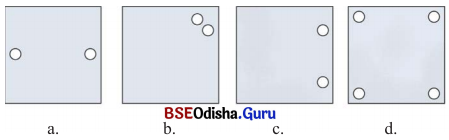
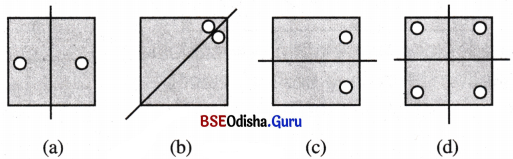
Question 2.
Given the line(s) of symmetry, find the other hole(s).
Symmetry Class 6 Solutions Maths Ganita Prakash Chapter 9 3
Solution:
Symmetry Class 6 Solutions Maths Ganita Prakash Chapter 9 4

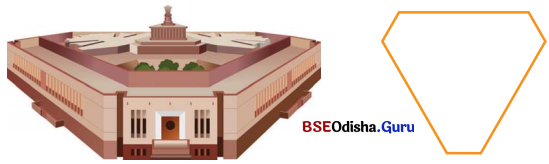
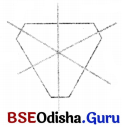
Question 3.
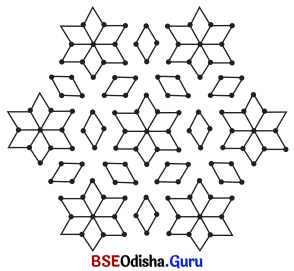
Find the lines of symmetry for the kolam below.
Symmetry Class 6 Solutions Maths Ganita Prakash Chapter 9 5
Solution:
Symmetry Class 6 Solutions Maths Ganita Prakash Chapter 9 6

Symmetry Class 6 Solutions Maths Ganita Prakash Chapter 9

Question 4.
Draw the following:
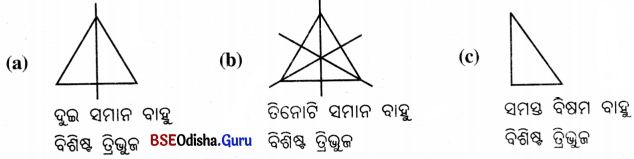
(a) A triangle with exactly one line of symmetry
(b) A triangle with exactly three lines of symmetry
(c) A triangle with no line of symmetry
Is it possible to draw a triangle with exactly two lines of symmetry?
Solution:
(a)
Symmetry Class 6 Solutions Maths Ganita Prakash Chapter 9 7
One line of symmetry (Isosceles Triangle)

(b)
Symmetry Class 6 Solutions Maths Ganita Prakash Chapter 9 8
Three lines of symmetry
(Equilateral Triangle)

(c)
Symmetry Class 6 Solutions Maths Ganita Prakash Chapter 9 9
No line of symmetry (Scalene Triangle)
No, it is not possible to draw a triangle with exactly two lines of symmetry.

Symmetry Class 6 Solutions Maths Ganita Prakash Chapter 9

Question 5.
Copy the following on a dot grid. For each figure draw two more lines to make a shape that has a line of symmetry.
Symmetry Class 6 Solutions Maths Ganita Prakash Chapter 9 10
Solution:
Symmetry Class 6 Solutions Maths Ganita Prakash Chapter 9 11

Symmetry Class 6 Solutions Maths Ganita Prakash Chapter 9

Question 6.
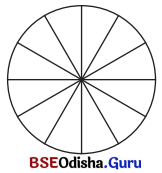
Color the sectors of the circle below so that the figure has i) 3 angles of symmetry, ii) 4 angles of symmetry, iii) what are the possible numbers of angles of symmetry you can obtain by coloring the sectors in different ways?
Symmetry Class 6 Solutions Maths Ganita Prakash Chapter 9 12
Solution:
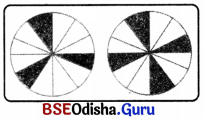
(i) Three angles of symmetry
Symmetry Class 6 Solutions Maths Ganita Prakash Chapter 9 13

(ii) Four angles of symmetry
Symmetry Class 6 Solutions Maths Ganita Prakash Chapter 9 14

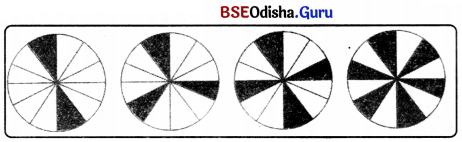
(iii)
Symmetry Class 6 Solutions Maths Ganita Prakash Chapter 9 15
For 2 angles of symmetry, the angles are: 180°, 360°
For 3 angles of symmetry, the angles are: 120°, 240°, 360° 1
For 4 angles of symmetry, the angles are: 90°, 180°, 270°, 360°
For 6 angles of symmetry, the angles are: 60°, 120°, 180°, 240°, 300°, 360°
For 12 angles of symmetry, the angles are: 30°, 60°, 90°, 120°, 150°, 180°, 210°, 240°, 270°, 300°, 330°, 360°

Symmetry Class 6 Solutions Maths Ganita Prakash Chapter 9

Question 7.
In a figure, 60° is an angle of symmetry. The figure has two angles of symmetry less than 60°. What is its smallest angle of symmetry?
Solution:
We know that the angles of symmetry of a figure having rotational symmetry about a point are multiples of the smallest angle of symmetry.

Let the smallest angle of symmetry be x. Then, the other angles of symmetry are 2x, 3x, 4x, 360°.

It is given that the figure has two angles of symmetry less than 60°. This means the third angle of symmetry is 60° itself.
∴ 3x = 60°
⇒ x = 20°
Hence, the smallest angle of symmetry is 20°.

Question 8.
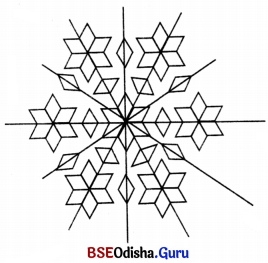
How many lines of symmetry does the shape sequence, the Koch Snowflake sequence, have? Also, find numbers of angles of symmetry.
Solution:
The equilateral triangle has 3 lines of symmetry and 3 angles of symmetry.
In six-pointed star, lines of symmetry are 6 and the angle of symmetry is 6.
The lines of symmetry and angle of symmetry for the rest three figures are the same as six-pointed stars.
Symmetry Class 6 Solutions Maths Ganita Prakash Chapter 9 16

InText Questions

Question 1.
Is there any other way to fold the square so that the two halves overlap? How many lines of symmetry does the square shape have?
Solution:
Yes, there are other ways to fold a square so that the two halves overlap exactly. This can be done along its lines of symmetry.
Symmetry Class 6 Solutions Maths Ganita Prakash Chapter 9 17
A square has 4 lines of symmetry:
(i) A vertical line (through the midpoints of the top and bottom sides),
(ii) A horizontal line (through the midpoints of the left Square and right sides),
(iii) A diagonal from the top-left to bottom-right corner,
(iv) A diagonal from the top-right to bottom-left corner.
So, we can fold the square along any of these 4 lines, and the two halves will perfectly overlap.

Symmetry Class 6 Solutions Maths Ganita Prakash Chapter 9

Question 2.
We saw that the diagonal of a square is also a line of symmetry. Let us take a rectangle that is not a square. Is its diagonal a line of symmetry?
Solution:
No, the diagonal of a rectangle is not a line of symmetry. Folding along the diagonal does not produce two matching parts.
Symmetry Class 6 Solutions Maths Ganita Prakash Chapter 9 18
So, while a square has both its diagonals as lines of symmetry (because they divide the square into two mirror-image triangles), a non-square rectangle does not have this property.

Question 3.
Consider a figure with radial arms having exactly 7 angles of symmetry. What will be its smallest angle of symmetry? Is the number of degrees a whole number in this case? If not, express it as a mixed fraction.
Solution:
When a figure has rotational symmetry with 7 angles of symmetry, it means it can be rotated around a central point and still look the same 7 times in a full 360° turn.

To find the smallest angle of symmetry, divide 360° by the number of symmetrical positions:
Smallest angle of symmetry = \(\frac{360^{\circ}}{7}\) = \(\left(51 \frac{3}{7}\right)^0\) which is not a whole number.
Mixed fraction form: \(\left(51 \frac{3}{7}\right)^0\)

Symmetry Class 6 Solutions Maths Ganita Prakash Chapter 9

Symmetry Class 6 Extra Questions

Symmetry Class 6 Very Short Question Answer

Question 1.
In the below figure, line l is the line of symmetry. Complete the figure to be symmetric about line /.
Symmetry Class 6 Solutions Maths Ganita Prakash Chapter 9 19
Solution:
The complete figure is as shown below.
Symmetry Class 6 Solutions Maths Ganita Prakash Chapter 9 20

Question 2.
For each of the following figure, identify the line(s) of symmetry if it exists.
Symmetry Class 6 Solutions Maths Ganita Prakash Chapter 9 21
Solution:
The line(s) of symmetry in the given figures are as follows:
Symmetry Class 6 Solutions Maths Ganita Prakash Chapter 9 22

Symmetry Class 6 Solutions Maths Ganita Prakash Chapter 9

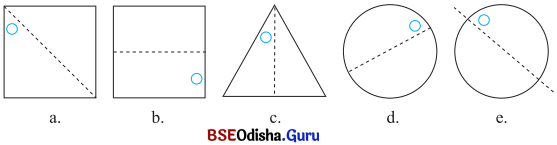
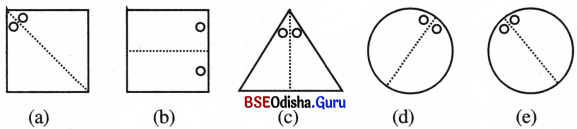
Question 3.
In the following figures if the dotted lines represent the lines of symmetry, find the other hole(s).
Symmetry Class 6 Solutions Maths Ganita Prakash Chapter 9 23
Solution:
The other hole(s) in the given figures is(are) as follows:
Symmetry Class 6 Solutions Maths Ganita Prakash Chapter 9 24

Question 4.
Observe each of the following sequences of paper folding and cutting. Draw the pattern obtained after unfolding the paper.
Symmetry Class 6 Solutions Maths Ganita Prakash Chapter 9 25
Solution:
The pattern obtained after unfolding the paper in each case are as follows:
Symmetry Class 6 Solutions Maths Ganita Prakash Chapter 9 26

Symmetry Class 6 Solutions Maths Ganita Prakash Chapter 9

Question 5.
In the following figure, identify the line of symmetry.
Symmetry Class 6 Solutions Maths Ganita Prakash Chapter 9 27
Solution:
We know that a line that cuts a plane figure into two parts that exactly overlap when folded along that line is called a line of symmetry or axis of symmetry of the figure.

In the given figure, we can see the figure is symmetrical about the line l.

Thus, the line of symmetry of the given figure is line l.

Question 6.
In a figure, 60° is the smallest angle of symmetry. What are the other angles of symmetry of this figure?
Solution:
We know that the angles of symmetry of a figure having rotational symmetry about a point are multiples of the smallest angle of symmetry.
So, the other angles of symmetry are
2 × 60° = 120°,
3 × 60° = 180°,
4 × 60° = 240°,
5 × 60° = 300° and
6 × 60° = 360°.

Symmetry Class 6 Solutions Maths Ganita Prakash Chapter 9

Question 7.
In a given figure, 45° is the smallest angle of symmetry. What are the other angles of symmetry?
Solution:
We know that the angles of symmetry of a figure having rotational symmetry about a point are multiples of the smallest angle of symmetry,

So, the other angles of symmetry are 2 × 45° = 90°, 3 × 45° = 135°, 4 × 45° = 180°, 5 × 45° = 225°, 6 × 45° = 270°, 7 × 45° = 315° and 8 × 45° = 360°.

Symmetry Class 6 Short Question Answer

Question 1.
Copy the following on square paper. Complete them so the dotted line is a line of symmetry.
Symmetry Class 6 Solutions Maths Ganita Prakash Chapter 9 28
Solution:
To complete a figure so that it becomes symmetric about dotted line, let us take the mirror image of the figure with respect to the dotted line. Therefore, the completed figures are as follows:
Symmetry Class 6 Solutions Maths Ganita Prakash Chapter 9 29

Symmetry Class 6 Solutions Maths Ganita Prakash Chapter 9

Question 2.
Each of the following figures shows a piece of paper with punched holes. Copy these figures onto a plain sheet of paper and draw the line of symmetry such that, when the paper is folded along this line, the holes on one side match exactly with the holes on the other side.
Symmetry Class 6 Solutions Maths Ganita Prakash Chapter 9 30
Solution:
The line(s) of symmetry in the given figures are as follows:
Symmetry Class 6 Solutions Maths Ganita Prakash Chapter 9 31

Question 3.
In each letter of the English alphabet given below, find the number of line(s) of symmetry.
(i) U
(ii) E
(iii) I
(iv) V
Solution:
We know that a line of symmetry cuts a plane figure into two equal but flipped figures.
Symmetry Class 6 Solutions Maths Ganita Prakash Chapter 9 32

Symmetry Class 6 Solutions Maths Ganita Prakash Chapter 9

Question 4.
For each of the following figure, identify the line(s) of symmetry if it exists.
Symmetry Class 6 Solutions Maths Ganita Prakash Chapter 9 33
Solution:
The line(s) of symmetry in the given figures are as follows:
Symmetry Class 6 Solutions Maths Ganita Prakash Chapter 9 34

Question 5.
In the following figures if the dotted lines represent the lines of symmetry, find the other hole(s).
Symmetry Class 6 Solutions Maths Ganita Prakash Chapter 9 35
Solution:
We know that a line that cuts a plane figure into two parts that exactly overlap when folded along that line is called a line of symmetry or axis of symmetry of the figure.

Therefore, the other hole(s) in the given figures is(are) as follows:
Symmetry Class 6 Solutions Maths Ganita Prakash Chapter 9 36

Symmetry Class 6 Solutions Maths Ganita Prakash Chapter 9

Question 6.
In a figure, 90° is an angle of symmetry. The figure has two angles of symmetry less than 90°. What is the smallest angle of symmetry?
Solution:
We know that the angles of symmetry of a figure having rotational symmetry about a point are multiples of the smallest angle of symmetry.

Let the smallest angle of symmetry be x. Then, the other angles of symmetry are 2x, 3x, 4x, …, 360°.

It is given that the figure has two angles of symmetry less than 90°. This means the third angle of symmetry is 90° itself.
∴ 3x = 90°
⇒ x = 30°
Hence, the smallest angle of symmetry is 30°.

Question 7.
How many angles of rotational symmetry does the given figure have and what are they?
Symmetry Class 6 Solutions Maths Ganita Prakash Chapter 9 37
Solution:
We notice that the figure returns to its original position only after a complete turn or a 360° rotation.

Therefore, the figure does not possess rotational symmetry, as 360° is the only angle at which it maps onto itself.

Hence, it has no angle of rotational symmetry.

Symmetry Class 6 Solutions Maths Ganita Prakash Chapter 9

Question 8.
Discuss the rotational symmetry of the given figure.
Symmetry Class 6 Solutions Maths Ganita Prakash Chapter 9 38
Solution:
We observe that when the given figure is rotated by 180° and 360°, it coincides exactly with its original position.
Symmetry Class 6 Solutions Maths Ganita Prakash Chapter 9 39
Thus, the given figure has rotational symmetry of order 2.

Question 9.
Discuss the rotational symmetry of the given figure.
Symmetry Class 6 Solutions Maths Ganita Prakash Chapter 9 40
Solution:
We observe that when the given figure is rotated by 120°, 240° and 360°, it coincides exactly with its original position.
Symmetry Class 6 Solutions Maths Ganita Prakash Chapter 9 41
Thus, the given figure has rotational symmetry of order 3.

Symmetry Class 6 Long Question Answer

Question 1.
Observe each of the following sequences of paper folding and cutting. Draw the pattern obtained after unfolding the paper.
(i)
Symmetry Class 6 Solutions Maths Ganita Prakash Chapter 9 42
(ii)
Symmetry Class 6 Solutions Maths Ganita Prakash Chapter 9 43
Solution:
The pattern obtained after unfolding the paper in each case are as follows:
Symmetry Class 6 Solutions Maths Ganita Prakash Chapter 9 44

Symmetry Class 6 Solutions Maths Ganita Prakash Chapter 9

Question 2.
Which of the following figures have rotational symmetry? Also, find the order of rotational symmetry.
Symmetry Class 6 Solutions Maths Ganita Prakash Chapter 9 45
Solution:
(i) We observe that the figure fits onto itself when we give it a half turn, i.e. when it is rotated through 180° as shown in given figure.
Symmetry Class 6 Solutions Maths Ganita Prakash Chapter 9 46
Thus, the figure has rotational symmetry of order 4.

(ii) We observe that the given figure fits onto itself once only when it is rotated through 360°, i.e. when it takes a full turn.
Symmetry Class 6 Solutions Maths Ganita Prakash Chapter 9 47
Thus, the figure has rotational symmetry of order 4.

(iii) We observe that the given figure fits onto itself once only when it is rotated through 360°, i.e. when it takes a full turn.
Symmetry Class 6 Solutions Maths Ganita Prakash Chapter 9 48
Thus, it does not have rotational symmetry.

Symmetry Class 6 Solutions Maths Ganita Prakash Chapter 9

Question 3.
Show that each of the letters H, I and N has a rotational symmetry of order 2. Also, mark the point of rotational symmetry in each case.
Solution:
Each of the letters H, I and N fits into itself when it is rotated through 180° and 360° about the marked point. Thus, each of the letters H, I and N has a
rotational symmetry of order 2.
Symmetry Class 6 Solutions Maths Ganita Prakash Chapter 9 49

Lines and Angles Class 6 MCQ Maths Chapter 2

Regular revision with Class 6 Maths MCQ with Answers and Ganita Prakash Class 6 Maths Chapter 2 Lines and Angles MCQ improves accuracy in objective exams.

MCQ on Lines and Angles Class 6

Lines and Angles MCQ Class 6

Class 6 Maths Lines and Angles MCQ

Question 1.
A line segment has:
(a) No endpoint
(b) One endpoint
(c) Two endpoints
(d) Infinite endpoints
Solution:
(c) Two endpoints
We know that the shortest path from point A to point B (including A and B) is called the line segment AB. It is denoted by either \(\overline{A B}\) or \(\overline{B A}\). The points A and B are called the endpoints of the line segment \(\overline{A B}\).

Question 2.
Which of these represents a ray in real life?
(a) Beam of light from a torch
(b) A thread
(c) A compass needle
(d) A pencil
Solution:
(a) Beam of light from a torch
We know that in geometry, a ray starts at one point and goes on infinitely in one direction.
Lines and Angles Class 6 MCQ Maths Chapter 2-1
The light comes out from the head of the torch and travels in a straight line. This is like a ray in real life.
A thread has two ends. In geometry, this is more like a line segment, not a ray.

A compass needle rotates and points in a direction, but it has two ends, and it does not extend infinitely. It’s not fixed in one direction from one point.
A pencil is a physical object with two definite ends. lake a thread, it is a line segment, not a ray.

Question 3.
The shortest path between two points is:
(a) A ray
(b) A line segment
(c) A curve
(d) A line
Solution:
(b) A line segment
We know that the shortest path between two points (including both points) is called a line segment.

Lines and Angles Class 6 MCQ Maths Chapter 2

Question 4.
Can you draw a complete line on paper?
(a) Yes, only if the line is horizontal
(b) Yes, only if the line is vertical
(c) No
(d) Can’t say
Solution:
(c) No
We know that a line passing through two points A and B is written as \(\overleftrightarrow{A B}\). It extends infinitely in both directions. Therefore, a complete line cannot be drawn on paper.

Question 5.
An angle is formed by two:
(a) Points
(b) Rays with different starting points
(c) Rays with a common starting point
(d) Line segments
Solution:
(c) Rays with a common starting point
We know that an angle is formed by two rays having a common starting point.

Question 6.
Which of the following does not show angle formation by rotation?
(a) Opening a book
(b) Drawing a straight line
(c) Turning the hands of a clock
(d) Opening a pair of scissors
Solution:
(b) Drawing a straight line
Opening a book: Yes, it makes an angle between the two covers.
Drawing a straight line: No turning or rotation happens. It’s just a line.
Turning the hands of a clock: Yes, the hands rotate and form angles.
Opening a pair of scissors: Yes, the blades form an angle when opened.

Lines and Angles Class 6 MCQ Maths Chapter 2

Question 7.
Superimposition of angles means:
(a) Extending both arms
(b) Placing one angle over the other
(c) Comparing only vertices
(d) Measuring angles with a ruler
Solution:
(b) Placing one angle over the other
The word superimpose means to place one thing exactly on top of another so that you can compare them. So, superimposition of angles means placing one angle over another angle so that their vertices (corners) and one arm (side) coincide.

This helps us see whether the two angles are equal or not, without using a protractor.

Question 8.
In ∠POM, what is the vertex of the angle?
(a) P
(b) M
(c) O
(d) PO
Solution:
(c) O
In ∠POM, 0 is the vertex of the angle as it is written in the middle.

Question 9.
Superimposed angles are equal when:
(a) They look similar
(b) Their vertices match but arms don’t
(c) Both rays and vertex match exactly
(d) They are on the same side
Solution:
(c) Both rays and vertex match exactly
We know that when two angles are superimposed, and the common vertex and the two rays of both angles lie on each other, then the sizes of the angles are equal.

Lines and Angles Class 6 MCQ Maths Chapter 2

Question 10.
An angle greater than 90° but less than 180° is called:
(a) Right angle
(b) Acute angle
(c) Reflex angle
(d) Obtuse angle
Solution:
(d) Obtuse angle
We know that an angle greater than 90° but less than 180° is called obtuse angle.

Question 11.
An angle that measures exactly 180° is called a:
(a) Right angle
(b) Reflex angle
(c) Obtuse angle
(d) Straight angle
Solution:
(d) Straight angle
An angle that measures exactly 180° is called a straight angle.

Question 12.
Which of the following is a reflex angle?
(a) 85°
(b) 135°
(c) 180°
(d) 220°
Solution:
(d) 220°
An angle that is greater than 180° but less than 360° is known as a reflex angle. Thus, 220° is a reflex angle.

Lines and Angles Class 6 MCQ Maths Chapter 2

Question 13.
The markings, formed by repeated folding of a semi-circle, divide it into equal parts using the concept of:
(a) Angle scaling
(b) Rotation
(c) Angle bisector
(d) Circular radius
Solution:
(c) Angle bisector
When we fold a semi-circle repeatedly, each fold divides the angle into two equal parts. This is done using the concept of an angle bisector, which divides the angle into two equal halves.

Question 14.
What is the measure of the angle between the hour hand and the minute hand of a clock when it is 4 o’clock?
(a) 180°
(b) 120°
(c) 90°
(d) 60°
Solution:
(b) 120°
We know that the clock has 12 hours and a full circle is 360°.
Lines and Angles Class 6 MCQ Maths Chapter 2-2
So, each hour mark is \(\frac{360^{\circ}}{12}\) = 30 apart.
Thus, the angle increases by 30° for each hour.
At 4 o’clock, the hour hand is at 4 and the minute hand is at 12.
From the figure, we can see that there is a gap of 4 hour marks between the hour hand and the minute hand.
Therefore, angle between the hour hand and the minute hand at 4 o’clock = 4 × 30° = 120°

Question 15.
If there are 18 spokes in a motorcycle wheel, then the angle between two adjacent spokes is:
(a) 10°
(b) 12°
(c) 18°
(d) 20°
Solution:
(d) 20°
We know that a complete angle is equal to 360°. Given, there are 18 spokes in a motorcycle wheel.
Therefore, these 18 spokes divide the complete angle into 18 equal parts.
Thus, the angle between two adjacent spokes = \(\frac{360^{\circ}}{18}\) = 20°

Lines and Angles Class 6 MCQ Maths Chapter 2

Question 16.
Which of the following statements are true?
(i) A line segment has two endpoints.
(ii) A ray extends endlessly in both directions.
(iii) A line can be named using any two points on it.
(iv) A ray has one endpoint and goes on endlessly in one direction.
Choose the correct option from the following:
(a) Only (i) and (iv)
(b) Only (i) and (ii)
(c) (i), (ii) and (iii)
(d) (i), (iii) and (iv)
Solution:
(d) (i), (iii) and (iv)
We know that
A line segment has two endpoints.
A line is named using any two points that lie on the line.
A ray has one endpoint and extends in one direction.
Thus, the statements (i), (iii) and (iv) are correct.

Question 17.
Which of the following are correct ways to name a given angle?
Lines and Angles Class 6 MCQ Maths Chapter 2-3
(i) ∠XYZ
(ii) ∠ZXY
(iii) ∠X
(iv) ∠YXZ
Choose the correct option from the following:
(a) Only (i) and (ii)
(b) Only (ii) and (iii)
(c) Only (iii) and (iv)
(d) (ii), (iiii) and (iv)
Solution:
(d) (ii), (iiii) and (iv)
To name an angle, we write the letter of one arm, followed by the letter of the vertex (always in the middle), and then the letter of the other arm.

For example, if O is the vertex and OA and OB are the arms or sides of the angle, then it can be written as ∠AOB or ∠BOA. If there is no other angle formed at the same vertex, we may simply name it ∠O.

Therefore, the given angle can be written as ∠YXZ, ∠ZXY or ∠X.
Thus, (ii), (iii) and (iv) are correct ways of writing the given angle.

Question 18.
While measuring an angle using a protractor, which of the following steps are correct?
(i) Place centre of protractor on the vertex of the angle.
(ii) Align one arm with the 0° mark.
(iii) Always use the outer scale.
(iv) Use subtraction if arms fall on different marks.
Choose the correct option from the following:
(a) Only (i) and (ii)
(b) (i), (ii) and (iv)
(c) Only (iii) and (iv)
(d) (ii), (iii) and (iv)
Solution:
(b) (i), (ii) and (iv)
While measuring an angle using a protractor, place the centre of the protractor on the vertex of the angle and align one arm with the 0° mark.

Now, depending on the orientation of the given angle, either the inner or outer scale of the protractor can he used.

If neither arm lies on the 0° mark, then subtraction can help to determine the actual measurement.
Thus, (i), (ii) and (iv) are correct.

Lines and Angles Class 6 MCQ Maths Chapter 2

Lines and Angles Class 6 Assertion and Reason Questions

The following questions are Assertion and Reason based questions. Two statements are given, one labelled .as Assertion (A) and the other is labelled as Reason (R). Select the correct answer to these questions from the codes (a), (b), (c) and (d) as given below.
(a) Both A and R are true and R is the correct explanation of A.
(b) Both A and R are true but R is not the correct explanation of A.
(c) A is true but R is false.
(d) A is false but R is true.

Question 1.
(A): Any two points determine a unique line.
(R): Through two distinct points, only one line can be drawn.
Solution:
(a) Both A and R are true and R is the correct explanation of A.
Through two distinct points, only one line can be drawn.
Lines and Angles Class 6 MCQ Maths Chapter 2-4

So, any two points determine a unique line.
Thus, both Assertion (A) and Reason (R) are true, and Reason (R) is the correct explanation of Assertion (A).

Question 2.
(A): An angle is formed when two rays have a common starting point.
(R): The two rays are called the arms of the angle and the common point is called the vertex.
Solution:
(b) Both A and R are true but R is not the correct explanation of A.
We know that an angle is formed by two rays having a common starting point.
Lines and Angles Class 6 MCQ Maths Chapter 2-5
Here is an angle formed by rays \(\overrightarrow{O P} \text { and } \overrightarrow{O M}\) where O is the common starting point.
The point 0 is called the vertex of the angle, and the rays \(\overrightarrow{O P} \text { and } \overrightarrow{O M}\) are called the arms of the angle.
Thus, both Assertion (A) and Reason (R) are true, but Reason (R) is not the correct explanation of Assertion (A).

Lines and Angles Class 6 MCQ Maths Chapter 2

Question 3.
(A): Superimposition helps us to compare the size of two angles accurately.
(R): By placing one angle over another with the same vertex, we can directly compare their
opening.
Solution:
(a) Both A and R are true and R is the correct explanation of A.
The word superimpose means to place one thing exactly on top of another so that you can compare them.
So, superimposition of angles means placing one angle over another angle so that their vertices (corners) and one arm (side) coincide.
This helps us to compare the size of two angles accurately.
Thus, both Assertion (A) and Reason (R) are true, and Reason (R) is the correct explanation of Assertion (A).

Question 4.
(A): Folding a semi-circle twice gives an angle of 90°.
(R): Each fold halves the angle, allowing us to mark standard angles like 45°, 90°, and 135°.
Solution:
(d) A is false but R is true.
Lines and Angles Class 6 MCQ Maths Chapter 2-6
We know that a semi-circle is half of a full circle, which is 180°. If we fold the semi-circle into 2 equal parts, each part is 90°, and if we fold it again, we get 45°. So, each fold halves the angle, allowing us to mark standard angles like 45°, 90°, and 135°.
Thus, Assertion (A) is false, but Reason (R) is true.

Question 5.
(A): The angle between the hands of a clock at 3 o’clock is 90°.
(R): Each hour mark on a clock corresponds to a 30° rotation.
Solution:
(a) Both A and R are true and R is the correct explanation of A.
We know that the clock has 12 hours and a full circle is 360°.
So, each hour mark is \(\frac{360^{\circ}}{12}\) = 30° apart.
Lines and Angles Class 6 MCQ Maths Chapter 2-7
Thus, the angle increases by 30° for each hour.
At 3 o’clock, the hour hand is at 3 and the minute hand is at 12.

From the figure, we can see that there is a gap of 3 hour marks between the hour hand and the minute hand.

Therefore, angle between the hour hand and the minute hand at 3 o’clock = 3 x 30° = 90°

Thus, both Assertion (A) and Reason (R) are true, and Reason (R) is the correct explanation of Assertion (A).

Lines and Angles Class 6 MCQ Maths Chapter 2

Lines and Angles Class 6 Fill in the Blanks

Question 1.
A line has no endpoints and extends infinitely in ___________ directions.
Solution: both
We know that a line is a geometrical figure that is straight, has no width, and extends indefinitely in both directions.
Therefore, a line has no endpoints and extends infinitely in both directions.

Question 2.
If A and B are two points, the line segment between them is written as ____ .
Solution: \(\overline{A B}\) or \(\overline{B A}\)
We know that if A and B are two points, the line segment between them is written as \(\overline{A B}\) or \(\overline{B A}\).

Question 3.
The correct way to name an angle formed by points D, B and E in the given order, is ______ .
Solution: ∠DBE or ∠EBD
An angle is formed by two rays having a common starting point.
Given, the points are D, B and E.
So, the arms of the angle will be \(\overrightarrow{B D} \text { and } \overrightarrow{B E}\).

Thus, The correct way to name an angle formed by points D, B and E in the give order, is ∠DBE or ∠EBD.

Lines and Angles Class 6 MCQ Maths Chapter 2

Question 4.
The common starting point of the arms of an angle is called the ____ .
Solution: vertex
We know that the common starting point of the arms of an angle is called the vertex.

Question 5.
Any point outside the arms of an angle lies in its ______ .
Solution: exterior
We know that any point outside the arms of an angle lies in its exterior.

Question 6.
While comparing two angles using superimposition, their ____ and _____ must coincide.
Solution: vertices, one arm
While comparing two angles using superimposition, their vertices and one arm must coincide,

Lines and Angles Class 6 MCQ Maths Chapter 2

Question 7.
There are 360° in a _____ turn.
Solution: full
We know that there are 360° in a full turn.

Question 8.
When we fold a quarter circle in half again, the resulting angle is __________ .
Solution: 45°
We know that a full circle is 360°.
A quarter circle is 90°. If we fold that quarter circle i. e. 90° in half again, we get \(\frac{90^{\circ}}{2}\) = 45°.
So, when we fold a quarter circle in half again, the resulting angle is 45°.

Question 9.
Two times of 45° is a _____ angle.
Solution: right
Two times of 45° = 2 × 45° = 90°, which is a right angle.
Thus, two times of 45° is a right angle.

Lines and Angles Class 6 MCQ Maths Chapter 2

Question 10.
A line that divides an angle into two equal parts, is called _________ .
Solution: angle bisector
A line that divides an angle into two equal parts, is called angle bisector.

Playing with Constructions Class 6 Solutions Maths Ganita Prakash Chapter 8

Students can refer to BSE Odisha Class 6 Math Solution and Ganita Prakash Chapter 8 Playing with Constructions Class 6 Question Answer to understand textbook questions step by step.

Class 6 Maths Chapter 8 Playing with Constructions Solutions

Ganita Prakash Class 6 Chapter 8 Solutions

Class 6 Maths Ganita Prakash Chapter 8 Solutions Playing with Constructions

Question 1.
Draw the rectangle and four squares configuration on a dot paper.
Playing with Constructions Class 6 Solutions Maths Ganita Prakash Chapter 8 1
What did you do to recreate this figure so that the four squares are placed symmetrically around the rectangle? Discuss with your classmates.
Solution:
Draw a rectangle using four dots and draw four squares to make sure all . the squares are equal in size and placed around the rectangle in symmetry.
Playing with Constructions Class 6 Solutions Maths Ganita Prakash Chapter 8 2

Playing with Constructions Class 6 Solutions Maths Ganita Prakash Chapter 8

Question 2.
Take a central line of a different length and try to draw the wave on it.
Solution:
Playing with Constructions Class 6 Solutions Maths Ganita Prakash Chapter 8 3
Step 1: Draw a central line AB = 10 cm.
Step 2: Since half of AB is 5 cm, mark a point X on AB such that AX = XB = 5 cm.
Step 3: Mark a point C on AX such that AC = CX =2.5 cm. Mark another point D on XB such that-.. . XD = DB = 2.5 cm.
Step 4: With C as centre and radius equal to AC, draw a semicircle above the line AB, Again, with D as centre and radius equal to BD, draw a semicircle below the line AB.
Step 5: The resultant figure is the required wavy wave with central line of length 10 cm.

InText Questions

Question 1.
Is it possible to construct a 4-sided figure in which all the angles are equal to 90° but opposite sides are not equal?
Solution:
Step 1: Draw a line segment AB = 7 cm.
Step 2: At A and B draw perpendiculars with the help of a protractor.
Step 3: fake two points C and D on the two perpendiculars such that AD = 4 cm and BC = 3 cm.
Step 4: Join DC.
Since the opposite sides AD and BC are not equal, it is found that neither ∠D nor ∠C is 90°.
Hence, we conclude that it is not possible to draw a four-sided figure with all angles equal to 90°, when opposite sides are not equal.

Playing with Constructions Class 6 Solutions Maths Ganita Prakash Chapter 8

Question 2.
Construct a rectangle in which one of the diagonals divides the opposite angles into 45° and 45°. What do you observe about the sides?
Solution:
Step 1: Draw a horizontal line segment AB (say 5 cm). This will be one side of the rectangle.
Step 2: At point A, use a protractor to measure and draw AX at 45° angle.
Step 3: At point B, measure and draw a 90° angle. Draw a line segment BC extending from B at this angle meeting AX at C.
Step 4: At points A and C, draw a 90° angle which meets at the point D.
Playing with Constructions Class 6 Solutions Maths Ganita Prakash Chapter 8 4
Thus, ABCD is the required rectangle.
We observe that all sides are equal. Hence, ABCD is a square.

Playing with Constructions Class 6 Extra Questions

Playing with Constructions Class 6 Very Short Question Answer

Question 1.
Construct a circle with the radius 4.5 cm.
Solution:
Steps of construction of a circle with radius 4.5 cm are as follows:
Step 1: Using a ruler, open the compass to a radius of 4.5 cm.
Step 2: Mark a point O on the paper. Place the pointed end of the compass on point O.
Step 3: Rotate the compass around point 0 to draw a circle ensuring that the pencil remains in contact with the paper at all times.
Playing with Constructions Class 6 Solutions Maths Ganita Prakash Chapter 8 5

Question 2.
Construct a square with the side 4 cm.
Solution:
Playing with Constructions Class 6 Solutions Maths Ganita Prakash Chapter 8 6
Steps of construction of a square with side 4 cm are as follows:
Step 1: Draw a line segment AB = 4 cm using a ruler.
Step 2: At points A and B, construct two perpendiculars to AB using a protractor.
Step 3: From points A and B, mark points D and C on the perpendiculars respectively such that AD = BC = 4 cm.
Step 4: Join CD to complete the square ABCD.

Playing with Constructions Class 6 Solutions Maths Ganita Prakash Chapter 8

Question 3.
Construct a rectangle with the side lengths 4 cm and 7 cm.
Solution:
Playing with Constructions Class 6 Solutions Maths Ganita Prakash Chapter 8 7
Steps of construction of a rectangle with side lengths 4 cm and 7 cm are as follows:
Step 1: Draw a line segment AB = 7 cm using a ruler.
Step 2: At points A and B, draw perpendiculars to AB using a protractor.
Step 3: From points A and B, mark points D and C on the perpendiculars respectively such that AD = BC = 4 cm.
Step 4: Join CD to complete the rectangle ABCD.

Playing with Constructions Class 6 Short Question Answer

Question 1.
Construct a circle with the following radius:
(i) 4 cm
(ii) 5 cm
(iii) 6 cm
Solution:
(i) Step by step construction of a circle with radius 4 cm:
Playing with Constructions Class 6 Solutions Maths Ganita Prakash Chapter 8 8
Step 1: Using a ruler, open the compass to a radius of 4 cm.
Step 2: Mark a point 0 on the paper. Place the pointed end of the compass on point 0.
Step 3: Rotate the compass around point 0 to draw a circle ensuring that the pencil remains in contact with the paper at all times.

(ii) Follow the same steps for radius 5 cm as in (i).
(iii) Follow the same steps for radius 6 cm as in (i).
Playing with Constructions Class 6 Solutions Maths Ganita Prakash Chapter 8 9

Question 2.
Recreate the following falling squares:
Playing with Constructions Class 6 Solutions Maths Ganita Prakash Chapter 8 10
Solution:
In the figure, we have three identical squares of side length 3 cm.
Playing with Constructions Class 6 Solutions Maths Ganita Prakash Chapter 8 11
Step 1: Construct a square ABCD with each side measuring 3 cm.
Step 2: Produce AD to a new point G and CD to a new point E such that DC = DE = 3 cm.
Step 3: Construct square DEFG.
Step 4: Produce EE to a new point J and GF to a A new point H such that FJ = FH = 3 cm.
Step 5: Construct square FHIJ.

Playing with Constructions Class 6 Solutions Maths Ganita Prakash Chapter 8

Question 3.
Recreate the following falling squares:
Playing with Constructions Class 6 Solutions Maths Ganita Prakash Chapter 8 12
Solution:
In the figure, we have three squares of side lengths 5 cm, 4 cm and 3 cm respectively.
Playing with Constructions Class 6 Solutions Maths Ganita Prakash Chapter 8 13
Step 1: Construct a square ABCD with each side measuring 5 cm.
Step 2: Produce AD to a new point G and CD to a new point E such that DG = DE = 4 cm.
Step 3: Construct square DEFG.
Step 4: Produce EF to a new point J and GF to a new point H such that FJ = FH = 3 cm.
Step 5: Construct square FHIJ.

Question 4.
Recreate the following combinations of square and hole:
Playing with Constructions Class 6 Solutions Maths Ganita Prakash Chapter 8 14
Centre of the hole is the same as the centre of the square containing it.
Solution:
Side length of square is not given. You can take any side length of your choice, say 5 cm.
Playing with Constructions Class 6 Solutions Maths Ganita Prakash Chapter 8 15
Step 1: Construct a square ABCD of side 5 cm.
Step 2: Draw diagonals AC and BD. Let O be their point of intersection. Point O is the centre of square ABCD.
Step 3: Using a compass, draw a circle with centre O and radius less than half of the side length of the square ABCD.
The figure so obtained is the required square with a hole.

Playing with Constructions Class 6 Solutions Maths Ganita Prakash Chapter 8

Question 5.
Construct a rectangle which can be divided into 2 identical squares.
Solution:
A rectangle that can be divided into two identical squares must have one side equal to twice of the other.
Playing with Constructions Class 6 Solutions Maths Ganita Prakash Chapter 8 16
Let’s take 3 cm and 6 cm as the side lengths of the rectangle.
Steps of construction:
Step 1: Draw a line segment AB = 6 cm using a ruler, (this will be the longer side of the rectangle).
Step 2: Divide AB into two equal parts. Mark the midpoint M, so that TM = MB = 3 cm.
Step 3: At points A, M and B, draw perpendiculars to AB (using a protractor) long enough to mark the height of the rectangle i.e. 3 cm.
Step 4: Mark points D, N and C on the perpendiculars respectively such that
AD = MN = BC = 3 cm.
Step 5: Join CD to complete the rectangle ABCD.
Here, the rectangle ABCD is divided into two squares (AMND and MBCN) each with the side length of 3 cm.

Playing with Constructions Class 6 Solutions Maths Ganita Prakash Chapter 8

Question 6.
Recreate the shadings as shown in the figure:
Playing with Constructions Class 6 Solutions Maths Ganita Prakash Chapter 8 17
Choose measurements of your choice.
Note: The larger 4 sided- figure is a square and so are the smaller ones.
Solution:
Let the side length of the smaller squares be 2 cm.
Then, the side length of the larger square = 4 × 2 = 8 cm.
Steps of construction are as follows:
Playing with Constructions Class 6 Solutions Maths Ganita Prakash Chapter 8 18
Step 1: Construct a square PQRS of side length 8 cm.
Step 2: Using a ruler, mark points at distances 2 cm on sides PQ, QR, RS and SP of square PQRS.
Step 3: Draw horizontal and vertical lines through the marked points to get smaller squares with side equal to 2 cm as shown in the figure.
Step 4: Draw diagonals of the smaller squares.
Step 5: In small squares with side equal to 2 cm, draw vertical lines in the portions below the diagonals as shown in the figure.

Playing with Constructions Class 6 Solutions Maths Ganita Prakash Chapter 8

Question 7.
Construct a rectangle in which one of its sides is 5 cm and the length of a diagonal is 7.5 cm.
Solution:
Steps of constructions are as follows:
Step 1: Draw a line segment AB of length 5 cm.
Step 2: Using protractor, draw perpendicular BX to AB through B.
Playing with Constructions Class 6 Solutions Maths Ganita Prakash Chapter 8 19
Step 3: Using compass, draw an arc with centre A and radius 7.5 cm.
Let arc and BX intersect at point C.
Step 4: Using protractor, draw perpendicular AY to AB through A, and perpendicular CZ to BC through C.
Let AY and CZ intersect at point D. ABCD is the required rectangle.

Question 8.
The distance between points A and B is 7 cm. Now, mark the points that are:
Playing with Constructions Class 6 Solutions Maths Ganita Prakash Chapter 8 20
(i) 3 cm away from both A and B
(ii) 4.5 cm away from both A and B
Solution:
(i) Step 1: Using a compass, draw a circle with centre A and radius 3 cm.
Step 2: Using a compass, draw a circle with centre B and radius 3 cm.

Since the two circles do not intersect, there is no point that is exattly 3 cm away from both point A and point B.
Playing with Constructions Class 6 Solutions Maths Ganita Prakash Chapter 8 21

(ii) Step 1: Using a compass, mark arcs (with centre A and radius 4.5 cm) above and below AB.
Step 2: Using a compass, mark arcs (with centre B and radius 4.5 cm) above and below AB such that they cut the arcs constructed in step 1.
Let above arcs intersect at point P and below arcs intersect at point Q.
P and Q are at distance of 4.5 cm from points A and B.
Playing with Constructions Class 6 Solutions Maths Ganita Prakash Chapter 8 22

Playing with Constructions Class 6 Solutions Maths Ganita Prakash Chapter 8

Question 9.
Construct a square with the following side length:
(i) 3 cm
(ii) 4.5 cm
(iii) 5.5 cm
Solution:
(i) Steps of construction of a square with side 3 cm are as follows:
Playing with Constructions Class 6 Solutions Maths Ganita Prakash Chapter 8 23
Step 1: Draw a line segment AB = 3 cm using a ruler.
Step 2: At points A and B, construct two perpendiculars using a protractor.
Step 3: From points A and B, mark points D and C on the perpendiculars respectively such that AD = BC = 3 cm.
Step 4: Join CD to complete the square ABCD.

(ii) Follow the same steps for square with side 4.5 m as in (i).
Playing with Constructions Class 6 Solutions Maths Ganita Prakash Chapter 8 24
(iii) Follow the same steps for square with side 5.5 cm as in (i).
Playing with Constructions Class 6 Solutions Maths Ganita Prakash Chapter 8 25

Playing with Constructions Class 6 Solutions Maths Ganita Prakash Chapter 8

Question 10.
Construct a rectangle of the following side lengths:
(i) 3 cm and 5 cm
(ii) 4 cm and 6.5 cm
(iii) 5.5 cm and 7.5 cm
Solution:
(i) Steps of construction of a rectangle with side lengths 3 cm and 5 cm are as follows:
Playing with Constructions Class 6 Solutions Maths Ganita Prakash Chapter 8 26
Step 1: Draw a line segment AB = 5 cm using a ruler.
Step 2: At points A and B, draw perpendiculars to AB using a protractor.
Step 3: Mark points D and C on both the perpendiculars respectively such that AD = BC = 3 cm.
Step 4: Join CD to complete the rectangle ABCD.

(ii) Follow the same steps for rectangle with side lengths 4 cm and 6.5 cm as in (i).
Playing with Constructions Class 6 Solutions Maths Ganita Prakash Chapter 8 27
(iii) Follow the same steps for rectangle with side lengths 5.5 cm and 7.5 cm as in (i).
Playing with Constructions Class 6 Solutions Maths Ganita Prakash Chapter 8 28

Playing with Constructions Class 6 Solutions Maths Ganita Prakash Chapter 8

Question 11.
Construct a square within a rectangle such that the centre of the square is the same as the centre of the rectangle. The sides of the rectangle are 7 cm and 4 cm.
Solution:
As square lies inside the rectangle, the side of the square is equal to the smaller side of the rectangle.
So, side of the square = 4 cm
Steps of construction:
Step 1: Draw a rectangle ABCD such that AB = 7 cm and BC = 4 cm.
Playing with Constructions Class 6 Solutions Maths Ganita Prakash Chapter 8 29
Step 2: With the help of ruler, mark P, Q, R and S as the mid-points of sides AB, BC, CD and DA.
Step 3: Join PR and QS. Their point of intersection 0 is the centre of the rectangle.
Step 4: With P as centre and OP as radius, mark arcs on both sides ofP intersecting AB at E and F respectively.
Step 5: Similarly, with R as centre and OR (= OP) as radius, mark arcs on both sides of R intersecting CD at G and H respectively. Then, join HE and GF.
Thus, EFGH is the required square whose centre is same as the centre of rectangle ABCD.

Question 12.
Recreate the following combinations of square and hole:
Playing with Constructions Class 6 Solutions Maths Ganita Prakash Chapter 8 30
Centre of the hole is the same as the centre of the square containing it.
Solution:
Side length of square is not given. You can take any side length of your choice, say 12 cm.
Playing with Constructions Class 6 Solutions Maths Ganita Prakash Chapter 8 31
Step 1: Construct a square ABCD of side 12 cm.
Step 2: Using a ruler, mark points P, Q, R and S as the mid-points of AB, BC, CD and DA respectively.
Join PR and QS. Let 0 be their point of intersection.
Step 3: Draw diagonals AO and PS. Let X be their point of intersection. Point X is the centre of square APOS.
Step 4: Using a compass, draw a circle with centre X and radius less than half of the side length of the square APOS.
Step 5: Draw circles in squares PBQO, OQCR and ORDS (same as step 4). Name their centres as Y, Z and W respectively.

Playing with Constructions Class 6 Solutions Maths Ganita Prakash Chapter 8

Playing with Constructions Class 6 Long Question Answer

Question 1.
Recreate the following combinations of square and curves:
Playing with Constructions Class 6 Solutions Maths Ganita Prakash Chapter 8 32
Note: All the 4 arcs bulge uniformly from each side.
Solution:
Side length of square is not given. We can take any side length of our choice, say 6 cm.
Steps of constructions are as follows:
Step 1: Construct a square ABCD of side 6 cm.
Step 2: Using a ruler, mark points P, Q, R and S as the mid-points of AB, BC, CD and DA respectively.
Step 3: Join PR and produce it in both directions. Also, join QS and produce it in both directions.
Step 4: Mark points X,Y, Z and W such that
Playing with Constructions Class 6 Solutions Maths Ganita Prakash Chapter 8 33
XP = YQ = ZR = WS ≥ \(\frac{A B}{2}\)
Step 5: Using compass, draw an arc with X as centre and AX as radius such that it passes through A and B.
Similarly, draw arcs with centres Y, Z and W and radius YB, ZC and DW respectively.
The figure so obtained is the required square with curves.

NOTE: If we take XP = YQ = ZR = WS < \(\frac{A B}{2}\), then adjacent arcs will intersect at two points. But that is not the case.

Playing with Constructions Class 6 Solutions Maths Ganita Prakash Chapter 8

Question 2.
A rectangular orchard of size 20 m × 15 m is to be planned using the square and diagonal planting systems. Each tree requires 5 m spacing. The planner uses only a compass, ruler and protractor to design accurate layouts based on geometric principles.
Playing with Constructions Class 6 Solutions Maths Ganita Prakash Chapter 8 34
Based on the above information, answer the following questions:
i) How many trees can be planted using the square system, with 5 in spacing on a 20m × 13 in held?
(ii) Two trees are 6 m apart. How can you find a point that is 4.5 m away from both? Explain using compass method.
Solution:
(i) Given, field dimensions = 20 m × 15 m
Playing with Constructions Class 6 Solutions Maths Ganita Prakash Chapter 8 35
Along the 20 m side (length), trees can be planted at the positions 0 m, 5 m, 10 m, 15 m, and 20 m. That is, there are a total of five positions along the 20 m side.
Therefore, the total number of columns of trees = 5.

Along the 15 m side (breadth), trees can be planted at the positions 0 m, 5 m, 10 m, and 15 m. That is, there are a total of four positions along the 15 m side.

Therefore, the total number of rows of trees = 4.

Hence, total trees = 5 × 4 = 20 trees

(ii) Given, two trees are 6 metres apart, we can find a point that is 4.5 metres away from both by following these steps:
Playing with Constructions Class 6 Solutions Maths Ganita Prakash Chapter 8 36
Step 1: Mark two points A and B, 6 metres apart and join them using ruler.
Step 2: Set your compass to 4.5 cm.
Step 3: With A as the centre, draw two arcs, one above and one below the line segment AB.
Step 4: With B as centre, draw arcs of the same radius to intersect the previous arcs.
Step 5: Label the intersection points as P and 0.
Hence, points P and Q are both exactly 4.5 m away from A and B.

Playing with Constructions Class 6 Solutions Maths Ganita Prakash Chapter 8

Question 3.
Recreate the following House:
Playing with Constructions Class 6 Solutions Maths Ganita Prakash Chapter 8 37
Note: All the lines forming the border of the house are of length 4 cm.
Solution:
Playing with Constructions Class 6 Solutions Maths Ganita Prakash Chapter 8 38
Steps of construction are as follows:
Step 1: Draw a line segment AB = 4 cm.
Step 2: Construct perpendiculars AD and BC to AB such that BC = AD = 4 cm.
Step 3: With D as centre draw an arc of length 4 cm. Also, draw an arc of same length with C as centre meeting previously drawn arc at point P.
Step 4: Join CP and PD, and with P as centre and CP as radius draw an arc joining C and D. The figure so formed represents a house whose all sides are of length 4 cm.
Step 5: Mark points E and F on AB such that
AE = BF = \(\left(\frac{4-1}{2}\right)\) cm = \(\frac{3}{2}\) cm = 1.5 cm.
Step 6: Draw perpendiculars EH and EC on AB at E and F respectively such that EH = FG = 2 cm. Join GH.

Patterns in Mathematics Class 6 MCQ Maths Chapter 1

Regular revision with Class 6 Maths MCQ with Answers and Ganita Prakash Class 6 Maths Chapter 1 Patterns in Mathematics MCQ improves accuracy in objective exams.

MCQ on Patterns in Mathematics Class 6

Patterns in Mathematics MCQ Class 6

Class 6 Maths Patterns in Mathematics MCQ

Question 1.
Which of the following is a triangular number?
(a) 8
(b) 11
(c) 18
(d) 21
Solution:
(d) 21
We know, the number sequence of triangular numbers is 1, 3, 6, 10, 15, 21, 28 … .
From the given numbers, 21 is present in the number sequence of triangular numbers.
Hence, 21 is a triangular number.

Question 2.
Which of the following is not a cube number?
(a) 8
(b) 27
(c) 125
(d) 169
Solution:
(d) 169
We know, the number sequence of cubes is 1, 8, 27, 64, 125, 216, … .
From the given numbers, 169 is not present in the number sequence of cubes.
Hence, 169 is not a cube.

Question 3.
Which of the following is not a power of 3?
(a) 9
(b) 63
(c) 81
(d) 243
Solution:
(b) 243
We know, the number sequence of powers of 3 is 1, 3, 9, 27, 81, 243, 729 … .
From the given numbers, 63 is not present in the number sequence of powers of 3.
Hence, 63 is not a power of 3.

Patterns in Mathematics Class 6 MCQ Maths Chapter 1

Question 4.
The pattern in the sequence 1, 4, 9, 16, 25, … is:
(a) nth term = 2n, where n = 1, 2, 3, 4, …
(b) nth term = n3, where n = 1, 2, 3, 4, …
(c) nth term = \(\frac{n}{2}\), where n = 1, 2, 3, 4, …
(d) nth term = n2, where n = 1, 2, 3, 4, …
Solution:
(d) nth term = n2, where n = 1, 2, 3, 4, …
Given sequence is 1, 4, 9, 16, 25, ….
First term = 1 = 1 × 1 = 12
Second term = 4 = 2 × 2 = 22
Third term = 9 = 3 × 3 = 32
Fourth term = 16 = 4 × 4 = 42
Fifth term = 25 = 5 × 5 = 52
Therefore, the sequence follows the pattern:
nth term = n~, where n = 1,2, 3, 4, …

Question 5.
The pattern in the sequence 1, 3, 6, 10, 15, 21, 28, … is:
(a) nth term = Sum of first n counting numbers + 1, where n = 1, 2, 3, 4, …
(b) nth term = Sum of first n counting numbers, where n = 1, 2, 3, 4, …
(c) nth term = Sum of first n counting numbers × 2, where n = 1, 2, 3, 4, …
(d) nth term = Sum of first n counting numbers ÷ 2, where n = 1, 2, 3, 4, …
Solution:
(b) nth term = Sum of first n counting numbers, where n = 1, 2, 3, 4, …
Given sequence is 1, 3, 6, 10, 15, 21, 28, … .
First term = 1 (First counting number)
Second term = 3 = 1 + 2 (Sum of first 2 . counting numbers)
Third term = 6 = 1 + 2 + 3 (Sum of first 3 counting numbers)
Fourth term = 10 = 1 + 2 + 3 + 4 (Sum of first 4 counting numbers)
Fifth term = 15 = 1 + 2 + 3 + 4 + 5 (Sum of first 5 counting numbers)
Therefore, the sequence follows the pattern:
nth term = Sum of first n counting numbers, where n = 1, 2, 3, 4, …

Question 6.
Which of the following sequence is represented by dots forming a square?
(a) 1, 4, 9, 16, 25, …
(b) 1, 3, 5, 7, 9, …
(c) 1, 2, 4, 8, 16, …
(d) 1, 3, 6, 10, 15, …
Solution:
(a) 1, 4, 9, 16, 25, …
We know, the square numbers 1, 4, 9, 16, 25,… are represented by dots forming the squares.

Patterns in Mathematics Class 6 MCQ Maths Chapter 1

Question 7.
The sequence 1, 8, 27, 64, 125, … is visualised using:
(a) Squares
(b) Circles
(c) Triangles
(d) Cubes
Solution:
(d) Cubes
The given sequence 1, 8, 27, 64, 125, … is asequence of cubes.
We know, the sequence of cubes can be visualised using cubes.

Question 8.
What is the next number in the sequence: 1, 7, 19, 37,…?
(a) 50
(b) 61
(c) 63
(d) 65
Solution:
(b) 61
The given sequence is 1, 7, 19, 37, …, which is the sequence of hexagonal numbers.
The rule followed in the sequence of hexagonal numbers is
1st term = 1, nth number (term) = Preceding term + 6 × (n – 1); n = 2, 3, 4, …
∴ Next term, i.e. fifth term = 37 + 6 v (5 – 1) = 37 + 6 × 4 = 61

Question 9.
Triangular numbers can be visualised by arranging dots in the form of:
(a) Rectangles
(b) Squares
(c) Triangles
(d) Hexagons
Solution:
(c) Triangles
We know, the triangular numbers 1, 3, 6, 10, 15, … can be visualised by arranging dots in the form of triangles.

Patterns in Mathematics Class 6 MCQ Maths Chapter 1

Question 10.
How many dots are there in the 4th triangular number?
(a) 6
(b) 10
(c) 15
(d) 21
Solution:
(b) 10
We know, the sequence of triangular numbers is 1, 3, 6, 10, 15, 21, 28, 36, 45, … .
So, the 4th triangular number is 10.
Thus, there are 10 dots in the triangle which represent the 4th triangular number.

Question 11.
How many dots are there in the 4th hexagonal number?
(a) 19
(b) 37
(c) 61
(d) 91
Solution:
(b) 37
We know, the sequence of hexagonal numbers is 1, 7, 19, 37, 61, 91, ……..
So, the 4th hexagonal number is 37.
Patterns in Mathematics Class 6 MCQ Maths Chapter 1-1
Thus, there are 37 dots in the hexagon which represent the 4th hexagonal number.

Question 12.
The sum 1 + 7 + 19 + 37 gives which type of number?
(a) Triangular
(b) Virahanka
(c) Square
(d) Hexagonal
Solution:
(c) Square
1 + 7 + 19 + 37 = 64, which is a square number.

Patterns in Mathematics Class 6 MCQ Maths Chapter 1

Question 13.
A polygon having 6 sides is known as:
(a) Quadrilateral
(b) Pentagon
(c) Hexagon
(d) Heptagon
Solution:
(c) Hexagon
Hexagon has 6 sides.

Question 14.
The geometric pattern 3, 12, 48, 192, 768, …, represents:
(a) The number of sides in the sequence of Koch Snowflakes
(b) The number of line segments in the sequence of Complete Graphs
(c) The number of vertices in the sequence of Regular Polygons
(d) The number of stacked triangles in the sequence of Stacked Triangles
Solution:
(a) The number of sides in the sequence of Koch Snowflakes
The geometric pattern 3, 12, 48, 192, 768, … represents the number of sides in the Koch snowflakes sequence.

Question 15.
The number of line segments in the sequence of complete graphs form a sequence of:
(a) even numbers
(b) virahanka numbers
(c) powers of 2
(d) triangular numbers
Solution:
(d) triangular numbers
The number of line segments in a complete graph follows the sequence: 0, 1, 3, 6, 10, 15…
Therefore, complete graphs sequence is related to triangular number sequence, i.e. i, 3, 6, 10,15 … .

Patterns in Mathematics Class 6 MCQ Maths Chapter 1

Question 16.
The number of stacked triangles in the stacked triangles sequence form a sequence of:
(a) triangular numbers
(b) square numbers
(c) powers of 2
(d) hexagonal numbers
Solution:
(b) square numbers
We know,
Patterns in Mathematics Class 6 MCQ Maths Chapter 1-2
Number of stacked triangles:
1 = 12 4 = 22 9 = 32
16 = 42 25 = 52
Thus, the number of stacked triangles in the stacked triangles sequence form a sequence of square numbers.

Question 17.
Which of the following statements is/are true regarding square numbers?
(i) The sum of the first n odd numbers gives a square number.
(ii) Adding counting numbers up from 1 to a number, and then back down again to 1, also gives a square number.
(iii) Adding up consecutive powers of 2, yields square number.
(iv) Multiplying triangular numbers by 6 and adding 1 to each term gives square numbers.
Choose the correct option from the following:
(a) (i) and (iii) only
(b) (i) and (ii) only
(c) (iii) and (iv) only
(d) (i), (iii) and (iv)
Solution:
(b) (i) and (ii) only
We have, the sum of the first two odd numbers = 1 + 3 = 4 = 22
The sum of the first three odd numbers = 1 + 3 + 5 = 9 = 32
The sum of the first four odd numbers =1 + 3 + 5 + 7 = 16 = 42 and so on.
Hence, the sum of the first n odd numbers gives a square number.
So, statement (i) is correct.

Also, adding counting numbers up and then down gives a square number.
For example, 1 + 2 + 1 = 4 = 22 and 1 + 2 + 3 + 2 + 1 = 9 = 32 and so on.
So, statement (ii) is also correct.

Now, adding consecutive powers of 2 does not give square numbers. The sequence powers of 2 is given as 1,2, 4, 8, 16, 32, …
Adding two consecutive numbers at a time, we get 3 (1 + 2 ), 6 (2 + 4), etc., which are not square numbers.
So, statement (iii) is incorrect.

We know that if we multiply triangular numbers by 6 and then add 1, we get a new number sequence: 7, 19, 37, 61 and so on. The new sequence is the sequence of hexagonal numbers starting with 7.
So, statement (iv) is also incorrect.

Patterns in Mathematics Class 6 MCQ Maths Chapter 1

Question 18.
Which of the following statements is/are true?
(i) The regular polygons sequence is related to counting numbers sequence starting with 3.
(ii) The complete graphs sequence is related to triangular numbers sequence, where numbers are given by \(\frac{n(n-1)}{2}\), n = 1, 2, 3, …, i.e. 0, 1, 3, 6, 10, 15 and so on.
(iii) The stacked squares sequence is related to square numbers sequence, i.e. 1, 4, 9, 16, 25 and so on.
(iv) The stacked triangles sequence is related to the square numbers sequence, i.e. 1, 4, 9, 16, 25 and so on.
Choose the correct option from the following:
(a) (i) and (ii) only
(b) (ii) and (iv) only
(c) (i) (ii) and (iii) only
(d) (i), (ii), (iii) and (iv)
Solution:
(d) (i), (ii), (iii) and (iv)
All the statements are correct.

Patterns in Mathematics Class 6 Assertion and Reason Questions

The following questions are Assertion and Reason based questions. Two statements are given, one labelled as Assertion (A) and the other is labelled as Reason (R). Select the correct answer to these questions from the codes (a), (b), (c) and (d) as given below.
(a) Both A and R are true and R is the correct explanation of A.
(b) Both A and R are true but R is not the correct explanation of A.
(c) A is true but R is false.
(d) A is false but R is true.

Question 1.
(A): All is sequence (1, 1, 1, 1, …) gives counting numbers when added up successively.
(R): Adding 1 repeatedly increases the total by 1 each time.
Solution:
(a) Both A and R are true and R is the correct explanation of A.
We know, all is sequence is 1, 1, 1, 1, …..
Here, 1 = 1 = 1
1 + 1 = 2 = 1 + 1
1 + 1 + 1 = 3 = 2 + 1
1 + 1 + 1 + 1 = 4 = 3 + 1
So, all is sequence (1, 1, 1, 1, ….) gives the counting numbers when added up successively and adding 1 repeatedly increases the total by 1 each time.
Thus, both Assertion (A) and Reason (R) are true, and Reason (R) is the correct explanation of Assertion (A).

Patterns in Mathematics Class 6 MCQ Maths Chapter 1

Question 2.
(A): The pattern 1, 2, 4, 8, 16, … represents the powers of 2.
(R): Each number in this sequence is obtained by adding 2 to the previous term.
Solution:
(c) A is true but R is false.
We know, the number sequence of powers of 2 is 1, 2, 4, 8, 16, 32, 64, … .
First term = 1
Second term = 2 = 1 × 2 (First term × 2)
Third term = 4 = 2 × 2 (Second term × 2)
Fourth term = 8 = 4 × 2 (Third term × 2)
Fifth term = 16 = 8 × 2 (Fourth term × 2)
So, we can say that each term of the number sequence of powers of 2 is obtained by multiplying 2 to the previous term.
Thus, Assertion (A) is true, but Reason (R) is false.

Question 3.
(A): Square numbers can be obtained by adding up the odd numbers.
(R): The sum 1 + 3 + 5 + 7 + 9 = 25, which is a perfect square.
Solution:
(a) Both A and R are true and R is the correct explanation of A.
We know, the sequence of odd numbers is 1, 3, 5, 7, 9, … .
And, the sequence of squares is 1, 4, 9, 16, 25, ….
Now, 1 = 1
1 + 3 = 4
1 + 3 + 5 = 9
1 + 3 + 5 + 7 = 16
1 + 3 + 5 + 7 + 9 = 25
So, the square numbers can be obtained by adding up the odd numbers.
Thus, both Assertion (A) and Reason (R) are true, and Reason (R) is the correct explanation of Assertion (A).

Question 4.
(A): The hexagonal number sequence starts with 1 and continues with 7, 19, 37, 61, and so on.
(R): Each number in the sequence adds a growing number of layers of dots in a hexagonal form.
Solution:
(a) Both A and R are true and R is the correct explanation of A.
We know, the sequence of hexagonal numbers is 1, 7, 19, 37, 61, 91, … .
Pictorial representation of hexagonal numbers is given below:
Patterns in Mathematics Class 6 MCQ Maths Chapter 1-3
Here, we observe that each number in the sequence adds a growing number of layers of dots in a hexagonal form.Thus, both Assertion (A) and Reason (R) are true, and Reason (R) is the correct explanation of Assertion (A).

Patterns in Mathematics Class 6 MCQ Maths Chapter 1

Patterns in Mathematics Class 6 Fill in the Blanks

Question 1.
The next term of the sequence 1, 16, 49, 100, 169,… is _______.
Solution: 256
Given sequence is 1, 16, 49, 100, 169, ….
First term = 1 = (3 × 0 + 1)2
Second term = 16 = (3 × 1 + 1)2
Third term = 49 = (3 × 2 + 1)2
Fourth term = 100 = (3 × 3 + 1)2
Fifth term = 169 = (3 × 4 + 1)2
∴ Next term, i.e. sixth term = (3 × 5 + 1)2
= (16)2 = 256
Hence, the next term of the sequence 1, 16, 49, 100, 169, … is 256.

Question 2.
A square number sequence can be visualised as dots arranged in shape of a _______ .
Solution: square
We know, a square number sequence can be visualised as dots arranged in the shape of a square.

Question 3.
In the triangular number sequence, the 5th number is ________ .
Solution: 15
We know, the triangular number sequence is 1,3, 6, 10, 15, 21, 28,… .
So, in the triangular number sequence, the 5th number is 15.

Patterns in Mathematics Class 6 MCQ Maths Chapter 1

Question 4.
The difference between consecutive square numbers forms an _______ sequence.
Solution: odd number
The difference between consecutive square numbers forms an odd number sequence: 3, 5, 7, 9, 11, … i.e. 4 – 1 = 3, 9 – 4 = 5, 16 – 9 = 7, and so on.

Question 5.
The pictorial representation of the sequence 1, 8, 27, 64, … is based on _______ .
Solution: cubes
We know, the sequence 1, 8, 27, 64, … is the sequence of cubes.
Thus, the pictorial representation of the sequence 1,8, 27, 64, … is based on cubes.

Question 6.
A polygon having 8 sides is known as __________ .
Solution: Octagon
A polygon having 8 sides is known as Octagon.

Patterns in Mathematics Class 6 MCQ Maths Chapter 1

Question 7.
The difference between the number of sides of a nonagon and a pentagon is _________ .
Solution: 4
A pentagon has 5 sides whereas a nonagon has 9 sides.
∴ The difference between the number of sides of a nonagon and a pentagon is 9 – 5 = 4.

Fractions Class 6 Solutions Maths Ganita Prakash Chapter 7

Students can refer to BSE Odisha Class 6 Math Solution and Ganita Prakash Chapter 7 Fractions Class 6 Question Answer to understand textbook questions step by step.

Class 6 Maths Chapter 7 Fractions Solutions

Ganita Prakash Class 6 Chapter 7 Solutions

Class 6 Maths Ganita Prakash Chapter 7 Solutions Fractions

Question 1.
Draw a picture and write an addition statement to show:
(a) 5 times \(\frac{1}{4}\) of a roti
(b) 9 times \(\frac{1}{4}\) of a roti
Solution:
(a)
Fractions Class 6 Solutions Maths Ganita Prakash Chapter 7 1
5 times \(\frac{1}{4}\) of a roti = \(\frac{1}{4}\) + \(\frac{1}{4}\) + \(\frac{1}{4}\) + \(\frac{1}{4}\) + \(\frac{1}{4}\)

(b)
Fractions Class 6 Solutions Maths Ganita Prakash Chapter 7 2
9 times \(\frac{1}{4}\) of a roti = \(\frac{1}{4}\) + \(\frac{1}{4}\) + \(\frac{1}{4}\) + \(\frac{1}{4}\) + \(\frac{1}{4}\) + \(\frac{1}{4}\) + \(\frac{1}{4}\) + \(\frac{1}{4}\) + \(\frac{1}{4}\)

Fractions Class 6 Solutions Maths Ganita Prakash Chapter 7

Question 2.
Match each fractional unit with the correct picture:
Fractions Class 6 Solutions Maths Ganita Prakash Chapter 7 3
Solution:
Fractions Class 6 Solutions Maths Ganita Prakash Chapter 7 4

Question 3.
On a number line, draw lines of lengths \(\frac{1}{10}\), \(\frac{3}{10}\), and \(\frac{4}{5}\).
Solution:
Fractions Class 6 Solutions Maths Ganita Prakash Chapter 7 5

Fractions Class 6 Solutions Maths Ganita Prakash Chapter 7

Question 4.
Write the fraction that gives the lengths of the lines in the respective boxes.
Fractions Class 6 Solutions Maths Ganita Prakash Chapter 7 6
Solution:
\(\frac{6}{5}\), \(\frac{7}{5}\), \(\frac{8}{5}\), \(\frac{9}{5}\)

Question 5.
Figure out the number of whole units in each of the following fractions:
(a) \(\frac{8}{3}\)
(b) \(\frac{11}{5}\)
(c) \(\frac{9}{4}\)
Solution:
(a) \(\frac{8}{3}\) = 2\(\frac{2}{3}\). So, 2 whole units.
(b) \(\frac{11}{5}\) = 2\(\frac{1}{5}\). So, 2 whole units.
(c) \(\frac{9}{4}\) = 2\(\frac{1}{4}\). So, 2 whole units.

Fractions Class 6 Solutions Maths Ganita Prakash Chapter 7

Question 6.
Are \(\frac{3}{6}\), \(\frac{4}{8}\) and \(\frac{5}{10}\) equivalent fractions ? Why?
Solution:
Yes, because all of them have the same length i.e., \(\frac{3}{6}\) = \(\frac{4}{8}\) = \(\frac{5}{10}\) = \(\frac{1}{2}\)

Question 7.
\(\frac{4}{6}\) = ___ = ____ = _____ = ____ (write as many as you can)
Solution:
\(\frac{4}{6}\) = \(\frac{2}{3}\) = \(\frac{6}{9}\) = \(\frac{8}{12}\) = \(\frac{10}{15}\)

Question 8.
Rahim mixes \(\frac{2}{3}\) litres of yellow paint with \(\frac{3}{4}\) litres of blue paint to make green paint. What is the volume of green paint he has made?
Solution:
Volume of yellow paint = \(\frac{2}{3}\) litres
Volume of blue paint = \(\frac{3}{4}\)
Volume of green paint = (\(\frac{2}{3}\) + \(\frac{3}{4}\)) litres = (\(\frac{2}{3}\) × \(\frac{4}{4}\) + \(\frac{3}{4}\) × \(\frac{3}{3}\))litres
= (\(\frac{8}{12}\) + \(\frac{9}{12}\))litres = \(\frac{17}{12}\)litres = 1\(\frac{5}{12}\) litres

Fractions Class 6 Solutions Maths Ganita Prakash Chapter 7

Question 9.
Geeta bought \(\frac{2}{5}\) metre of lace and Shamim bought \(\frac{3}{4}\) metre of the same lace to put a complete border on a table cloth whose perimeter is 1 metre long. Find the total length of the lace they both have bought. Will the lace be sufficient to cover the whole border?
Solution:
Length of lace bought by Geeta = \(\frac{2}{5}\) metre
Length of lace bought by Shamim = \(\frac{3}{4}\) metre
∴ Total length of lace bought = (\(\frac{2}{5}\) + \(\frac{3}{4}\))metres = (\(\frac{2}{5}\) × \(\frac{4}{4}\) + \(\frac{3}{4}\) × \(\frac{5}{5}\))metres
= (\(\frac{8}{20}\) + \(\frac{15}{20}\))metres = \(\frac{23}{20}\) metres = 1\(\frac{3}{20}\) metres > 1 m
Yes, the lace will be sufficient to cover the whole border as it exceeds the perimeter of table cloth, which is 1 m long.

Question 10.
Solve the following problems:
(a) Jaya’s school is \(\frac{7}{10}\) km from her home. She takes an auto for \(\frac{2}{5}\) km from her home daily, and then walks the remaining distance to reach her school. How much does she walk daily to reach the school?
(b) Jeevika takes \(\frac{10}{3}\) minutes to take a complete round of the park and her friend Namit takes \(\frac{13}{4}\) minutes to do the same. Who takes less time and by bow much?
Solution:
(a) Total distance between school and home = \(\frac{7}{10}\) km
Distance travelled in auto = \(\frac{1}{2}\) km.
∴ Distance she walks daily to reach the school = (\(\frac{7}{10}\) – \(\frac{1}{2}\))km = (\(\frac{7}{10}\) – \(\frac{1}{2}\) × \(\frac{5}{5}\))km
= (\(\frac{7}{10}\) – \(\frac{5}{10}\))km = \(\frac{2}{10}\) km = \(\frac{1}{5}\) km

(b) Time taken by Jeevika = \(\frac{10}{3}\) minutes and time taken by Namit = \(\frac{13}{4}\) minutes
Now, \(\frac{10}{3}\) × \(\frac{4}{4}\) = \(\frac{40}{12}\) and \(\frac{13}{4}\) × \(\frac{3}{3}\) = \(\frac{39}{12}\)
Clearly, \(\frac{10}{3}\) > \(\frac{13}{4}\)
∴ Namit takes less time by (\(\frac{10}{3}\) – \(\frac{13}{4}\)) minutes = (\(\frac{40}{12}\) – \(\frac{39}{12}\)) minutes = \(\frac{1}{12}\) minutes

Fractions Class 6 Solutions Maths Ganita Prakash Chapter 7

Fractions Class 6 Extra Questions

Fractions Class 6 Very Short Question Answer

Question 1.
What fraction of a year is 5 months?
Solution:
We know, number of months in a year = 12
So. 5 month is of a \(\frac{5}{12}\) year.

Question 2.
Represent \(\frac{2}{7}\), \(\frac{4}{7}\), \(\frac{6}{7}\) on a number line.
Solution:
In order to represent \(\frac{2}{7}\), \(\frac{4}{7}\), \(\frac{6}{7}\) on a number line. we divide the gap between 0 and 1. i.e. 1 unit, into 7 equal parts and take second, fourth and sixth points from 0, as shown in the figure.
Fractions Class 6 Solutions Maths Ganita Prakash Chapter 7 7

Fractions Class 6 Solutions Maths Ganita Prakash Chapter 7

Question 3.
What fraction of a dozen banana is 7 bananas?
Solution:
Number of bananas in 1 dozen = 12
So, 7 bananas is \(\frac{7}{12}\) of a dozen.

Question 4.
Represent \(\frac{1}{8}\), \(\frac{2}{8}\), \(\frac{4}{8}\) on a number line.
Solution:
In order to represent \(\frac{1}{8}\), \(\frac{2}{8}\), \(\frac{4}{8}\) on a number line, we divide the gap between 0 and 1 into 8 equal parts and take first, second and fourth points from 0, as shown in the figure.
Fractions Class 6 Solutions Maths Ganita Prakash Chapter 7 8

Question 5.
Write the fraction that gives the length of the lines in the respective boxes.
Fractions Class 6 Solutions Maths Ganita Prakash Chapter 7 9
Solution:
Fractions Class 6 Solutions Maths Ganita Prakash Chapter 7 10

Fractions Class 6 Solutions Maths Ganita Prakash Chapter 7

Question 6.
Write some equivalent fractions which contain all digits from 1 to 9 once only.
Solution:
\(\frac{2}{6}\) = \(\frac{3}{9}\) = \(\frac{58}{174}\),
\(\frac{2}{4}\) = \(\frac{3}{6}\) = \(\frac{79}{158}\)

Question 7.
Write three equivalent fractions of \(\frac{3}{4}\).
Solution:
Equivalent fractions of \(\frac{3}{4}\) are:
\(\frac{3}{4}\) = \(\frac{3 \times 2}{4 \times 2}\) = \(\frac{6}{8}\),
\(\frac{3}{4}\) = \(\frac{3 \times 3}{4 \times 3}\) = \(\frac{9}{12}\),
\(\frac{3}{4}\) = \(\frac{3 \times 4}{4 \times 4}\) = \(\frac{12}{16}\)

Question 8.
Subtract \(\frac{3}{7}\) from \(\frac{6}{7}\).
Solution:
\(\frac{6}{7}\) – \(\frac{3}{7}\) = \(\frac{6-3}{7}\) = \(\frac{3}{7}\)

Question 9.
Subtract 8\(\frac{1}{5}\) from 12\(\frac{2}{5}\).
Solution:
8\(\frac{1}{5}\) from 12\(\frac{2}{5}\) = \(\left(\frac{12 \times 5+2}{5}\right)\) – \(\left(\frac{8 \times 5+1}{5}\right)\)
= \(\left(\frac{60+2}{5}\right)\) = \(\left(\frac{40+1}{5}\right)\)
= \(\frac{62}{5}\) – \(\frac{41}{5}\) = \(\frac{62-41}{5}\) = \(\frac{21}{5}\)

Fractions Class 6 Solutions Maths Ganita Prakash Chapter 7

Question 10.
Rohit travelled \(\frac{200}{3}\) km by train and \(\frac{50}{3}\) km by bus. What is the total distance travelled by Rohit?
Solution:
Distance travelled by train = \(\frac{200}{3}\) km;
Distance travelled by bus = \(\frac{50}{3}\) km
∴ Total distance covered
= (\(\frac{200}{3}\) \(\frac{50}{3}\)) km = (\(\frac{200+50}{3}\))km
= \(\frac{250}{3}\) km

Question 11.
Find the difference of \(\frac{19}{24}\) and \(\frac{13}{16}\).
Solution:
We can write 24 = 2 × 2 × 2 × 3 and
16 = 2 × 2 × 2 × 2
So, LCM of 24 and 16 is 2 × 2 × 2 × 2 × 3 = 48.
Now, \(\frac{19}{24}\) = \(\frac{19 \times 2}{24 \times 2}\) = \(\frac{38}{48}\) and
\(\frac{13}{16}\) = \(\frac{13 \times 3}{16 \times 3}\) = \(\frac{39}{48}\)
Clearly, \(\frac{38}{48}\) < \(\frac{39}{48}\) ⇒ \(\frac{19}{24}\) < \(\frac{13}{16}\)
Thus, required difference
= \(\frac{13}{16}\) – \(\frac{19}{24}\) = \(\frac{39}{48}\) – \(\frac{38}{48}\)
= \(\frac{39-38}{48}\) = \(\frac{1}{48}\)

Fractions Class 6 Solutions Maths Ganita Prakash Chapter 7

Question 12.
Subtract \(\frac{5}{9}\) from \(\frac{7}{9}\).
Solution:
\(\frac{7}{9}\) – \(\frac{5}{9}\) = \(\frac{7-5}{9}\) = \(\frac{2}{9}\)

Fractions Class 6 Short Question Answer

Question 1.
Write the following fractions as mixed fractions:
(i) \(\frac{10}{3}\)
(ii) \(\frac{12}{5}\)
(iii) \(\frac{16}{7}\)
(iv) \(\frac{11}{3}\)
(v) \(\frac{63}{4}\)
Solution:
(i) \(\frac{10}{3}\) = 3 + \(\frac{1}{3}\) = 3\(\frac{1}{3}\)
Fractions Class 6 Solutions Maths Ganita Prakash Chapter 7 11

(ii) \(\frac{12}{5}\) = 2 + \(\frac{2}{5}\) = 2\(\frac{2}{5}\)
Fractions Class 6 Solutions Maths Ganita Prakash Chapter 7 12

Fractions Class 6 Solutions Maths Ganita Prakash Chapter 7

(iii) \(\frac{16}{7}\) = 2 + \(\frac{2}{7}\) = 2\(\frac{2}{7}\)
Fractions Class 6 Solutions Maths Ganita Prakash Chapter 7 13

(iv) \(\frac{11}{3}\) = 3 + \(\frac{2}{3}\) = 3\(\frac{2}{3}\)
Fractions Class 6 Solutions Maths Ganita Prakash Chapter 7 14

(v) \(\frac{63}{4}\) = 15 + \(\frac{3}{4}\) = 15\(\frac{3}{4}\)
Fractions Class 6 Solutions Maths Ganita Prakash Chapter 7 15

Question 2.
Write the following mixed fractions into improper fractions:
(i) 4\(\frac{1}{3}\)
(ii) 2\(\frac{1}{4}\)
(iii) 7\(\frac{3}{10}\)
(iv) 12\(\frac{1}{2}\)
(v) 5\(\frac{3}{7}\)
Solution:
(i) 4\(\frac{1}{3}\) = 4 + \(\frac{1}{3}\) = \(\frac{4 \times 3+1}{3}\)
= \(\frac{12+1}{3}\) = \(\frac{13}{3}\)

(ii) 2\(\frac{1}{4}\) = 2 + \(\frac{1}{4}\) = \(\frac{2 \times 4+1}{4}\)
= \(\frac{8+1}{4}\) = \(\frac{9}{4}\)

(iii) 7\(\frac{3}{10}\) = 7 + \(\frac{3}{10}\) = \(\frac{7 \times 10+3}{10}\)
= \(\frac{70+3}{10}\) = \(\frac{73}{10}\)

(iv) 12\(\frac{1}{2}\) = 12 + \(\frac{1}{2}\) = \(\frac{12 \times 2+1}{2}\)
= \(\frac{24+1}{2}\) = \(\frac{73}{2}\)

(v) 5\(\frac{3}{7}\) = 5 + \(\frac{3}{7}\) = \(\frac{5 \times 7+3}{7}\)
= \(\frac{35+3}{7}\) = \(\frac{35}{7}\)

Fractions Class 6 Solutions Maths Ganita Prakash Chapter 7

Question 3.
Replace ☐ in each of the following by the correct number:
(i) \(\frac{2}{5}\) = \(\frac{10}{}\)
(ii) \(\frac{3}{7}\) = \(\frac{27}{}\)
(iii) \(\frac{9}{13}\) = \(\frac{27}{}\)
(iv) \(\frac{6}{7}\) = \(\frac{}{49}\)
(v) \(\frac{5}{7}\) = \(\frac{}{35}\)
Solution:
(i) We know, 10 = 2 × 5
Fractions Class 6 Solutions Maths Ganita Prakash Chapter 7 16
So, we replace ☐ by 25 to get \(\frac{2}{5}\) = \(\frac{10}{25}\)

(ii) We know, 27 = 3 × 7
Fractions Class 6 Solutions Maths Ganita Prakash Chapter 7 17
So, we replace ☐ by 63 to get \(\frac{3}{7}\) = \(\frac{27}{63}\)

Fractions Class 6 Solutions Maths Ganita Prakash Chapter 7

(iii) We know, 27 = 9 × 3
Fractions Class 6 Solutions Maths Ganita Prakash Chapter 7 18
So, we replace ☐ by 39 to get \(\frac{9}{13}\) = \(\frac{27}{39}\)

(iv) We know, 49 = 7 × 7
Fractions Class 6 Solutions Maths Ganita Prakash Chapter 7 19
So, we replace ☐ by 42 to get \(\frac{6}{7}\) = \(\frac{42}{49}\)

(v) We know, 27 = 3 × 7
Fractions Class 6 Solutions Maths Ganita Prakash Chapter 7 20
So, we replace ☐ by 63 to get \(\frac{3}{7}\) = \(\frac{27}{63}\)

Question 4.
Find the fraction equivalent to \(\frac{30}{45}\), having:
(i) Numerator 16
(ii) Denominator 30
Solution:
We have, \(\frac{30}{45}\) = \(\frac{2 \times 15}{3 \times 15}\) = \(\frac{2}{3}\)
(i) On dividing 16 by 2, we get 8
Fractions Class 6 Solutions Maths Ganita Prakash Chapter 7 21
So, the fraction with numerator 16 and equivalent to \(\frac{30}{45}\) is \(\frac{16}{24}\).

(ii) On dividing 30 by 3, we get 10
Fractions Class 6 Solutions Maths Ganita Prakash Chapter 7 22
So, the fraction with denominator 30 and equivalent to \(\frac{30}{45}\) is \(\frac{20}{30}\).

Fractions Class 6 Solutions Maths Ganita Prakash Chapter 7

Question 5.
Write the following mixed fractions as fractions:
(i) 12\(\frac{3}{10}\)
(ii) 9\(\frac{5}{8}\)
(iii) 7\(\frac{6}{11}\)
(iv) 4\(\frac{2}{9}\)
(v) 6\(\frac{3}{7}\)
Solution:
(i) 12\(\frac{3}{10}\) = 12 + \(\frac{3}{10}\) = \(\frac{12 \times 10+3}{10}\)
= \(\frac{120+3}{10}\) = \(\frac{123}{10}\)

(ii) 9\(\frac{5}{8}\) = 9 + \(\frac{5}{8}\) = \(\frac{9 \times 8+5}{8}\)
= \(\frac{72+5}{8}\) = \(\frac{77}{8}\)

(iii) 7\(\frac{6}{11}\) = 7 + \(\frac{6}{11}\) = \(\frac{7 \times 11+6}{11}\)
= \(\frac{77+6}{11}\) = \(\frac{83}{11}\)

(iv) 4\(\frac{2}{9}\) = 4 + \(\frac{2}{9}\) = \(\frac{4 \times 9+2}{9}\)
= \(\frac{36+2}{9}\) = \(\frac{38}{9}\)

(v) 6\(\frac{3}{7}\) = 6 + \(\frac{3}{7}\) = \(\frac{6 \times 7+3}{7}\)
= \(\frac{42+3}{7}\) = \(\frac{45}{7}\)

Fractions Class 6 Solutions Maths Ganita Prakash Chapter 7

Question 6.
Replace ☐ in each of the following by the correct number:
(i) \(\frac{3}{4}\) = \(\frac{15}{}\)
(ii) \(\frac{7}{3}\) = \(\frac{}{15}\)
(iii) \(\frac{10}{7}\) = \(\frac{30}{}\)
(iv) \(\frac{11}{15}\) = \(\frac{44}{}\)
(v) \(\frac{15}{4}\) = \(\frac{}{24}\)
Solution:
(i) On dividing 15 by 3, we get 5.
Now, multiplying the numerator and denominator of \(\frac{3}{4}\) by 5, we get
\(\frac{3}{4}\) = \(\frac{3 \times 5}{4 \times 5}\) = \(\frac{15}{20}\)
So, we replace ☐ by 20.

(ii) On dividing 15 by 3, we get 5.
Now, multiplying the numerator and denominator of \(\frac{7}{3}\) by 5, we get
\(\frac{7}{3}\) = \(\frac{7 \times 5}{3 \times 5}\) = \(\frac{35}{15}\)
So, we replace ☐ by 35.

(iii) On dividing 30 by 10, we get 3.
Now, multiplying the numerator and denominator of \(\frac{10}{7}\) by 3, we get
\(\frac{10}{7}\) = \(\frac{10 \times 3}{7 \times 3}\) = \(\frac{30}{21}\)
So, we replace ☐ by 21.

(iv) On dividing 44 by 11, we get 4.
Now, multiplying the numerator and denominator of \(\frac{11}{15}\) by 4, we get
\(\frac{11}{15}\) = \(\frac{11 \times 4}{15 \times 4}\) = \(\frac{44}{60}\)
So, we replace ☐ by 60.

(v) On dividing 24 by 4, we get 6.
Now, multiplying the numerator and denominator of \(\frac{15}{4}\) by 6, we get
\(\frac{15}{4}\) = \(\frac{15 \times 6}{4 \times 6}\) = \(\frac{90}{24}\)
So, we replace ☐ by 90.

Question 7.
Find the fraction equivalent to \(\frac{18}{45}\), having:
(i) Numerator 50
(ii) Denominator 60
Solution:
We have, \(\frac{15}{45}\) = \(\frac{2 \times 9}{5 \times 9}\) = \(\frac{2}{5}\)
(i) On dividing 50 by 2, we get 25.
Now, multiplying the numerator and denominator of \(\frac{2}{5}\) by 25, we get
\(\frac{2}{5}\) = \(\frac{2 \times 25}{5 \times 25}\) = \(\frac{50}{125}\)
So, the fraction with numerator 50 and equivalent to \(\frac{18}{45}\) is \(\frac{50}{125}\).

(ii) On dividing 60 by 5, we get 12.
Now, multiplying the numerator and ‘ denominator of \(\frac{2}{5}\) by 12, we get
\(\frac{2}{5}\) = \(\frac{2 \times 12}{5 \times 12}\) = \(\frac{24}{60}\)
So, the fraction with denominator 60 and equivalent to\(\frac{18}{45}\) is \(\frac{24}{60}\).

Fractions Class 6 Solutions Maths Ganita Prakash Chapter 7

Question 8.
Write the following fractions in the simplest form:
(i) \(\frac{45}{81}\)
(ii) \(\frac{65}{91}\)
(iii) \(\frac{441}{483}\)
Solution:
(i) We have, \(\frac{45}{81}\) = \(\frac{3 \times 3 \times 5}{3 \times 3 \times 3 \times 3}\) = \(\frac{5}{9}\)
(ii) We have, \(\frac{65}{91}\) = \(\frac{5 \times 13}{7 \times 13}\) = \(\frac{5}{7}\)
(iii) We have, \(\frac{441}{483}\) = \(\frac{3 \times 3 \times 7 \times 7}{3 \times 7 \times 23}\) = \(\frac{21}{23}\)

Question 9.
Arrange the following fractions in ascending order:
\(\frac{10}{3}\), \(\frac{21}{6}\), \(\frac{9}{2}\), \(\frac{13}{4}\), \(\frac{25}{8}\)
Solution:
Denominators of the given fractions are 3, 6, 2, 4 and 8.
The smallest common multiple of 3, 6, 2, 4 and 8 is 24.
Now, converting each fraction into equivalent fraction with 24 as its denominator, we get
\(\frac{10}{3}\) = \(\frac{10 \times 8}{3 \times 8}\) = \(\frac{80}{24}\)
\(\frac{21}{6}\) = \(\frac{21 \times 4}{6 \times 4}\) = \(\frac{84}{24}\)
\(\frac{9}{2}\) = \(\frac{9 \times 12}{2 \times 12}\) = \(\frac{108}{24}\)
\(\frac{13}{4}\) = \(\frac{13 \times 6}{4 \times 6}\) = \(\frac{78}{24}\)
\(\frac{25}{8}\) = \(\frac{25 \times 3}{8 \times 3}\) = \(\frac{75}{24}\)
We know, 75 < 78 < 80 < 84 < 108
⇒ \(\frac{75}{24}\) < \(\frac{78}{24}\) < \(\frac{80}{24}\) < \(\frac{84}{24}\) < \(\frac{108}{24}\)
⇒ \(\frac{25}{8}\) < \(\frac{13}{4}\) < \(\frac{10}{3}\) < \(\frac{21}{6}\) < \(\frac{9}{2}\)

Fractions Class 6 Solutions Maths Ganita Prakash Chapter 7

Question 10.
There are 30 students in section A & 40 in section B of class VI. Among them, 25 students from section A 8c 34 from section B passed with distinction. Which section performed better?
Solution:
Here, we have to compare \(\frac{25}{30}\) and \(\frac{34}{40}\).
We can write 30 = 3 × 10 and 40 = 4 × 10.
The least common multiple of 30 and 40 is 3 × 4 × 10 = 120.
∴ \(\frac{25}{30}\) = \(\frac{25 \times 4}{30 \times 4}\) = \(\frac{100}{120}\) and \(\frac{34}{40}\) = \(\frac{34 \times 3}{40 \times 3}\) = \(\frac{102}{120}\)
We know, 100 < 102
⇒ \(\frac{100}{120}\) < \(\frac{102}{120}\)
⇒ \(\frac{25}{30}\) < \(\frac{34}{40}\)
So, section B performed better than section A.

Question 11.
The refractive index of stone A and stone B are \(\frac{121}{50}\) and \(\frac{58}{25}\) respectively. Which stone has greater refractive index?
Solution:
Here, we have to compare \(\frac{121}{50}\) and \(\frac{58}{25}\).
The least common multiple of 50 and 25 is 50.
∴ \(\frac{58}{25}\) = \(\frac{58 \times 2}{25 \times 2}\) = \(\frac{116}{50}\)
We know, 121 > 116
⇒ \(\frac{121}{50}\) > \(\frac{116}{50}\)
⇒ \(\frac{151}{50}\) > \(\frac{58}{25}\)
So, the refractive index of stone A is greater than the refractine index of stone B.

Question 12.
Solve the following:
(i) \(\frac{2}{9}\) + \(\frac{3}{9}\)
(ii) \(\frac{1}{7}\) + \(\frac{3}{7}\) + \(\frac{12}{7}\)
(iii) \(\frac{1}{4}\) + \(\frac{3}{4}\) + \(\frac{2}{5}\) + \(\frac{3}{5}\)
(iv) 2\(\frac{3}{5}\) + \(\frac{2}{5}\) + 3\(\frac{1}{5}\)
Solution:
(i) \(\frac{2}{9}\) + \(\frac{3}{9}\)
= \(\frac{2+3}{9}\) = \(\frac{5}{9}\)

(ii) \(\frac{1}{7}\) + \(\frac{3}{7}\) + \(\frac{12}{7}\)
= \(\frac{1+3+12}{7}\) = \(\frac{16}{7}\)

(iii) \(\frac{1}{4}\) + \(\frac{3}{4}\) + \(\frac{2}{5}\) + \(\frac{3}{5}\)
= (\(\frac{1+3}{4}\)) + (\(\frac{2+3}{5}\))
= \(\frac{4}{4}\) + \(\frac{5}{5}\) = 1 + 1 = 2

(iv) 2\(\frac{3}{5}\) + \(\frac{2}{5}\) + 3\(\frac{1}{5}\)
= (\(\frac{2 \times 5+3}{5}\)) + \(\frac{1}{5}\) + (\(\frac{3 \times 5+1}{5}\))
= (\(\frac{10+3}{5}\)) + \(\frac{2}{5}\) + (\(\frac{15+1}{5}\))
= \(\frac{13}{5}\) + \(\frac{2}{5}\) + \(\frac{16}{5}\)
= \(\frac{13+2+16}{5}\) = \(\frac{31}{5}\)

Fractions Class 6 Solutions Maths Ganita Prakash Chapter 7

Question 13.
Simplify the following:
(i) 5\(\frac{1}{4}\) + \(\frac{3}{4}\) – 2\(\frac{1}{4}\)
(ii) 7\(\frac{1}{7}\) – \(\frac{13}{7}\) + 2\(\frac{2}{7}\)
Solution:
(i) 5\(\frac{1}{4}\) + \(\frac{3}{4}\) – 2\(\frac{1}{4}\) = (\(\frac{5 \times 4+2}{4}\)) + \(\frac{3}{4}\) – (\(\frac{2 \times 4+1}{4}\))
= (\(\frac{20+2}{4}\)) + \(\frac{3}{4}\) – (\(\frac{8+1}{4}\))
= \(\frac{22}{4}\) + \(\frac{3}{4}\) – \(\frac{9}{4}\)
= \(\frac{22+3-9}{4}\) = \(\frac{16}{4}\) = 4

(ii) 7\(\frac{1}{7}\) – \(\frac{13}{7}\) + 2\(\frac{2}{7}\)
= (\(\frac{7 \times 7+1}{7}\)) – \(\frac{13}{7}\) – (\(\frac{2 \times 7+2}{7}\))
= (\(\frac{49+1}{7}\)) – \(\frac{13}{7}\) – (\(\frac{14+2}{4}\))
= \(\frac{50}{7}\) – \(\frac{13}{7}\) + \(\frac{16}{7}\)
= \(\frac{50-13+16}{7}\) = \(\frac{53}{7}\)

Question 14.
Shikha ate \(\frac{1}{5}\) of the pizza and her friend Sanvi ate \(\frac{3}{5}\) of the pizza. Did they eat whole of the pizza? If not, then what fraction of the pizza is left?
Solution:
Fraction of pizza eaten by Shikha = \(\frac{1}{5}\)
Fraction of pizza eaten by Sanvi = \(\frac{3}{5}\)
Total pizza eaten by both Shikha and Sanvi
= \(\frac{1}{5}\) + \(\frac{3}{5}\) = \(\frac{4}{5}\) < 1 Fraction representing the remaining pizza = 1 – \(\frac{4}{5}\) = \(\frac{5}{5}\) – \(\frac{4}{5}\) = \(\frac{5-4}{5}\) = \(\frac{1}{5}\) So, \(\frac{1}{5}\) of the pizza is left.

Fractions Class 6 Solutions Maths Ganita Prakash Chapter 7

Question 15.
Fill in the missing fractions:
(i) \(\frac{3}{8}\) + ☐ = \(\frac{5}{8}\)
(ii) \(\frac{4}{9}\) – ☐ = \(\frac{2}{9}\)
(iii) \(\frac{8}{15}\) – ☐ = \(\frac{1}{5}\)
(iv) ☐ – \(\frac{4}{10}\) = \(\frac{3}{10}\)
Solution:
Let x be the missing fraction.
(i) \(\frac{3}{8}\) + x = \(\frac{5}{8}\)
⇒ x = \(\frac{5}{8}\) – \(\frac{3}{8}\)
⇒ x = \(\frac{5-3}{8}\) = \(\frac{2}{8}\) = \(\frac{1}{4}\)

(ii) \(\frac{4}{9}\) – x = \(\frac{2}{9}\)
⇒ \(\frac{4}{9}\) – \(\frac{2}{9}\) = x
⇒ x = \(\frac{4-2}{9}\)
⇒ x = \(\frac{2}{9}\)

(iii) \(\frac{8}{15}\) – x = \(\frac{1}{5}\)
⇒ \(\frac{8}{15}\) – \(\frac{1}{5}\) = x
⇒ \(\frac{8}{15}\) – \(\frac{3}{5}\) = x
⇒ x = \(\frac{8-3}{15}\)
⇒ x = \(\frac{5}{15}\) ⇒ x = \(\frac{1}{3}\)

(iv) x – \(\frac{4}{10}\) = \(\frac{3}{10}\)
⇒ x = \(\frac{3}{10}\) + \(\frac{4}{10}\)
⇒ x = \(\frac{3+4}{10}\)
⇒ x = \(\frac{7}{10}\)

Question 16.
Arrange the following fractions in descending order:
\(\frac{28}{9}\), \(\frac{55}{18}\), \(\frac{37}{12}\), 3, \(\frac{31}{4}\)
Solution:
Denonimators of the given fractions are 9, 18, 12, 1 and 4.
The smallest common multiple of 9, 18, 12, 1 and 4 is 36.
Now, converting each fraction into equivalent fraction with 36 as its denominator, we get
\(\frac{28}{9}\) = \(\frac{28 \times 4}{9 \times 4}\) = \(\frac{112}{36}\),
\(\frac{55}{18}\) = \(\frac{55 \times 2}{18 \times 2}\) = \(\frac{110}{36}\),
\(\frac{37}{12}\) = \(\frac{37 \times 3}{12 \times 3}\) = \(\frac{11}{36}\),
\(\frac{3}{1}\) = \(\frac{3 \times 36}{1 \times 36}\) = \(\frac{108}{36}\),
\(\frac{31}{4}\) = \(\frac{31 \times 9}{4 \times 9}\) = \(\frac{279}{36}\)
We know, 279 > 112 > 111 > 110 > 108
⇒ \(\frac{279}{36}\) > \(\frac{112}{36}\) > \(\frac{111}{36}\) > \(\frac{110}{36}\) > \(\frac{108}{36}\)
⇒ \(\frac{31}{4}\) > \(\frac{28}{9}\) > \(\frac{37}{12}\) > \(\frac{55}{18}\) > 3

Fractions Class 6 Solutions Maths Ganita Prakash Chapter 7

Question 17.
Rahul scored 54 out of 75 marks, while Swati scored 92 out of 125. Who performed better?
Solution:
Here, we have to compare \(\frac{54}{75}\) and \(\frac{92}{125}\).
We can write, 75 = 3 × 25 and 125 = 5 × 25.
Now, the least common multiple of 75 and 125 is 3 × 5 × 25 = 375.
∴ \(\frac{54}{75}\) = \(\frac{54 \times 5}{75 \times 5}\) = \(\frac{270}{375}\) and \(\frac{92}{125}\) = \(\frac{92 \times 3}{125 \times 3}\) = \(\frac{276}{375}\)
We know 270 < 276
⇒ \(\frac{270}{375}\) < \(\frac{276}{375}\)
⇒ \(\frac{54}{75}\) < \(\frac{92}{125}\)
So, Swati performed better than Rahul.

Question 18.
The distance from Delhi to Gurugram is \(\frac{310}{15}\)km, while the distance from Delhi to Noida is \(\frac{415}{20}\) km. Which city, Gurugram or Noida, is
closer to Delhi?
Solution:
Here, we have to compare \(\frac{310}{15}\) and \(\frac{415}{20}\).
We can write, 15 = 3 × 5 and 20 = 4 × 5.
The least common multiple of 15 and 20 is 3 × 4 × 5 = 60.
∴ \(\frac{310}{15}\) = \(\frac{310 \times 4}{15 \times 4}\) = \(\frac{1240}{60}\) and \(\frac{415}{20}\) = \(\frac{415 \times 3}{20 \times 3}\) = \(\frac{1245}{60}\)
We know 1240 < 1245
⇒ \(\frac{1240}{60}\) < \(\frac{1245}{60}\)
⇒ \(\frac{310}{15}\) < \(\frac{415}{20}\)
So, Gurugram is closer to Delhi.

Fractions Class 6 Solutions Maths Ganita Prakash Chapter 7

Question 19.
Solve the following:
(i) \(\frac{5}{11}\) + \(\frac{13}{11}\)
(ii) \(\frac{3}{12}\) + \(\frac{4}{12}\) + \(\frac{7}{12}\)
(iii) \(\frac{1}{6}\) + \(\frac{2}{6}\) + \(\frac{3}{6}\)
(iv) 4\(\frac{3}{15}\) + \(\frac{11}{15}\) + 5\(\frac{7}{15}\)
Solution:
(i) \(\frac{5}{11}\) + \(\frac{13}{11}\) = \(\frac{5+13}{11}\) = \(\frac{18}{11}\)

(ii) \(\frac{3}{12}\) + \(\frac{4}{12}\) + \(\frac{7}{12}\)
= \(\frac{3+4+7}{12}\) = \(\frac{14}{12}\)
= \(\frac{7}{6}\)

(iii) \(\frac{1}{6}\) + \(\frac{2}{6}\) + \(\frac{3}{6}\)
= \(\frac{1+2+3}{6}\) = \(\frac{6}{6}\)
= 1

(iv) 4\(\frac{3}{15}\) + \(\frac{11}{15}\) + 5\(\frac{7}{15}\)
= (\(\frac{4 \times 15+3}{15}\)) + \(\frac{11}{15}\) + (\(\frac{5 \times 15+7}{15}\))
= (\(\frac{60+3}{11}\)) + \(\frac{11}{15}\) + (\(\frac{75+7}{15}\))
= \(\frac{63}{15}\) + \(\frac{11}{15}\) + \(\frac{82}{15}\) = \(\frac{63+11+82}{15}\)
= \(\frac{156}{15}\) = \(\frac{3 \times 52}{3 \times 5}\)
= \(\frac{52}{5}\)

Question 20.
Add the following fractions:
(i) \(\frac{3}{4}\) and \(\frac{4}{3}\)
(ii) \(\frac{7}{4}\), \(\frac{2}{3}\) and \(\frac{1}{5}\)
Solution:
(i) LCM of denominators i.e., 4 and 3 is 12.
∴ \(\frac{3}{4}\) = \(\frac{3 \times 3}{4 \times 3}\) = \(\frac{9}{12}\),
\(\frac{4}{3}\) = \(\frac{4 \times 4}{3 \times 4}\) = \(\frac{16}{12}\)
Now, \(\frac{3}{4}\) + \(\frac{4}{3}\) = \(\frac{9}{12}\) + \(\frac{16}{12}\)
= \(\frac{9+16}{12}\) = \(\frac{25}{12}\)

(ii) LCM of denominators i.e., 4, 3 and 5 is 60.
∴ \(\frac{7}{4}\) = \(\frac{7 \times 15}{4 \times 15}\) = \(\frac{105}{60}\),
\(\frac{2}{3}\) = \(\frac{2 \times 20}{3 \times 20}\) = \(\frac{40}{60}\),
\(\frac{1}{5}\) = \(\frac{1 \times 12}{5 \times 12}\) = \(\frac{12}{60}\)
Now, \(\frac{7}{4}\) + \(\frac{2}{3}\) + \(\frac{1}{5}\) = \(\frac{105}{60}\) + \(\frac{40}{60}\) + \(\frac{12}{60}\)
= \(\frac{105+40+12}{60}\) = \(\frac{157}{60}\)

Fractions Class 6 Solutions Maths Ganita Prakash Chapter 7

Question 21.
Simplify: 4\(\frac{1}{5}\) – 3\(\frac{2}{3}\)
Solution:
4\(\frac{1}{5}\) – 3\(\frac{2}{3}\) = \(\frac{4 \times 5+1}{5}\) – \(\frac{3 \times 3+2}{3}\)
= \(\frac{20+1}{5}\) – \(\frac{9+2}{3}\) = \(\frac{21}{5}\) – \(\frac{11}{3}\)
L.C.M of denominator i.e. 5 and 3 is 15.
∴ \(\frac{21}{5}\) = \(\frac{21 \times 3}{5 \times 3}\) = \(\frac{63}{15}\),
\(\frac{11}{3}\) = \(\frac{11 \times 5}{3 \times 5}\) = \(\frac{55}{15}\)
Now, 4\(\frac{1}{5}\) – 3\(\frac{2}{3}\) = \(\frac{21}{5}\) – \(\frac{11}{3}\) = \(\frac{63}{15}\) – \(\frac{55}{15}\)
= \(\frac{63-55}{15}\) = \(\frac{8}{15}\)

Question 22.
Rahul, Ashok and Anshika buy a toy. Rahul gives \(\frac{3}{10}\) of the total cost, Anshika gives \(\frac{5}{10}\) of the total cost, and the remaining amount is paid by Ashok. What fraction of the total cost is paid by Ashok?
Solution:
Rahul’s share of total cost = \(\frac{3}{10}\)
Anshika’s share of total cost = \(\frac{5}{10}\)
Total share of Rahul and Anshika
= \(\frac{3}{10}\) + \(\frac{5}{10}\) = \(\frac{3+5}{10}\) = \(\frac{8}{10}\)
∴ Ashok’s share of total cost
= 1 – \(\frac{8}{10}\) = \(\frac{10}{10}\) – \(\frac{8}{10}\) = \(\frac{10-8}{10}\)
= \(\frac{2}{10}\) = \(\frac{2}{2 \times 5}\) = \(\frac{1}{5}\)

Fractions Class 6 Solutions Maths Ganita Prakash Chapter 7

Question 23.
Find the difference of \(\frac{17}{12}\) and \(\frac{11}{18}\).
Solution:
We can write 12 = 2 × 2 × 3 and 18 = 2 × 3 × 3.
So, LCM of 12 and 18 is 2 × 2 × 3 × 3 = 36.
∴ \(\frac{17}{12}\) = \(\frac{17 \times 3}{12 \times 3}\) = \(\frac{51}{36}\) and
\(\frac{11}{18}\) = \(\frac{11 \times 2}{18 \times 2}\) = \(\frac{22}{36}\)
We know, 51 > 22
⇒ \(\frac{51}{36}\) > \(\frac{22}{36}\)
⇒ \(\frac{17}{12}\) > \(\frac{11}{18}\)
Thus, the required difference
= \(\frac{17}{12}\) – \(\frac{11}{18}\) = \(\frac{51}{36}\) – \(\frac{22}{36}\)
= \(\frac{51-22}{36}\) = \(\frac{29}{36}\)

Fractions Class 6 Long Question Answer

Question 1.
Write a fraction to represent the shaded part in each of the following diagrams:
Fractions Class 6 Solutions Maths Ganita Prakash Chapter 7 23
Solution:
(i) Number of equal parts or fractional units = 7,
Number of shaded parts = 3
So, the required fraction
= \(\frac{\text { Number of shaded parts }}{\text { Total number of fractional units }}\) = \(\frac{3}{7}\)

(ii) Number of equal parts or fractional units = 9,
Number of shaded parts = 4
So, the required fraction .
= \(\frac{\text { Number of shaded parts }}{\text { Total number of fractional units }}\) = \(\frac{4}{9}\)

(iii) Number of equal parts or fractional units = 8,
Number of shaded parts = 6
So, the required fraction
= \(\frac{\text { Number of shaded parts }}{\text { Total number of fractional units }}\)
= \(\frac{6}{8}\) = \(\frac{6 \div 2}{8 \div 2}\) = \(\frac{3}{4}\)

(iv) Number of equal parts or fractional units = 7,
Number of shaded parts = 4
So, the required fraction
= \(\frac{\text { Number of shaded parts }}{\text { Total number of fractional units }}\) = \(\frac{4}{7}\)

Fractions Class 6 Solutions Maths Ganita Prakash Chapter 7

Question 2.
Write a fraction to represent the shaded part in each of the following diagrams:
Fractions Class 6 Solutions Maths Ganita Prakash Chapter 7 24
Solution:
(i) Number of equal parts or fractional units = 12,
Number of shaded parts = 8
So, the required fraction
= \(\frac{\text { Number of shaded parts }}{\text { Total number of fractional units }}\)
= \(\frac{8}{12}\) = \(\frac{2 \times 4}{3 \times 4}\) = \(\frac{2}{3}\)

(ii) Number of equal parts or fractional units = 16,
Number of shaded parts = 8
So, the required fraction
= \(\frac{\text { Number of shaded parts }}{\text { Total number of fractional units }}\)
= \(\frac{8}{16}\) = \(\frac{8 \times 1}{8 \times 2}\) = \(\frac{1}{2}\)

(iii) Number of equal parts or fractional units = 6,
Number of shaded parts = 2
So, the required fraction
= \(\frac{\text { Number of shaded parts }}{\text { Total number of fractional units }}\)
= \(\frac{2}{6}\) = \(\frac{2 \times 1}{2 \times 3}\) = \(\frac{1}{3}\)

(iv) Number of equal parts or fractional units = 8,
Number of shaded parts = 3
So, the required fraction
= \(\frac{\text { Number of shaded parts }}{\text { Total number of fractional units }}\) = \(\frac{3}{8}\)

(v) Number of equal parts or fractional units = 8,
Number of shaded parts = 5
So, the required fraction
= \(\frac{\text { Number of shaded parts }}{\text { Total number of fractional units }}\) = \(\frac{5}{8}\)

Fractions Class 6 Solutions Maths Ganita Prakash Chapter 7

Question 3.
Compare the following fractions:
(i) \(\frac{7}{3}\) and \(\frac{11}{5}\)
(ii) \(\frac{4}{7}\) and \(\frac{5}{9}\)
(iii) \(\frac{26}{14}\) and \(\frac{40}{21}\)
(iv) \(\frac{13}{7}\) and \(\frac{23}{11}\)
Solution:
(i) 3 × 5 = 15 is a common multiple of 3 and 5.
∴ \(\frac{7}{3}\) = \(\frac{7 \times 5}{3 \times 5}\) = \(\frac{35}{15}\) and
\(\frac{11}{5}\) = \(\frac{11 \times 3}{5 \times 3}\) = \(\frac{33}{15}\)
We know, 35 > 33
⇒ \(\frac{35}{15}\) > \(\frac{35}{15}\)
⇒ \(\frac{7}{3}\) > \(\frac{11}{5}\)

(ii) 7 × 9 = 63 is a common multiple of 7 and 9.
∴ \(\frac{4}{7}\) = \(\frac{4 \times 9}{7 \times 9}\) = \(\frac{36}{63}\) and
\(\frac{5}{9}\) = \(\frac{5 \times 7}{9 \times 7}\) = \(\frac{35}{63}\)
We know, 35 > 33
⇒ \(\frac{36}{63}\) > \(\frac{35}{63}\)
⇒ \(\frac{4}{7}\) > \(\frac{5}{9}\)

(iii) We can write \(\frac{26}{14}\) = \(\frac{13}{7}\).
21 is a common multiple of 7 and 21.
∴ \(\frac{13}{7}\) = \(\frac{13 \times 3}{7 \times 3}\) = \(\frac{39}{21}\)
We know, 39 < 40
⇒ \(\frac{39}{21}\) > \(\frac{40}{21}\)
⇒ \(\frac{13}{7}\) > \(\frac{40}{21}\)
⇒ \(\frac{26}{14}\) > \(\frac{40}{21}\)

(iv) 7 × 11 = 77 is a common multiple of 7 and 11.
∴ \(\frac{13}{7}\) = \(\frac{13 \times 11}{7 \times 11}\) = \(\frac{143}{77}\) and
\(\frac{23}{11}\) = \(\frac{23 \times 7}{11 \times 7}\) = \(\frac{161}{77}\)
We know, 143 < 161
⇒ \(\frac{143}{77}\) > \(\frac{161}{77}\)
⇒ \(\frac{13}{7}\) > \(\frac{23}{11}\)

Fractions Class 6 Solutions Maths Ganita Prakash Chapter 7

Question 4.
Compare the following fractions:
(i) \(\frac{17}{12}\) and \(\frac{11}{6}\)
(ii) \(\frac{13}{5}\) and \(\frac{23}{10}\)
(iii) \(\frac{6}{5}\) and \(\frac{9}{8}\)
(iv) \(\frac{23}{8}\) and \(\frac{17}{6}\)
Solution:
(i) 12 is a common multiple of 12 and 6.
∴ \(\frac{11}{6}\) = \(\frac{11 \times 2}{6 \times 2}\) = \(\frac{22}{12}\)
We know, 17 < 22
⇒ \(\frac{17}{12}\) > \(\frac{22}{12}\)
⇒ \(\frac{17}{12}\) > \(\frac{11}{6}\)

(ii) 10 is a common multiple of 5 and 10.
∴ \(\frac{13}{5}\) = \(\frac{13 \times 2}{5 \times 2}\) = \(\frac{26}{10}\)
We know, 26 < 23
⇒ \(\frac{26}{10}\) > \(\frac{23}{10}\)
⇒ \(\frac{13}{5}\) > \(\frac{23}{10}\)

(iii) 5 × 8 = 40 is a common multiple of 5 and 8.
∴ \(\frac{6}{5}\) = \(\frac{6 \times 8}{5 \times 8}\) = \(\frac{48}{40}\)
\(\frac{9}{8}\) = \(\frac{9 \times 5}{8 \times 5}\) = \(\frac{45}{40}\)
We know, 48 < 4
⇒ \(\frac{48}{40}\) > \(\frac{45}{40}\)
⇒ \(\frac{6}{5}\) > \(\frac{9}{8}\)

(iv) 24 is a common multiple of 8 and 6.
∴ \(\frac{23}{8}\) = \(\frac{23 \times 3}{8 \times 3}\) = \(\frac{69}{24}\) and
\(\frac{17}{6}\) = \(\frac{17 \times 4}{6 \times 4}\) = \(\frac{68}{24}\)
We know, 69 < 68
⇒ \(\frac{69}{24}\) > \(\frac{68}{24}\)
⇒ \(\frac{23}{8}\) > \(\frac{17}{6}\)

Fractions Class 6 Solutions Maths Ganita Prakash Chapter 7

Question 5.
Simplify the following:
(i) 3\(\frac{7}{10}\) + \(\frac{3}{10}\) – 2\(\frac{4}{10}\)
(ii) 5\(\frac{1}{6}\) – 3\(\frac{5}{6}\) + 1\(\frac{3}{6}\)
(iii) 4\(\frac{2}{11}\) – 3\(\frac{4}{11}\) + \(\frac{10}{11}\)
(iv) 6\(\frac{3}{13}\) – 2\(\frac{4}{13}\) – 1\(\frac{9}{13}\)
Solution:
(i) 3\(\frac{7}{10}\) + \(\frac{3}{10}\) – 2\(\frac{4}{10}\)
= \(\left(\frac{3 \times 10+7}{10}\right)\) + \(\frac{3}{10}\) – \(\left(\frac{2 \times 10+4}{10}\right)\)
= \(\left(\frac{30+7}{10}\right)\) + \(\frac{3}{10}\) – \(\left(\frac{20+4}{10}\right)\)
= \(\frac{37}{10}\) + \(\frac{3}{10}\) – \(\frac{24}{10}\)
= \(\frac{37+3-24}{10}\) = \(\frac{16}{10}\) = \(\frac{2 \times 8}{2 \times 5}\)
= \(\frac{8}{5}\)

(ii) 5\(\frac{1}{6}\) – 3\(\frac{5}{6}\) + 1\(\frac{3}{6}\)
= \(\left(\frac{5 \times 6+1}{6}\right)\) – \(\left(\frac{3 \times 6+5}{6}\right)\) + \(\left(\frac{1 \times 6+3}{6}\right)\)
= \(\left(\frac{30+1}{6}\right)\) – \(\left(\frac{18+5}{6}\right)\) + \(\left(\frac{6+3}{6}\right)\)
= \(\frac{31}{6}\) – \(\frac{23}{6}\) + \(\frac{9}{6}\)
= \(\frac{31-23+9}{6}\)
= \(\frac{17}{6}\)

(iii) 4\(\frac{2}{11}\) – 3\(\frac{4}{11}\) + \(\frac{10}{11}\)
= \(\left(\frac{4 \times 11+2}{11}\right)\) – \(\left(\frac{3 \times 11+4}{11}\right)\) + \(\frac{10}{11}\)
= \(\left(\frac{44+2}{11}\right)\) – \(\left(\frac{33+4}{11}\right)\) + \(\frac{10}{11}\)
= \(\frac{46}{11}\) – \(\frac{37}{11}\) + \(\frac{10}{11}\)
= \(\frac{46-37+10}{11}\)
= \(\frac{19}{11}\)

(iv) 6\(\frac{3}{13}\) – 2\(\frac{4}{13}\) – 1\(\frac{9}{13}\)
= \(\left(\frac{6 \times 13+3}{13}\right)\) – \(\left(\frac{2 \times 13+4}{13}\right)\) – \(\left(\frac{1 \times 13+9}{13}\right)\)
= \(\left(\frac{78+3}{13}\right)\) – \(\left(\frac{26+4}{13}\right)\) – \(\left(\frac{13+9}{13}\right)\)
= \(\frac{81}{13}\) – \(\frac{30}{13}\) – \(\frac{22}{13}\)
= \(\frac{81-30-22}{13}\)
= \(\frac{29}{13}\)

Fractions Class 6 Solutions Maths Ganita Prakash Chapter 7

Question 6.
Simplify the following:
(i) \(\frac{3}{11}\) – \(\frac{7}{9}\) + \(\frac{13}{3}\)
(ii) 5\(\frac{2}{3}\) – 2\(\frac{1}{4}\) + 3\(\frac{1}{6}\)
(iii) 1\(\frac{5}{7}\) – \(\frac{5}{9}\) + 6
(iv) 8\(\frac{1}{4}\) – 2\(\frac{5}{6}\) + 1\(\frac{2}{3}\)
Solution:
(i) \(\left(\frac{3 \times 9}{11 \times 9}\right)\) – \(\left(\frac{7\times 11}{9 \times 11}\right)\) + \(\left(\frac{13 \times 33}{3 \times 33}\right)\)
= \(\frac{29}{13}\) – \(\frac{29}{13}\) + \(\frac{29}{13}\)
[∵ L.C.M of 11, 9 and 3 is 99.]
= \(\frac{27}{99}\) – \(\frac{77}{99}\) + \(\frac{429}{99}\)
= \(\frac{29-77+429}{99}\)
= \(\frac{379}{99}\)

(ii) 5\(\frac{2}{3}\) – 2\(\frac{1}{4}\) + 3\(\frac{1}{6}\)
= \(\left(\frac{5 \times 3+2}{3}\right)\) – \(\left(\frac{2 \times 4+1}{4}\right)\) + \(\left(\frac{3 \times 6+1}{6}\right)\)
= \(\left(\frac{15+2}{3}\right)\) – \(\left(\frac{8+1}{4}\right)\) + \(\left(\frac{18+1}{6}\right)\)
= \(\frac{17}{3}\) – \(\frac{9}{4}\) + \(\frac{19}{6}\)
= \(\left(\frac{17 \times 4}{3 \times 4}\right)\) – \(\left(\frac{9 \times 3}{4 \times 3}\right)\) + \(\left(\frac{19 \times 2}{6 \times 2}\right)\)
[∵ LCM of 3, 4 and 6 is 12.]
= \(\frac{68}{12}\) – \(\frac{27}{12}\) + \(\frac{38}{12}\)
= \(\frac{68-27+38}{12}\) = \(\frac{79}{12}\)

(iii) 1\(\frac{5}{7}\) – \(\frac{5}{9}\) + 6
= \(\left(\frac{1 \times 7+5}{7}\right)\) – \(\frac{5}{9}\) + \(\frac{6}{1}\)
= \(\left(\frac{7+5}{7}\right)\) – \(\frac{5}{9}\) + \(\frac{6}{1}\)
= \(\frac{12}{7}\) – \(\frac{5}{9}\) + \(\frac{6}{1}\)
= \(\left(\frac{12 \times 9}{7 \times 9}\right)\) – \(\left(\frac{5 \times 7}{9 \times 7}\right)\) + \(\left(\frac{6 \times 63}{1 \times 63}\right)\)
[∵ LCM of 7, 9 and 1 is 63.]
= \(\frac{108}{63}\) – \(\frac{35}{63}\) + \(\frac{378}{63}\)
= \(\frac{108-35+378}{63}\) = \(\frac{451}{63}\)

Fractions Class 6 Solutions Maths Ganita Prakash Chapter 7

(iv) 8\(\frac{1}{4}\) – 2\(\frac{5}{6}\) + 1\(\frac{2}{3}\)
= \(\left(\frac{8 \times 4+1}{4}\right)\) – \(\left(\frac{2 \times 6+5}{6}\right)\) + \(\left(\frac{1 \times 3+2}{3}\right)\)
= \(\left(\frac{32+1}{4}\right)\) – \(\left(\frac{12+5}{6}\right)\) + \(\left(\frac{3+2}{3}\right)\)
= \(\frac{33}{4}\) – \(\frac{17}{6}\) + \(\frac{5}{3}\)
= \(\frac{33 \times 3}{4 \times 3}\) – \(\frac{17 \times 2}{6 \times 2}\) + \(\frac{5 \times 4}{3 \times 4}\)
[∵ LCM of 4, 6 and 3 is 12.]
= \(\frac{99}{12}\) – \(\frac{34}{12}\) + \(\frac{20}{12}\)
= \(\frac{99-34+20}{12}\) = \(\frac{85}{12}\)

Perimeter and Area Class 6 Solutions Maths Ganita Prakash Chapter 6

Students can refer to BSE Odisha Class 6 Math Solution and Ganita Prakash Chapter 6 Perimeter and Area Class 6 Question Answer to understand textbook questions step by step.

Class 6 Maths Chapter 6 Perimeter and Area Solutions

Ganita Prakash Class 6 Chapter 6 Solutions

Class 6 Maths Ganita Prakash Chapter 6 Solutions Perimeter and Area

Question 1.
A rectangle having sidelengths 5 cm and 3 cm is made using a piece of wire. If the wire is straightened and then bent to form a square, what will be the length of a side of the square?
Solutions:
Given, length of rectangle = 5 cm and breadth of rectangle = 3 cm
We know that perimeter of rectangle = 2 × (length + breadth) = 2 × (5 + 3) = 16 cm
Now, if we bend the wire to form a square, the total length of the wire (16 cm) will be divided equally among the four sides of the square.
So, each side of the square = \(\frac{\text { Perimeter }}{4}\) = \(\frac{16}{4}\) = 4 cm

Perimeter and Area Class 6 Solutions Maths Ganita Prakash Chapter 6

Question 2.
A piece of string is 36 cm long. What will be the length of each side, if it is used to form:
(a) Square
(b) Equilateral Triangle
(c) Regular Hexagon
Solutions:
Given, total length of string = 36 cm
(a) For a square. each side of the square = \(\frac{\text { Total length of string }}{4}\) = \(\frac{36}{4}\) = 12 cm
(b) For a triangle with all si(les of edila! length. each side of the triangle = \(\frac{\text { Total length of string }}{3}\) = \(\frac{36}{3}\) = 12 cm
(c) For a hexagon wit h all sides oI’egual length, each sidle oÍ the hexagon = \(\frac{\text { Total length of string }}{6}\) = \(\frac{36}{6}\) = 6 cm

InText Questions

Question 1.
Deep Dive: In races, usually there is a common finish line for all the runners. Here are two square running tracks with the inner track of 100 m each side and outer track of 150 m each side. The common finishing line for both runners is shown by the flags in the figure which are in the center of one of the sides of the tracks. If the total race is of 350 m, then we have to find out where the starting positions of the two runners should be on these two tracks so that they both have a common finishing fine after they run for 350 m. Mark the starting points of the runner on the inner track as ‘A’ and the runner on the outer track as ‘B’.
Perimeter and Area Class 6 Solutions Maths Ganita Prakash Chapter 6 1
Solution:
For the inner square track, each side is 100 m.
For the outer square track, each side is 150 m.
So, inner track perimeter = 4 × side = 4 × 100 m = 400 m
Outer track perimeter = 4 × side = 4 × 150 m = 600 m
Perimeter and Area Class 6 Solutions Maths Ganita Prakash Chapter 6 2
Both runners start at different points and run along their respective square tracks, possibly completing full or partial laps. The finish line is fixed at the middle of one side.
The total race distance is 350 m for both runners.
Therefore, each runner must start 350 m before the finish line, in the direction of the run.

Runner A runs on the inner track (400 m) and runner B runs on the outer track (600 m).
Now, we calculate how far before the finish line each runner should start:
Start Point A: 400 m – 350 m = 50 m
Thus, position A is 50 m behind the finish line (in the direction of the run) on the inner track.
Start Point B: 600 m – 350 m = 250 m
Thus, position B is 250 m behind the finish line (in the direction of the run) on the outer track.

Thus, mark point A on the inner track, 50 m behind the flag (finish line), and point B on the outer track, 250 m behind the flag, both measured in the direction of the run.

Perimeter and Area Class 6 Solutions Maths Ganita Prakash Chapter 6

Question 2.
Look at the figures below and guess which one of them has a larger area.
Perimeter and Area Class 6 Solutions Maths Ganita Prakash Chapter 6 3
Solution:
We can estimate the area of any simple closed shape by using a sheet of squared paper or graph paper where every square measures 1 unit X 1 unit or 1 square unit.
To estimate the area, we can trace the shape onto a piece of transparent paper and place the same on a piece of squared or graph paper and then follow the below conventions:

  1. Count all the full squares inside the figure. Area of each is 1 square unit.
  2. For squares that are more than half filled, count them as 1 square unit.
  3. For squares that are exactly half filled, count them as \(\frac{1}{2}\) square unit.
  4. Ignore squares that are less than half filled.

Now, adding a square grid, where every square measures 1 unit × 1 unit, we get the following figure.
Perimeter and Area Class 6 Solutions Maths Ganita Prakash Chapter 6 4
In figure (a): Number of full squares inside the figure = 31
Number of squares that are more than half filled = 13
Area of figure (a) = 31 × 1 + 13 × 1
= 31 + 13 = 44 sq. units
In figure (b): Number of full squares inside the figure = 16
Number of squares that are more than half filled = 20
Area of figure (b) = 16 × 1 + 20 × 1
= 16 + 20 = 36 sq. units
Thus, figure (a) has a larger area.

Perimeter and Area Class 6 Solutions Maths Ganita Prakash Chapter 6

Question 3.
Use your understanding from, previous grades to calculate the area of any closed figure using grid paper and
Perimeter and Area Class 6 Solutions Maths Ganita Prakash Chapter 6 5
(a) Find the area of triangle BAD. _________
(b) Find the area of triangle ABE. _________
Solution:
From the given figure,
Perimeter and Area Class 6 Solutions Maths Ganita Prakash Chapter 6 5
Area of rectangle A BCD = 20 sq. units
Area of rectangle AFED = 12 sq. units
Area of rectangle FBCE = 8 sq. units
(a) Area of triangle BAD
= \(\frac{1}{2}\) × Area of rectangle ABCD
= \(\frac{1}{2}\) × 20 sq. units = 10 sq. units

(b) Area of triangle ABE
= Area of triangle AFE + Area of triangle BEE
= \(\frac{1}{2}\) × Area of rectangle AFED + \(\frac{1}{2}\) × Area of rectangle FBCE
= \(\frac{1}{2}\) × 12 sq. units + \(\frac{1}{2}\) × 8 sq. units
= 6 sq. units + 4 sq. units = 10 sq. units

Question 4.
Using 9 unit squares, solve the following.
(a) What is the smallest perimeter possible?
(b) What is the largest perimeter possible?
(c) Make a figure with a perimeter of 18 units.
(d) Can you make other shaped figures for each of the above three perimeters, or is there only one shape with that perimeter? What is your reasoning?
Solution:
(a) The smallest perimeter possible is 12 units.
This occurs when the 9 unit squares are arranged to form a 3 × 3 square.
Perimeter and Area Class 6 Solutions Maths Ganita Prakash Chapter 6 6
Side length = 3 units
Perimeter = 4 × 3 = 12 units

Perimeter and Area Class 6 Solutions Maths Ganita Prakash Chapter 6

(b) The largest perimeter possible is 20 units.
This occurs when the 9 unit squares are arranged in a single straight line to form 1 × 9 or 9 × 1 rectangle.
Perimeter and Area Class 6 Solutions Maths Ganita Prakash Chapter 6 7
Perimeter of rectangle = 2 × (9 + 1) = 20 units

(c) A figure with a perimeter of 18 units is given alongside:
Perimeter and Area Class 6 Solutions Maths Ganita Prakash Chapter 6 8

(d) Yes, we can make multiple different shapes for each of the three perimeter values 12, 18 and 20 units as long as the number of external sides (edges not shared with another square) adds up to the correct perimeter.

Reasoning: Each square has 4 edges.

Every time two squares are placed adjacent to each other, they share an edge, reducing the total perimeter by 2 units (1 edge from each square).

By changing how the 9 squares are joined linear, block, zig-zag, L-shape, etc. we can vary how many edges are shared and hence control the perimeter.

The number of shared sides determines the final perimeter, not the specific shape.

Perimeter and Area Class 6 Solutions Maths Ganita Prakash Chapter 6

Question 5.
Let’s do something tricky now! We have^ a figure below having perimeter 24 units.
Without calculating all over again, observe, think and find out what will be the change in the perimeter if a new square is attached as shown on the right.
Perimeter and Area Class 6 Solutions Maths Ganita Prakash Chapter 6 9
Experiment placing this new square at different places and think what the change in perimeter will be. Can you place the square so that the perimeter: (a) increases; (b) decreases; (c) stays the same?
Solution:
When a new square is attached to an existing figure:
If it shares one full side with the existing figure, the perimeter increases by 2 units. (Because one new side is hidden in the shared boundary, and 3 new sides are exposed.
So, net change = + 3 – 1 = + 2).

If it shares two sides (like being inserted into a corner), the perimeter stays the same. (2 new sides added, but 2 sides of the previous figure are now internal and not counted: + 2 – 2 = 0).

If it shares three sides (nestled into a concave corner), the perimeter decreases by 2 units. (Only 1 side added is exposed, 3 sides of the previous figure are hidden: + 1 – 3 = – 2).

(a) Perimeter increases when the new square is added such that only one side touches the original figure.
(b) Perimeter decreases when the square is placed within a corner, sharing three sides with the original figure.
(c) Perimeter stays the same when the square is added in such a way that two sides are shared with the original figure (like being placed into an edge corner).

Perimeter and Area Class 6 Solutions Maths Ganita Prakash Chapter 6

Perimeter and Area Class 6 Extra Questions

Perimeter and Area Class 6 Very Short Question Answer

Question 1.
Find the perimeter of the given quadrilateral.
Perimeter and Area Class 6 Solutions Maths Ganita Prakash Chapter 6 10
Solution:
We know that the perimeter of a polygon is the sum of the lengths of its all sides.
So, the perimeter of given quadrilateral
= AB + BC + CD + DA
= 5 cm + 3 cm + 7.5 cm + 4.5 cm
= 20 cm

Perimeter and Area Class 6 Solutions Maths Ganita Prakash Chapter 6

Question 2.
Find the perimeter of the following figure:
Perimeter and Area Class 6 Solutions Maths Ganita Prakash Chapter 6 11
solution:
We know that the perimeter of a closed figure is the sum of the lengths of its all sides.
So, the perimeter of given figure
= PQ + QR + RS + ST + TU + UP
= 6.4 cm + 2.5 cm + 2.6 cm + 2.6 cm + 2.5 cm + 6.4 cm
= 23 cm

Question 3.
Find the perimeter of a rectangle whose length and breadth are 1.25 m and 75 cm, respectively.
Perimeter and Area Class 6 Solutions Maths Ganita Prakash Chapter 6 12
Solution:
Given, length of the rectangle = 1.25 m = 125 cm [∵ 1 m = 100 cm]
Breadth of the rectangle = 75 cm We know,
Perimeter of the rectangle = 2 (Length + Breadth)
= 2 (125 cm + 75 cm) = 2 × 200 cm = 400 cm

Perimeter and Area Class 6 Solutions Maths Ganita Prakash Chapter 6

Question 4.
Find the perimeter of the following figures:
Perimeter and Area Class 6 Solutions Maths Ganita Prakash Chapter 6 13
Perimeter and Area Class 6 Solutions Maths Ganita Prakash Chapter 6 14
Solution:
We know that the perimeter of a polygon is the sum of the lengths of its all sides.
(i) Perimeter = 2 cm + 7 cm + 2 cm + 7 cm = 18 cm
(ii) Perimeter = 4 cm + 4 cm + 3 cm = 11 cm
(iii) Perimeter = 3 cm + 3 cm + 3 cm + 3 cm + 3 cm + 3 cm = 18 cm
(iv) Perimeter = 3 cm + 5 cm + 4 cm + 2 cm = 14 cm

Question 5.
Find the perimeter of the following figure:
Perimeter and Area Class 6 Solutions Maths Ganita Prakash Chapter 6 15
Solution:
We know that the perimeter of a closed figure is the sum of the lengths of its all sides.
So, the perimeter of given figure = LM + MN + NO + OP + PCI + QR + RS + SL
= 2.9 cm + 2.9 cm + 1.4 cm + 5.5 cm + 2.4 cm + 2.4 cm + 5.5 cm + 1.4 cm
= 24.4 cm

Perimeter and Area Class 6 Solutions Maths Ganita Prakash Chapter 6

Question 6.
The lengths of two sides of a triangle are 15 cm and 21 cm. The perimeter of the triangle is 46 cm. Find the length of its third side.
Solution:
Given, the perimeter of a triangle is 46 cm.
Length of first side =15 cm
Perimeter and Area Class 6 Solutions Maths Ganita Prakash Chapter 6 16
Length of second side = 21 cm
We know, the perimeter of a triangle
= Sum of the lengths of all sides of the triangle
⇒ 46 cm = Length of first side + Length of second side + Length of third side
⇒ 46 cm =15 cm + 21 cm 4 Length of third side
⇒ 46 cm = 36 cm 4 Length of third side
⇒ Length of third side = 46 cm – 36 cm = 10 cm

Question 7.
If the perimeter of a regular heptagon is 63 cm, find the length of its one side.
Solution:
Given, perimeter of a regular heptagon is 63 cm.
We know, number of sides in a regular heptagon = 7
And, perimeter of a regular polygon = Number of sides × Length of one side
So, the perimeter of given regular heptagon
= 7 × Length of one side
⇒ 63 cm = 7 × Length of one side
⇒ Length of one side = \(\frac{63}{7}\) cm = 9 cm

Perimeter and Area Class 6 Solutions Maths Ganita Prakash Chapter 6

Question 8.
A rectangular carpet has an area of 72 sq. m and a width of 6 m. What is its length?
Solution:
Given, width (breadth) of a rectangular carpet = 6 m
And, area of a rectangular carpet = 72 sq. m
We know, area of the rectangular carpet = Length × breadth
⇒ 72 sq. m = Length × 6 m
⇒ Length = \(\frac{72}{6}\) = 12 m
Thus, the length of the rectangular carpet is 12 m.

Question 9.
If rectangle ABCD has area 42 sq. units, then find the area of triangle ABC, cut along the diagonal of the rectangle ABCD.
Solution:
Given, the area of rectangle ABCD is 42 sq. units.
We know that if a rectangle is cut along one of its diagonals, then the area of each resulting triangle is half the area of the rectangle.
∴ Area of triangle ABC
= \(\frac{1}{2}\) × Area of rectangle ABCD
= \(\frac{1}{2}\) × 42 sq. units = 21 sq. units

Perimeter and Area Class 6 Short Question Answer

Question 1.
The perimeter of a rectangle is 72 cm and its breadth is 8 cm. Find its length.
Perimeter and Area Class 6 Solutions Maths Ganita Prakash Chapter 6 17
Solution:
Given, perimeter of the rectangle = 72 cm
Breadth of the rectangle = 8 cm
We know,
Perimeter of the rectangle = 2 (Length + Breadth )
⇒ 72 cm = 2(Length + 8 cm)
⇒ 2(Length + 8 cm) = 72
⇒ Length + 8 cm = \(\frac{72}{2}\) = 36 cm
⇒ Length = 36 cm – 8 cm = 28 cm

Perimeter and Area Class 6 Solutions Maths Ganita Prakash Chapter 6

Question 2.
In the adjoining figure, the length of each side is 2.75 cm. Find the perimeter of the figure.
Perimeter and Area Class 6 Solutions Maths Ganita Prakash Chapter 6 18
Solution:
Given figure is a polygon and the length of its each side is 2.75 cm.
Also, the number of sides is 10.
So, the perimeter of given polygon
= 10 × Length of one side
= 10 × 2.75 cm
= 27.5 cm

Question 3.
If the perimeter of a regular pentagon is 55 cm, find the length of its one side.
Perimeter and Area Class 6 Solutions Maths Ganita Prakash Chapter 6 19
Solution:
Given, perimeter of a regular pentagon is 55 cm.
We know, the number of sides in a regular pentagon is 5.
And, perimeter of a regular polygon
= Number of sides × Length of each side
So, the perimeter of regular pentagon = 5 × Length of each side
⇒ 55 cm = 5 × Length of each side
⇒ Length of each side = \(\frac{55}{5}\) cm = 11 cm

Perimeter and Area Class 6 Solutions Maths Ganita Prakash Chapter 6

Question 4.
The lid of a rectangular box of length 45 cm and breadth 30 cm is sealed all around with tape. Find the required length of tape.
Perimeter and Area Class 6 Solutions Maths Ganita Prakash Chapter 6 20
Solution:
Given, length of the rectangular box is 45 cm.
Breadth of the rectangular box is 30 cm.
And, the lid of the rectangular box is sealed all around with tape.
Therefore, length of the tape
= Perimeter of the rectangle
= 2(Length + Breadth)
= 2(45 cm + 30 cm)
= 2 × 75 cm = 150 cm

Question 5.
A wire is in the shape of an equilateral triangle of side 26 cm. It is rebent into the shape of rectangle whose length is 23 cm, find its breadth.
Solution:
Given, length of the side of an equilateral triangle is 26 cm.
Therefore, length of the wire = Perimeter of the equilateral triangle of side 26 cm
= 3 × 26 cm [∵ Number of sides in an equilateral triangle is 3.]
= 78 cm
Perimeter and Area Class 6 Solutions Maths Ganita Prakash Chapter 6 21
Given that the wire is rebent into the shape of rectangle whose length is 23 cm.
∴ Perimeter of the rectangle = Length of wire
⇒ 2(Length + Breadth) = 78 cm
⇒ 2(23 cm + Breadth) = 78 cm
⇒ 23 cm + Breadth = \(\frac{78}{2}\) = 39 cm
⇒ Breadth = 39 cm – 23 cm = 16 cm

Perimeter and Area Class 6 Solutions Maths Ganita Prakash Chapter 6

Question 6.
Priya went to a rectangular field 160 m long and 110 m wide. She took 4 complete rounds on its boundary. Find the distance covered by her.
Perimeter and Area Class 6 Solutions Maths Ganita Prakash Chapter 6 22
Solution:
Given, length of the rectangular field = 160 m
Breadth of the rectangular field = 1 10 m
∴ Distance covered by Priya in one round
= Perimeter of the rectangular field
= 2(Length + Breadth)
= 2(160 m + 110 m)
= 2 × 270 m = 540 m
Since she took 4 complete rounds on its boundary,
Distance covered by Priya in four rounds
= 4 × Distance covered by Priya in one round
= 4 × 540 m = 2160 m
Thus, Priya covers 2160 m distance in 4 rounds.

Question 7.
In below figure, the length of each side is 3.25 cm. Find the perimeter of the figure.
Perimeter and Area Class 6 Solutions Maths Ganita Prakash Chapter 6 23
Solution:
In the given figure, number of sides is 14.
Also, the length of each side is 3.25 cm.
So, the perimeter of given polygon = 14 × Length of one side = 14 × 3.25 cm = 45.5 cm

Perimeter and Area Class 6 Solutions Maths Ganita Prakash Chapter 6

Question 8.
The perimeter of a rectangle is 56 cm and its length is 20 cm. Find its breadth.
Solution:
Given, perimeter of the rectangle = 56 cm
Perimeter and Area Class 6 Solutions Maths Ganita Prakash Chapter 6 24
Length of the rectangle = 20 cm
We know, perimeter of the rectangle = 2 (Length 4- Breadth)
⇒ 56 cm = 2(20 cm + Breadth)
⇒ 28 cm = 20 cm + Breadth
⇒ Breadth = 28 cm – 20 cm = 8 cm

Question 9.
A rectangular piece of land measures 0.95 km by 0.65 km. Each side of the land is to be fenced with 5 rows of wires. Find the required length of the wire.
Solution:
Given, length of the rectangular piece of land = 0.95 km
Perimeter and Area Class 6 Solutions Maths Ganita Prakash Chapter 6 25
Breadth of the rectangular piece of land = 0.65 km
∴ Perimeter of the rectangular piece of land
= 2(Length + Breadth)
= 2(0.95 km + 0.65 km)
= 2 × 1.60 km = 3.20 km
Since each side of the land is to he fenced with 5 rows of wires, length of the wire is five times the perimeter of the land.
∴ Required length of wire = 5 × 3.20 km = 16 km

Question 10.
Find the perimeter of a rectangular field whose length is 345 cm and which has an area equal to 56925 sq. cm.
Solution:
Given, length of rectangular field = 345 cm and area of the field = 56925 sq. cm
We know, area of rectangular field
= Length × Breadth
⇒ 56925 sq. cm = 345 cm × Breadth
⇒ Breadth = \(\frac{56925}{345}\) = 165 cm
So, breadth of the field is 165 cm.
Hence,
perimeter of the field = 2 (Length + Breadth)
= 2 (345 cm + 165 cm) = 2 × 510 cm = 1020 cm
Thus, the perimeter of the rectangular field is 1020 cm.

Perimeter and Area Class 6 Solutions Maths Ganita Prakash Chapter 6

Question 11.
In the figure, find the area of the path which is 2.5 m wide all around.
Perimeter and Area Class 6 Solutions Maths Ganita Prakash Chapter 6 26
Solution:
Given, length of outer rectangle = 70 m
Breadth of outer rectangle = 44 m
As the path is 2.5 m wide,
Length of inner rectangle = 70 m – 2.5 m – 2.5 m
= 65 m
Breadth of inner rectangle = 44 m – 2.5 m – 2.5 m
= 39 m
Now, the area of path = Area of outer rectangle – Area of inner rectangle
= 70 m × 44 m – 65 m × 39 m
= 3080 sq. m – 2535 sq. m = 545 sq. m
Thus, the area of the path is 545 sq. m

Question 12.
Four square tiles of side 2.5 m each are placed together without any gaps. What is the total area covered?
Solution:
Given, the side of a square tile is 2.5 m.
We know, area of a square = Side × Side
∴ Area of a square tile = 2.5 m × 2.5 m
= 6.25 sq. m
As four square tiles are placed together without any gaps,
Total covered area = 4 × Area of one square tile
= 4 × 6.25 sq. m = 25 sq. m
Thus, total area covered by the four square tiles of side 2.5 m is 25 sq. m.

Perimeter and Area Class 6 Solutions Maths Ganita Prakash Chapter 6

Question 13.
A floor measuring 15 m by 9 m is covered with a carpet of size 12 m × 8 m. Find the area that remains uncovered.
Solution:
Given, length of the floor = 15 m,
Breadth of the floor = 9 m,
Length of the carpet = 12 m
and breadth of the carpet = 8 m
Therefore, area of the floor
= Length of the floor × Breadth of the floor
= 15 m × 9 m = 135 sq. m
And, area of the carpet
= Length of the carpet × Breadth of the carpet
= 12 m × 8 m = 96 sq. m
Thus, area that remains uncovered = Area of the floor – Area of the carpet
= 135 sq. m – 96 sq. m = 39 sq. m

Question 14.
Find the area of the given shaded region (figure alongside) drawn on a square paper, taking the area of each square as 1 cm2.
Perimeter and Area Class 6 Solutions Maths Ganita Prakash Chapter 6 27
Solution:
The figure drawn on square paper contains 35 complete squares and 9 half squares.
∴ Area of given closed figure = Area of 35 complete squares + Area of 9 half squares
= 35 × 1 cm2 + 9 × \(\frac{1}{2}\) cm2
= 35 cm2 + 4.5 cm2 = 39.5 cm2

Perimeter and Area Class 6 Solutions Maths Ganita Prakash Chapter 6

Perimeter and Area Class 6 Long Question Answer

Question 1.
A wire is 39 cm long. What will be the length of each side if the wire is used to form
(i) an equilateral triangle?
(ii) a regular hexagon?
Solution:
Given, a wire is 39 cm long.
(i) The wire is used to form an equilateral triangle.
We know that there are 3 equal sides in an equilateral triangle.
∴ Perimeter of equilateral triangle = Length of wire
⇒ 3 × Length of side = 39 cm
⇒ Length of side = \(\frac{39}{3}\) cm = 13 cm

(ii) The wire is used to form a regular hexagon.
We know that there are 6 equal sides in a regular hexagon.
∴ Perimeter of regular hexagon = Length of wire
⇒ 6 × Length of side = 39 cm
⇒ Length of side = \(\frac{39}{6}\) cm = 6.5 cm

Perimeter and Area Class 6 Solutions Maths Ganita Prakash Chapter 6

Question 2.
A farmer has a rectangular field of length 350 m and breadth 175 m. He wants to fence it with 4 rounds of rope as shown in the figure. If cost of rope is ₹ 4.5 per metre, then find the cost of fencing the field.
Perimeter and Area Class 6 Solutions Maths Ganita Prakash Chapter 6 28
Solution:
Given, length of the rectangular field = 350 m
Breadth of the rectangular field = 175 m
∴ Perimeter of the rectangular field = 2(Length + Breadth)
= 2(350 m + 175 m)
= 2 × 525 m = 1050 m
Since the farmer wants to fence the field with 4 rounds of rope, length of the rope is four times the perimeter of the field.
∴ Required length of rope = 4 × 1050 m = 4200 m
Given, the cost of 1 m rope is ₹ 4.5.
∴ Total cost of 4200 m rope = ₹ 4.5 × 4200
= ₹ 18,900
Thus, the cost of fencing the field is ₹ 18,900.

Question 3.
Priya runs around a square field of side 90 m. Rishi runs around a rectangular field of length 120 m and breadth 75 m. Who covers more distance and by how much in one round?
Perimeter and Area Class 6 Solutions Maths Ganita Prakash Chapter 6 29
Solution:
Given, Priya runs around a square field of side 90 m.
∴ Distance covered by Priya in one round
= Perimeter of the square field
= 4 × length of a side of the square field
= 4 × 90 m = 360 m
And, Rishi runs around a rectangular field of length 120 m and breadth 75 m.
∴ Distance covered by Rishi in one round
= Perimeter of the rectangular field
= 2(Length + Breadth)
= 2(120 m + 75 m) = 2 × 195 m = 390 m
So, difference in the distance covered in one round = 390 m – 360 m = 30 m
Thus, Rishi covers more distance by 30 m in one round.

Perimeter and Area Class 6 Solutions Maths Ganita Prakash Chapter 6

Question 4.
A rectangle, having side lengths 19 cm and 13 cm, is made using a piece of wire. If the wire is straightened and then bent to form a square, what will be the length of a side of the square?
Solution:
Given, length of the rectangle is 19 cm.
Breadth of the rectangle is 13 cm.
Perimeter and Area Class 6 Solutions Maths Ganita Prakash Chapter 6 30
Therefore, length of the wire
= Perimeter of the rectangle
= 2(Length + Breadth)
= 2(19 cm + 13 cm)
= 2 × 32 cm = 64 cm
Given that the wire is rebent into the shape of a square.
∴ Perimeter of the square = Length of wire
⇒ 4 × Length of side = 64 cm
⇒ Length of side = \(\frac{64}{4}\) cm = 16 cm

Question 5.
A wire is 39 cm long. What will be the length of each side if the wire is used to form
(i) a square?
(ii) a regular pentagon?
Solution:
Given, a wire is 39 cm long.
(i) The wire is used to form a square.
We know that there are 4 equal sides in a square.
∴ Length of wire = 4 × Length of side
⇒ 39 cm = 4 × Length of side
⇒ Length of side = \(\frac{39}{4}\) cm = 9.75 cm

(ii) The wire is used to form a regular pentagon.
We know that there are 5 equal sides in a regular pentagon.
∴ Length of wire = 5 × Length of side
⇒ 39 cm = 5 × Length of side
⇒ Length of side = \(\frac{39}{5}\) cm = 7.8 cm

Perimeter and Area Class 6 Solutions Maths Ganita Prakash Chapter 6

Question 6.
The length of a rectangular field is four times its breadth. A man runs around it 4 times and covered a distance of 5 km. What is the length of the field?
Solution:
Given, the length of a rectangular field is four times its breadth.
∴ Length = 4 × Breadth ……. (i)
And, a man runs around the field 4 times and covered a distance of 5 km.
∴ Distance covered in 4 rounds
= 4 × Perimeter of the field
⇒ 5 km = 4 × 2 (Length + Breadth)
⇒ 5000 m = 8 × (4 × Breadth + Breadth) [From (i)] [∵ 1 km = 1000 m]
⇒ 5000 m = 8 × 5 × Breadth
⇒ 5000 m = 40 × Breadth
⇒ Breadth = \(\frac{5000 \mathrm{~m}}{40}\) = 125 m
Substituting I he value of breadth in (I). we gel
Length = 4 × 125 m = 500 m
Thus, the length of the field is 500 m.

Question 7.
Seema runs 6 times around a rectangular park with length 70 m long and breadth 45 m while Ramesh runs 5 times around a square park of side 65 m. Who covers more distance and by how much?
Perimeter and Area Class 6 Solutions Maths Ganita Prakash Chapter 6 31
Solution:
Given, Seema runs around a rectangular park of length 70 m and breadth 45 m.
∴ Distance covered by Seema in one round
= Perimeter of the rectangular park
= 2(Length + Breadth)
= 2(70 m + 45 m) = 2 × 115 m = 230 m
So, distance covered by Seema in 6 rounds
= 6 × Distance covered by Seema in one round
= 6 × 230 m = 1380 m
And Ramesh runs around a square park of side 65 m.
∴ Distance covered by Ramesh in one round
= Perimeter of the square park
= 4 × length of a side of the square park
= 4 × 65 m = 260 m
So, distance covered by Ramesh in 5 rounds
= 5 × Distance covered by Ramesh in one round
= 5 × 260 m = 1300 m
So, difference in the distance covered
= 1380 m- 1300 m = 80 m
Thus, Seema covers 80 m more distance than Ramesh.

Perimeter and Area Class 6 Solutions Maths Ganita Prakash Chapter 6

Question 8.
Match the closed figure given in Column I with their perimeter given in Column II.
Perimeter and Area Class 6 Solutions Maths Ganita Prakash Chapter 6 32
Perimeter and Area Class 6 Solutions Maths Ganita Prakash Chapter 6 33
Solution:
We know that the perimeter of a polygon/closed figure is the sum of the lengths of its all sides.
(A) Perimeter = 40 cm + 40 cm + 40 cm + 40 cm = 160 cm
(B) Perimeter = 30 cm + 60 cm + 30 cm + 60 cm = 180 cm
(C) Perimeter = 35 cm + 35 cm + 35 cm = 105 cm
(D) Perimeter = 30 cm + 20 cm + 25 cm + 24 cm = 99 cm
(E) Perimeter = 31 cm + 40 cm + 20 cm + 22 cm + 40 cm = 153 cm
(F) Perimeter = 15 cm + 28 cm + 15 cm + 2 cm + 25 cm + 10 cm + 5 cm + 40 cm = 140 cm
Thus, (A) – (t), (B) – (s), (C) – (p), (D) – (q), (E) – (u), (T) – (r)

Perimeter and Area Class 6 Solutions Maths Ganita Prakash Chapter 6

Question 9.
Rishi wants to cover the floor of a room 4 m wide & 8 m long by square tiles. If each square tile is of side 0.4 m, then find the number of tiles required.
Solution:
Given, length of the room = 8 m and breadth of the room = 4 m
As the room is in rectangular shape,
Area of the room = Length × Breadth
= 8 m × 4 m = 32 sq. m
And, side length of each square tile = 0.4 m
∴ Area of each tile = Side × Side
= 0.4 m × 0.4 m = 0.16 sq. m
Now, number of tiles = \(\frac{\text { Area of floor of the room }}{\text { Area of one tile }}\)
= \(\frac{32}{0.16}\) = 200
Thus, the number of required tiles is 200.

Question 10.
A square and a rectangle have equal area. If the side of the square is 36 cm and the length of the rectangle is 54 cm, then find:
(i) the breadth of the rectangle)
(ii) the perimeter of die rectangle.
Solution:
(i) Given, side of the square
= 36 cm and length of the rectangle
= 54 cm
∴ Area of the square = Side × Side
= 36 cm × 36 cm = 1296 sq. cm
As area of the rectangle = area of the square
⇒ Length × Breadth = 1296 sq. cm
⇒ 54 cm × Breadth = 1296 sq. cm
⇒ Breadth = \(\frac{1296}{54}\) = 24 cm
Thus, the breadth of the rectangle is 24 cm.

(ii) We know, perimeter of the rectangle
= 2 (Length + Breadth)
= 2 (54 cm + 24 cm)
= 2 × 78 cm = 156 cm

Perimeter and Area Class 6 Solutions Maths Ganita Prakash Chapter 6

Question 11.
Find the area of the given figure.
Perimeter and Area Class 6 Solutions Maths Ganita Prakash Chapter 6 34
Solution:
To find the required area, we divide the enclosed region of given figure into rectangles and squares as shown in the figure.
Perimeter and Area Class 6 Solutions Maths Ganita Prakash Chapter 6 35
Part I is a rectangle of length 200 m and breadth 100 m.
Part II is a square of side length 100 m.
Part III is a rectangle of length 400 m and breadth 200 m.
Now, area of part I = 200 m × 100 m = 20000sq. m
Area of part II = 100 m × 100 m = 10000 sq.m
And area of part III = 400 m × 200 in = 80000 sq. m
Total area of given closed figure
= 20000 sq. m + 10000 sq. m + 80000 sq. m
= 110000 sq.m

Question 12.
In the following figure, find the missing value of the area of a region.
Perimeter and Area Class 6 Solutions Maths Ganita Prakash Chapter 6 36
Solution:
We name the given figure as shown.
Here,
breadth of the rectangle II = 7 m
And area of the rectangle II = 63 sq. m
∴ Length of rectangle II × Breadth of rectangle
II = 63 sq. m
⇒ Length of rectangle II × 7 m = 63 sq. m
Perimeter and Area Class 6 Solutions Maths Ganita Prakash Chapter 6 37
⇒ Length of rectangle II = \(\frac{63}{7}\) = 9 m
= IG = HD
So, JC = IC – IJ = 9m – 5m = 4 m
GD = GH + HD = 2m + 9m = 11m
Now, area of rectangle III = 33 sq. m
∴ Length of rectangle III × Breadth of rectangle III = 33 sq. m
⇒ GD × Breadth of rectangle III = 33 sq. m
⇒ 11 m × Breadth of rectangle III = 33 sq. m
⇒ Breadth of rectangle III = \(\frac{33}{11}\) = 3 m
= FG = DE
Given, BE = 14 m
⇒ BC + CD + DE = 14 m
⇒ BC + 7 m + 3 m = 14 m
⇒ BC = 14 m – 7 m – 3 m = 4 m = AJ
As AJ = JC = 4 m, ABCJ is a square.
∴ Area of square I = AJ × JC = 4 × 4
= 16 sq. m.

Perimeter and Area Class 6 Solutions Maths Ganita Prakash Chapter 6

Question 13.
A square and a rectangle have equal area. If the side of the square is 27 cm and length of rectangle is 81 cm, then find:
(i) the breadth of the rectangle.
(ii) the perimeter of the rectangle.
Solution:
(i) Given, side of the square = 27 cm
and length of the rectangle = 81 cm
∴ Area of the square = Side × Side
= 27 cm × 27 cm
= 729 sq. cm
As area of the rectangle = Area of the square
⇒ Length × Breadth = 729 sq. cm
⇒ 81 cm × Breadth = 729 sq. cm
⇒ Breadth = \(\frac{729}{81}\) = 9 cm
Thus, the breadth of the rectangle is 9 cm.

(ii) We know, perimeter of the rectangle
= 2 (Length + Breadth)
= 2 (81 cm + 9 cm)
= 2 × 90 cm = 180 cm

Question 14.
If the perimeter of the square is thrice the perimeter of a triangle whose sides are 3 cm, 4 cm and 5 cm, then find the area of the square.
Solution:
Given, sides of a triangle are 3 cm, 4 cm and 5 cm.
∴ Perimeter of the triangle
= 3 cm + 4 cm + 5 cm = 12 cm
As the perimeter of the square is thrice the perimeter of a triangle,
Perimeter of the square = 3 × Perimeter of the triangle
⇒ 4 × Side = 3 × 12 cm
⇒ Side = \(\frac{3 \times 12}{4}\) = 9 cm 4
Now, area of the square = Side × Side
= 9 cm × 9 cm
= 81 sq. cm
Thus, the area of the square is 81 sq. cm.

Perimeter and Area Class 6 Solutions Maths Ganita Prakash Chapter 6

Question 15.
Find the area of the given figure (a) alongside.
Perimeter and Area Class 6 Solutions Maths Ganita Prakash Chapter 6 38
Solution:
To find the required area, we divide the enclosed region of given figure into rectangles as shown in the figure.
Part I is a rectangle of length 10 m and breadth 2 m.
Part II is a rectangle of length 6 m and breadth 2 m.
Part III is a rectangle of length 6 m and breadth 2 m.
Part IV is a rectangle of length 10 m and breadth 2 m.
Now, area of part I = 10 m × 2 m = 20 sq. m
Area of part II = 6 m × 2 m = 12 sq. m
Area of part III = 6 m × 2 m = 12 sq. m
And area of part IV = 10m × 2m = 20 sq. m
Total area of given dosed figure
= 20 sq. m + 12 sq. m + 12 sq. m + 20 sq. m
= 64 sq. m

Question 16.
In the following figure, find the missing value of the area of a region.
Perimeter and Area Class 6 Solutions Maths Ganita Prakash Chapter 6 39
Solution:
To find the required area, we divide the enclosed region of given figure into squares and rectangles as shown in the figure.
Perimeter and Area Class 6 Solutions Maths Ganita Prakash Chapter 6 40
Now, breadth of the rectangle I = 3 cm
And area of the rectangle I = 21 sq. cm
∴ Length of rectangle I × Breadth of rectangle I
= 21 sq. cm
⇒ Length of rectangle I × 3 cm = 21 sq. cm
⇒ Length of rectangle I = \(\frac{21}{3}\) = 7 cm
So, Breadth of rectangle II = 7 cm – 4 cm
= 3 cm
Now, area of rectangle II = 27 sq. cm
∴ Length of rectangle II × Breadth of rectangle
II = 27 sq. cm
⇒ Length of rectangle II × 3 = 27 sq. cm
⇒ Length of rectangle II = \(\frac{27}{3}\) = 9 cm
So, breadth of region III = 9 cm – 4 cm
= 5 cm
Now, area of square III
= Side length × Side length
= 5 cm × 5 cm = 25 sq. cm

Perimeter and Area Class 6 Solutions Maths Ganita Prakash Chapter 6

Question 17.
In the following figure, find the missing value of the area of a region.
Perimeter and Area Class 6 Solutions Maths Ganita Prakash Chapter 6 41
Solution:
We name the given figure as shown.
Perimeter and Area Class 6 Solutions Maths Ganita Prakash Chapter 6 42
Area of the rectangle I is 17 sq. cm, which can be written as 1 cm × 17 cm or 17 cm × 1 cm.
And area of the rectangle II is 51 sq. cm, which can be written as 3 cm × 17 cm or 17 cm × 3 cm.
Front figure, we can see that the breadth of the rectangles I and II are equal.
Therefore,
Length of rectangle I = 1 cm
Breadth of rectangle I = 17 cm
Length of rectangle II = 3 cm
Breadth of rectangle II = 17 cm
For rectangle III, length = 1 cm
Now, area of rectangle III = 30 sq. cm [Given]
⇒ Length of rectangle III × Breadth of rectangle III = 30 sq. cm
⇒ 1 cm × Breadth of rectangle III = 30 sq. cm
⇒ Breadth of rectangle III = 30 cm
So, length of rectangle IV = 3 cm and breadth of rectangle IV = 30 cm
∴ Area of rectangle IV = 3 cm × 30 cm
= 90 sq. cm

Perimeter and Area Class 6 Solutions Maths Ganita Prakash Chapter 6

Question 18.
Find the area of the given figure.
Perimeter and Area Class 6 Solutions Maths Ganita Prakash Chapter 6 43
Solution:
To find the required area, we divide the enclosed region of given figure into rectangles and squares as shown in the figure.
Part I is a square of side 6 cm.
Part II is a rectangle of length 6 cm and breadth 2 cm.
Part III is a square of side 6 cm.
Part IV is a rectangle of length 7 cm and breadth 2 cm.
Now, area of part I = 6 cm × 6 cm = 36 sq. cm
Perimeter and Area Class 6 Solutions Maths Ganita Prakash Chapter 6 44
Area of part II = 6 cm × 2 cm = 12 sq. cm
Area of part III = 6 cm × 6 cm = 36 sq. cm
And area of part IV = 7 cm × 2 cm = 14 sq. cm
Total area of given closed figure
= 36 sq. cm + 12 sq. cm + 36 sq. cm + 14 sq. cm
= 98 sq. cm

Perimeter and Area Class 6 Solutions Maths Ganita Prakash Chapter 6

Perimeter and Area Class 6 Case Based Questions

Question 1.
Priya and Rishi start running along the rectangular tracks as shown in the figure. Rishi runs along the outer track. Priya runs along the inner track. Now, they are wondering who ran more.
Perimeter and Area Class 6 Solutions Maths Ganita Prakash Chapter 6 45
Based on the above information, answer the following questions:
(i) Find the distance covered by Priya in one round.
(ii) Find the distance covered by Rishi in one round.
(iii) Find out who ran the longer distance when Rishi runs 6 rounds and Priya runs 7 rounds.
Solution:
(i) Given, Priya runs along the rectangular track of length 130 m and breadth 80 m.
∴ Distance covered by Priya in one round
= Perimeter of the inner rectangular track
= 2(Length + Breadth)
= 2(130 m + 80 m) = 2 × 210 m = 420 m

(ii) Given, Rishi runs along the rectangular track of length 150 m and breadth 100 m.
∴ Distance covered by Rishi in one round
= Perimeter of the outer rectangular track
= 2(Length + Breadth)
= 2(150 m + 100 m) = 2 × 250 m = 500 m

(iii) Distance covered by Rishi in 6 rounds
= 6 × Distance covered by Rishi in one round
= 6 × 500 m = 3000 m
And, distance covered by Priya in 7 rounds
= 7 × Distance covered by Priya in one round
= 7 × 420 m = 2940 m

So, difference in the distance covered = 3000 m – 2940 m = 60 m
Thus, Rishi covers 60 m more distance than Priya.

Perimeter and Area Class 6 Solutions Maths Ganita Prakash Chapter 6

Question 2.
Look at the plan of a house build on a rectangular plot as shown in the below figure.
Perimeter and Area Class 6 Solutions Maths Ganita Prakash Chapter 6 46
Based on the above information, answer the following questions:
(i) Find the missing measurements.
(ii) Compare areas of the small bedroom & kitchen. Which one has a bigger area? By how much?
(iii) Compare areas of small bedroom & drawing room. Which one has a bigger area? By how much?
Solution:
(i) For store room, length = 8 ft and breadth = 7 ft
∴ Area of store room = 8 ft × 7 ft = 56 sq. ft

For toilet:
Length = Length of store room = 8 ft
And breadth = 6 ft
∴ Area of toilet = 8 ft × 6 ft = 48 sq. ft

For master bedroom:
Length = 15 ft
Breadth = 26 ft – Breadth of store room – Breadth of toilet
= 26 ft – 7 ft – 6 ft = 13 ft
∴ Area of master bedroom = 15 ft × 13 ft
= 195 sq. ft

Perimeter and Area Class 6 Solutions Maths Ganita Prakash Chapter 6

For entrance:
Breadth = 8 ft
And, Area = 80 sq. ft
⇒ Length × Breadth = 80 sq. ft
⇒ Length × 8 ft = 80 sq. ft
⇒ Length = \(\frac{80}{8}\) = 10 ft

For drawing room:
Breadth = Breadth of master bedroom = 13 ft
Length = 38 ft – Length of master bedroom – Length of entrance
= 38 ft – 15 ft – 10 ft = 13 ft
∴ Area of drawing room = 13 ft × 13 ft = 169 sq. ft

For hall:
Breadth = Length of entrance =10 ft
Length = 26 ft – Breadth of entrance = 26 ft – 8 ft = 18 ft
∴ Area of hall = 18 ft × 10 ft = 180 sq. ft

For kitchen:
Breadth = 8 ft
Length = 26 ft – Breadth of drawing room
= 26 ft – 13 ft = 13 ft
∴ Area of kitchen = 13 ft × 8 ft = 104 sq. ft

For small bedroom:
Length = Length of kitchen = 13 ft
Breadth = 38 ft – Length of toilet – Breadth of kitchen – Breadth of hall ,
= 38 ft – 8 ft – 8 ft – 10ft = 12ft
∴ Area of small bedroom = 13 ft × 12 ft = 156 sq. ft

(ii) Area of small bedroom =156 sq. ft
Area of kitchen =104 sq. ft
Difference of areas = 156 sq. ft – 104 sq. ft = 52 sq. ft
Thus, the small bedroom has 52 sq. ft more area than the kitchen.

Perimeter and Area Class 6 Solutions Maths Ganita Prakash Chapter 6

(iii) Area of small bedroom = 156 sq. ft
Area of drawing room = 169 sq. ft
Difference of areas = 169 sq. ft – 156 sq. ft = 13 sq. ft
Thus, the drawing room has 13 sq. ft. area more than small bedroom.

Prime Time Class 6 Solutions Maths Ganita Prakash Chapter 5

Students can refer to BSE Odisha Class 6 Math Solution and Ganita Prakash Chapter 5 Prime Time Class 6 Question Answer to understand textbook questions step by step.

Class 6 Maths Chapter 5 Prime Time Solutions

Ganita Prakash Class 6 Chapter 5 Solutions

Class 6 Maths Ganita Prakash Chapter 5 Solutions Prime Time

Question 1.
Who am I?
(a) I am a number less than 40. One of my factors is 7. The sum of my digits is 8.
(b) I am a number less than 100. Two of my factors are 3 and 5. One of my digits is 1 more than the other.
Solution:
(a) The numbers less than 40 whose one of the factor is 7 are 7, 14, 21, 28, 35. Out of these numbers the sum of digits of 35 is 8.
Hence, the number less than 40 whose one of the factors is 7 and sum of digits equals to 8 is 35.

(b) The number less than 100 whose two factors 3 and 5 are 15, 30, 45, 60, 75, 90. Out of these numbers, the number 45 has one of its digits 1 more than the other.
Hence, the number less than 100 whose two factors are 3 and 5 and one of its digits is 1 more than the other is 45.

Prime Time Class 6 Solutions Maths Ganita Prakash Chapter 5

Question 2.
In the diagram below, Guna has erased all the numbers except the common multiples. Find out what those numbers could be and fill in the missing numbers in the empty regions.
Prime Time Class 6 Solutions Maths Ganita Prakash Chapter 5 1
Solution:
Prime Time Class 6 Solutions Maths Ganita Prakash Chapter 5 2
Factors of 24 are 1, 2, 3, 4, 6, 8, 12 and 24.
Factors of 48 are 1, 2, 3, 4, 6, 8, 12, 16, 24 and 48.
Factors of 72 are 1, 2, 3, 4, 6, 8, 9, 12, 18, 24, 36 and 72.
Common factors of 24, 48 and 72 are 1, 2, 3, 4, 6, 8, 12, 24.
So, in multiples of 6 and 8, common multiples are 24, 48 and 72.
Other possibilities of the numbers are 3 and 8, 3 and 24, 4 and 6, 4 and 24, 6 and 24, etc.

Question 3.
Find the smallest number that is a multiple of all the numbers from 1 to 10.
Solution:
To find the smallest number that is a multiple of all numbers from 1 to 10, we need to determine least common multiple (LCM) of the numbers from 1 to 10.
Prime factorisation of numbers from 1 to 10.
1 = 1; 2 = 2; 3 = 3; 4 = 2 × 2; 5 = 5; 6 = 2 × 3; 7 = 7; 8 = 2 × 2 × 2; 9 = 3 × 3; 10 = 2 × 5
LCM (1 to 10) = 2 × 2 × 2 × 3 × 3 × 5 × 7 = 2520 Thus, the required smallest number is 2520.

Prime Time Class 6 Solutions Maths Ganita Prakash Chapter 5

Question 4.
Write three pairs of prime numbers less than 20 whose sum is a multiple of 5.
Solution:
Prime numbers less than 20 are 2, 3, 5, 7, 11, 13, 17 and 19.
Now, 2 + 3 = 5 (multiple of 5)
2 + 13 = 15 (multiple of 5)
7 + 13 = 20 (multiple of 5)
Thus, three pairs are (2, 3), (2, 13) and (7, 13).

Question 5.
The numbers 13 and 31 are prime numbers. Both these numbers have same digits 1 and 3 . Find such pairs of prime numbers up to 100.
Solution:
Pairs of prime numbers having same digits upto 100 are:
17 and 71 (both have digits 1 and 7);
37 and 73 (both have digits 3 and 7)
79 and 97 (both have digits 7 and 9)

Question 6.
Twin primes are pairs of primes having a difference of 2. For example, 3 and 5 are twin primes. So are 17 and 19. Find the other twin primes between 1 and 100.
Solution:
Twin primes between 1 and 100 are
(3, 5) → 5 – 3 = 2;
(5, 7) → 7 – 5 = 2;
(17, 19) → 19- 17 = 2;
(29, 31) → 31 – 29 = 2;
(59, 61) → 61 – 59 = 2;
(71, 73) → 73 – 71 = 2

Prime Time Class 6 Solutions Maths Ganita Prakash Chapter 5

Question 7.
Observe that 3 is a prime number and 2 × 3 + 1 = 7 is also a prime. Are there other primes for which doubling and adding 1 give another prime? Find atleast five such examples.
Solution:
Five such examples are:
2 × 2+ 1 = 5 (prime number)
2 × 5 + 1 = 11 (prime number)
2 × 11 + 1 = 23 (prime number)
2 × 23 + 1 = 47 (prime number)
and 2 × 29 + 1 = 59 (prime number)

Question 8.
What is the smallest number whose prime factorisation has
(a) three different prime numbers?
(b) four different prime numbers?
Solution:
(a) The smallest three prime numbers are 2, 3 and 5.
Thus, the smallest number with exactly three different prime factors = 2 × 3 × 5 = 30

(b) The smallest four prime numbers are 2, 3, 5 and 7.
Thus, the smallest number with exactly four different prime factors = 2 × 3 × 5 × 7 = 210

Question 9.
The first number has prime factorisation 2 × 3 × 7 and the second number has prime factorisation 3 × 7 × 11. Are they co-prime? Does one of them divide the other?
Solution:
Prime factorisation of two numbers are 2 × 3 × 7 and 3 × 7 × 11.
Both the numbers have common factors 3 and 7. Therefore, they are not co-prime.
Since the prime factors of one number are not the prime factors of another number, therefore one of them does not divide the other.

Prime Time Class 6 Solutions Maths Ganita Prakash Chapter 5

Question 10.
Find the largest and smallest 4-digit numbers that are divisible by 4 and are also palindromes.
Solution:
The smallest 4-digit palindrome is 1001 .
Checking divisibility by 4:
1001 (not divisible by 4);
1111 (not divisible by 4);
1221 (not divisible by 4)
1331 (not divisible by 4);
1441 (not divisible by 4);
1551 (not divisible by 4);
1661 (not divisible by 4);
1771 (not divisible by 4);
1881 (not divisible by 4);
1991 (not divisible by 4);
2002 (not divisible by 4);
2112 (divisible by 4)
Therefore, die smallest 4-digit palindromic number divisible by 4 is 2112 .
The largest 4-digit palindrome is 9999.
Checking divisibility by 4:
9999 (not divisible by 4);
9669 (not divisible by 4);
9339 (not divisible by 4);
9009 (not divisible by 4):
9889 (not divisible by 4);
9559 (not divisible by 4);
9229 (not divisible by 4);
8998 (not divisible by 4);
9779 (not divisible by 4);
9449 (not divisible by 4);
9119 (not divisible by 4);
8888 (divisible by 4)
Therefore, the largest 4 -digit palindromic number divisible by 4 is 8888.

Question 11.
The teacher asked if 14560 is divisible by all of 2, 4, 5, 8 and 10. Guna checked for divisibility of 14560 by only two of these numbers and then declared that it was also divisible by all of them. What could those two numbers be?
Solution:
If a number is divisible by 8 and 5, then it will also be divisible by 2, 4 and 10.
Divisibility by 8 ensures it is always divisible by 2 and 4.
Divisibility by 5 ensures it ends with 0 or 5. But since the number also needs to be divisible by 8 then it must end with 0.
A number ending with 0 is also divisible by 10.
Therefore, 8 and 5 are the required numbers.

InText Questions

Prime Time Class 6 Solutions Maths Ganita Prakash Chapter 5

Question 1.
Look at the table below. What do you notice?
Prime Time Class 6 Solutions Maths Ganita Prakash Chapter 5 3
(i) Is there anything common among the shaded numbers?
(ii) Is there anything common among the circled numbers?
(iii) Which numbers are both shaded and circled? What are these numbers called?
Solution:
(i) All shaded numbers are multiples of 3.
(ii) All circled numbers are multiples of 4.
(iii) Numbers (both shaded and circled) are 36, 48 and 60.
They are called ‘common multiples of 3 and 4’.

Question 2.
Grumpy and Jumpy are playing treasure finding game. Treasures are kept on two numbers. Jumpy gets the treasures only if he is able to reach both the numbers with the same jump size. Also, a jump size of 1 is not allowed.
Where should Grumpy place the treasures so that Jumpy cannot reach both the treasures? Check if these pairs are safe:
(a) 15 and 39
(b) 4 and 15
(c) 18 and 29
(d) 20 and 55
Solution:
Grumpy should place the treasures at co-prime numbers.
(a) Pair (15 and 39) is not safe because 15 and 39 are not co-prime as 3 is their common factor.
(b) Pair (4 and 15) is safe because 4 and 15 are co-prime.
(c) Pair (18 and 29) is safe because 18 and 29 are co-prime.
(d) Pair (20 and 55) is not safe because 20 and 55 are not co-prime as 5 is their common factor.

Prime Time Class 6 Solutions Maths Ganita Prakash Chapter 5

Question 3.
Observe the following thread art. The first diagram has 12 pegs and the thread is tied to every fourth peg (we say that the thread-gap is 4). The second diagram has 13 pegs and the thread- gap is 3. What about the other diagrams? Observe these pictures, share and discuss your findings in class. In some diagrams, the thread is tied to every peg. In some, it is not. Is it related to the two numbers (the number of pegs and the thread- gap) being co-prime?
Prime Time Class 6 Solutions Maths Ganita Prakash Chapter 5 4
Make such pictures for the following:
(a) 15 pegs, thread-gap of 10
(b) 10 pegs. thread-gap of’ 7
(c) 14 pegs, thread-gap of 6
(d) 8 pegs, thread -gap of 3
Solution:
Yes, when two numbers are co-prime, the thread is tied to every peg.
Prime Time Class 6 Solutions Maths Ganita Prakash Chapter 5 5

Question 4.
Find numbers between 330 and 340 that are divisible by 4. Also, find numbers between 1730 and 1740, and 2030 and 2040, that are divisible by 4. What do you observe?
Solution:
Numbers between 330 and 340 that are divisible by 4 are 332 and 336
Numbers between 1730 and 1740 that are divisible by 4 are 1732 and 1736
Numbers between 2030 and 2040 that are divisible by 4 are 2032 and 2036
We observe that if number formed by last two digits of a number is divisible by 4, then the number is divisible by 4.

Prime Time Class 6 Solutions Maths Ganita Prakash Chapter 5

Question 5.
Find numbers between 120 and 140 that are divisible by 8. Also find numbers between 1120 and 1140, and 3120 and 3140, that are divisible by 8. What do you observe?
Solution:
Numbers between 120 and 140 that are divisible by 8 are 128 and 136.
Numbers between 1120 and 1140 that are divisible by 8 are 1128 and 1136.
Numbers between 3120 and 3140 that are divisible by 8 are 3128 and 3136.
We observe that if last three digits of a number is divisible by 8, then the number is divisible by 8.

Question 6.
Fill the grid with prime numbers only so that the product of each row is the number to the right of the row and the product of each column is the number below the column.
Prime Time Class 6 Solutions Maths Ganita Prakash Chapter 5 6
Solution:
(i)

7 5 3 105
2 5 2 20
2 5 3 30
28 125 18

(ii)

2 2 2 8
3 5 7 105
5 7 2 70
30 70 28

Prime Time Class 6 Solutions Maths Ganita Prakash Chapter 5

Prime Time Class 6 Extra Questions

Prime Time Class 6 Very Short Question Answer

Question 1.
Write all factors of each of the following numbers:
(i) 24
(ii) 32
Solution:
(i) We can write 24 = 1 × 24 = 2 × 12 = 3 × 8 = 4 × 6
∴ 1,2,3, 4, 6, 8, 12 and 24 are the factors of 24.

(ii) We can write 32 = 1 × 32 = 2 × 16 = 4×8
1, 2, 4, 8, 16 and 32 are the factors of 32.

Prime Time Class 6 Solutions Maths Ganita Prakash Chapter 5

Question 2.
Write first five multiples of each of the following numbers.
(i) 9
(ii) 13
Solution:
(i) To obtain first five multiples of 9, we multiply it by 1,2, 3, 4 and 5 respectively.
9 × 1 = 9;
9 × 2 = 18;
9 × 3 = 27;
9 × 4 = 36;
9 × 5= 45
Hence, the first five multiples of 9 are 9, 18, 27, 36 and 45.

(ii) To obtain first five multiples of 13, we multiply it by 1, 2, 3, 4 and 5 respectively.
13 × 1 = 13;
13 × 2 = 26;
13 × 3 = 39;
13 × 4 = 52;
13 × 5 = 65
Hence, the first five multiples of 13 are 13, 26, 39, 52 and 65.

Question 3.
Show that 17 is a factor of 170017 without actual division.
Solution:
We can write
170017 = 170000 + 17 = 17 × 10000 + 17 × 1 = 17 × (10000 + 1) = 17 × 10001
Hence, 17 is a factor of 170017.

Prime Time Class 6 Solutions Maths Ganita Prakash Chapter 5

Question 4.
Write any three numbers that are multiples of 15 but not of 30.
Solution:
Multiples of 15 are 15, 30, 45, 60, 75, 90, … Multiples of 30 are 30, 60, 90, …
Thus, three numbers that are multiples of 15 but not of 30 are 15, 45 and 75.

Question 5.
Find the common factors of 16 and 28.
Solution:
We can write 16 = 1 × 16 = 2 × 8 = 4 × 4
∴ The factors of 16 are 1, 2, 4, 8 and 16.
And, 28 = 1 × 28 = 2 × 14 = 4 × 7
∴ The factors of 28 are 1, 2, 4, 7, 14 and 28.
Hence, the common factors of 16 and 28 are 1, 2 and 4.

Question 6.
Write five prime triplets such that the difference between the greatest and the smallest prime number is 6.
Solution:
{7, 11, 13}, (11, 13, 17}, {13, 17, 19}, {17, 19, 23} and {37, 41, 43}.

Question 7.
Write all prime numbers less than 100.
Solution:
The prime numbers less than 100 are 2, 3, 5, 7, 11, 13, 17, 19, 23, 29, 31, 37, 41, 43, 47, 53, 59, 61, 67, 71, 73, 79, 83, 89 and 97.

Prime Time Class 6 Solutions Maths Ganita Prakash Chapter 5

Question 8.
Write five pairs of co-prime numbers.
Solution:
Two numbers are said to be co-prime if they do not have a common factor other than 1. Thus, five pairs of co-primes are (2, 3), (4, 5), (5, 6), (9, 10), (10, 21).

Question 9.
Write two numbers whose product is 10000. The two numbers should not have 0 as the units digit.
Solution:
We can write 10000 = 100 × 100
= (2 × 2 × 5 × 5) × (2 × 2 × 5 × 5)
= (2 × 2 × 2 × 2) × (5 × 5 × 5 × 5)
= 16 × 625

Question 10.
Check the divisibility 100100 by 10:
Solution:
Since 100100 ends with the digit 0, it is divisible by 10.

Question 11.
Check the divisibility 412030 by 10:
Solution:
Since 412030 ends with the digit 0, it is divisible by 10.

Prime Time Class 6 Solutions Maths Ganita Prakash Chapter 5

Question 12.
Check the divisibility 718005 by 10:
Solution:
Since 718005 does not end with the digit 0, it is not divisible by 10.

Question 13.
Check the divisibility 123456 by 4:
Solution:
The number formed by the last two digits of 123456 is 56.
Since 56 = 4 × 14, it is divisible by 4.
∴ 123456 is divisible by 4.

Question 14.
Check the divisibility 725976 by 4:
Solution:
The number formed by the last two digits of 725976 is 76.
Since 76 = 4 × 19, it is divisible by 4.
∴ 725976 is divisible by 4.

Question 15.
Check the divisibility 985442 by 4:
Solution:
The number formed by the last two digits of 985442 is 42.
Clearly, 42 is not divisible by 4.
∴ 985442 is not divisible by 4.

Question 16.
Give an example of a number which is divisible by 2 but not by 4
Solution:
6

Prime Time Class 6 Solutions Maths Ganita Prakash Chapter 5

Question 17.
Give an example of a number which is divisible by 4 but not by 8.
Solution:
20

Question 18.
Give an example of a number which is divisible by both 4 and 8 but not by 32.
Solution:
48

Question 19.
Express each of the following as a sum of three unique prime numbers.
(i) 10
(ii) 25
(iii) 35
(iv) 49
Solution:
(i) 10 = 2 + 3 + 5
(ii) 25 = 5 + 7 + 13
(iii) 35 = 5 + 7 + 23
(iv) 49 = 13 + 17 + 19

Prime Time Class 6 Solutions Maths Ganita Prakash Chapter 5

Question 20.
Express each of the following as a sum of two unique prime numbers:
(i) 15
(ii) 30
(iii) 54
(iv) 80
Solution:
(i) 15 = 2 + 13
(ii) 30 = 7 + 23
(iii) 54 = 13 + 41
(iv) 80 = 19 + 61

Question 21.
Express each of the following as a sum of twin primes:
(i) 12
(ii) 36
(iii) 60
(iv) 84
Solution:
(i) 12 = 5 + 7
(ii) 36 = 17 + 18
(iii) 60 = 29 + 31
(iv) 84 = 41 + 43

Question 22.
Check the divisibility of the following numbers by 5:
(i) 235965
(ii) 783120
(iii) 415812
Solution:
(i) Since 235965 ends with the digit 5, it is divisible by 5.
(ii) Since 783120 ends with the digit 0, it is divisible by 5.
(iii) Since 415812 does not end with the digits 0 or 5, it is not divisible by 5.

Prime Time Class 6 Solutions Maths Ganita Prakash Chapter 5

Prime Time Class 6 Short Question Answer

Question 1.
Write all factors of each of the following numbers:
(i) 60
(ii) 420
Solution:
(i) We can write
60 = 1 × 60 = 2 × 30 = 3 × 20 = 4 × 15
= 5 × 12 = 6 × 10
∴ 1, 2, 3, 4, 5, 6, 10, 12, 15, 20, 30 and 60 are the factors of 60.

(ii) We can write
420 = 1 × 420 = 2 × 210 = 3 × 140 = 4 × 105 = 5 × 84 = 6 × 70 = 7 × 60 = 10 × 42
= 12 × 35 = 14 × 30 = 15 × 28 = 20 × 21
∴ 1, 2, 3, 4, 5, 6, 7, 10, 12, 14, 15, 20, 21, 28, 30, 35, 42, 60, 70, 84, 105, 140, 210 and 420 are the factors of 420.

Question 2.
The product of two numbers is 42. Their sum is 17. What are the numbers?
Solution:
We can write 42 = 1 × 42 = 2 × 21 = 3 × 14 = 6 × 7.
∴ 1, 2, 3, 6, 7, 14, 21 and 42 are the factors of 42.
Out of all the above factors, only 3 and 14 add up to a total of 17.
Hence, the required numbers are 3 and 14.

Prime Time Class 6 Solutions Maths Ganita Prakash Chapter 5

Question 3.
Find the smallest number that is a multiple of all the numbers from 1 to 10 except 7.
Solution:
We know, 8 is a multiple of 1, 2, 4 and 8.
9 is a multiple of 1, 3 and 9.
8 × 9 is a multiple of 6.
5 × 8 × 9 is a multiple of 5 and 10.
[As 5 × 8 = 40 is a multiple of 5 and 10.]
∴ Required smallest number is 5 × 8 × 9 = 360.

Question 4.
Find the common factors of 12, 18 and 24.
Solution:
We can write 12 = 1 × 12 = 2 × 6 = 3 × 4
∴ The factors of 12 are 1, 2, 3, 4, 6 and 12.
18 = 1 × 18 = 2 × 9 = 3 × 6
∴ The factors of 18 are 1, 2, 3, 6, 9 and 18.
24 = 1 × 24 = 2 × 12 = 3 × 8 = 4 × 6
∴ The factors of 24 are 1,2, 3, 4, 6, 8, 12 and 24.
Hence, the common factors of 12, 18 and 24 are 1, 2, 3 and 6.

Question 5.
Find the common multiples of 6, 9 and 12.
Solution:
The multiples of 6 are 6, 12, 18, 24, 30, 36, 42, 48, 54, 60, 66, 72, …
The multiples of 9 are 9, 18, 27, 36, 45, 54, 63, 72, ……
The multiples of 12 are 12, 24, 36, 48, 60, 72, 84, ………
Hence, the common multiples of 6, 9 and 12 are 36, 72, 108, … .

Prime Time Class 6 Solutions Maths Ganita Prakash Chapter 5

Question 6.
A number is divisible by both 6 and 14. By which other number will that number be always divisible?
Solution:
Since the number is divisible by 6 and 14, the number is a common multiple of 6 and 14. So, the number will always be divisible by the smallest common multiple of 6 and 14.
Now, the multiples of 6 are 6, 12, 18, 24, 30, 36, 42, 48, … .
And, the multiples of 14 are 14, 28. 42, 56, 70, 84,
So, the common multiples of 6 and 14 are 42, 84, 126,….
∴ The smallest common multiple of 6 and 14 is 42.
Hence, 42 is the required number.

Question 7.
How many numbers between 1 and 100 have exactly three factors?
Solution:
As we know, prime numbers have exactly two factors, 1 and itself. So, squares of prime numbers will have exactly three factors.
22 = 4 has factors 1, 2 and 4.
32 = 9 has factors 1,3 and 9. .
52 = 25 has factors 1,5 and 25.
72 = 49 has factors 1, 7 and 49.
Thus, four numbers i.e. 4, 9, 25 and 49 between 1 and 100 have exactly three factors.

Question 8.
The product of two numbers is 36. Their difference is 9. What are the numbers?
Solution:
We can write 36 = 1 × 36 = 2 × 18 = 3 × 12 = 4 × 9 = 6 × 6.
∴ 1, 2, 3, 4, 6, 9, 12, 18 and 36 are the factors of 36.
The difference between factors 12 and 3 is 9.
Hence, the required numbers are 3 and 12.
Note: The difference between factors 18 and 9 is also 9, but their product is not equal to 36.

Prime Time Class 6 Solutions Maths Ganita Prakash Chapter 5

Question 9.
Without actual division, show that 13 is a factor of each of the following numbers:
(i) 1313
(ii) 13013
(iii) 131313
Solution:
(i) We can write
1313 = 1300 + 13 = 13 × 100 + 13× 1 = 13(100 + 1) = 13 × 101
Hence, 13 is a factor of 1313.

(ii) We can write
13013 = 13000 + 13 = 13 × 1000 + 13 × 1 = 13(1000 + 1) = 13 × 1001
Hence, 13 is a factor of 13013.

(iii) We can write
131313 = 130000 + 1300 + 13 = 13 × 10000 + 13 × 100 + 13 × 1
= 13(10000 + 100 + 1) = 13 × 10101
Hence, 13 is a factor of’ 131313.

Question 10.
Find the common factors of:
(i) 12 and 18
(ii) 35 and 63
(iii) 60 and 210
Solution:
(i) We can write 12 = 1 × 12 = 2 × 6 = 3 × 4
∴ The factors of 12 are 1, 2, 3, 4, 6 and 12.
And, 18 = 1 × 18 = 2 × 9 = 3 × 6
∴ The factors of 18 are 1,2, 3, 6, 9 and 18.
Hence, the common factors of 12 and 18 are 1, 2, 3 and 6.

(ii) We can write 35 = 1 × 35 = 5 × 7
∴ The factors of 35 are 1, 5, 7 and 35.
And, 63 = 1 × 63 = 3 × 21 = 7 × 9
∴ The factors of 63 are 1. 3, 7, 9, 21 and 63.
Hence, the common factors of 35 and 63 are 1 and 7.

(iii) We can write 60 = 1 × 60 = 2 × 30 = 3 × 20 = 4 × 15 = 5 × 12 = 6 × 10
∴ The factors of 60 are 1, 2, 3, 4, 5, 6, 10, 12, 15, 20, 30 and 60.
210 = 1 × 210 = 2 × 105 = 3 × 70 = 5 × 42 = 6 × 35 = 7 × 30 = 10 × 21 = 14 × 15
∴ The factors of 210 are 1, 2, 3, 5, 6, 7, 10, 14, 15, 21, 30, 35, 42, 70, 105 and 210.
Hence, the common factors of 60 and 210 are 1, 2, 3, 5, 6, 10, 15 and 30.

Prime Time Class 6 Solutions Maths Ganita Prakash Chapter 5

Question 11.
Find first three common multiples of:
(i) 10 and 20
(ii) 25 and 50
(iii) 40 and 60
Solution:
(i) The multiples of 10 are 10, 20, 30, 40, 50, 60,
The multiples of 20 are 20, 40, 60, 80, …
Hence, the first three common multiples of 10 and 20 are 20, 40 and 60.

(ii) The multiples of 25 are 25, 50, 75, 100, 125, 150, …
The multiples of 50 are 50, 100, 150, 200, …
Hence, the first three common multiples of 25 and 50 are 50, 100 and 150.

(iii) The multiples of 40 are 40; 80, 120, 160, 200, 240, 280, 320, 360 …
The multiples of 60 are 60, 120, 180, 240, 300, 360 …
Hence, the first three common multiples of 40 and 60 are 120, 240 and 360.

Question 12.
A number is divisible by both 8 and 12. By which other numbers will that number be always divisible?
Solution:
Since the number is divisible by 8 and 12, the number is a common multiple of 8 and 12. So, the number will always he divisible by the smallest common multiple of 8 and 12.
Now, the multiples of 8 are 8, 16, 24, 32, 40, 48, 56, 64, 72 …
The multiples of 12 are 12, 24, 36, 48, 60, 72, …
So, the common multiples of 8 and 12 are 24, 48, 72, …
∴ The smallest common multiple of 8 and 12 is 24.
Hence, the number is divisible by 24 and hence by all factors of 24, i.e., 1, 2, 3, 4, 6, 8, 12 and 24.

Prime Time Class 6 Solutions Maths Ganita Prakash Chapter 5

Question 13.
Write all pairs of twin primes between 1 and 100.
Solution:
The prime numbers less than 100 are 2, 3, 5, 7, 11, 13, 17, 19, 23, 29, 31, 37, 41, 43, 47, 53, 59, 61, 67, 71, 73, 79, 83,89 and 97.
The required pairs of twin primes are (3, 5), (5, 7), (11, 13), (17, 19), (29, 31), (41, 43), (59, 61) and (71, 73).

Question 14.
Write all pairs of prime numbers less than 30 whose sum is a multiple of 5.
Solution:
The prime numbers less than 30 are 2, 3, 5, 7, 11, 13, 17, 19, 23 and 29.
Now, 2 + 3 = 5, 2 + 13 = 15, 2 + 23 = 25, 3 + 7=10,
3 + 17 = 20, 7 + 13 = 20, 7 + 23 = 30, 11 + 19 = 30,
11 + 29 = 40, 13 + 17 = 30, 17 + 23 = 40
∴ The required pairs are (2, 3), (2, 13), (2, 23), (3, 7), (3, 17), (7, 13), (7, 23), (1 1, 19), (11, 29), (13, 17) and (17, 23).

Question 15.
Determine the prime factorisation of the following numbers:
(i) 3094
(ii) 5082
(iii) 10010
Solution:
(i) The prime factorisation of 3094 is 2 × 7 × 13 × 17.
(ii) The prime factorisation of 5082 is 2 × 3 × 7 × 11 × 11.
(iii) The prime factorisation of 10010 is 2 × 5 × 7 × 11 × 13.
Prime Time Class 6 Solutions Maths Ganita Prakash Chapter 5 7

Question 16.
Find prime factorisation of the following numbers without multiplying first:
(i) 48 × 60
(ii) 56 × 75
(iii) 81 × 25
Solution:
(i) Prime factorisation of 48 = 2 × 2 × 2 × 2 × 3
Prime factorisation of 60 = 2 × 2 × 3 × 5
Thus, prime factorisation of 48 × 60 is 2 × 2 × 2 × 2 × 2 × 2 × 3 × 3 × 5.

(ii) Prime factorisation of 56 = 2 × 2 × 2 × 7
Prime factorisation of 75 = 3 × 5 × 5
Thus, prime factorisation of 56 × 75 is 2 × 2 × 2 × 3 × 5 × 5 × 7.

(iii) Prime factorisation of 81 = 3 × 3 × 3 × 3
Prime factorisation of 25 = 5 × 5
Thus, prime factorisation of 81 × 25 is 3 × 3 × 3 × 3 × 5 × 5.

Prime Time Class 6 Solutions Maths Ganita Prakash Chapter 5

Question 17.
The first number has prime factorisation 2 × 5 × 7 and the second number has prime factorisation 5 × 7 × 11. Are they co-prime? Does one of them divide the other?
Solution:
Since 5 and 7 are the common prime factors of two numbers, they are not co-prime.
Clearly, 2 is a prime factor of first number but not a prime factor of second number.
Hence, second number is not divisible by first number.
And, 1 1 is a prime factor of second number but not a prime factor of first number.
Hence, first number is not divisible by second number. So, none of them divide the other number.

Question 18.
Check the divisibility of the following numbers by 8:
(i) 6245826
(ii) 2727272
(iii) 2491664
Solution:
(i) The number formed by the last three digits of 6245826 is 826.
Clearly, 826 is not divisible by 8.
∴ 6245826 is not divisible by 8.

(ii) The number formed by the last three digits of 2727272 is 272.
Since 272 = 8 x 34, it is divisible by 8.
∴ 2727272 is divisible by 8.

(iii) The number formed by the last three digits of 2491664 is 664.
Since 664 = 8 X 83, it is divisible by 8.
∴ 2491664 is divisible by 8.

Prime Time Class 6 Solutions Maths Ganita Prakash Chapter 5

Prime Time Class 6 Long Question Answer

Question 1.
Who am I?
(i) I am a number less than 50. One of my factors is 11. The sum of my digits is 8.
(ii) I am an even number less than 100. One of my factors is 7. One of my digits is 1 more than the other.
Solution:
(i) Numbers less than 50 and having 11 as a factor are
11 × 1 = 11, 11 × 2 = 22, 11 × 3 = 33, 11 × 4 = 44
Out of these numbers, only 44 is the number whose sum of digits is 8.
Hence, the required number is 44.

(ii) Even numbers less than 100 and having 7 as a factor are
7 × 2 = 14, 7 × 4 = 28, 7 × 6 = 42, 7 × 8 = 56, 7 × 10 = 70, 7 × 12 = 84, 7 × 14 = 98
Out of these numbers, only 56 and 98 are the numbers whose one digit is 1 more than the other.
Hence, the required number is either 56 or 98.

Question 2.
Using prime factorisation, check whether the following pairs of numbers are co-prime or not:
(i) 154 and 195
(ii) 132 and 225
(iii) 357 and 286
Solution:
(i) Prime factorisations of 154 and 195 are as follows:
154 = 2 × 7 × 11 and 195 = 3 × 5 × 13
Since there are no common prime factors, 154 and 195 are co-prime.

(ii) Prime factorisations of 132 and 225 are as follows:
132 = 2 × 2 × 3 × 11 and 225 = 3 × 3 × 5 × 5
Since 3 is a common prime factor, 132 and 225 are not co-prime.

(iii) Prime factorisations of 357 and 286 are as follows:
357 = 3 × 7 × 17 and 286 = 2 × 11 × 13
Since there are no common prime factors, 357 and 286 are co-prime.

Prime Time Class 6 Solutions Maths Ganita Prakash Chapter 5

Question 3.
Using prime factorisation method, determine whether the first number is divisible by the second number or not:
(i) 420 and 105
(ii) 693 and 78
(iii) 990 and 90
Solution:
(i) Prime factorisations of 420 and 105 are as follows:
420 = 2 × 2 × 3 × 5 × 7 and 105 = 3 × 5 × 7
Clearly, all prime factors of 105 are prime factors of 420 and prime factorisation of 105 is included in the prime factorisation of 420.
We can write, 420 = (3 × 5 × 7) × 2 × 2 = 105 × 4
Hence, 420 is divisible by 105.

(ii) Prime factorisations of 693 and 78 are as follows:
693 = 3 × 3 × 7 × 11 and 78 = 2 × 3 × 13 Clearly, 13 is a prime factor of 78 but not a prime factor of 693.
Hence, 693 is not divisible by 78.

(iii) Prime factorisations of 990 and 90 are as follows:
990 = 2 × 3 × 3 × 5 × 11 and 90 = 2 × 3 × 3 × 5
Clearly, all prime factors of 90 are prime factors of 990 and prime factorisation of 90 is included in the prime factorisation of 990.
We can write, 990 = (2 × 3 × 3 × 5) × 11 = 90 × 11
Hence, 990 is divisible by 90.

Question 4.
Using prime factorisation, check whether the following pairs of numbers are co-prime or not:
(i) 308 and 585
(ii) 396 and 450
(iii) 1071 and 1430
Solution:
(i) Prime factorisations of 308 and 585 are as follows:
308 = 2 × 2 × 7 × 11 and 585 = 3 × 3 × 5 × 13
Since there are no common factors in these prime factorisations, 308 and 585 are co-prime.

(ii) Prime factorisations of 396 and 450 are as follows:
396 = 2 × 2 × 3 × 3 × 11 and 450 = 2 × 3 × 3 × 5 × 5
Since 2 and 3 are common factors in these prime factorisations, 396 and 450 are not co-prime.

(iii) Prime factorisations of 1071 and 1430 are as follows:
1071 = 3 × 3 × 7 × 17 and 1430 = 2 × 5 × 11 × 13
Since there are no common factors in these prime factorisations, 1071 and 1430 are co-prime.

Prime Time Class 6 Solutions Maths Ganita Prakash Chapter 5

Question 5.
Using prime factorisation method, determine whether the first number is divisible by the second number or not:
(i) 1260 and 315
(ii) 7623 and 198
(iii) 3780 and 126
Solution:
(i) Prime factorisations of 1260 and 315 are as follows:
1260 = 2 × 2 × 3 × 3 × 5 × 7 and 315 = 3 × 3 × 5 × 7
Clearly, all prime factors of 315 are prime factors of 1260 and prime factorisation of 315 is included in the prime factorisation of 1260.
We can write, 1260 = (3 × 3 × 5 × 7) × 2 × 2 = 315 × 4
Hence, 1260 is divisible by 315.

(ii) Prime factorisations of 7623 and 198 are as follows:
7623 = 3 × 3 × 7 × 11 × 11 and 198 = 2 × 3 × 3 × 11
Clearly, 2 is a prime factor of 198 but not a prime factor of 7623.
Hence, 7623 is not divisible by 198.

(iii) Prime factorisations of 3780 and 126 are as follows:
3780 = 2 × 2 ×3 × 3 × 3 × 5 × 7 and 126 = 2 × 3 × 3 × 7
Clearly, all prime factors of 126 are prime factors of 3780 and prime factorisation of 126 is included in the prime factorisation of 3780.
We can write,
3780 = (2 × 3 × 3 × 7) × 2 × 3 × 5 = 126 × 30
Hence, 3780 is divisible by 126.

Prime Time Class 6 Solutions Maths Ganita Prakash Chapter 5

Question 6.
State whether the following statements are true or false. Give reasons.
(i) If a number is divisible by 4, then it must be divisible by 8.
(ii) If a number is divisible by 8, then it must be divisible by 4.
(iii) If a number exactly divides the sum of two numbers, it must exactly divide the numbers separately.
(iv) The sum of two consecutive odd numbers is always divisible by 4.
(v) Sum of two even numbers gives a multiple of 4.
(vi) Sum of two odd numbers gives a multiple of 4.
Solution:
(i) False.
For example, 28 is divisible by 4 but not by 8.

(ii) True.
If a number is divisible by 8, then it must be divisible by 4 because 4 is a factor of 8.

(iii) False.
For example, let us take 14 and 6. Their sum, 14 + 6 = 20, is divisible by 4. But neither 14 nor 6 are divisible by 4.

(iv) True.
Let 2n + 1 and 2n + 3 be two consecutive odd numbers, where n = 0, 1,2,3, … .
Then, their sum,
(2n + 1) + (2n + 3) = 4n + 4 = 4(n + 1), is divisible by 4.
For example, 3 and 5 are two consecutive odd numbers, whose sum is 8 and 8 is divisible by 4.

(v) False.
For example, 12 and 6 are even numbers but their sum 18 is not a multiple of 4.

(vi) False.
For example, 13 and 5 are odd numbers but their sum 18 is not a multiple of 4.

Question 7.
Solve the prime puzzle given below:
Prime Time Class 6 Solutions Maths Ganita Prakash Chapter 5 8
Solution:
385 = 5 × 7 × 11;
190 = 2 × 5 × 19;
42 = 2 × 3 × 7;
285 = 3 × 5 × 19;
154 = 2 × 7 × 11;
70 = 2 × 5 × 7
∴ Solution of given prime puzzle is as follows:
Prime Time Class 6 Solutions Maths Ganita Prakash Chapter 5 15

Prime Time Class 6 Solutions Maths Ganita Prakash Chapter 5

Question 8.
Solve the prime puzzle given below:
Prime Time Class 6 Solutions Maths Ganita Prakash Chapter 5 10
Solution:
Prime factorisations of the given numbers are as follows:
231 = 3 × 7 × 11;
130 = 2 × 13 × 5;
170 = 2 × 5 × 17;
102 = 3 × 2 × 17;
182 = 2 ×7 × 13;
275 = 5 × 5 × 11
∴ Solution of given prime puzzle is as follows:
Prime Time Class 6 Solutions Maths Ganita Prakash Chapter 5 11

Prime Time Class 6 Solutions Maths Ganita Prakash Chapter 5

Question 9.
Solve the prime puzzle given below:
Prime Time Class 6 Solutions Maths Ganita Prakash Chapter 5 12
Solution:
Prime factorisations of the given numbers are as follows:
286 = 2 × 11 × 13;
30 = 2 × 3 × 5;
70 = 2 × 5 × 7;
42 = 2 × 3 × 7;
110 = 2 × 5 × 11;
130 = 2 × 5 × 13
∴ Solution of given prime puzzle is as follows:
Prime Time Class 6 Solutions Maths Ganita Prakash Chapter 5 13

Prime Time Class 6 Case Based Questions

Question 1.
A Greek mathematician Eratosthenes, who lived around 2200 years ago, gave a method to list the prime numbers. The method is called the Sieve of Eratosthenes. In the given figure, encircled numbers arc prime numbers.
Prime Time Class 6 Solutions Maths Ganita Prakash Chapter 5 14
Based on the above information, answer the following questions:
(i) How many prime numbers are there between 1 and 100?
(ii) Which digits can never appear in the units place of a prime number?
(iii) Which digit most frequently appears in the units place of prime numbers less than 100?
(iv) Write live consecutive composite numbers less than 100 so that there is no prime number between them.
Solution:
(i) There are 25 prime numbers between 1 and 100.
(ii) 0, 4, 6 and 8 never appear in the unit place of a prime number.
(iii) Digit 3 appears 7 times in the units place of prime numbers less than 100.
(iv) 24, 25, 26, 27, 28 or 32, 33, 34, 35, 36 or 48, 49, 50, 51, 52 or 54, 55,56,57, 58 or 62, 63, 64, 65, 66 or 74, 75, 76, 77, 78 or 84, 85, 86, 87, 88
or 90, 91,92, 93, 94 or 91,92, 93, 94, 95 or 92, 93, 94, 95,96

Prime Time Class 6 Solutions Maths Ganita Prakash Chapter 5

Question 2.
The school gardening club has 210 marigold plants and 150 sunflower plants. The club members want to create equal rows for each type of flower such that each row contains the same number of one kind of plant and no plants are left unused.
Based on the above information, answer the following questions:
(i) Can they arrange the marigold plants in rows of 2, 5 or 7?
(ii) What is the largest number of plants per row they can use for each type so that all plants are used and plants in each row are equal?
(iii) They decide to pack the flowers into minimum flower boxes, and each box must contain the same number of plants. Which number less than 10 can they choose so that both 210 and 150 divide evenly by it?
(iv) Perform prime factorisation of 150 and 210 and find the common prime factors.
Solution:
(i) It is given that the school gardening club has 210 marigold plants. For 210 marigold plants to be arranged in rows of 2, 5 or 7, 210 must be divisible by 2, 5 or 7.
As 210 ends with 0, it is divisible by 2 and 5 both.
Now, 210 ÷ 7 = 30. Thus, 210 is also divisible by 7.
Thus, the marigold plants can be arranged in rows of 2, 5 or 7.

(ii) We need the largest number of plants of the same type per row such that

  • Each row has the same number of plants.
  • There are no leftover plants.
  • Thus, we are looking for the largest number that can:
  • Evenly divide 210 (so marigold plants are used up completely)
  • Evenly divide 150 (so sunflower plants are used up completely)

This number will be the highest common factor of 210 and 150.
Now, the factors of 210 are 1, 2, 3, 5, 6, 7, 10, 14, 15, 21, 30, 35, 42, 70, 105 and 210.
And, the factors of 150 are 1, 2, 3, 5, 6, 10, 15, 25, 30, 50, 75 and 150.
The highest common factor is 30. Thus, if we use 30 plants in each row we get 210 ÷ 30 = 7 rows of marigold plant and 150 ÷ 30 = 5 rows of sunflower plant and no plants are left.

Prime Time Class 6 Solutions Maths Ganita Prakash Chapter 5

(iii) It is given that each flower box must contain equal number of plants and the number must be less than 10. Thus, we need to find the common factors of 150 and 210 which are less than 10.
Now, the factors of 210 are 1, 2, 3, 5, 6, 7, 10, 14, 15, 21, 30, 35, 42, 70, 105 and 210.
And, the factors of 150 are 1, 2, 3, 5, 6, 10, 15, 25, 30, 50, 75 and 150.
Thus, the common factors less than 10 are 1,2, 3, 5 and 6. ‘
For minimum boxes, the club members must place maximum plants in each box.
Thus, club members can keep 6 plants in each box, so that the flower boxes are minimum and there are equal plants in each box.

(iv) Prime factorisation of 210 = 2 × 3 × 5 × 7.
Prime factorisation of 150 = 2 × 3 × 5 × 5.
Thus, the common prime factors of 210 and 150 are 2, 3 and 5.