
For better exam readiness, students can include Class 7 Science MCQ and Curiosity Chapter 4 The World of Metals and Non-metals MCQ in their daily study routine.
Class 7 Science Chapter 4 The World of Metals and Non-metals MCQ
The World of Metals and Non-metals MCQ Class 7
MCQ On The World of Metals and Non-metals Class 7
Question 1.
Which of the following objects is lustrous as well as a good conductor of electricity?
(a) Eraser
(b) Wooden block
(c) Silver coin
(d) Glass tumbler
Answer:
(c) The silver coin, is lustrous as well as a good conductor of electricity, as silver is a metal.
Question 2.
An ironsmith heats an iron rod before hammering it into a desired shape. Which property of metals is mainly utilised in this process?
(a) Sonority
(b) Ductility
(c) Malleability
(d) Lustre
Answer:
(c) Malleability
Question 3.
A student needs a material to make thin wires for an electrical circuit. Apart from being a good conductor of electricity, which of the following properties should the material possess?
(a) Malleability
(b) Hardness
(c) Ductility
(d) Sonority
Answer:
(c) Ductility
Question 4.
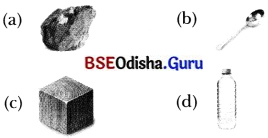
Which of the following objects produces a ringing sound when dropped from a certain height?
Answer:
(b) A metal spoon produces a ringing sound when dropped from a certain height as it is sonorous, while the piece of coal, wooden block and plastic bottle produce dull sounds.
Question 5.
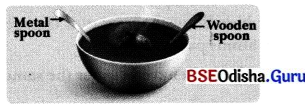
On a winter evening, Nitin’s mother cooked soup and asked him to taste the salt. He noticed that the metal spoon became very hot, while the wooden spoon stayed cool, even though both were placed in the same soup. This is because
(a) the metal spoon was smaller than the wooden spoon.
(b) metal is a good conductor of heat, while wood is a poor conductor of heat.
(c) the metal spoon was lustrous, while the wooden spoon was non-lustrous.
(d) metal is a poor conductor of heat, while wood is a good conductor of heat.
Answer:
(b) Metal is a good conductor of heat; thus, the heat from the hot soup transfers easily throughout the metal spoon. In contrast, wood is a poor conductor of heat; therefore, the wooden spoon stayed cool.
Question 6.
On a Sunday morning, Amar’s father called an electrician to their home to repair the electric heater. Amar noticed that the electrician was wearing rubber gloves and shoes while working. What could be the possible reason for this?
(a) Rubber provides a better grip on his tools while working.
(b) Rubber is a poor conductor of electricity; thus, it protects the electrician against electric shock.
(c) Rubber is a good conductor of electricity; hence, it increases the flow of electric current in the heater.
(d) Rubber helps keep the electrician’s hands and feet warm while working with electrical wires.
Answer:
(b) Rubber is a poor conductor of electricity; thus, it protects the electrician against electric shock.
Question 7.
While returning from school with her father, Reena saw a small furniture shop where she noticed an old, damaged iron almirah with several dark brown patches on it. Her father explained that this is due to the rusting of iron. Select the option that represents the correct condition(s) required for the rusting of iron.
(a) Presence of air (oxygen) only
(b) Presence of hydrogen only
(c) Presence of water only
(d) Presence of both air and water
Answer:
(d) Presence of both air and water
Question 8.
An element X is burned in air. To the product formed, water is added and tested with red and blue litmus papers. The following results are obtained:
(i) Blue litmus paper turns red.
(ii) Red litmus paper remains red.
Which of the following statements is true about element X and the nature of its oxide?
(a) X is a non-metal that forms a basic oxide.
(b) X is a metal that forms an acidic oxide.
(c) X is a metal that forms a basic oxide.
(d) X is a non-metal that forms an acidic oxide.
Answer:
(d) An acidic oxide turns blue litmus paper red and does not change the colour of red litmus paper. Non-metals generally form acidic oxides. Hence, X must be a non-metal.
Question 9.
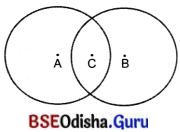
Consider the Venn diagram given alongside. Here, A represents the group of properties shown by metals only, B represents the group of properties shown by non-metals only, and the overlapping part C represents the properties shown by both metals and non-metals. Which of the following properties can be written in the overlapping part?
(a) Sonority
(b) Good conductors of heat and electricity
(c) Formation of oxides
(d) Malleability and Ductility
Answer:
(c) Both metals and non-metals form oxides when burned in the presence of air (oxygen).
Question 10.
A metal X is so soft that it can be cut with a knife and is also stored under kerosene. Which of the following statements is true regarding metal X?
(a) Metal X does not react with oxygen or water.
(b) The oxide of metal X turns moist blue litmus red.
(c) The oxide of metal X turns moist red litmus blue.
(d) No heat is generated when metal X reacts with oxygen and water.
Answer:
(c) It is given that metal X is soft and can be cut with the help of a knife. Therefore, metal X can be sodium or potassium. Both these metals react vigorously with oxygen and water, and a lot of heat is generated in the reactions. Storing these metals under kerosene prevents their exposure to air and moisture. Metallic oxides are basic in nature; hence, they turn moist red litmus blue.
Question 11.
During a science fair, students were asked to design a cooking pan that heats quickly but has a handle that remains cool. Which combination of materials would be the most suitable?
(a) Iron pan with an iron handle
(b) Aluminium pan with a plastic handle
(c) Plastic pan with an aluminium handle
(d) Copper pan with a copper handle
Answer:
(b) Aluminium is a good conductor of heat, while plastic is a poor conductor of heat and therefore it remains cool.
Question 12.
During a music class, Rohan explored different musical instruments such as the veena, sitar, violin, and guitar. He noticed that there are metal wires that play an important role in producing a variety of sounds. Which of the following sets of properties of metals is used here?
(a) Lustre and ductility
(b) Sonority and ductility
(c) Ductility and malleability
(d) Lustre and malleability
Answer:
(b) Ductility – so that the metals are drawn into wires. Sonority – so that the metal wires produce sweet sound when plucked or bowed.
Question 1
Students of class 7 were instructed to test the electrical conductivity of different materials using a simple circuit. They were provided with an aluminium foil, an iron nail, an eraser and a piece of dry wood. Observations made are listed in the following table:
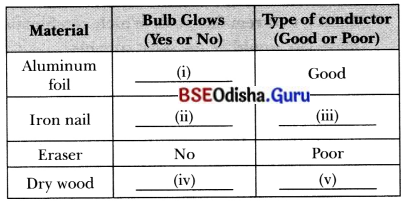
Select the option that correctly fills the numbered blanks:
(a) (i) – Yes, (ii) – Yes, (iii) – Poor, (iv) – No, (v) – Good
(b) (i) – No, (ii) – Yes, (iii) – Poor, (iv) – No, (v) – Good
(c) (i) – Yes, (ii) – Yes, (iii) – Good, (iv) – Yes, (v) – Poor
(d) (i) – Yes, (ii) – Yes, (iii) – Good, (iv) – No, (v) – Poor
Answer:
(d) The material that makes the bulb glow is a good conductor of electricity, while the material that does not make the bulb glow is a poor conductor of electricity.
Question 2.
Which of the following metals are soft?
(i) Sodium
(ii) Iron
(iii) Gold
(iv) Potassium
(a) (i) and (ii)
(b) (ii) and (iii)
(c) (i) and (iv)
(d) (iii) and (iv)
Answer:
(c) Sodium and potassium are so soft that they can be cut with a knife.
Question 3.
Mehak loved dancing, so she joined a dance class at her school. While practising, she heard the pleasant ringing sound of her ghungroos. After the class ended, she heard the ringing sound of the school bell. Based on this scenario, which of the following statements is/are correct?
(i) Both the ghungroos and the school bell produced sound as they were malleable.
(ii) Both the ghungroos and the school bell produced sound as they were sonorous.
(iii) The ringing sound was produced because metals are good conductors of heat.
(iv) Both the ghungroos and the school bell produced sound because they were made up of non-metals.
(a) (i) only
(b) (ii) only
(c) (ii) and (iv)
(d) (iii) and (iv)
Answer:
(b) Both the ghungroos and the school bell were made up of metals, and hence, they produced ringing sounds due to a property called sonority.
Question 4.
A science teacher of class 7 listed the names of the following objects on a whiteboard to explain the different properties of materials:
(i) An aluminium spoon
(ii) A copper wire
(iii) A wooden spoon
(iv) An eraser
(v) A silver coin
During class discussion, a few students of her class gave the following statements:
Priya: Object (i) produces a ringing sound when struck against a hard surface, while no ringing sound is produced by object (iii).
Ravina: Both (i) and (v) objects are good conductors of heat and electricity.
Raj: Object (iii) is a good conductor of heat.
Rohan: Electric circuits contain (iii) because the material is malleable, ductile, a good conductor of electricity, and economical.
Which of these students gave the correct statement(s)?
(a) Priya and Ravina only
(b) Raj only
(c) Priya only
(d) Priya, Ravina, and Rohan
Answer:
(a) Object (iii), i.e., the wooden spoon is a poor conductor of heat.
Question 5.
Which of the following statements is/are incorrect regarding corrosion?
(i) Corrosion of iron objects is called rusting of iron.
(ii) The formation of black coating on both copper and silver objects is due to corrosion.
(iii) Corrosion results in the formation of a green coating on copper objects and a black coating on silver objects.
(iv) Only iron undergoes corrosion, as it is a highly reactive metal.
(a) (i) and (iii)
(b) (iii) only
(c) (ii) and (iv)
(d) (iv) only
Answer:
(c) (ii) and (iv)
Question 6.
Iron nails are placed in four different jars: A, B, C and D. In which of the following will rusting of iron take place?
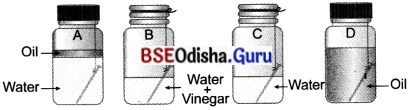
(a) C only
(b) B and C only
(c) A, B and D
(d) C and D only
Answer:
(b) Rusting will take place in jars B and C because both air (oxygen) and water are essential for the rusting of iron to take place. Jar A has oil over water, which cuts off the supply of air, while in Jar D, both water and air are missing.
Question 7.
The following reactions show the burning of magnesium and sulphur in air (oxygen):
Magnesium + Oxygen → X
Sulphur + Oxygen → Y
Which of the following statements is/are incorrect regarding X and Y?
(i) X is an acidic oxide and turns blue litmus paper red.
(ii) Y is a basic oxide and turns red litmus paper blue.
(iii) X is a basic oxide, while Y is an acidic oxide.
(iv) Both X and Y do not change the colour of any of the litmus papers.
(a) (iii) only
(b) (i) and (ii) only
(c) (i), (ii), and (iv)
(d) (iv) only
Answer:
(c) X, i.e., magnesium oxide is a basic oxide and turns red litmus paper blue, while Y, i.e., sulphur dioxide is an acidic oxide and turns blue litmus paper red.
The World of Metals and Non-metals Class 7 Assertion and Reason Questions