
Regular revision with Class 7 Maths MCQ with Answers and Ganita Prakash Class 7 Maths Part 2 Chapter 1 Geometric Twins MCQ improves accuracy in objective exams.
MCQ on Geometric Twins Class 7
Geometric Twins MCQ Class 7
Class 7 Maths Geometric Twins MCQ
Question 1.
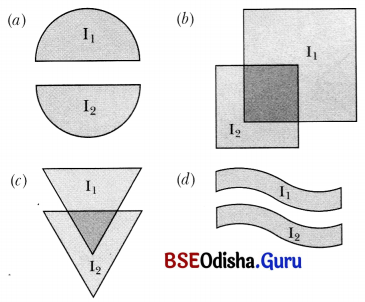
In the given figures, select the option in which figures I1 and I2 do not appear congruent.
Solution:
(b) 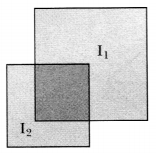
The figures given in options (a), (c) and (d) have same shape and size. So, the figures are congruent.
In figure given in option (b), the shape is same, but sizes are different. So, they are not congruent.
Question 2.
If two squares are congruent, then which of the following is true?
(a) They have same length of sides.
(b) They have same length of diagonals.
(c) both (a) and (b)
(d) None of these
Solution:
(c) both (a) and (b)
If two squares are congruent, they have equal corresponding sides. Since the diagonals depend on the side length, their diagonals are also equal.
Question 3.
When checking congruence, which of the following movement is allowed?
(a) Moving (Sliding)
(b) Rotating
(c) Flipping (reflection)
(d) All of the above
Solution:
(d) All of the above
Moving, rotating or flipping the figure changes only its position or orientation. It does not change the shape or size of the figure. So, all the three movements are allowed.

Question 4.
For two line segments to be congruent, which of the following is correct?
(a) They have the same orientation (direction).
(b) They have at least one common point.
(c) They have the same length.
(d) They have the different orientation (direction).
Solution:
(c) They have the same length.
For two line segments to be congruent, only their lengths need to be equal.
Question 5.
∆ABC and ∆XYZ are two triangles such that AB = XY = 6 cm, AC = XZ = 5 cm and ∠A = ∠X = 30°. ∆ABC and ∆XYZ are congruent by:
(a) SSS congruence rule
(b) SAS congruence rule
(c) ASA congruence rule
(d) The given information is not sufficient.
Solution:
(b) SAS congruence rule
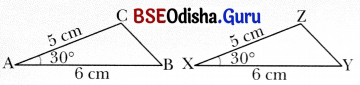
In ∆ABC and ∆XYZ, we have
AB = XY = 6 cm [Given]
AC = XZ = 5 cm [Given]
∠A = ∠X = 30° [Given]
∴ ∆ABC ≅ ∆XYZ [By SAS congruence rule]
Question 6.
If ∆ABC ≅ ∆FDE such that AB = 5 cm, ∠B = 40° and ∠A = 80°, then which of the following is true?
(a) DF = 5 cm, ∠F = 80°
(b) DF = 5 cm, ∠E = 80°
(c) DE = 5 cm, ∠E = 60°
(d) DE = 5 cm, ∠D = 40°
Solution:
(a) DF = 5 cm, ∠F = 80°
Given, ∆ABC ≅ ∆FDE,
AB = 5 cm, ∠B = 40°, ∠d = 80°
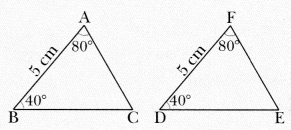
The corresponding sides are: AB and FD, BC and DE, AC and FE.
The corresponding angles are: ∠A and ∠F, ∠B and ∠D, ∠C and ∠E.
∴ ∠F = ∠A = 80° and DF = BA = 5 cm
Question 7.
In ∆PQR and ∆XYZ, PQ = XY, ∠P = ∠X and PR = XZ. ∆PQR and ∆XYZ are congruent by:
(a) SSS
(b) SAS
(c) ASA
(d) RHS
Solution:
(b) SAS
In ∆PQR and ∆XYZ, two sides and included angle are the same.
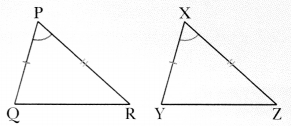
∴ ∆PQR ≅ ∆XYZ [By SAS congruence rule]
Question 8.
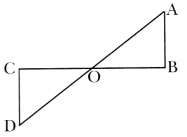
In the given figure, if AO = OD and BO = OC then ∆AOB ≅ ∆DOC by:
(a) SSS
(b) SAS
(c) ASA
(d) AAS
Solution:
(b) SAS
In ∆AOB and ∆DOC, we have
AO = DO [Given]
BO = CO [Given]
∠AOB = ∠DOC [Vertically opposite angles]
∴ ∆AOB ≅ ∆DOC [By SAS congruence rule]
Question 9.
Out of four given circles, identify the circles that are congruent?
(i) Circle with radius, r = 10 cm
(ii) Circle with area, A = 100π cm2
(iii) Circle with circumference, S = 30π cm
(iv) Circle with area, A = 25π cm2
Choose the correct option from the following:
(a) (i) and (iii)
(b) (ii) and (iv)
(c) (i) and (ii)
(d) (iii) and (iv)
Solution:
(c) (i) and (ii)
For two circles to he congruent, their radii must be the saune, and hence Perimeter (2πR) and area (πR2) will also be the same.
For (i): r = 10 cm
For (ii): A = 100π cm2
⇒ πr2 = 100π cm2 ⇒ r2 = 100 cm2
⇒ r = 10 cm
For (iii): S = 30π cm
⇒ 2πr = 30π cm ⇒ r = \(\frac{30 \pi}{2 \pi} \mathrm{~cm}\) = 150 cm
For (iv): A = 25π cm2
⇒ πr2 = 25π cm2 ⇒ r2 = 25 cm2
⇒ r = 5 cm
As circles given (i) and (ii) have same radii, they are congruent.
Question 10.
In the given figure, BD = CE and BD and CE are altitudes of ∆ABC.
Which of the following are correct?
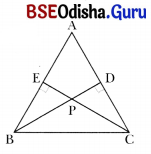
(i) ∆BCD £ ∆CBE
(ii) ∠DBE = ∠DCE
(iii)) ∠DCB = ∠ECB
(iv) ∠DPE + ∠DAE = 180°
Choose the correct option from the following:
(a) (i) and (ii) only
(b) (ii), (iii) and (iv)
(c) (i), (ii) and (iv)
(d) (i) and (iv) only
Solution:
(c) (i), (ii) and (iv)
In ∆BDC and ∆CEB, we have
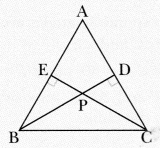
BC = CB [Common side (Hypotenuse)]
BD = CE [Given]
∠CDB = ∠BEC [Each 90°]
∴ ∆BDC ≅ ∆CEB [By RHS congruence rule]
⇒ ∆BCD ≅ ∆CBE
⇒ ∠DCB = ∠EBC and ∠DBC = ∠ECB
[By CPCT]
⇒ ∠DCB – ∠ECB = ∠EBC – ∠DBC
⇒ ∠DCE = ∠EBD
In quadrilateral AEPD,
∠PEA + ∠PDA + ∠DPE + ∠DAE = 360°
[Sum of all interior angles is 360°]
⇒ 90° + 90° + ∠DPE + ∠DAE = 360°
⇒ ∠DPE + ∠DAE = 360° – 180° = 180°
So, (i), (ii) and (iv) are correct.
Geometric Twins Class 7 Assertion and Reason Questions
The following questions are Assertion and Reason based questions. Two statements are given, one labelled as Assertion (A) and the other is labelled as Reason (R). Select the correct answer to these questions from the codes (a), (b), (c) and (d) as given below.
(a) Both A and R are true and R is the correct explanation of A.
(b) Both A and R are true but R is not the correct explanation of A.
(c) A is true but R is false.
(d) A is false but R is true.
Question 1.
(A): If ∆ABC ≅ ∆RPQ, then BC = QR.
(R): Corresponding parts of two congruent triangles are equal.
Solution:
(d) A is false but R is true.
We have, ∆ABC ≅ ∆RPQ
Here, the corresponding vertices are: A and R, B and P, C and Question
⇒ BC – PQ [∵ Corresponding parts of two congruent triangles are equal.]
∴ Assertion (A) is false, but Reason (R) is true.
Question 2.
(A): In ∆PQR, if PQ = PR, then ∠P = ∠R.
(R): Angles opposite to equal sides of a triangle are equal.
Solution:
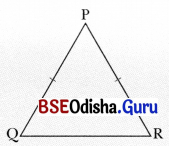
(d) A is false but R is true.
In ∆PQR, we have
PQ = PR
⇒ ∠PRQ = ∠PQR
⇒ ∠R = ∠Q [Angles opposite to equal sides are equal.]
∴ Assertion (A) is false, but Reason (R) is true.
Question 3.
(A): Two congruent triangles have all corresponding angles equal.
(R): AAA criterion is sufficient to prove congruency of two triangles.
Solution:
(c) A is true but R is false.
Two triangles are said to be congruent, if they can be superimposed exactly, one over the other.
∴ Two congruent triangles have all the corresponding sides and corresponding angles equal.
But AAA criterion is not enough to prove congruency of two triangles, because size of triangles might be different.
∴ Assertion (A) is true, but Reason (R) is false.
Question 4.
(A): In ∆ABC, if AB = AC and ∠B = 50°, then ∠C = 50°.
(R): In a triangle, angles opposite to equal sides are equal.
Solution:
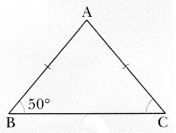
(a) Both A and R are true and R is the correct explanation of A.
Given, AB = AC and ∠B = 50°
We know that angles opposite to equal sides of a triangle are equal.
∴ ∠C = ∠B
⇒ ∠C = 50°
∴ Both .Assertion (A) and Reason (R) are true, and Reason (R) is the correct explanation of Assertion (A).
Geometric Twins Class 7 Fill in the Blanks
Question 1.
A rectangle of length 10 cm and breadth 5 cm is congruent to another rectangle with length _______ and breadth ___________ .
Solution: 10 cm, 5 cm.
For two rectangles to be congruent, their length and breadth must be same.
So, a rectangle of length 10 cm and breadth 5 cm is congruent to another rectangle with length 10 cm and breadth 5 cm.
Question 2.
If two sides and a non-including angle are given, the triangle may or may not uniquely determined. This ambiguous situation is called _______ condition, which can produce ________ different triangles.
Solution: SSA, two
If two sides and a non-including angle are given, the triangle may or may not uniquely determined. This ambiguous situation is called SSA condition, which can produce two different triangles.
Question 3.
For congruent triangles, the perimeters of both triangles are __________ .
Solution: equal
If two triangles are congruent, their corresponding sides and angles are equal.
For congruent triangles, the perimeters of both triangles are equal.
Question 4.
If ∆ABC ≅ ∆XYZ, then AB = ___________, ∠B = ______ and BC = __________ .
Solution: XY, ∠Y, YZ
If two triangles are congruent, their corresponding sides and angles are equal.
Given, ∆ABC ≅ ∆XYZ, then AB = XY, ∠B = ∠Yand BC = YZ.