
Regular revision with Class 7 Maths MCQ with Answers and Ganita Prakash Class 7 Maths Chapter 8 Working with Fractions MCQ improves accuracy in objective exams.
MCQ on Working with Fractions Class 7
Working with Fractions MCQ Class 7
Class 7 Maths Working with Fractions MCQ
Question 1.
The value of \(\frac{5}{6}\) of 30 is:
(a) 20
(b) 25
(c) 30
(d) 35
Solution:
(b) 25
We know, ‘of’ means multiplication.
∴ \(\frac{5}{6} \text { of } 30=\frac{5}{6} \times 30\) = 5 × 5 = 25
Question 2.
What is the value of \(\frac{5}{8}\) × 64 ?
(a) 35
(b) 40
(c) 45
(d) 50
Solution:
(b) 40
\(\frac{5}{8} \times 64\) = 5 × 8 = 40
Question 3.
The value of \(3 \frac{1}{2}+\frac{4}{3}-2 \frac{2}{5}\) is:
(a) \(\frac{89}{30}\)
(b) \(\frac{91}{30}\)
(c) \(\frac{87}{30}\)
(d) \(\frac{73}{30}\)
Solution:
(d) \(\frac{73}{30}\)
We can write, \(3 \frac{1}{2}=\frac{7}{2} \text { and } 2 \frac{2}{5}=\frac{12}{5}\)
∴ \(3 \frac{1}{2}+\frac{4}{3}-2 \frac{2}{5}=\frac{7}{2}+\frac{4}{3}-\frac{12}{5}=\frac{105}{30}+\frac{40}{30}-\frac{72}{30}\)
[∵ LCM of 2, 3 and 5 is 30.]
= \(\frac{105+40-72}{30}=\frac{73}{30}\)

Question 4.
The cost of one notebook is \(\frac{3}{4}\) rupees. What is the cost of 32 such notebooks?
(a) ₹20
(b) ₹22
(c) ₹24
(d) ₹26
Solution:
(c) ₹24
Given, the cost of one notebook is \(\frac{3}{4}\) rupees.
Therefore, the cost of 32 notebooks
= \(32 \times \frac{3}{4}\) = 8 × 3 = ₹24
Question 5.
The value of \(\frac{11}{18}+\left(\frac{7}{15} \times \frac{1}{4}\right)\) is:
(a) \(\frac{3}{180}\)
(b) \(\frac{56}{180}\)
(c) \(\frac{131}{180}\)
(d) \(\frac{9}{180}\)
Solution:
(c) \(\frac{131}{180}\)
Given, \(\frac{11}{18}+\left(\frac{7}{15} \times \frac{1}{4}\right)=\frac{11}{18}+\frac{7}{60}=\frac{110}{180}+\frac{21}{180}\)
[∵ LCM of 18 and 60 is 180]
= \(\frac{110+21}{180}=\frac{131}{180}\)
Question 6.
The reciprocal of \(\frac{8}{7}\) is:
(a) \(\frac{1}{8}\)
(b) \(\frac{7}{8}\)
(c) \(\frac{1}{7}\)
(d) \(\frac{8}{7}\)
Solution:
(b) \(\frac{7}{8}\)
The reciprocal of \(\frac{8}{7} \text { is } \frac{7}{8}\).
Question 7.
The value of \(5 \frac{2}{3} \div 1 \frac{5}{6}\) is:
(a) \(3 \frac{1}{11}\)
(b) \(2 \frac{2}{3}\)
(c) \(1 \frac{1}{6}\)
(d) \(3 \frac{2}{5}\)
Solution:
(a) \(3 \frac{1}{11}\)
We have, \(5 \frac{2}{3} \div 1 \frac{5}{6}\)
= \(\frac{17}{3} \div \frac{11}{6}=\frac{17}{8} \times \frac{6}{11}\)
[As \(5\frac{2}{3}=\frac{17}{3} \text { and } 1 \frac{5}{6}=\frac{11}{6}\)]
= \(\frac{17 \times 2}{1 \times 11}=\frac{34}{11}=3 \frac{1}{11}\)
Question 8.
\(\left(\frac{18}{6} \div \frac{3}{9}\right)+\left(\frac{21}{7} \div \frac{6}{4}\right)\) =
(a) 9
(b) 11
(c) 12
(d) 10
Solution:
(b) 11
We have, \(\left(\frac{18}{6} \div \frac{3}{9}\right)+\left(\frac{21}{7} \div \frac{6}{4}\right)\)
= \(\left(\frac{38}{6} \times \frac{3}{8}\right)+\left(\frac{21}{7} \times \frac{4}{6}\right)\)
= \(\frac{3 \times 3}{1 \times 1}+\frac{9 \times 2}{1 \times 3}\) = 9 + 2 = 11
Question 9.
The reciprocal of \(2 \frac{3}{4}\) is:
(a) \(\frac{11}{4}\)
(b) \(\frac{13}{4}\)
(c) \(\frac{4}{11}\)
(d) \(\frac{4}{13}\)
Solution:
(c) \(\frac{4}{11}\)
We have \(2\frac{3}{4}=\frac{(2 \times 4)+3}{4}=\frac{8+3}{4}=\frac{11}{4}\)
Now, reciprocal of \(\frac{11}{4} \text { is } \frac{4}{11}\)
Question 10.
The value of \(\frac{7}{8} \div 4\) is:
(a) \(\frac{7}{2}\)
(b) \(\frac{7}{32}\)
(c) \(\frac{4}{7}\)
(d) \(2\frac{1}{4}\)
Solution:
(b) \(\frac{7}{32}\)
We have, \(\frac{7}{8} \div 4=\frac{7}{8} \times \frac{1}{4}=\frac{7 \times 1}{8 \times 4}=\frac{7}{32}\)
Question 11.
The value of \(4 \frac{3}{5} \div 2 \frac{1}{4}\) is:
(a) \(2\frac{2}{45}\)
(b) \(3\frac{1}{5}\)
(c) \(1\frac{4}{9}\)
(d) \(2\frac{1}{4}\)
Solution:
(a) \(2\frac{2}{45}\)
We have, \(4 \frac{3}{5} \div 2 \frac{1}{4}=\frac{23}{5} \div \frac{9}{4}=\frac{23}{5} \times \frac{4}{9}\)
[∵ \(4 \frac{3}{5}=\frac{23}{5}, 2 \frac{1}{4}=\frac{9}{4}\)
= \(\frac{23 \times 4}{5 \times 9}=\frac{92}{45}=2 \frac{2}{45}\)
Question 12.
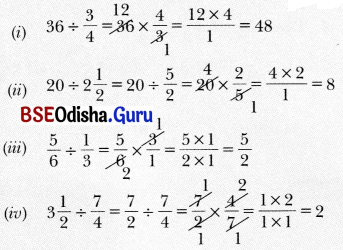
Which of the following is/are correct?
(i) \(36 \div \frac{3}{4}=48\)
(ii) \(20 \div 2 \frac{1}{2}=8\)
(iii) \(\frac{5}{6} \div \frac{1}{3}=\frac{5}{2}\)
(iv) \(3 \frac{1}{2} \div \frac{7}{4}=2\)
Choose the correct option from the following:
(a) (i), (ii) and (iii) only
(b) (i), (iii) and (iv) only
(c) (ii), (iii) and (iv) only
(d) (i), (ii), (iii) and (iv)
Solution:
(d) (i), (ii), (iii) and (iv)
Question 13.
Which of the following is/are correct?
(i) \(36 \div \frac{3}{4}=48\)
(ii) \(45 \div 5 \frac{5}{6}=6\)
(iii) \(\frac{7}{9} \div \frac{1}{3}=\frac{7}{2}\)
(iv) \(3 \frac{1}{2} \div \frac{7}{4}=2\)
Choose the correct option from the following:
(a) (i), (ii) and (iv)
(b) (ii), (iii) and (iv)
(c) (i) and (iv) only
(d) (i), (ii) and (iii)
Solution:
(c) (i) and (iv) only
(i) 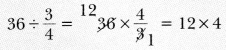
= 48 – correct
(ii) 
= \(\frac{9 \times 6}{7}=\frac{54}{7} \neq 6\) = Incorrect
(iii) 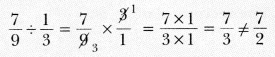 – Incorrect
(iv)  – Correct
A Tale of Three Intersecting Lines Class 7 Assertion and Reason Questions
The following questions are Assertion and Reason based questions. Two statements are given, one labelled as Assertion (A) and the other is labelled as Reason (R). Select the correct answer to these questions from the codes (a), (b), (c) and (d) as given below.
(a) Both A and R are true and R is the correct explanation of A.
(b) Both A and R are true but R is not the correct explanation of A.
(c) A is true but R is false.
(d) A is false but R is true.
Question 1.
(A): The product of \(\frac{2}{5} \text { and } \frac{3}{4} \text { is } \frac{6}{20}\)
(R): To multiply two fractions, we take the LCM of the denominators and then add the numerators.
Solution:
(c) A is true but R is false.
To multiply two fractions, we do not take the LCM or add numerators. Instead, we multiply numerators and denominators directly.
∴ \(\frac{2}{5} \times \frac{3}{4}=\frac{2 \times 3}{5 \times 4}=\frac{6}{20}\)
Thus, Assertion (A) is true, but Reason (R) is false.
Question 2.
(A): \(\frac{4}{3}\) of 15 is 20.
(R): In \(\frac{4}{3}\) of 15 , ‘of’ means ‘multiplication’.
Solution:
(a) Both A and R are true and R is the correct explanation of A.
In \(\frac{4}{3}\) of 15 , ‘of ’ means ‘multiplication’.
Thus, \(\frac{4}{3}\) of 15 = \(\frac{4}{3} \times 15\) = 4 × 5 = 20
Therefore, both Assertion (A) and Reason (R) are true, and Reason (R) is the correct explanation of Assertion (A).
Question 3.
(A): The product of \(\frac{2}{3}, \frac{3}{4} \text { and } \frac{1}{2} \text { is } \frac{1}{4}\)
(R): To multiply three fractions, we take the LCM of the denominators and then add the numerators.
Solution:
(c) A is true but R is false.
To multiply three fractions, we do not take the LCM or add the numerators.
Instead, we multiply the numerators and multiply the denominators directly.
∴ \(\frac{2}{3} \times \frac{3}{4} \times \frac{1}{2}=\frac{2 \times 3 \times 1}{3 \times 4 \times 2}=\frac{1}{4}\)
Therefore, Assertion (A) is true, but Reason (R) is false.
Question 4.
(A): The product of two improper fractions is not smaller than any of the two fractions.
(R): Multiplication of two improper fractions gives a result that is greater than both the fractions or equal to either of them.
Solution:
(a) Both A and R are true and R is the correct explanation of A.
An improper fraction has its numerator equal to or greater than the denominator (e.g. \(\frac{5}{4}, \frac{7}{3},\) 1, etc.). Its value is greater than or equal to 1.
Thus, the product of two improper fractions is equal to either of them or greater than each fraction.
Therefore, both Assertion (A) and Reason (R) are true, and Reason (R) is the correct explanation of Assertion (A).
A Tale of Three Intersecting Lines Class 7 Fill in the Blanks
Question 1.
The product of two proper fractions is found by multiplying the _______ of both and the _____ of both.
Solution: numerators, denominators
The product of two proper fractions is found by multiplying the numerators of both and the
denominators of both.
Question 2.
Priya is making lemonade. She uses \(\frac{2}{3}\) of a lemon for one glass. If she makes \(\frac{3}{4}\) of a glass, she will use ______ of a lemon.
Solution: \(\frac{1}{2}\) of a glass
Given, lemon used for 1 full glass is \(\frac{2}{3}\) and glass prepared = \(\frac{3}{4}\) of a glass
∴ Required lemon = \(\frac{3}{4} \times \frac{2}{3}=\frac{3 \times 2}{4 \times 3}=\frac{6}{12}=\frac{1}{2}\) = of a lemon.
Question 3.
The product of \(\frac{5}{8}\) and 96 is _______ .
Solution: 60
Product of \(\frac{5}{8}\) and 96 is \(\frac{5}{8} \times 96\) = 5 × 12 = 60
Question 4.
Ravi is painting a wall. He uses \(\frac{3}{5}\) of a bucket of paint for one wall. If he paints \(\frac{2}{3}\) of a wall, he wil use ______ of a bucket.
Solution: \(\frac{2}{5}\)
Given, paint required to paint 1 wall = \(\frac{3}{5}\) of a bucket
Paint required to paint \(\frac{2}{3}\) of a wall
= \(\frac{2}{3} \times \frac{3}{5}=\frac{2}{5}\) of a bucket
Question 5.
Complete the following:

Solution:

Question 6.
If the product of two numbers is ________ the numbers are called reciprocal of each other.
Solution: 1
If the product of two numbers is 1, then the numbers are called reciprocal of each other.
Question 7.
Reciprocal of \(\frac{5}{11}\) is ______.
Solution: \(\frac{11}{5}\)
Reciprocal of \(\frac{5}{11} \text { is } \frac{\mathbf{1 1}}{\mathbf{5}}\)
Question 8.
\(\frac{1}{5}\) is ________ of 5.
Solution: reciprocal or multiplicative inverse
\(\frac{1}{5}\) is reciprocal or multiplicative inverse of 5.
Question 9.
\(\frac{8}{5} \div \frac{9}{}=\frac{8}{5} \times \frac{7}{9}\)
Solution: \(\frac{9}{7}\)
\(\frac{8}{5} \div \frac{9}{7}=\frac{8}{5} \times \frac{7}{9}\)