
Students can refer to BSE Odisha Class 6 Math Solution and Ganita Prakash Chapter 3 Number Play Class 6 Question Answer to understand textbook questions step by step.
Class 6 Maths Chapter 3 Number Play Solutions
Ganita Prakash Class 6 Chapter 3 Solutions
Class 6 Maths Ganita Prakash Chapter 3 Solutions Number Play
Question 1.
Fill the table below with only 4-digit numbers such that the supercells are exactly the coloured cells.

Solution:
| 5346 | 8643 | 1166 | 1258 | 1056 | 2012 | 8000 | 9635 | 9905 |
Question 2.
Fill the table below such that we get as many supercells as possible. Use numbers between 100 and 1000 without repetitions.

Solution:
| 999 | 102 | 909 | 110 | 918 | 210 | 928 | 350 | 958 |

Question 3.
Can you fill a supercell table without repeating numbers such that there are no supercells? Why or why not?
Solution:
No, we cannot fill a supercell table without repeating numbers such that there are no supercells because at least one number will always be larger than its adjacent cell unless repetition is allowed.
For example,
| 3 | 6 | 9 | 12 | 15 | 18 | 21 | 20 or 22 |
Here, if the last number is greater than 21, it is a supercell and if less than 21, then 21 itself is a supercell number.
Question 4.
Will the cell having the largest number in a table always be a supercell? Can the cell having the smallest number in a table be a supercell? Why or why not?
Solution:
Yes, the cell having the largest number in a table will always be a supercell, because largest number will always be greater than its neighbouring numbers.
But, the cell having smallest number in a table can never be a supercell, because it will always be smaller than its neighbouring numbers.
Question 5.
Fill a table such that the cell having the second largest number is not a supercell but the second smallest number is a supercell. Is it possible?
Solution:
Yes, it is possible.
| 245 | 147 | 368 | 313 | 696 | 758 | 532 | 590 | 485 |
In this table, the second largest number is 696, it is not a supercell number and second smallest number is 245, which is a supercell number.
Question 6.
What is the sum of the smallest and largest 5-digit palindrome? What is their difference?
Solution:
Smallest 5-digit palindrome = 10001
Largest 5-digit palindrome = 99999
Sum = 10001 + 99999 = 110000
Difference = 99999 – 10001 = 89998
Question 7.
Write an example for each of the below scenarios whenever possible.
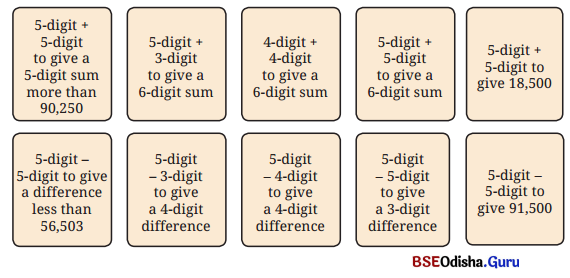
Could you find examples for all the cases? If not, think and discuss what could be the reason. Make other such questions and challenge your classmates.
Solution:
(i) 45000 + 50000 = 95000 > 90250
(ii) 99999 + 900 = 100899
(iii) 4-digit 4- 4-digit to give a 6-digit sum. Since, the maximum sum for two 4-digit numbers (9999 + 9999) is 19998. Thus, it is not possible to get a 6 -digit number by adding two 4-digit numbers.
(iv) 50000 + 61000 = 111000
(v) The minimum sum of two 5-digit numbers (10000 + 10000) is 20000, which is greater than 18500. Therefore, it is not possible to get a sum of 18500 with two 5-digit numbers.
(vi) 70000 – 15000 = 55000 < 56503
(vii) 10000 – 999 = 9001
(viii) 12000 – 8000 = 4000
(ix) 20000 – 19500 = 500
(x) The difference between the largest 5-digit number and smallest 5-digit number (99999 – 10000) is 89999 which is less than 91500.
Therefore, it not possible to get the difference of 91500 between two 5-digit numbers.
Question 8.
There is only one supercell (number greater than all its neighbours) in this grid. If you exchange two digits of one of the numbers, there will be 4 supercells.
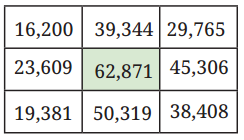
Figure out which digits to swap.
Solution:
Swap the digits 6 and 1 in the number 62,871. The number becomes 12,876 which will be the smallest among all the numbers.
| 16,200 | 39,344 | 29,765 |
| 23,609 | 12,876 | 45,306 |
| 19,381 | 50,319 | 38,408 |
Now, there are four supercells.
Question 9.
We are the group of 5-digit numbers between 35000 and 75000 such that all of our digits are odd. Who is the largest number in our group? Who is the smallest number in our group? Who among us is the closest to 50,000?
Solution:
The possible odd digits are: 1, 3, 5, 7 and 9.
Largest odd number is 73,999. (between 35000 and 75000)
Smallest odd number is 35,111. (between 35000 and 75000)
Closest odd number to 50,000 is 51,111.
Question 10.
Recall the sequence of powers of 2 from chapter 1. Why is the Collatz conjecture correct for all the starting numbers in this sequence?
Solution:
Powers of 2 → 2, 4, 8, 16,
For 2 (even) → 2 divide by 2 = 1
For 4 (even) → 4 divide by 2 = 2 (even) → 2 divide by 2 = 1
For 8 (even) → 8 divide by 2 = 4 (even) → 4 divide by 2 = 2 (even) → 2 divide by 2 = 1
Thus, for starting numbers that are powers of 2, the Collatz conjecture holds true because the sequence of operations simply involves a series of divisions by 2, which eventually leads to 1.
InText Questions
[Instruction for Q1 to Q7]
Some Children in a park are standing in a line. Each one says a number.
- A child says ‘1’ if there is only one taller child standing next to them.
- A child says ‘2’ if both the children standing next to them are taller.
- A child says ‘O’, if neither of the children standing next to them are taller.
That is each person says the number of taller neighbours they have.
Question 1.
Can the children rearrange themselves so that the children standing at the ends say ‘2’?
Solution:
No, the children cannot line up in a way that the ones at the ends say ‘2′ because a child only says ‘2’ when both of their neighbours are taller and children at the ends have only one neighbour, not two.
Question 2.
Can we arrange the children in a line so that all would say only 0s?
Solution:
No, it’s not possible to arrange the children in a line so that they all say only ‘0’, because a child says ‘0’ only when neither of their neighbours is taller. This would only happen if all the children are the same height.
Question 3.
Can two children standing next to each other say the same number?
Solution:
Yes, two children standing next to each other can say the same number i.e. 1 because there can be one taller and one smaller child standing next to them.
Question 4.
There are 5 children in a group, all of different heights. Can they stand such that four of them say 1 and the last one says ‘0’? Why or why not?
Solution:
Yes, because a child can say ‘0’ only if neither of the children standing next to them are taller. Arranging them in increasing or decreasing order of heights will eventually put tallest child at one of the end. So it is obvious that last child will say ‘0’.
Question 5.
For this group of 5 children, is the sequence 1, 1, 1, 1, 1 possible?
Solution:
No, the sequence 1, 1, 1, 1, 1 is not possible because there are 5 children and first four will say 1 only if they are arranged in increasing order of height. So, the last child will be tallest and will say 0 (not 1).
Question 6.
Is the sequence 0, 1,2, 1,0 possible? Why or why not?
Solution:
Yes, the sequence 0, 1, 2, 1, 0 is possible. It represents a situation where the middle child is the smallest (has two taller neighbours). The two children at the end are taller than the second last child from both the ends.
Question 7.
How would you rearrange the five children so that the maximum number of children say ‘2’?
Solution:
We can rearrange the five children so that the maximum number of children say ‘2’ as 0, 2, 0, 2, 0.
Thus, maximum number of children who can say ‘2’ is 2 . ,
Question 8.
Complete Table 2 with 5-digit numbers whose digits are ‘1’, ‘0’, ‘6’, ‘3’, and ‘9’ in some order. Only a coloured cell should have a number greater than all its neighbours.
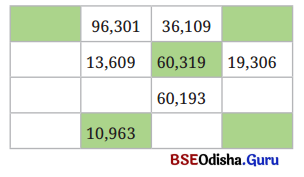
Once you have filled the table above, put commas appropriately after the thousands digit.
The biggest number in the table is _______.
The smallest even number in the table is ______.
The smallest number greater than 50,000 in the table is _______.
Solution:
| 96,310 | 96,301 | 36,109 | 36,190′ |
| 93,610. | 13,609 | 60,319 | 19,306 |
| 93,106 | 10,639 | 60,193 | 30,196 |
| 10,369 | 10,963 | 10,396 | 31,906 |
The biggest number in the table is 96,310.
The smallest even number in the table is 10,396.
The smallest number greater than 50,000 in the table is 60,193.
Question 9.
Among the numbers 1-100, how many times will the digit 7’ occur? Among the numbers 1-1000, how many times will the digit ‘7’ occur?
Solution:
Among the numbers 1-100, we can divide the range into two parts: When ‘7’ appears in the ones place and when ‘7’ appears in the tens place.
In the ones place: The numbers that have ‘7’ in the ones place are: 7, 17, 27, 37, 47, 57, 67, 77, 87, and 97. So, there are 10 numbers where ‘7’ appears in the ones place.
In the tens place: The numbers 70 to 79 contain the digit ‘7’ in the tens place. So, there are 10 numbers where ‘7’ appears in the tens place.
Total occurrences of ‘7’ between 1 and 100:
Ones place: 10 times and Tens place: 10 times
Total = 10 + 10 = 20
So, digit ‘7’ appears 20 times among the numbers 1-100.
Among the numbers 1-1000, we can divide the range into three parts:
hundreds place, tens place and ones place
In the hundreds place: The numbers 700 to 799 contain the digit ‘7’ in the hundreds place. There are 100 numbers front 700 to 799.
In the tens place: We already know that in each set of 100 numbers (i.e. 0-99, 100-199, …, 900-999),
‘7’ will appear in the tens place 10 times (just like in the 1-100 range). Since we have 10 sets of 100 numbers, ‘7’ will appear in the tens place, 10 × 10 = 100 times.
In the ones place: Similarly, for each set of 100 numbers (i.e. 0-99, 100-199, …. 900-999), 7’ will appear in the ones place 10 times (like in the 1-100 range). So, across 10 sets of 100 numbers, 7’ will appear in the ones place 10 × 10 = 100 times.
Total occurrences of 7’ between 1 and 1000:
Hundreds place: 100 times, Tens place: 100 times, Ones place: 100 times
Total = 100 + 100 + 100 = 300
So, digit ‘7’ appears 300 times among the numbers 1-1000.
Question 10.
Write all possible 3-digit palindromes using 1, 2, 3.
Solution:
All the possible 3-digit palindromes using the digits ‘1’, ‘2’, and ‘3’ are: 111, 121, 131, 212, 222, 232, 313, 323 and 333.
There are 9 possible palindromes using the digits ‘1’, ‘2’, and ‘3’.
Question 11.
Puzzle time:
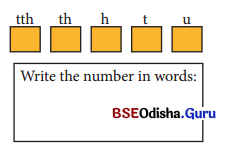
I am a 5-digit palindrome.
I am an odd number.
My ‘t’ digit is double of my ‘M’ digit.
My ‘h’ digit is double of my ‘t’ digit.
Who am I? _______
Solution:
Since palindrome is an odd number, u digit would be 1, 3, 5, 7 or 9 and tth digit would be same as u digit.
Since double of 5, 7 and 9 is not a digit, u digit would be either 1 or 3.
Double of 1 is 2 and double of 3 is 6. So, t digit would be either 2 or 6.
Since double of 6 is not a digit, u digit is 1 and t digit is 2.
Then, h digit would be 4.
So, the required 5-digit odd palindrome number is 12421.
In words: Twelve thousand four hundred twenty one
Number Play Class 6 Extra Questions
Number Play Class 6 Very Short Question Answer
Question 1.
What is the largest 4-digit number with non-zero digits such that its digits add up to 14?
Solution:
The largest 4-digit number must have largest digit ‘9’ at thousands place and the remaining digits in descending order such that the sum of all digits is 14.
Hence, the required number is 9311.
Question 2.
Write all 2-digit palindromic numbers.
Solution:
The 2-digit palindromic numbers are: I 1, 22, 33, 44, 55, 66, 77, 88 and 99.
Question 3.
Write all possible 3-digit palindromes using the digits 7, 8, 9.
Solution:
Using digits 7, 8 and 9, we get the following palindromes:
777, 787, 797, 878, 888, 898, 979, 989, 999
Question 4.
Write two 4-digit numbers such that their difference is a 2-digit number.
Solution:
Let us take 5500 and 5460 as two 4-digit numbers.
Clearly, 5500 – 5460 = 40 which is a 2-digit number.
Question 5.
Write two 5-digit numbers whose sum is 32500.
Solution:
Let us take 12500 and 20000 as two 5-digit numbers.
Clearly, 12500 + 20000 = 32500
Question 6.
Write two 4-digit numbers whose difference is 4680.
Solution:
Let us take 7500 and 2820 as two 4-digit numbers.
Clearly, 7500 – 2820 = 4680
Question 7.
Write the smallest and largest 4-digit palindromes. Find their sum and difference.
Solution:
Smallest 4-digit palindrome = 1001 and largest 4-digit palindrome = 9999
Required sum = 1001 + 9999 = 11000
Required difference = 9999 – 1001 = 8998
Question 8.
Write the second smallest and second largest 5-digit palindromes. Find their sum.
Solution:
Second smallest 5-digit palindrome = 10101
Second largest 5-digit palindrome = 99899
Required sum = 10101 + 99899 = 110000
Question 9.
Write a 6-digit number and a 4-digit number such that their difference is a 5-digit number.
Solution:
Let us take 103200 as a 6-digit number and 8200 as a 4-digit number.
Clearly, 103200 – 8200 = 95000 which is a 5-digit number.
Question 10.
Write a 6-digit number and a 5-digit number such that their difference is a 5-digit number.
Solution:
Let us take 120500 as a 6-digit number and 40500 as a 5-digit number.
Clearly, 120500 – 40500 = 80000, which is a 5-digit number.
Question 11.
Rearrange the digits of 48900125 to get the largest 8-digit number?
Solution:
In order to get the largest 8-digit number using the digits of 48900125, digits should be in descending order on moving from left to right.
Therefore, the required largest number is 98542100.
Question 12.
What is the smallest number whose digit sum is 16?
Solution:
There is no single digit number to give digit sum equal to 16.
The 2-digit numbers whose digits add up to 16 are: 79, 88 and 97.
We see that 79 is the smallest number among these numbers.
Therefore, 79 is the smallest number whose digit sum is 16.
Question 13.
Rearrange the digits of 4500731 to get the smallest 7-digit number?
Solution:
In order to get the smallest 7-digit number using the digits of 4500731, the first digit from left to right should be the smallest digit except 0. So, in this case, it is 1. Then, on moving from left to right further, digits should be in ascending order.
Therefore, the required smallest number is 1003457.
Question 14.
What is the largest 4-digit number whose digits add up to 15?
Solution:
The largest 4-digit number should have the largest digit at thousands place. Since 9 is the largest digit, it takes thousands place. Then, 6 takes the hundreds place because 9 + 6 = 15. As the sum is exhausted by thousands and hundreds place digits, rest places will take digit ‘0’.
Therefore, the required largest 4-digit number is 9600.
Number Play Class 6 Short Question Answer
Question 1.
Fill the given table such that the cell having the 2nd largest number is not a supercell but the cell having 2nd smallest number is a supercell. Use numbers between 10 and 100.

Solution:
To make sure the cell with the second largest number is not a supercell, it has to be next to the cell with the largest number. This is because the cell with the largest number is always a supercell, and two supercells cannot be next to each other.
To make the cell with the second smallest number a supercell, it should be one of the extreme end cells and the smallest number should be in the adjacent cell.
| 53 | 88 | 72 | 64 | 22 | 32 |
Here, 72 is the second largest number and 32 is the second smallest number
Activity: Think of another numbers by yourself.
Question 2.
Mark the supercells in the table below.
| 6828 | 670 | 9435 | 2180 |
| 3780 | 3708 | 7308 | 9225 |
| 8000 | 5583 | 52 | 5001 |
Solution:
6828 is a supercell because it is larger than its neighbours 670 and 3780.
9435 is a supercell because it is larger than its neighbours 670, 2180 and 7308.
9225 is a supercell because ii is larger than its neighbours 2180, 7308 and 5001.
8000 is a supercell because it is larger than its neighbours 3780 and 5583.
| 6828 | 670 | 9435 | 2180 |
| 3780 | 3708 | 7308 | 9225 |
| 8000 | 5583 | 52 | 5001 |
Question 3.
Fill in the table using only 3-digit numbers, making sure that the supercells line up exactly with the coloured cells.

Solution
Since 2nd cell is a supercell, it must contain a number greater than 576. Let it he 832.
Since 3rd and 5th cells are not supercells and 4th cell is a supercell, the numbers in 3rd and 5th cells should be smaller than the number in 4th cell i.e., 188. Let them he 112 and 176 respectively.
| 576 | 832 | 112 | 188 | 176 | 912 |
The last cell is a supercell, and its neighbouring cell contains 912. So, the number in the last cell should be greater than 912. Let it be 950.
Since 7th cell is not a supercell, it must contain number smaller than 912. Let it be 492.
Also, 6th cell is not a supercell, it must contain a number smaller than the number present in 7th cell, i.e. 492. Let it be 350.
Now, the complete table is as follows:
| 576 | 832 | 112 | 188 | 176 | 350 | 492 | 912 | 950 |
Activity: Think of another numbers by yourself.
Question 4.
Fill in the table using only 3-digit numbers, making sure that the supercells line up exactly with the coloured cells.

Solution:
Since 2nd cell is a supercell, it must contain a number greater than 576. Let it be 832. Then, number in 1st cell should be less than 432. Let it be 100.
| 100 | 432 | 120 | 312 | 731 | 512 |
Since 4th cell is not supercell, it may Contain any 3-digit number less than 312. Let it be 230.
Also. 7th cell is not supercell and second last cell is a supercell. it must contain number smaller than 731 and 512. I et it be 219.
The second last cell is a supercell, and it contains 512. So, the number in the last cell should be smaller than 512. Let it he 194.
Now, the complete table is as follows:
| 100 | 432 | 120 | 230 | 312 | 731 | 219 | 512 | 494 |
Question 5.
Calculate the digit sums of 2-digit numbers whose digits are consecutive. Do you observe a pattern?
Solution:
2-digit numbers having consecutive digits are: 12, 23, 34, 45, 56, 67, 78 and 89 .
The sums of digits of these 8 numbers arc:
1 + 2 = 3
2 + 3 = 5
3 + 4 = 7
4 + 5 = 9
5 + 6 = 11
6 + 7 = 13
7 + 8 = 15
8 + 9 = 17
We find that each sum is 2 more than the preceding sum.
Question 6.
What is the largest 5-digit number with non-zero digits whose digits add up to 17?
Solution:
Non-zero digits are 1, 2, 3, 4, 5, 6, 7, 8, 9.
The largest 5-digit number must have largest digit ‘9’ at ten thousands place (tth) and the remaining digits in descending order such that the sum of all digits is 17.
| tth | th | h | t | u |
Question 7.
Calculate the digit sums of 4-digit numbers whose digits are consecutive. Do you observe any pattern?
Solution:
The 4-digit numbers having consecutive digits are 1234,2345, 3456, 4567, 5678 and 6789.
The sum of digits of these 6 numbers are 10, 14, 18, 22, 26 and 30 respectively.
We find that each sum is 4 more than the preceding sum.
Question 8.
What is the smallest 5-digit number whose digits add up to 18?
Solution:
In order to write smallest 5-digit number, ten thousands place must be occupied by digit ‘1’. Then, sum of the rest of the digits should be 18 – 1 = 17.
The smallest 5-digit number should have the largest digit at units place. Since 9 is the largest digit, it takes units place. Then, 8 takes the tens place because 9 + 8 = 17. As the sum is exhausted by ten thousands, tens and units place digits, rest places will take digit ‘0’.
Therefore, the required smallest 5-digit number is 10089.
Question 9.
Convert the following times from 12-hour format to 24-hour format.
(i) 02:00 PM
(ii) 10:00 AM
(iii) 07:30 PM
(iv) 12:20 AM
(v) 12:15 PM
Solution:
| 12-hour Format | 24-hour Format | |
| (i) | 02:00 PM | 14:00 hours |
| (ii) | 10:00 AM | 10:00 hours |
| (iii) | 07:30 PM | 19:30 hours |
| (iv) | 12:20 AM | 00:20 hours |
| (v) | 12:15 PM | 12:15 hours |
Question 10.
What can be the previous number in the Collatz sequence to 40?
Solution:
Let x be the required number.
If x is an even number, then
\(\frac{x}{2}\) = 40 ⇒ x = 2 × 40 ⇒ x = 80
If x is an odd number, then
3x + 1 = 40 ⇒ 3x = 40 – 1
⇒ 3x = 39 ⇒ x = \(\frac{39}{3}\) = 13
Thus, either 80 or 13 can be the number preceding 40 in a Collatz sequence.
Question 11.
Observe the following numbers written in a pattern. Find their sum.
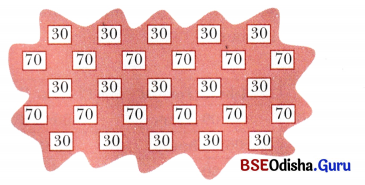
Solution:
We find that there are 3 rows each consisting of 5 boxes written with 30 and 2 rows each consisting of 6 boxes written with 70.
∴ Total sum = 3(5 × 30) + 2(6 × 70)
= 3 × 150 + 2 × 420
= 450 + 840 = 1290
Question 12.
Apply Kaprekar’s routine on the number 3562 to get Kaprekar constant.
Solution:
The number is 3562.
Round 1: A = Largest number using digits of the number 3562 = 6532
B = Smallest number using digits of the number 3562 = 2356
C = A – B = 6532 – 2356 = 4176
Round 2: A = Largest number using digits of the number 4176 = 7641
B = Smallest number using digits of the number 4176 = 1467
C = A – B = 7641 – 1467 = 6174
Question 13.
Apply Kaprekar’s routine on the number 8825 to get Kaprekar constant.
Solution:
The number is 8825.
Round 1:
A = Largest number using digits of the number 8825 = 8852
B = Smallest number using digits of the number 8825 = 2588
C = A – B = 8852 – 2588 = 6264
Round 2:
A = Largest number using digits of the number 6264 = 6642
R = Smallest number using digits of the number 6264 = 2466
C = A – B = 6642 – 2466 = 4176
Round 3:
A = Largest number using digits of the number 4176 = 7641
B = Smallest number using digits of the number 4176 = 1467
C = A – B = 7641 – 1467 = 6174
Question 14.
Convert the following times from 24-hour format to 12-hour format.
(i) 18:00 hours
(ii) 06:00 hours
(iii) 12:30 hours
(iv) 00:45 hours
(v) 23:15 hours
Solution:
| 24-hour Format | 12-hour Format | |
| (i) | 18:00 hours | 06:00 PM |
| (ii) | 06:00 hours | 06:00 AM |
| (iii) | 12:30 hours | 12:30 PM |
| (iv) | 00:45 hours | 12:45 AM |
| (v) | 23:15 hours | 11:15 PM |
Question 15.
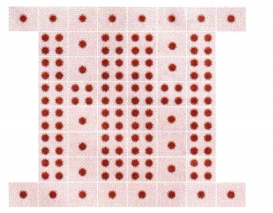
Count all the suns in the following pattern.
Solution:
There are 26 boxes with 1 sun each and 26 boxes with 4 suns each.
∴ Total number of suns = (26 × 1) + (26 × 4)
= 26 + 104 = 130
Question 16.
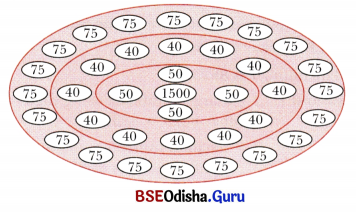
Find the sum of the numbers in the number pattern shown in the figure.
Solution:
We note that the number 75 occurs 20 times around the outer edge, the number 40 appears 12 times along the second layer, the number 50 is present 4 times on the edge of the inner layer, and the number 1500 is located at the centre.
∴ Required sum
= (20 × 75) + (12 × 40) + (4 × 50) + 1500
= 1500 + 480 + 200 + 1500 = 3680
Question 17.
Consider the numbers in the following boxes:
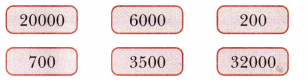
Using operations addition/subtraction on these numbers, we can get
13100 = 32000 – 20000 + 700 + 200 + 200
Similarly, obtain the following numbers by using the numbers in the boxes.
(i) 25800
(ii) 28000
(iii) 7500
(iv) 14400
(v) 53000
Solution:
(i) 25800 = 20000 + 6000 – 200
(ii) 28000 = 32000 – 3500 – 700 + 200
(iii) 7500 = 3500 + 3500 + 700 – 200
(iv) 14400 = 20000 – 6000 + 200 + 200
(v) 53000 = 32000 + 20000 – 6000 + 3500 + 3500
Question 18.
Consider the numbers in the following boxes:
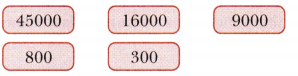
Using operations addition/subtraction on these numbers, we can get
23300 = 16000 + 16000 – 9000 + 300
Similarly, obtain the following numbers by using the numbers in the boxes.
(i) 60200
(ii) 2500
(iii) 7700
(iv) 64600
(v) 17300
Solution:
(i) 60200 = 45000 4 16000-800
(ii) 2500 = 9000 + 9000 – 16000 + 800 – 300
(iii) 7700 = 9000 – 800 – 800 + 300
(iv) 64600 = 45000 + 9000 + 9000 + 800 + 800
(v) 17300 = 16000 + 800 + 800 – 300
Number Play Class 6 Long Question Answer
Question 1.
Colour or mark the supercells in the given table:
| 6235 | 970 | 8145 | 4780 | 4708 | 7084 | 9000 | 160 |
Solution:
Clearly, 6235 is greater than the number 970 in the neighbouring cell.
Hence, the cell containing 6235 is the supercell.
970 is smaller than 6235 and 8145, so the cell containing 970 is not a supercell.
As 8145 is greater than the numbers 970 and 4780 in the neighbouring cells, the cell containing 8145 is a supercell.
As 4780 is smaller than 8145, the cell containing 4780 is not a supercell.
As 4708 is smaller than 4780 and 7084, the cell containing 4708 is not a supercell.
As 7084 is smaller than 9000, the cell containing 7084 is not a supercell.
As 9000 is greater than the numbers 7084 and 160 in the neighbouring cells, the cell containing 9000 is a supercell.
As 160 is smaller than 9000, the cell containing 160 is not a supercell.
| 6235 | 970 | 8145 | 4780 | 4708 | 7084 | 9000 | 160 |
Question 2.
Mark supercells in the following grid:
| 3462 | 2198 | 6757 | 5678 |
| 1001 | 5982 | 4723 | 2345 |
| 2723 | 5600 | 7210 | 2316 |
| 3298 | 1465 | 3467 | 4621 |
Solution:
The cell containing 3462 is a supercell as the numbers 2198 and 1001 in neighbouring cells are smaller than 3462.
The cell containing 6757 is a supercell as the numbers 2198, 4723 and 5678 in neighbouring cells are smaller than 6757.
The cell containing 5982 is a supercell as the numbers 2198, 4723, 5600 and 1001 in neighbouring cells are smaller than 5982.
The cell containing 7210 is a supercell as the numbers 4723, 2316, 3467 and 5600 in neighbouring cells are smaller than 7210.
The cell containing 3298 is a supercell as the numbers 2723 and 1465 in neighbouring cells are smaller than 3298.
The cell containing 4621 is a supercell as the numbers 2316 and 3467 in neighbouring cells are smaller than 4621.
| 3462 | 2198 | 6757 | 5678 |
| 1001 | 5982 | 4723 | 2345 |
| 2723 | 5600 | 7210 | 2316 |
| 3298 | 1465 | 3467 | 4621 |
Question 3.
Identify the numbers marked on the number lines below, and label the remaining positions.
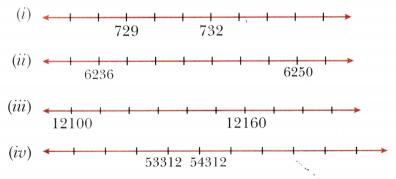
Put a circle around the smallest number and a box around the largest number in each of the sequences above.
Solution:
(i) There are 3 sub-divisions between 729 and 732.
Therefore, each sub-division represents \(\frac{732-729}{3}\) = \(\frac{3}{3}\) = 1 number.

(ii) There are 7 sub-divisions between 6236 and 6250.
Therefore, each sub-division represents \(\frac{6250-6250}{7}\) = \(\frac{14}{7}\) = 2 numbers.

(iii) There are 6 sub-divisions between 12100 and 12160.
Therefore, each sub-division represents \(\frac{12100-12160}{6}\) = \(\frac{60}{6}\) = 10 numbers.

(iv) There is 1 sub-division between 53312 and 54312.
Therefore, each sub-division represents \(\frac{53312-54312}{1}\) = 1000 numbers

Question 4.
Among the numbers 100 – 1000, how many times will the digit ‘3’ occur?
Solution:
There are 901 numbers from 100 to 1000.
When digit ‘3’ is at hundreds place:
Numbers with ‘3’ in the hundreds place look like: 300 – 399
So, total count of digit ‘3’ at hundreds place = 100
When digit ‘3’ is at tens place:
To count how often ‘3’ appears in the tens place, fix the hundreds and units digit, and loop through all possibilities:
There are:
- 9 choices for hundreds digit (1 to 9)
- 1 choice for tens digit (3)
- 10 choices for units digit (0 to 9)
So, total count of digit ‘3’ at tens place = 9 × 1 × 10 = 90
When digit ‘3’ is at units place:
To count how often ‘3’ appears in the units place, fix the hundreds and tens digit, and loop through all possibilities:
There are:
- 9 choices for hundreds digit (1 to 9)
- 10 choices for tens digit (0 to 9)
- 1 choice for units digit (3)
So, total count of digit ‘3’ at units place = 9 × 1 × 10 = 90
Total count of digit ‘3’ = 100 + 90 + 90 = 280
Thus, digit ‘3’ occurs 280 times.
Question 5.
How big a number can you form having the digit sum 16? Can you make an even bigger number?
Solution:
2-digit numbers having the digit sums 16 are: 79, 88 and 97.
3-digit numbers having the digit sums 16 are: 169, 178, 187, 196, 259, 268, 277, 286, 295, 349, 358, 367, 376, 385, 394, 439, 448, 457, 466, 475, 484, 493, 529, 538, 547, 556, 565, 574, 583, 592, 619, 628, 637, 646, 655, 664, 673, 682, 691, 709, 718, 727, 736, 745, 754, 763, 772, 781, 790, 808, 817, 826, 835, 844, 853, 862, 871, 880, 907, 916, 925, 934, 943, 952, 961 and 970.
To form a 4-digit number having the digit sum 16, put one 0 in any of the above 3-digit numbers anywhere after first digit from left or two 0 in any of the above 2-digit numbers anywhere after first digit from left.
Similarly, we can form w-digit numbers by putting an appropriate number of 0 in any of the above numbers.
Thus, there will be infinitely many numbers with digit sum 16.
Yes, we can make even much bigger numbers.
Question 6.
Solve the puzzle:
My father’s salary is a 6-digit palindrome.
It is an even number.
Its tens digit is double of units digit and hundreds digit is double of tens digit.
What is my father’s salary?
Solution:
Units digit of an even number is 0 or 2 or 4 or 6 or 8. Since it is a palindrome, 0 cannot be the units digit. It is given that tens digit is double of units digit. So, 6 and 8 cannot be the units digit as 6 × 2 = 12 and 8 × 2 = 16 but 12 and 16 are not digits. If 4 is the units digit, then 8 would be the tens digit. But it is given that hundreds digit is double of tens digit, then hundreds digit would be 16, which is not possible.
So, units digit must be 2 only. Then, tens digit would be 4 and hundreds digit would be 8.
| 2 | 4 | 8 | 8 | 4 | 2 |
Thus, the palindromic number is 248842.
Hence, father’s salary is 248842.
Question 7.
List all 3-digit palindromic numbers and highlight those whose digit sum is greater than 15.
Solution:
3-digit palindromic numbers are given in the below table:
| 101 | 111 | 121 | 131 | 141 | 151 | 161 | 171 | 181 | 191 |
| 202 | 212 | 222 | 232 | 242 | 252 | 262 | 272 | 282 | 292 |
| 303 | 313 | 323 | 333 | 343 | 353 | 363 | 373 | 383 | 393 |
| 404 | 414 | 424 | 434 | 444 | 454 | 464 | 474 | 484 | 494 |
| 505 | 515 | 525 | 535 | 545 | 555 | 565 | 575 | 585 | 595 |
| 606 | 616 | 626 | 636 | 646 | 656 | 666 | 676 | 686 | 696 |
| 707 | 717 | 727 | 737 | 747 | 757 | 767 | 777 | 787 | 797 |
| 808 | 818 | 828 | 838 | 848 | 858 | 868 | 878 | 888 | 898 |
| 909 | 919 | 929 | 939 | 949 | 959 | 969 | 979 | 989 | 999 |
Highlighted (bold) palindromes have their digit sum greater than 15.
Question 8.
Write a 5-digit number, a 4-digit number and a 3-digit number such that their sum is 24680.
Solution:
Let us take 20000 as a 5-digit number. Then,
20000 + Sum of a 4-digit number and a 3-digit number = 24680
⇒ Sum of a 4-digit number and a 3-digit number
= 24680 – 20000 = 4680
Let us take 4500 as a 4-digit number. Then,
4500 + a 3-digit number = 4680
⇒ 3-digit number = 4680 – 4500 = 180
Hence, 20000 is a 5-digit number, 4500 is a 4-digit number and 180 is a 3-digit number such that their sum is 24680.
There can also be other numbers like
19000 + 5100 + 580 = 24680,
17500 + 7000 4 180 = 24680 etc.
Think of another numbers by yourself.
Question 9.
State whether the following statements are True/ False.
(i) The sum of two 5-digit numbers is always a 5-digit number.
(ii) The sum of a 5-digit number and a 3-digit number is always a 5-digit number.
(iii) 4’be sum of a 5-digit number and a 3-digit number is always a 6-digit number.
(iv) The difference of two 4-digit numbers is always a 4-digit number.
(ii) The difference between a 5-digit number and a 3-digit number is always a 4-digit number.
Solution:
(i) False; 26000 + 42000 = 68000 → a 5-digit number
76000 + 84000 = 160000 + not → a 5-digit number
Thus, the sum of two 5-digit numbers may or may not be a 5-digit number.
(ii) False; 10000 + 100 = 10100 → a 5-digit number
99900 + 900 = 100800 → not a 5-digit number
Thus, the sum of a 5-digit number and a 3-digit number may or may not be a 5-digit number.
(iii) False; 10000 + 100 = 10100 → not a 6-digit number
99900 + 900 = 100800 → a 6-digit number
Thus, the sum of a 5-digit number and a 3-digit number may or may not be a 6-digit number.
(iv) False; 8040 – 6080 = 1960 → a 4-digit number
1980 – 1200 = 780 → not a 4-digit number
Thus, the difference of two 4-digit numbers may or may not be a 4-digit number.
(v) False; 10250 – 750 = 9500 → a 4-digit number
15500 – 900 = 14600 → not a 4-digit number
Thus, the difference between a 5-digit number and a 3-digit number may or may not be a 4-digit number.
Question 10.
Apply Kaprekar’s routine on a 3-digit number. What number will start repeating?
Solution:
Let the number be 729.
Round 1:
A = Largest number using digits of the number 729 = 972
B = Smallest number using digits of the number 729 = 279
C = A – B = 972 – 279 = 693
Round 2:
A = Largest number using digits of the number 693 = 963
B = Smallest number using digits of the number 693 = 369
C = A – B = 963 – 369 = 594
Round 3:
A = Largest number using digits of the number 594 = 954
B = Smallest number using digits of the number 594 = 459
C = A – B = 954 – 459 = 495
Round 4:
A = Largest number using digits of the number 495 = 954
B = Smallest number using digits of the number 495 = 459
C = A – B = 954 – 459 = 495
Clearly, 495 repeats after 3 iterations.
Question 11.
How many rounds does the number 7443 take to reach the Kaprekar constant.
Solution:
The number is 7443.
Round 1:
A = Largest number using digits of the number 7443 = 7443
B = Smallest number using digits of the number 7443 = 3447
C = A – B = 7443 – 3447 = 3996
Round 2:
A = Largest number using digits of the number 3996 = 9963
B = Smallest number using digits of the number 3996 = 3699
C = A – B = 9963 – 3699 = 6264
Round 3:
A = Largest number using digits of the number 6264 = 6642
B = Smallest number using digits of the number 6264 = 2466
C = A – B = 6642 – 2466 = 4176
Round 4:
A = Largest number using digits of the number 4176 = 7641
B = Smallest number using digits of the number 4176 = 1467
C = A – B = 7641 – 1467 = 6174, which is the Kaprekar constant
Thus, we reach at the Kaprekar constant in four rounds.
Question 12.
Make the Collatz sequence by starting with number 24.
Solution:
The rule followed by a Collatz sequence is: Start with any number; if the number is even, take half of it; if the number is odd, multiply it by 3 and add 1; repeat till 1 is obtained.
First term: 24
Second term: \(\frac{24}{2}\) = 12 [As 24 is an even number.]
Third term: \(\frac{12}{2}\) = 6 [As 12 is an even number.] 0
Fourth term: \(\frac{6}{2}\) = 3 [As 6 is an even number.]
Fifth term: 3 × 3 + 1 = 10 [As 3 is an odd number.]
Sixth term: \(\frac{10}{2}\) = 5 [As 10 is an even number.]
Seventh term: 3 × 5 + 1 = 16 [As 5 is an odd number.]
Eighth term: \(\frac{16}{2}\) = 8 [As 16 is an even number.]
Ninth term: \(\frac{8}{2}\) = 4 [As 8 is an even number.]
Tenth term: \(\frac{4}{2}\) = 2 [As 4 is an even number.]
Eleventh term: \(\frac{2}{2}\) = 1 [As 2 is an even number.]
Hence, the Collatz sequence starting with 24 is:
24, 12, 6, 3, 10, 5, 16, 8, 4, 2, 1
Question 13.
Make the Collatz sequence by starting with number 17.
Solution:
The rule followed by a Collatz sequence is: Start with any number; if the number is even, take half of it; if the number is odd, multiply it by 3 and add 1; repeat till I is obtained.
1st term : 17
2nd term : 3 × 17 + 1 = 52 [As 17 is an odd number]
3rd term : \(\frac{52}{2}\) = 26 [As 52 is an even number]
4th term : \(\frac{26}{2}\) = 13 [As 26 is an even number]
5th term : 3 × 13 + 1 = 40 [As 13 is an odd number]
6th term : \(\frac{40}{2}\) = 20 [As 40 is an even number]
7th term : \(\frac{20}{2}\) = 10 [As 20 is an even number]
8th term : \(\frac{10}{2}\) = 5 [As 10 is an even number]
9th term : 3 × 5 + 1 = 16 [As 5 is an odd number]
10th term : \(\frac{16}{2}\) = 8 [As 16 is an even number]
11th term : \(\frac{8}{2}\) = 4 [As 8 is an even number]
12th term : \(\frac{4}{2}\) = 2 [As 4 is an even number]
13th term : \(\frac{2}{2}\) = 1 [As 2 is an even number]
Hence, the Collatz sequency starting with 17 is: 17, 52, 26, 13, 40, 20, 10, 5, 16, 8, 4, 2, 1.
Question 14.
Find the Collatz sequence by starting with number 11.
Solution:
The rule followed by a Collatz sequence is: Start with any number; if the number is even, take half of it; if the number is odd, multiply it by 3 and add 1; repeat till 1 is obtained.
1st term : 11
2nd term : 3 × 11 + 1 = 34 [As 11 is an odd number]
3rd term : \(\frac{34}{2}\) = 17 [As 34 is an even number]
4th term : 3 × 17 + 1 = 52 [As 1 7 is an odd number]
5th term : \(\frac{52}{2}\) = 26 [As 52 is an even number]
6th term : \(\frac{26}{2}\) = 13 [As 26 is an even number]
7th term : 3 × 13 + 1 = 40 [As 13 is an odd number]
8th term : \(\frac{40}{2}\) = 20 [As 40 is an even number]
9th term : \(\frac{20}{2}\) = 10 [As 20 is an even number]
10th term : \(\frac{10}{2}\) = 5 [As 10 is an even number]
11th term : 3 × 5 + 1 = 16 [As 5 is an odd number]
12th term : \(\frac{16}{2}\) = 8 [As 16 is an even number]
13th term : \(\frac{8}{2}\) = 4 [As 8 is an even number]
14th term : \(\frac{4}{2}\) = 2 [As 4 is an even number]
15th term : \(\frac{2}{2}\) = 1 [As 2 is an even number]
Question 15.
Make a quick estimate. Take about 30 seconds. Then compare your answer with your friends.
(i) Number of tiles on your classroom floor:
(a) More than 200
(b) Less than 200
(Hint: Count how many tiles there are*in one row and one column.)
(ii) Time taken to write your full name:
(a) More than 10 seconds
(b) Less than 10 seconds
(iii) Estimate the number of books in your school library.
(a) More than 2000
(b) Less than 2000
(iv) Weight of a fully packed school bag:
(a) More than 4 kg
(b) Less than 4 kg
(v) Estimate the number of leaves on a big tree near your school.
(a) Around 1000
(b) Around 10,000
(c) More than 50,000
Solution:
(i) Estimate the number of tiles in one row and one column. Multiply the two to get the total. If it is 20 rows and 15 columns, then 20 × 15 = 300 tiles.
(ii) Say your name aloud and imagine writing each letter. Most students take 5-12 seconds depending on length.
(iii) Think of how many shelves there are and how many books per shelf. For example, 50 shelves × 50 books = 2500 books.
(iv) Lift your bag and guess based on how heavy it feels. Most packed school bags weigh around 3-5 kg.
(v) A large tree has thousands of branches and leaves. It’s very hard to count, but an estimate can be made.
Number Play Class 6 Case Based Questions
Question 1.
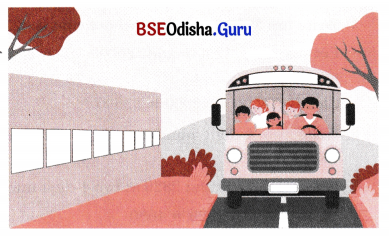
During a school trip, Class 6 students noticed a unique design featuring a 9-box row on a wall. Inspired, they decided to fill the boxes with numbers between 300 and 700, using each number only once.
They were excited to experiment with different number arrangements and see what interesting patterns might emerge.
Based on the above information, answer the following:
(ii) Fill the table such that we get maximum number of supercells.
(ii) How many supercells are there in the table.
Solution:
(i) If there are n cells in a row, then maximum number of supercells = \(\left\{\begin{array}{c}
\frac{n}{2}, \text { if } n \text { is even } \\
\frac{n+1}{2}, \text { if } n \text { is odd }
\end{array}\right.\)
Since total number of cells is 9, maximum 9 +1
number of supercell = \(\frac{9+1}{2}\) = 5
We know that two adjacent cells can never be supercells. So, the maximum number of supercells would be obtained when every alternate cell is a supercell.
In order to get the maximum number of supercells, always consider the 1st cell to be the supercell.
One such table with numbers between 300 and 700 is as follows:
| 699 | 301 | 698 | 302 | 697 | 303 | 696 | 304 | 695 |
(ii) Clearly, there are 5 supercells.
Question 2.
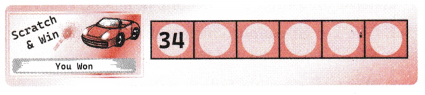
One day, Raghu bought a packet of pencils and found a lottery scratch coupon tucked inside. Curious, he scratched it off and revealed six two-digit numbers. The first number was 34, and to his surprise, the rest of the numbers followed the mysterious pattern of the Collatz sequence.
Based on the above information, answer the following questions:
(i) What number is written in second box?
(ii) What number is written in last box?
(iii) How many boxes are supercells?
Solution:
(i) As the numbers on the lottery ticket follow the Collatz sequence, and the first number is 34, which is even, the number in second box = \(\frac{34}{2}\) = 17
(ii) In the given Collatz sequence
First term = 34
Second term = \(\frac{34}{2}\) = 17 [As 34 is an even number]
Third term = 3 × 17 + 1 = 52 [As 17 is an odd number]
Fourth term = \(\frac{52}{2}\) = 26 [As 52 is an even number]
Fifth term = \(\frac{26}{2}\) = 13 [As 26 is an even number]
Sixth term = 3 × 13 + 1 = 40 [As 13 is an odd number]
Thus, the number in the last i.e. sixth box is 40.
The list of numbers obtained on the lottery ticket is given below.
(iii) The list of numbers obtained on the lottery ticket is given below.
| 34 | 17 | 52 | 26 | 13 | 40 |
Clearly, 3 boxes are supercells.