
Easy-to-read Ganita Prakash Class 7 Notes and Chapter 4 Expressions using Letter Numbers Class 7 Notes save valuable study time during exam season.
Class 7 Maths Chapter 4 Expressions using Letter Numbers Notes
Class 7 Expressions using Letter Numbers Notes
Letters such as x, y, t, p, etc. that are used to represent numbers are called letter-numbers or variables.
They help us write general rules, patterns and formulas using algebra. For example:
if n represents the number of cows, then the algebraic expression 4n gives the total number of legs, since each cow has 4 legs.
A combination of constants and variables connected by the signs of fundamental operations (addition, subtraction, multiplication or division) is called an algebraic expression.
For example, 2x + 3, 4p – 7q + 4, 10a ÷ b etc.
The terms of an algebraic expression are the individual parts of the expression that are separated by the ‘+ ’ sign.
For example, in expressions 2x + 3 and 4p – 7q + 4 – 4p + (- 7q) + 4 the terms are 2x, 3 and 4p, – 7q, 4 respectively.

In an algebraic expression,
If a number and a letter-number are written together, it means they are multiplied.
For example, 6m + 2 = 6 × m + 2,
The value of the expression 6m + 2, when m = 3, is 6 × 3 + 2 = 18 + 2 = 20.
If two letter-numbers are written together, it means they are multiplied.
For example, 5mn – 3 = 5 × m × n – 3.
Any term without a letter-number (variable) is known as constant term. For example:
- In the expression 7m + 4, 4 is a constant term.
- In the expression 7mn – 2, – 2 is a constant term.
Terms with the same letter-numbers are like terms, otherwise they are unlike terms.
To add or subtract algebraic expressions, we group the like terms together and then find their sum or difference.
We can use ‘Swapping’ (adding two terms in any order) and ‘Grouping’ (adding like terms by
grouping them conveniently) to add multiple algebraic expressions. For example:
2x + 3y + 6x – y + 4y – 3x = (2x + 6x – 3x) + (3y – y + 4y) = 5x + 6y
In an algebraic expression, when bracket is preceded by a sign and the bracket is removed, the sign of each term inside the bracket changes from (+) to (-) and (-) to (+).
For example, 3x – (5x – 7) = 3x – 5x + 7.
To subtract an expression from another, we change the sign (from ‘+ ’ to and from to ‘ + ’) of each term of the expression to be subtracted and then add the two expressions.
For example, (2x + 3) – (5 – 4x) = (2x + 3) + (-5 + 4x)
Distributive property: It states that multiple of a sum is the same as sum of multiples.
If any number/variable is outside the bracket, then that number/variable is multiplied with each term inside the bracket with same algebraic sign +/- between them. For example:

Algebra is not just about calculations. It helps us understand how numbers and operations are connected. Using algebra, we can solve problems more easily and understand real-life situations.
A number machine is a way of doing the same set of operations on different numbers.
numbers.
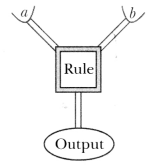
- We give the machine some input numbers (say a and b), and it follows a set of fixed steps or mathematical rules to produce an output.
- Even though the input numbers may change, the rule (or steps) always remain the same.
Diagonal Number Patterns in a Calendar: Imagine the calendar continues beyond 30, with numbers going on forever in rows.
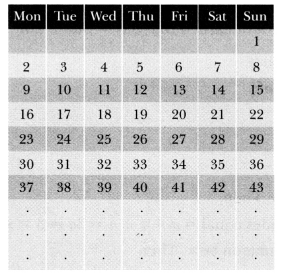
Now, take any 2 × 2 square in this extended calendar. Suppose the top-left number is x. Then,
- The number to the right of ‘x’ will be x + 1.
- The number below V will be x + 7.
- The number diagonal (bottom-right) to ‘x’ will be x + 8.
So, the other numbers in the 2 × 2 square can be represented as shown in the grid.
| x | x+1 |
| x+7 | x+8 |
Plus shape patterns in a calendar: Consider a plus shape grid from a calendar. Suppose the centre number is a. Then,
- The numbers on the left and right of ‘a’ are (a – 1) and (a + 1) respectively.
- The numbers above and below V are (a – 7) and (a + 7) respectively.
- So, the required numbers in the grid can be represented as follows:
| a-7 | ||
| a-1 | a | a+1 |
| a+7 |
Letter-Numbers
The letters which are used to represent numbers are called leucr:numbers or variables.
If a number and a letter-number are written together, it means they are multiplied.
For example, 5m + 3 = 5 × m + 3,
The value of the expression 5m + 3, when m = 2, is 5 × 2 + 3 = 10 + 3 = 13.
If two letter-numbers are written together, it means they are multiplied.
For example, 4mn – 1 = 4 × m × n – 1.
Algebraic Expressions
A combination of constants and variables connected by the signs of fundamental operations (addition, subtraction, multiplication or division) is called an algebraic expression.
For example, 2x + 1, 7p – 5q + 3, 9a ÷ b etc.
The terms of an algebraic expression are the individual parts of the expression that are separated by the ‘+’ sign.
For example, in expressions 2x + 1 and 7p – 5q + 3 = 7p + (-5q) + 3 the terms are 2x, 1 and 7p, -5q, 3 respectively.
Operations on Algebraic Expressions
Terms with the same letter-numbers are like terms, otherw ise they are unlike terms.
To add or subtract algebraic expressions, we group the like terms together and then find their sum or difference.
For example, (3x + 5y) + (7x – 2y)
= (3x + 7x) + (5y – 2y)
= 10x + 3y
When bracket is preceded by a sign and the bracket is removed, the sign of each term inside the bracket changes form ( + ) to (-) and (-) to (+).
For example, 4x – (6x – 8) = 4x – 6x + 8.
To subtract an expression from another, we change the sign (from ‘+ ’ to ‘-‘ and from to ‘+’) of each term of the expression to be subtracted and then add the two expressions.
For example, (2x + 1) – (7 – 4x)
= (2x + 1) + (- 7 + 4x)
Formulae Using Algebraic Expressions
| Shape | Figure | Formulae |
| Triangle | 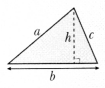 |
Perimeter = a + b + c Area = \(\frac{1}{2}\) × Base × Height = \(\frac{1}{2}\) × b × h |
| Rectangle | 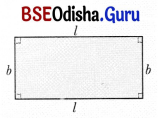 |
Perimeter = 2(l + b) Area = Length × Breadth = l × b |
| Square | 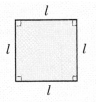 |
Perimeter = 4l Area = side × side = l × l = l2 |