
Easy-to-read Ganita Prakash Class 7 Notes and Chapter 2 Arithmetic Expressions Class 7 Notes save valuable study time during exam season.
Class 7 Maths Chapter 2 Arithmetic Expressions Notes
Class 7 Arithmetic Expressions Notes
Arithmetic Expression: An arithmetic expression is a combination of numbers and basic operations. For example,
6 + 4
15 – 7
3 × 8
24 ÷ 6
We use ‘equal to’ sign (‘ = ’) to show that the expression and its value are the same.

An arithmetic expression may have multiple operations.
For example, 8 + 36 = 12 – 7 × 4. Here, all four basic operations are used.
Two expressions may have the same value. If they have the same value, then they are considered equal to each other.
If two expressions or numbers are not equal, then one of them is greater or smaller than the other. .
- To show‘greater than’we use the symbol ‘>’
- To show‘less (smaller) than’we use the symbol ‘<’.
This type of representation is called an ‘inequality’.
To compare two expressions, we do not compare their length, number of operators or individual numbers in the expression. To compare the expressions, we must compare their values.

BODMAS is a rule that tells us about the correct order to solve different operations in an Arithmetic Expression. If we do not follow this order, we will get a wrong answer.
What does BODMAS stand for?
|
Letter |
Meaning |
Example |
| B | Brackets | (3 + 2) × 5 = 5 × 5 = 25 |
| O | Order (Powers: Squares, Cubes, etc.) | 32 + 2 = 3 × 3 + 2 = 9 + 2 = 11 |
| D | Division | 20 + 5 = 4 |
| M | Multiplication | 4 × 3 = 12 |
| A | Addition | 6 + 2 = 8 |
| S | Subtraction | 9 – 3 = 6 |
Remember, always solve expressions in this order:
Brackets → Order → Division → Multiplication → Addition → Subtraction
The most commonly used brackets are Round brackets or parentheses ()
Curly brackets or braces {}
Square brackets []
Bar or vinculum –
A bar is used to signify that certain terms should be considered together, similar to parentheses.
For example, 8 ÷ 2 + 2 = 8 ÷ 4 = 2
If there are multiple types of brackets in an expression, the order in which the brackets are solved is:
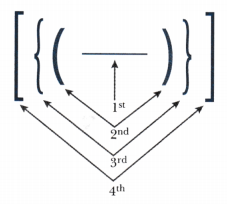
Quick Rules: Multiplication of Signs
(+) × (+) = (+)
(-) × (-) = (+)
(+) × (-) = (-)
(-) × (+) = (-)
Subtracting a number is the same as adding its additive inverse.
So, 25 – 13 is the same as 25 + -13
The commutative property of addition means that you can swap the terms when adding, and the
result will still be the same.
Term 1 + Term 2 + Term 3 + Term 1
Example: 5 + 7 = 7 + 5
According to the associative property of addition, the sum of three or more terms remains the same regardless of how the terms are grouped.

Example: (5 + 3) + 9 = 5 + (3 + 9)
If there is a plus sign before a bracket, remove the bracket without changing the signs of the terms inside it.
If there is a minus sign before a bracket, remove the bracket by changing the sign of each term inside the bracket.
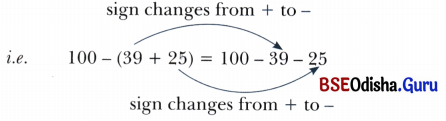
The distributive property of multiplication over addition states that ‘multiplying a number by a sum in brackets is the same as multiplying the number by each term inside the brackets and then adding the results’.
a × (b + c) = a × b + a × c
Distributive property of multiplication over subtraction: a × (b – c) = a × b – a × c
Arithmetic Expressions
An arithmetic expression is a combination of numbers and basic operations.
For example, 3 + 8, 5 × 13
An arithmetic expression may have multiple operations.
For example, 3 – 5 × 7 + 8
Terms are the parts of an expression separated by a ‘ + ’ sign.
For example, in 10 + 4, the terms are 10 and 4.
Comparison of Expressions
An inequality is a mathematical expression that compares two expressions using symbols > (greater than) or < (smaller than). For example, 5 > 3, 7 < 9 To compare two arithmetic expressions, we compare their values. For example, 5 × 3 = 15, 5 + 7 = 12 ⇒ 5 × 3 > 5 + 7
If a > b and c > d then a + c > b + d. For example, 7 > 2 and 8 > 6 then 7 + 8 > 2 + 6
If a > b and c > d then a – d > b – c. For example, 7 > 2 and 8 > 6 then 7 – 6 > 2 – 8
BODMAS
BODMAS is a rule that shows the correct order to solve operations in a mathematical expression.
Brackets → Order → Division → Multiplication → Addition → Subtraction
If there is a minus sign before a bracket, remove the bracket by changing the sien of each term inside the bracket.
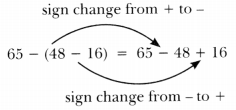
Multiplication of Signs:
(+) × (+) = (+)
(-) × (-) = (+)
(+) × (-) = (-)
(-) × (+) = (-)
Properties of Addition
- Commutative property of addition: a + b = b + a (Swapping the terms does not change the sum)
- Associative property of addition: a + (b + c) = (a + b) + c (Grouping numbers differently does not affect their sum)
- Distributive property of multiplication over addition: a × (b + c) = a × b + a × c
- Distributive property of multiplication over subtraction: a × (b – c) = a × b – a × c
Important Points
- When 0 is divided by any non-zero integer, the result is always 0.
- When the integer is divided by 0, the result is always undefined.
- Any integer when multiplied or divided by 1 gives itself and when multiplied or divided by – 1 gives its additive inverse.
- Sometimes we use expressions like ‘thrice of’, ‘one fourth of’. In these expressions, ‘of’ means ‘multiplication with’.
- For Example: \(\frac{1}{3}\) of 15 = \(\frac{1}{3}\) × 15.