
Go through BSE Odisha Class 7 Science Solutions and Class 7 Science Chapter 2 Exploring Substances: Acidic, Basic, and Neutral Question Answer to understand textbook questions more clearly.
Class 7 Science Curiosity Chapter 2 Question Answer
Science Curiosity Class 7 Chapter 2 Question Answer
Exploring Substances: Acidic, Basic, and Neutral Class 7 Questions and Answers
Let Us Enhance Our Learning
Question 1.
A solution turns the red litmus paper to blue. Excess addition of which of the following solution would reverse the change?
(a) Lime water
(b) Baking soda
(c) Vinegar
(d) Common salt solution
Answer:
(c) A basic solution turns red litmus paper blue. To reverse the change, an acidic solution must be added to it. Therefore, vinegar, being acidic, should be added to the given solution to reverse the change.

Question 2.
You are provided with three unknown solutions labelled A, B, and C, but you do not know which of these are acidic, basic, or neutral. Upon adding a few drops of red litmus solution to solution A, it turns blue. When a few drops of turmeric solution are added to solution B, it turns red. Finally, after adding a few drops of red rose extract to solution C, it turns green. Based on the observations, which of the following is the correct sequence for the nature of solutions A, B, and C?
(a) Acidic, acidic, and acidic
(b) Neutral, basic, and basic
(c) Basic, basic, and acidic
(d) Basic, basic, and basic
Answer:
(d) Solution A is basic, as it turns blue on adding red litmus solution.
Solution B is basic, as it turns red on adding the turmeric solution.
Solution C is basic, as it turns green on adding the red rose extract.
Question 3.
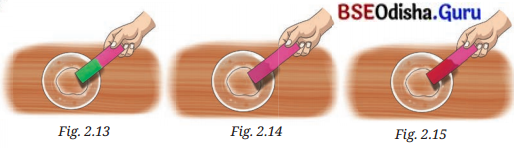
Observe and analyse figures A, B and C, in which red rose extract paper strips are used. Label the nature of solutions present in each of the containers.
Answer:
The red rose indicator turns to a shade of red in an acidic solution, green in a basic solution, and does not change its colour in a neutral solution.
In figure A, red rose extract paper turns green. Thus, the solution is basic in nature.
In figure B, there is no change in the colour of the red rose extract paper. Thus, the solution is neutral.
In figure C, the red rose extract paper turns to a shade of red. Thus, the solution is acidic in nature.
Question 4.
A liquid sample from the laboratory was tested using various indicators:

Based on the tests, identify the acidic or basic nature of the liquid and justify your answer.
Answer:
According to the data given in the question, the liquid sample is acidic in nature. This is because acids do not change the colour of red litmus or turmeric indicator.
Question 5.
Manya is blindfolded. She is given two unknown solutions to test and determine whether they are acidic or basic. Which indicator should Manya use to test the solutions and why?
Answer:
Since Manya is blindfolded, an indicator that can be identified by its smell rather than colour should be used. Therefore, an olfactory indicator such as onion extract should be used to test the given solutions. Manya should take two cloth strips with onion smell and add a few drops of one solution on one of the strips and a few drops of the other solution in the other strip. The solution that makes the onion smell vanish, is basic. On the other hand, if the smell remains, the corresponding solution is either acidic or neutral.
Question 6.
A secret message, written on a white sheet of paper, was made visible by spraying a liquid on it. Could you suggest various materials which can be used for writing the message on the white sheet of paper and what could be in the spray bottle? Make a table of various possible combinations and the colour of the writing obtained.
Answer:
Visual acid-base indicators show different colours in acidic and basic solutions. Thus, they can be filled in the spray bottle. Whereas colourless, mild acidic or basic solutions can be used for writing the message on the white sheet of paper. The possible combinations are listed below:
| Filled in the spray bottle | Used for writing the message | Colour of the writing obtained |
| Red rose extract | Lemon juice | Red |
| Red rose extract | Soap solution | Green |
| Turmeric solution | Lime water (A solution of calcium hydroxide) | Red |
| Blue litmus solution | Vinegar | Red |
| Red litmus solution | Baking soda solution | Blue |
Question 7.
Grape juice was mixed with red rose extract; the mixture got a tint of red colour. What will happen if baking soda is added to this mixture? Justify your answer.
Answer:
Red rose extract turns green in a basic solution. Thus, if baking soda is added to the mixture of red rose extract and grape juice, the resulting solution becomes basic and turns green.
Question 8.
Keerthi wrote a secret message to her grandmother on her birthday using orange juice. Can you assist her grandmother in revealing the message? Which indicator would you use to make it visible?
Answer:
Orange juice is acidic in nature. Thus, blue litmus solution can be used to spray on the secret message. The regions containing orange juice turn red, while the remaining paper stays blue.
Question 9.
How can natural indicators be prepared? Explain by giving an example.
Answer:
Natural indicators are obtained from natural sources such as fruits, vegetables, and flowers.
They are used to identify the acidic or basic nature of a substance. Turmeric is a natural indicator, and it can be prepared as follows:
Materials required: Turmeric powder (haldi), warm water, a small bowl, a spoon, and white tissue papers (to make strips).
Procedure:
Add 1 tablespoon of turmeric powder into a small bowl and pour 2-3 tablespoons of warm water into it.
- Mix with the help of a spoon to make a thick paste.
- Apply the turmeric paste on a white tissue paper and let it completely dry.
- Cut the tissue paper into thin strips to use as an indicator.
Question 10.
Three liquids are given to you. One is vinegar, another is a baking soda solution, and the third is a sugar solution. Can you identify them only using turmeric paper? Explain.
Answer:
Yes, they can be identified by only using turmeric paper. Take three strips of turmeric paper, and dip a paper strip in each of the solutions. The solution that changes the colour of the paper to reddish-brown is basic. Label this basic solution as the baking soda solution. Now, test the remaining solutions on the turned reddish-brown turmeric paper. If the reddish-brown colour disappears, the solution is acidic; label it as vinegar. If there is no change, the solution is neutral; label it as the sugar solution.
Question 11.
The extract of red rose turns the liquid X to green. What will the nature of liquid X be? What will happen when excess of amla juice is added to liquid X?
Answer:
Red rose extract turns green in a basic solution thus, the liquid X is basic in nature. When an excess of amla juice is added to the solution, it turns acidic, and the colour changes to a shade of red.
Question 12.
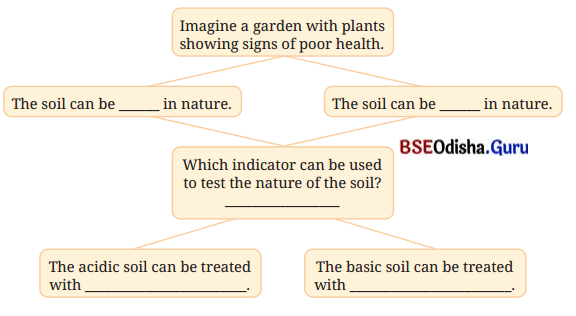
Observe and analyse the information given in the following flowchart. Complete the missing information.
Answer:
(i) acidic
(ii) basic
(iii) red or blue litmus paper (or any other acid-base indicator)
(iv) lime water
(v) organic matter
Class 7 Curiosity Chapter 2 Question Answer
InText Questions
Question 1.
What are red and blue litmus paper strips made of? Why do they change colour when drops of different samples are put on them? [Page 10]
Answer:
Red and blue litmus paper strips are made from a natural substance called litmus, which comes from lichens. When you put drops of different liquids on these papers, they change colour because litmus works as an acid-base indicator. If you have an acidic substance, it will turn the blue litmus paper red. On the other hand, if it’s basic, the red litmus paper will turn blue. Neutral substances do not change the colour of either of the litmus papers.
Question 2.
Find out and write the names of the most common acids present in the following substances: [Page 11]
(i) Lemon
(ii) Curd
(iii) Tamarind
(iv) Vinegar
Answer:
The common acids present in the following substances are as follows:
- Lemon- Citric acid
- Curd- Lactic acid
- Tamarind- Tartaric acid
- Vinegar- Acetic acid
Question 3.
If litmus is not available, are there some other natural substances that can serve as acid-base indicators? [Page 11]
Answer:
Yes, there are a few other natural substances that can serve as acid-base indicators. They are as follows:
- Red rose
- Turmeric
- Beetroot
- Purple cabbage
- Indian blackberry (amun)
- Red hibiscus (Gudhal flower)
Question 4.
What will you observe while rubbing the baking soda solution in between your fingers? [Page 11]
Answer:
The baking soda solution feels slippery when rubbed in between the fingers.
Question 5.
Can turmeric paper be used as an indicator for acidic substances? [Page 15]
Answer:
No, turmeric paper cannot be used as an indicator for acidic substances because it gives the same result (no change in colour) with acidic as well as neutral substances. Thus, turmeric paper cannot differentiate between them.
Question 6.
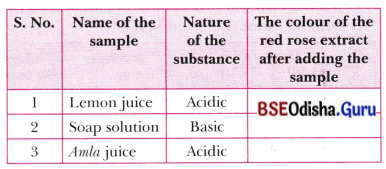
The following table lists a few substances along with their nature, that were added to a few drops of red rose extract indicator. Mention the colour change. [Page 13]
Answer:
| S. No. | Name of the sample | Nature of the substance | The colour of the red rose extract after adding the sample |
| 1. | Lemon juice | Acidic | Red |
| 2. | Soap solution | Basic | Green |
| 3. | Amla juice | Acidic | Red |
Question 7.
Are there any substances whose odours change on adding acidic or basic substances? [Page 16]
Answer:
Yes, there are some substances whose odour changes in acidic or basic medium. These substances are known as olfactory indicators.
Question 8.
What can be applied to the affected area of the skin bitten by an ant bite? Why? [Page 18]
Answer:
When an ant bites, it injects an acidic liquid (formic acid) into the skin. The effect of the acid can be neutralised by rubbing moist baking soda, which is a base.
Question 9.
If the soil is too acidic, the plants do not grow well. What can be added to such soil to improve the growth of the plants? [Page 18]
Answer:
If the soil is too acidic, it can be treated with a substance such as lime water, which is a base. This is because lime water, being a base, neutralises the acidity of the soil, thereby improving the growth of the plants.
Question 10.
What could be done to save the fish in the lake, if acidic factory waste is released into it? [Page 19]
Answer:
Acidic factory waste must be neutralised by adding basic substances such as lime water before releasing them into the lakes.