
Easy-to-read Ganita Prakash Class 7 Notes and Chapter 5 Parallel and Intersecting Lines Class 7 Notes save valuable study time during exam season.
Class 7 Maths Chapter 5 Parallel and Intersecting Lines Notes
Class 7 Parallel and Intersecting Lines Notes
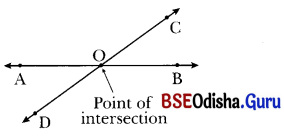
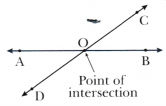
Two lines that cross each other at exactly one point are called intersecting lines. The point at which two lines meet, is called the point of intersection.
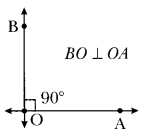
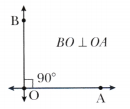
When two lines intersect and form an angle of 90°, they are called perpendicular lines.
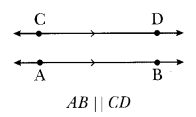
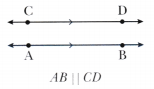
Two lines on the same plane that never meet, no matter how far they are extended at both ends are called parallel lines.
When two or more rays originate from a common initial point, they form different angles around that point. Such angles are collectively known as angles at a point.
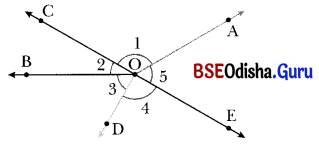

The sum of all angles around a point is always 360° as they form a complete angle.
Thus, ∠1 + ∠2 + ∠3 + ∠4 + ∠5 = 360°
- Two angles are said to be complementary if the sum of their measures is 90°.
- Two angles are called supplementary if the sum of their measures is 180°.
Two angles in a plane are said to be adjacent angles if:
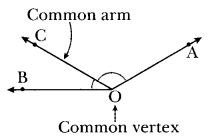
(i) they have a common vertex and a common arm.
(ii) their other arms lie on the opposite side of the common arm.
For example, ∠AOC and ∠BOC are adjacent angles.
A linear pair of angles is a pair of adjacent angles whose non-common arms form a straight line.
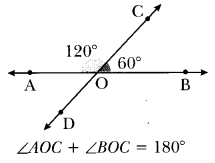
The sum of the angles in a linear pair is always 180°.
When two lines intersect, the angles opposite to each other are called vertically opposite angles. They are always equal.
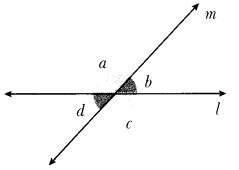
In the given figure, ∠a and ∠c, ∠b and ∠d are vertically opposite angles.
Thus, ∠a = ∠c and ∠b = ∠d.
Transversal is a line that intersects a set of two or more lines at distinct points.
Angles formed by a transversal (t) intersecting a pair of non-parallel lines (l and m):
Interior Angles
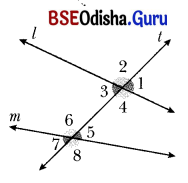
When a transversal intersects two lines, the angles that lie between the two lines are called interior angles.
In the given figure, ∠3, ∠4, ∠5 and ∠6 are interior angles.
The pair of interior angles on the same side of the transversal are called
co-interior (consecutive interior) angles.
- ∠4 and ∠5 are co-interior (consecutive interior) angles.
- ∠3 and ∠6 are co-interior (consecutive interior) angles
Exterior Angles
When a transversal intersects two lines, the angles that lie outside the two lines are called exterior angles.
In the given figure, ∠1, ∠2, ∠7 and ∠8 are exterior angles.
The pair of exterior angles on the same side of the transversal are called co-exterior (consecutive exterior) angles.
- ∠l and ∠8 are co-exterior (consecutive exterior) angles.
- ∠2 and ∠7 are co-exterior (consecutive exterior) angles
Corresponding Angles
The pair of angles on one side of the transversal, one of which is an exterior angle while the other is an interior angle, but together do not form a linear pair are known as corresponding angles.
In the figure, when a transversal t cuts across two lines l and m, it creates two sets of four angles — one set at the intersection with line l, and another at the intersection with line m.
In the figure, pairs of corresponding angles are: ∠1 and ∠5; ∠2 and ∠6; ∠3 and ∠7; ∠4 and ∠8.
Although ∠5 and ∠8 lie on the same side of transversal, and ∠5 is an interior angle while ∠8 is an exterior angle but they are not corresponding to each other as together they form linear pair.
Alternate Angles
When a transversal intersects two lines, the pair of angles that lie on opposite sides of the transversal are called alternate angles.
When a transversal cuts two lines,
- the angles that lie inside the two lines and on opposite sides of the transversal are called alternate interior angles.
- the angles that lie outside the two lines and on opposite sides of the transversal are called alternate exterior angles.
In the given figure, a transversal t cuts across two lines l and m,
- Alternate interior angle: ∠3 and ∠5; ∠4 and ∠6
- Alternate exterior angle: ∠1 and ∠7; ∠2 and ∠8
When a transversal (t) intersects a pair of lines (l and m) that are parallel to each other, then:
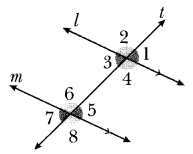
(i) the alternate angles are equal to each other, i.e. ∠3 = ∠5, ∠4 = ∠Z6, ∠1 = ∠7 and ∠2 = ∠8.
(iii) the sum of co-interior angles and co-exterior angles is 180°,
i. e. ∠4 + ∠5 = 180°; ∠3 + ∠6 = 180° and ∠1 + ∠8 = 180°; ∠2 + ∠7 = 180°.
Conversely, if any of the above three properties holds when two lines are intersected by a transversal, then the two lines must be parallel to each other.
Important Points to Remember
- A plane is a flat two-dimensional surface (e.g., paper, table top, blackboard).
- A line has no thickness and extends infinitely in both directions.
- Complement of angle x° is (90° – x°). Supplement of angle x° is (180° – x°).
- Complementary and supplementary angles may or may not share a common arm, i.e. they may or may not be adjacent angles.
Types of Lines
Intersecting Lines: Two lines that cross each other at exactly one point are called intersecting lines.
Perpendicular Lines: When two lines intersect and form an angle of 90°, they are called perpendicular lines.
Parallel Lines: Two lines on the same plane that never meet, no matter how far they are extended at both ends are called parallel lines.
Pair of Angles
|
Adjacent Angles |
Linear Pairs |
Vertically Opposite Angles |
| Two angles in a plane are said to be adjacent angles if:
(i) they have a common vertex and a common arm. (ii) their other arms lie on the opposite side of the common arm. |
A linear pair of angles is a pair of adjacent angles whose non-common arms form a straight line.
The sum of the angles in a linear pair is always 180°. |
When two lines intersect, the angles opposite to each other are called vertically opposite angles.
They are always equal. |
Note: (i) The sum of angles at a point is always 360°.
(ii) Two angles are said to be complementary if the sum of their measures is 90°.
(iii) Two angles are called supplementary if the sum of their measures is 180°.