
Easy-to-read Ganita Prakash Class 7 Notes and Chapter 6 Number Play Class 7 Notes save valuable study time during exam season.
Class 7 Maths Chapter 6 Number Play Notes
Class 7 Number Play Notes
A number that can be arranged in pairs without any leftovers is called an even number.
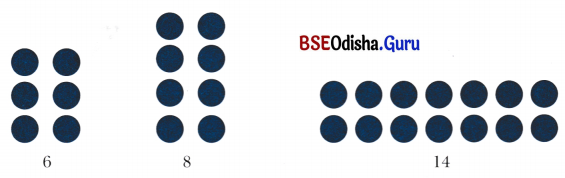
A number that cannot be arranged in pairs is called an odd number.
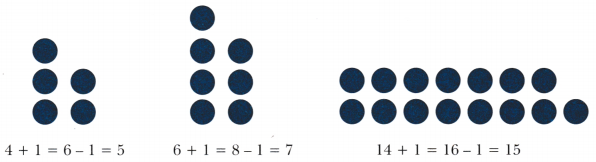
Parity denotes the property of a number being classified as even or odd.
For example, 9 has odd parity and 8 has even parity.
The parity of sum or difference of numbers is given as:
- Even + Even = Even; Even – Even = Even
- Odd + Odd = Even; Odd – Odd = Even
- Odd + Even = Odd; Odd – Even = Odd
The parity of product of two numbers is given as:
(i) Even × Even = Even
(ii) Odd × Odd = Odd
(iii) Odd × Even = Even

Parity of Expressions
- The parity of 2n is always even, where n = 0, 1, 2, 3, 4, 5,…
- The parity of 2n – 1 or 2n + 1 is always odd, where n = 1, 2, 3, 4, 5, …
- The parity of n2 is the same as n., where n = 0, 1, 2, 3, 4, 5, …
A magic square is a numerical arrangement in a square grid in which the sums of all rows, columns, and diagonals are equal, and this constant total is termed as the magic sum.
For a 3 × 3 magic square using digits 1-9:
Magic sum =15
Centre position → always 5
Corner positions → even numbers
Middle-edge positions → odd numbers
| 6 | 1 | 8 |
| 7 | 5 | 3 |
| 2 | 9 | 4 |
We can generate new magic squares from an existing one by applying simple arithmetic operations like addition, subtraction, or multiplication to each number in the square. These transformations will change the magic sum while preserving the magic square structure.
If each entry of a 3 × 3 magic square is increased by n, the magic sum becomes (15 + 3n); if each entry is decreased by n, the magic sum becomes (15 – 3n); and if each entry is multiplied by n, the magic sum becomes (15 × n).
The number pattern 1, 2, 3, 5, 8, 13, 21, 34… is known as the Virahanka-Fibonacci sequence. Each term in the sequence is obtained by adding the two previous terms.
- 1 + 2 = 3
- 2 + 3 = 5
- 3 + 5 = 8, and so on.
Applications of the Virahanka-Fibonacci Sequence
Poetry and Music: Used in syllable arrangements or rhythms.
Nature: The numbers of petals in daisy flowers follow this pattern.
Honeybees: The ancestry of honeybees also forms Fibonacci sequence.
Cryptarithms: Cryptarithms are mathematical puzzles where letters represent unique digits. The goal is to solve the arithmetic problem by finding the correct digit-letter combination.
In cryptarithms, letters takes values from the digits 0-9.
The important points to remember while solving cryptarithms problems are:
- Each letter stands for unique digit.
- Same letter always means the same digit.
- Different letters mean different digits.
For example:

Here, 2 + C = 6 ⇒ C = 4
Now, B + 6 = EC = E4 [Since C = 4]
⇒ B = 8 and E = 1
Parity
Parity denotes the property of a number being classified as even or odd. For example, 9 has odd parity and 8 has even parity.
Parity of Numbers
- Even + Even = Even
- Odd + Odd = Even
- Odd + Even = Odd
- Even × Even = Even
- Odd × Odd = Odd
- Odd × Even = Even
Parity of Expressions
- 2w → Always even, where n = 0, 1,2, 3, 4, 5. …
- 2n – 1 or 2n + 1 → Always odd, where n = 1, 2, 3, 4. 5. …
- The parity of n2 is the same as n, where n = 0, 1, 2, 3, 4, 5, …
Magic Square
A magic square is a numerical arrangement in a square grid in which the sums of all rows, columns, and diagonals are equal, and this constant total is termed as the magic sum.
For a 3 × 3 magic square using digits 1-9:
Magic sum = 15
Centre position→ always 5
Corner positions → even numbers
Middle-edge positions → odd numbers
| 6 | 1 | 8 |
| 7 | 5 | 3 |
| 2 | 9 | 4 |
If each entry of a 3 × 3 magic square is increased by n, magic sum becomes (15 + 3n).
If each entry of a 3 × 3 magic square is decreased bv n, magic sum becomes (15 – 3n).
If each entry of a 3 × 3 magic square is multiplied by n, magic sum becomes (15 × n).
Digits in Disguise (Cryptarithms/Alphametics)
In Cryptarithms, letters takes values from the digits 0-9.
The important points to remember while solving Cryptarithms are:
- Each letter stands for unique digit.
- Same letter always means the same digit.
- Different letters mean different digits.
For example:

Here, 2 + Q = 8 ⇒ Q = 6
Now, P + 7 = RQ = R6 [Since Q = 6]
⇒ P = 9 and R = 1
Virahanka-Fibonacci Sequence
The number pattern 1, 2, 3, 5, 8, 13, 2h, 34… is known as the Virahanka-Fibonacci sequence.
Each term in the sequence is obtained by adding the two previous terms.
- 1 + 2 = 3
- 2 + 3 = 5
- 3 + 5 = 8, and so on.