
Students can include Class 7 Curiosity Extra Questions and Class 7 Science Chapter 11 Light: Shadows and Reflections Extra Question Answer in their daily self-study routine.
Class 7 Science Chapter 11 Light: Shadows and Reflections Extra Questions
Class 7 Science Chapter 11 Extra Questions on Light: Shadows and Reflections
Light: Shadows and Reflections Class 7 Very Short Question Answer
Question 1.
Riya noticed that her book, table, and chair were clearly visible even though they were not emitting light. How is she able to see these objects?
Answer:
Riya is able to see the book, table and chair because light from a luminous source (such as a bulb) falls on them and is reflected to her eyes. These objects do not produce their own light; they are visible due to reflected light.
Question 2.
Why is our shadow shorter at noon compared to in the morning or evening?
Answer:
In the morning and evening, the Sun is near the horizon, so sunlight comes from a small angle from the horizon and makes our shadows long. At noon, the Sun is almost right above us, so sunlight comes straight down, and our shadows are very short.
Question 3.
What are luminous and non-luminous objects?
Answer:
Luminous objects are those that emit their own light (e.g., Sun, candle flame, electric bulb). Nonluminous objects do not emit light and are seen only when they reflect light from a luminous source (e.g., Moon, book, chair).

Question 4.
You are given a transparent glass sheet. Suggest any two ways to make it translucent without breaking it.
Answer:
Two ways to make a transparent glass sheet translucent (without breaking it):
- Rub its surface with sandpaper to make it rough.
- Apply a thin coating of oil/grease/wax/paint on the glass surface.
Question 5.
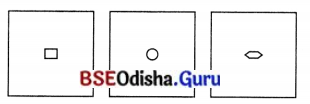
You have three opaque strips with very small holes of different shapes as shown in figure below. If you obtain an image of the sun on a wall through these holes, will the image formed by these holes be the same or different?
Answer:
When the image of the Sun is obtained on a wall through small holes of different shapes, the images formed will all appear the same, that is circular. The shape of the hole only changes brightness and sharpness, not the basic circular shape of the Sun’s image.
Question 6.
What are the three things required to form a shadow?
Answer:
Three things required to form a shadow are a source of light, an opaque object, and a screen/surface (wall, floor, paper etc.)
Question 7.
Which object produces a shadow of the same shape irrespective of its orientation with respect to the light source?
Answer:
A spherical object produces a circular shadow in every position because its outline remains the same in all orientations with respect to the light source and the screen.
Question 8.
Why does a rubber ball cast a shadow but a glass ball does not?
Answer:
A rubber ball is opaque, so it blocks light and forms a clear shadow. A glass ball is transparent, so it allows most light to pass through it and therefore does not form a distinct shadow.
Question 9.
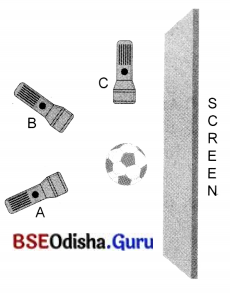
Three torches A, B and C shown in figure alongside are switched on one by one. The light from which of the torches will not form a shadow of the ball on the screen.
Answer:
A shadow is formed only when an object blocks the path of light falling on a screen. If the light from a torch does not directly fall on the screen, then no shadow can be produced. In this case, the light from torch C does not reach the screen, so it will not form any shadow of the ball on the screen.
Question 10.
Look at the figure given below.
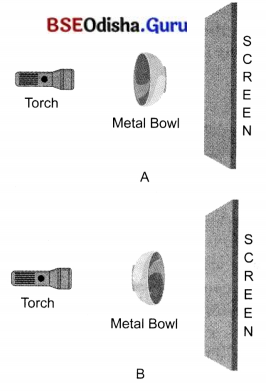
Will there be any difference in the shape of the shadow formed on the screen in A and B?
Answer:
No, the shape of the shadow formed in both the cases will be circular.
Question 11.
A small mirror can still show the complete image of a large tree. How is this possible?
Answer:
A plane mirror forms an image using the light reflected from the object. Even a small mirror can reflect light coming from different parts of a large tree into our eyes. Therefore, the whole tree can be seen in the mirror, though the image appears smaller because the tree is far away.
Question 12.
Write one difference and one similarity in the nature of the image formed by a plane mirror and a pinhole camera.
Answer:
Similarity: In both cases, the image formed is laterally inverted.
Difference: A plane mirror forms a vertically erect image, while a pinhole camera forms a vertically inverted image.
Light: Shadows and Reflections Class 7 Short Question Answer
Question 1.
A student covered a torch with red cellophane sheet to obtain red light. Using the red light she obtains a shadow of an opaque object. She repeats this activity with green and blue light. Will the colour of the light affect the shadow? Explain.
Answer:
The colour of light does not change the shadow. The shadow remains dark because it is the region where light is blocked by the opaque object. Only the colour of the illuminated area around the shadow changes according to the colour of the torch light (red/green/blue).
Question 2.
State any two observations that show light travels in a straight line.
Answer:
- A candle flame can be seen through a straight tube, but it cannot be seen through a bent tube.
- When light is passed through two or three pinholes, a bright spot is obtained on the screen only when the pinholes are exactly in one line; if any one pinhole is shifted, the spot disappears.
Question 3.
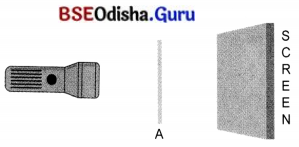
A sheet of plywood, a piece of muslin cloth and that of a transparent glass, all of the same size and shape, were placed at A one by one in the arrangement shown in the figure. Will a shadow be formed in each case? If yes, how will the shadow on the screen be different in each case? Give reasons for your answer.
Answer:
Yes, shadows will differ because the three materials are opaque, translucent and transparent. A sheet of plywood will form a dark, well-defined shadow on the screen because plywood is opaque and does not allow light to pass through it. A piece of muslin cloth will form a faint and less sharp shadow because muslin cloth is translucent. It allows some light to pass through, so the shadow is lighter and blurred. A transparent glass sheet will not form a distinct shadow (it may be very faint) because glass is transparent and allows most of the light to pass through it.
Question 4.
How can the same object form shadows of different sizes and shapes?
Answer:
The size of a shadow depends on the distance between the light source, the object and the screen. When the object is moved closer to the light source, the shadow becomes larger; when it is moved closer to the screen, the shadow becomes smaller and clearer. The shape of the shadow can change when the object is tilted or turned because the outline of the object facing the light changes.
Question 5.
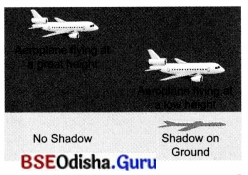
Observe the given illustration of two aeroplanes flying at different heights above the ground. Why is the shadow of the aeroplane visible on the ground when it is flying low, but hardly visible when it is flying very high in the sky? Explain scientifically.
Answer:
When an aeroplane is flying very high, it is far from the ground. Therefore, the shadow spreads over a large area and its edges become less sharp. As a result, the shadow becomes very faint and is hardly visible on the ground. When the aeroplane is flying low, it is closer to the ground. It blocks sunlight over a smaller area and forms a sharper, darker shadow. Hence, the shadow is clearly visible.
Question 6.
Answer the following questions.
(i) Does the image formed in a plane mirror change size when we move farther or closer to it?
Answer:
No. The image formed by a plane mirror remains the same size as the object.
(ii) Why cannot images formed by a plane mirror be obtained on a screen?
Answer:
A plane mirror forms a virtual image. Since the reflected rays do not actually meet, the image cannot be obtained on a screen.
(iii) If a person moves 1 m closer to a plane mirror, how much does the image move and in which direction?
Answer:
The image also moves 1 m closer to the mirror, i.e., it shifts by the same distance as the person moves.
Question 7.
Answer the following questions.
(i) What is a kaleidoscope? How does it work?
Answer:
A kaleidoscope is an optical instrument made using plane mirrors arranged inside a tube. Small coloured beads or pieces are kept at one end. Light entering the tube undergoes multiple reflections in the mirrors and forms repeated images of the coloured pieces, producing patterns seen through the viewing end.
(ii) Why does a kaleidoscope show a new pattern every time it is rotated?
Answer:
On rotating the kaleidoscope, the coloured pieces change their arrangement. This changes the pattern of multiple reflections, so a new pattern is seen each time.
Light: Shadows and Reflections Class 7 Long Question Answer
Question 1.
What is reflection of light? Describe an activity to show this effect.
Answer:
Reflection of light is the phenomenon in which light, after striking a smooth and polished surface, bounces back into the same medium.
Activity to show reflection of light: Take a plane mirror or a shiny steel plate and place it upright on a table. Allow light from a torch to fall on its surface. The light ray strikes the mirror and is reflected back from its surface, showing the reflection of light. This activity demonstrates that smooth and shiny surfaces reflect light.
Question 2.
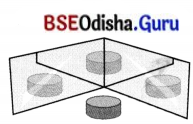
During a science activity, Riya placed two plane mirrors perpendicular to each other on a table. She kept a bottle cap between them and observed three images of the bottle cap.
(i) What will happen to the number of images if the mirrors in this activity are brought closer at a smaller angle?
(ii) What will happen if the mirrors are kept parallel to each other? Give one real-life example where this effect can be seen.
(iii) Name one device that works on the principle of multiple reflections.
(iv) Can these images be obtained on a screen?
Answer:
(i) When the mirrors are brought closer by making the angle between them smaller, the number of images increases. This is because light undergoes more reflections between the mirrors.
(ii) If the mirrors are kept parallel to each other, a very large number of images are formed due to repeated reflections of light. This effect can be seen in barber shops or dressing rooms where mirrors are placed opposite each other.
(iii) A kaleidoscope works on the principle of multiple reflections of light.
(iv) No, these images cannot be obtained on a screen because plane mirrors form virtual images.
Question 3.
A periscope and a kaleidoscope use mirrors in different ways. Explain the arrangement of mirrors in each and how this arrangement helps in their use.
Answer:
A periscope consists of two plane mirrors placed inside a tube in a particular arrangement. The mirrors are kept parallel to each other and are inclined at an angle (45°) so that light from an object enters the top opening, reflects from the first mirror, then from the second mirror, and finally reaches the observer’s eyes. This arrangement allows light to change direction twice, enabling a person to see objects that are not directly visible, such as objects behind a wall or above eye level.
A kaleidoscope uses plane mirrors (generally three) arranged in a pattern inside a tube, with coloured beads or pieces at one end. Light enters the tube and undergoes multiple reflections between the three mirrors. Because of these repeated reflections, many images of the coloured objects are formed, creating beautiful and symmetrical patterns. This arrangement is useful for producing decorative designs.
Question 4.
Riya, a curious class 7 student, chooses a reverse periscope as her science project for the school exhibition. She wants to show how light can be redirected so that a person looking from a low position can see above a raised platform.
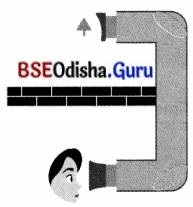
(i) How many times does light get reflected in this optical device?
Answer:
Light gets reflected two times in the reverse periscope, once from the top mirror and once from the bottom mirror.
(ii) What would happen if one of the mirrors inside the reverse periscope is tilted at the wrong angle?
Answer:
If a mirror is tilted wrongly, the light rays will not reach the eye properly. As a result, the image may look shifted, unclear, or may not be visible at all.
(iii) What is the principle behind the working of a reverse periscope?
Answer:
The principle behind the working of a reverse periscope is the reflection of light travelling in a straight line from plane mirrors.
When light from an object strikes the mirrors placed at 45° inside the reverse periscope, it gets reflected twice and changes direction. This allows a person to see over a raised platform without changing their position.
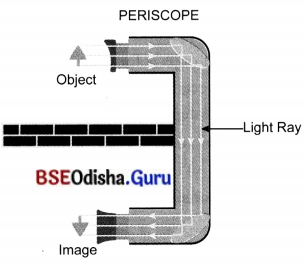
(iv) Is the image formed by the given reverse periscope laterally inverted? Explain with the help of a diagram.
Answer:
No, the image formed by a periscope is not laterally inverted. This is because the two successive reflections cancel each other’s lateral inversion.
Light: Shadows and Reflections Class 7 Picture Based Questions
Observe the given pictures and answer the questions that follow:
Question 1.
A wall clock is shown in the figure alongside.

(i) What will be the vertical mirror image time of the clock?
Answer:
In the figure, the clock shows 3:00. Its vertical mirror image time will be 9:00.
(ii) At what time will the clock and its mirror image be the same?
Answer:
The clock and its mirror image show the same time at 12:00 and 6:00.
(iii) Find the vertical mirror image times if the actual time in the above clock is 1:00, 2:00, 4:00, and 5:00. Observe the pattern and state the relation between clock and its mirror image time.
[Hint: Compare each time with its mirror image and notice what they add up to.]
Answer:
Vertical mirror image times:
1: 00 11: 00 2: 00
10: 00,100
Relation/pattern: Actual time + mirror image time =12: 00 (i.e., mirror time =12: 00- actual time).
OR
(iii) Find the time in vertical mirror image if the time in the clock is (a) 4: 45 (b) 10:10.
Answer:
Mirror time =11: 60- given time
(a) 11: 60-4: 45=7: 15
(b) 11: 60-10: 10=1: 50
Question 2.
Few words are given in the boxes as shown alongside:
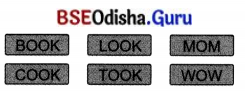
(i) Identify the words whose mirror image changes in a vertical plane mirror.
Answer:
BOOK, LOOK, COOK, TOOK
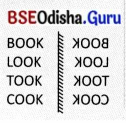
(ii) Identify the words whose mirror image changes in a horizontal plane mirror.
Answer:
MOM, LOOK, WOW, TOOK
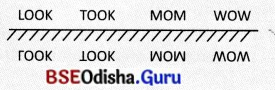
(iii) Write two properties of the image formed by a plane mirror.
Answer:
Two properties of the image formed by a plane mirror:
- The image is erect.
- The image is of the same size as the object.
OR
(iii) If the distance between a plane mirror and a person is 2 m, what will be the distance between the person and his image in the mirror?
Answer:
Distance between mirror and person =2m In a plane mirror, the image forms at the same distance behind the mirror.
So, image is 2 m behind the mirror.
Distance between person and image
= 2 m+2m=4m
Light: Shadows and Reflections Class 7 Activity Based Questions
Read the following activity and answer the questions that follow:
1. Objective: To demonstrate that light travels in a straight line and use this fact to explain why a pinhole camera forms an inverted image.
Materials required: Torch, two cardboard sheets, pin/needle, tape, a candle, a white sheet/wall as screen, 2 books/stands.
Procedure:
- Take two cardboard sheets and make a small hole at the centre of each using a pin. Name them Sheet A and Sheet B.
- In a dark room, fix Sheet A upright on a table using books so that it stands vertically. Place the torch behind Sheet A so that light passes through the hole.
- Keep Sheet B a little away from Sheet A. Adjust Sheet B until you can see a bright spot of light passing through both holes and falling on the wall/screen.
- Now shift Sheet B slightly sideways and observe what happens to the bright spot on the screen.
- Remove Sheet B and place a lighted candle (or any bright object) behind Sheet A. Observe the image formed on the screen through the pinhole. Note that the image appears inverted.
- Enlarge the pinhole slightly and observe the image again.
(i) When Sheet B is shifted slightly to one side, the bright spot on the screen disappears. Explain why this happens.
Answer:
The bright spot is seen only when both pinholes are in the same straight line. Light travels in a straight line, so when the second sheet is shifted, the holes are no longer aligned and light cannot pass through both pinholes to reach the screen. Hence, the bright spot disappears.
(ii) Describe the image formed on the wall/screen by the pinhole camera. Mention any two characteristics of the image.
Answer:
The image formed by a pinhole camera on the wall/screen is inverted (upside down). It is usually smaller than the object and it is also laterally inverted.
(iii) Predict what will happen if the pinhole is made larger. Mention the change in brightness and sharpness of the image.
Answer:
If the pinhole is made larger, more light enters, so the image becomes brighter. However, the image becomes less sharp (blurred) because rays from one point of the object spread over a larger area of the screen.
OR
(iii) Why is the image formed by the pinhole inverted?
Answer:
The image formed by a pinhole is inverted because light travels in straight lines. Rays of light from the top of the object pass through the small hole and reach the lower part of the screen, while rays from the bottom of the object reach the upper part of the screen. This crossing of light rays at the pinhole causes the image to appear upside down.
Light: Shadows and Reflections Extra Questions for Practice
Question 1.
A ball is placed between a torch and a wall. The torch and wall remain fixed. The ball is moved closer to the torch. What change will occur?
(a) The shadow becomes smaller and sharper
(b) The shadow becomes larger and blurred
(c) The shadow disappears completely
(d) The shadow shifts colour
Answer:
(b) When the ball is moved closer to the torch, it blocks a wider spread of rays, so the shadow on the wall becomes larger: The shadow also becomes blurred and the edges less sharp because the light spreads out more from the torch.
Question 2.
A shiny steel plate is placed between a torch and a wall. A dark patch is seen on the wall, and a bright spot appears elsewhere on the opposite wall. The best explanation is:
(a) The steel plate is translucent, so both shadow and light pass through.
(b) The steel plate blocks some light and emits its own light.
(c) The steel plate blocks and reflects the same light to another direction.
(d) Torchlight bends around the steel plate to form the bright spot.
Answer:
(c) The steel plate acts as an opaque object for the direct beam, so it creates a shadow (dark patch). At the same time, its shiny surface reflects part of the light, producing a bright spot on the opposite wall.
Question 3.
A student observes a beam of sunlight entering a dark room through a small hole. Which of the following statements are correct?
(i) Light travels in a straight line.
(ii) The beam spreads in all directions immediately upon entering the room.
(iii) A narrow beam is formed due to linear propagation of light.
(iv) This observation supports the idea of reflection.
(a) (i) and (iii) only
(b) (i), (ii) and (iii)
(c) (ii) and (iv) only
(d) (i), (iii) and (iv)
Answer:
(a) (i) and (iii) only
Question 4.
An object is placed in front of a screen with a light source behind it. Which of the following statements are correct?
(i) The object must block light to form a shadow.
(ii) Transparent objects form dark shadows.
(iii) Opaque objects form dark shadows.
(iv) Shadow size depends only on the position of the object and the light source.
(a) (i) and (iii) only
(b) (i), (iii) and (iv)
(c) (ii) and (iv) only
(d) (i), (ii) and (iv)
Answer:
(a) Shadow size depends on the position of the object, the light source and the screen.
Questions 5 and 6 consist of two statements – Assertion (A) and Reason (R). Answer these questions by selecting the correct option:
(a) Both A and R are true and R is the correct explanation of A.
(b) Both A and R are true but R is not the correct explanation of A.
(c) A is true but R is false.
(d) A is false but R is true.
Question 5.
Assertion (A): The image formed by a pinhole camera shows the colours of the object.
Reason (R): A pinhole camera forms an image due to reflection from a shiny surface inside the box.
Answer:
(c) A pinhole camera can show colours because light coming from the object carries colour information and forms the image on the sereen. But the image is not formed due to reflection inside the box: it is formed because light passes through a tiny hole and falls on an opposite screen.
Question 6.
Assertion (A): The left side of the object appears as the right side in the mirror image.
Reason (R): The image formed by a plane mirror is laterally inverted.
Answer:
(a) Both A and R are true and R is the correct explanation of A.
Question 7.
What is a luminous object? Give one example.
Answer:
A luminous object is an object that emits its own light. The Sun is an example of a luminous object.
Question 8.
State one observation that proves that light travels in a straight line.
Answer:
When light passes through two or more pinholes, a bright spot is seen on the screen only when the pinholes are in one straight line. This observation shows that light travels in a straight line.
Question 9.
Define reflection of light with one observation.
Answer:
Reflection of light is the change in direction of light when it falls on a shiny surface or a mirror. For example, when sunlight falls on a plane mirror or a polished steel plate, a bright spot is seen on a wall, showing that the light has been redirected.
Question 10.
In a torch-ball-screen setup, two different shadow sizes are obtained without changing the ball. How is this possible?
Answer:
The size of the shadow depends on both the size and position of the object relative to the light source and the screen. If the ball is moved closer to the torch, its shadow on the screen becomes larger. If the ball is moved closer to the screen (keeping the torch fixed), the shadow becomes smaller.
Question 11.
Meera stands in front of a plane mirror while getting ready for school. She moves a little closer to the mirror and then steps back. She also raises her right hand and notices the movement of the image.
(i) Why is Meera able to see her image in the plane mirror?
Answer:
Light from Meera’s body falls on the plane mirror and is reflected back into her eyes, allowing her to see her image.
(ii) What change does Meera observe in the image when she moves closer to or away from the mirror?
Answer:
The image also appears to move closer or farther by the same distance, because the image in a plane mirror is formed at the same distance behind the mirror as the object is in front.
(iii) Why does Meera see her raised right hand as the left hand in the mirror?
Answer:
A plane mirror causes lateral inversion, due to which the right side of the object appears as the left side in the image.
OR
(iii) Will the size of Meera’s image change if she moves nearer to the mirror? Give a reason.
Answer:
No, the size of the image remains the same because a plane mirror always forms an image equal in size to the object.
Question 12.
(i) Classify materials as transparent, translucent and opaque on the basis of transmission of light. Give an example of each.
Answer:
Materials are classified on the basis of how much light they allow to pass through them. Transparent materials allow light to pass almost completely, for example, clean water Translucent materials allow light to pass partially, for example, frosted glass. Opaque materials do not allow light to pass through at all, for example, cardboard.
(ii) Explain how these materials affect shadow formation.
Answer:
Opaque materials block light completely and form dark, clear shadows. Translucent materials block only part of the light, so they form lighter shadows. Transparent materials allow most of the light to pass. so they generally do not form a dark shadow, though some transparent objects may produce a faint shadow.