
Students can include Class 7 Curiosity Extra Questions and Class 7 Science Chapter 12 Earth, Moon, and the Sun Extra Question Answer in their daily self-study routine.
Class 7 Science Chapter 12 Earth, Moon, and the Sun Extra Questions
Class 7 Science Chapter 12 Extra Questions on Earth, Moon, and the Sun
Earth, Moon, and the Sun Class 7 Very Short Question Answer
Question 1.
(i) State the direction of the Earth’s rotation.
(ii) What is the time taken by the Earth to complete one rotation?
Answer:
(i) The Earth rotates from west to east.
(ii) The Earth requires approximately 24 hours to complete one full rotation on its axis.

Question 2.
Meera observed shadows of trees in her garden and found that the shadows were longest in the morning. What causes this change in shadow length?
Answer:
Shadows change length because the Earth rotates, causing the Sun’s position to shift during the day. In the morning, the Sun is low on the horizon, so shadows appear longer, while at noon, when the Sun is overhead, shadows become shorter.
Question 3.
Why do constellations appear to shift their position in the sky over different months?
Answer:
Constellations appear to shift their position in the sky over different months because of the Earth’s revolution around the Sun. As a result, different parts of the night sky are visible at different times of the year.
Question 4.
Why are seasons in the Northern Hemisphere opposite to those in the Southern Hemisphere?
Answer:
Seasons in the Northern Hemisphere are opposite to those in the Southern Hemisphere due to the tilt of the Earth’s axis. When the Northern Hemisphere tilts towards the Sun and experiences summer, the Southern Hemisphere tilts away and experiences winter, and vice versa.
Question 5.
(i) Arjun saw that sometimes the Moon completely blocks the Sun’s light during the day. Which phenomenon explains this?
(ii) Differentiate between a partial lunar eclipse and a total lunar eclipse.
Answer:
(i) When the Moon completely blocks the Sun’s light during the day, the phenomenon is called a solar eclipse.
(ii) When the Moon passes completely into the Earth’s shadow, it appears dark red in colour. This phenomenon is known as a total lunar eclipse.
When only a part of the Moon enters the Earth’s dark shadow, that portion appears dark or reddish, while the remaining part of the Moon, which is outside the shadow, remains bright and visible. This phenomenon is known as a partial lunar eclipse.
Question 6.
One night, a child notices that a group of stars seems to change position in one hour, but one particular star appears almost fixed in the sky. Explain why this happens.
Answer:
The apparent change in position of a group of stars within one hour is due to the rotation of the Earth. The star that appears almost fixed is the Pole Star, which lies nearly along the Earth’s axis of rotation above the North Pole, so its position appears almost unchanged while other stars seem to move around it.
Question 7.
Raghav travels from Mumbai to Kolkata and finds that the Sun seems to rise earlier in Kolkata on the same date. Explain.
Answer:
Kolkata lies to the east of Mumbai. Since the Earth rotates from west to east, places located further east receive sunlight earlier. Therefore, sunrise is observed earlier in Kolkata than in Mumbai on the same date.
Question 8.
Riya says, “If the Earth stopped rotating but kept revolving around the Sun, we would still have normal days and nights.” Is this statement correct? Give a reason.
Answer:
No, this statement is not correct. Normal day and night occur due to the Earth’s rotation on its axis. If the Earth stopped rotating, one side would face the Sun continuously for months (continuous day) while the other side would remain in darkness for months (continuous night), so normal days and nights would not occur.
Question 9.
On a particular day, a student in Delhi says, “Today is the longest day of the year for us,” while another student in Sydney says, “Today is our shortest day.” Explain why this happens.
Answer:
Delhi is in the Northern Hemisphere, while Sydney is in the Southern Hemisphere. When the Northern Hemisphere is tilted towards the Sun and experiences its longest day (around 21 June), the Southern Hemisphere is tilted away from the Sun and experiences its shortest day.
Question 10.
Christmas in Australia is celebrated in the summer season. Explain how this is possible.
Answer:
Australia lies in the Southern Hemisphere. Around 25 December, the Southern Hemisphere is tilted towards the Sun, experiencing summer. Therefore, Christmas in Australia is celebrated during the summer season.
Earth, Moon, and the Sun Class 7 Short Question Answer
Question 1.
Ravi fixed a camera at a particular spot and took pictures of the night sky at different times. He observed that the stars and constellations were not in the same place in all the pictures.
(i) In which direction do you think the stars have moved?
(ii) Are the stars and constellations really moving in the night sky?
(iii) If not, then why do they appear to change their position?
Answer:
(i) The stars appear to move from east to west.
(ii) No, the stars and constellations are not actually moving in the night sky.
(iii) They appear to change position because the Earth rotates on its axis, making the sky seem to move.
Question 2.
Consider a region on Earth where daytime lasts for many hours in summer but becomes very short in winter.
(i) What could be the reason for such extreme variation in day length?
(ii) How do the Earth’s axial tilt and its motion around the Sun influence seasons in such regions?
Answer:
(i) Such extreme variation in day length occurs in regions near the poles. It is caused by the tilt of the Earth’s axis.
(ii) The Earth’s axis is tilted, and it maintains this tilt while revolving around the Sun. Because of this, different regions of the Earth receive different intensities and durations of sunlight during the year. When a region is tilted towards the Sun, it receives more intense sunlight for a longer time, and when tilted away, it receives less intense sunlight for a shorter time. These differences in sunlight cause the change of seasons in different regions.
Question 3.
(i) Describe the causes of a solar eclipse.
(ii) Why is a solar eclipse visible only from a small part of the Earth?
Answer:
(i) A solar eclipse occurs when the Moon comes between the Earth and the Sun and blocks sunlight from reaching parts of the Earth, forming a shadow.
(ii) A solar eclipse is visible only from a small part of the Earth because the Moon’s shadow is narrow and covers only a limited region on the Earth’s surface.
Question 4.
A student lives near the Equator and records the length of day and night at different times of the year.
(i) What does the student observe about the duration of day and night in different months? Give a reason for your answer.
(ii) Does the apparent motion of the Sun mean that the Sun is actually moving around the Earth in one day? Explain briefly.
Answer:
(i) The student observes that the length of day and night remains nearly equal throughout the year. This happens because the Equator receives almost the same amount of sunlight in all seasons, and the illuminated half of the Earth always divides the Equator into nearly equal halves.
(ii) No, the apparent motion of the Sur across the sky does not mean that the Sun moves around the Earth. It only appears to move because the Earth rotates from west to east on its axis.
Question 5.
(i) Explain why the North Pole can have continuous daylight for about six months and continuous darkness for about six months.
(ii) Why are the seasonal changes not very prominent in places close to the Equator compared to places farther north or south?
Answer:
(i) The Earth’s axis is tilted, and the Earth maintains this tilt while revolving around the Sun. Because of this tilt, the North Pole remains tilted towards the Sun for about six months, during which the Sun does not set and there is continuous daylight. During the other six months, the North Pole is tilted away from the Sun, so sunlight does not reach it, resulting in continuous darkness.
(ii) Seasonal changes are not very prominent near the Equator because the intensity of sunlight and the length of day and night change very little during the year. The Sun remains almost overhead, resulting in nearly uniform heating throughout the year.
Question 6.
Arjun lives in Delhi (Northern Hemisphere), and his cousin Sara lives in Melbourne, Australia (Southern Hemisphere). They video call each other twice: once in June and once in December.
(i) In June, Arjun says it is very hot and the days are long, while Sara says it is cold and the days are shorter. Explain why they experience opposite seasons.
(ii) Which main features of the Earth together mainly cause the seasons?
Answer:
(i) In June, the Northern Hemisphere is tilted towards the Sun, so places like Delhi receive more intense sunlight for longer hours and experience summer. At the same time, the Southern Hemisphere is tilted away from the Sun, so places like Melbourne receive less sunlight and experience winter.
(ii) The seasons are mainly caused by the tilt of the Earth’s axis, its revolution around the Sun, and the spherical shape of the Earth.
Question 7.
During a total solar eclipse, some regions of the Earth still experience a partial solar eclipse. Explain why this happens.
Answer:
During a total solar eclipse, the Moon comes between the Sun and the Earth and casts its shadow on the Earth’s surface. The darkest part of the Moon’s shadow falls on a small region of the Earth. Observers present in this region are unable to see any part of the Sun and, therefore, experience a total solar eclipse. At the same time, in the surrounding regions of the Earth, the Moon blocks only a portion of the Sun. Hence, observers in these areas experience a partial solar eclipse.
Earth, Moon, and the Sun Class 7 Long Question Answer
Question 1.
(i) Mention the two main types of motion that the Earth shows and briefly describe each.
(ii)Explain how one of these motions is related to the change of day and night.
(iii) Explain how one of these motions, along with the tilt of the Earth’s axis, is related to the change of seasons.
(iv) Describe the changes that take place in the night sky over the course of a year.
Answer:
(i) Rotation: The spinning of the Earth about its own axis, an imaginary line passing through the North Pole and South Pole.
Revolution: The motion of the Earth around the Sun in a nearly circular orbit, taking about 365 days to complete one round.
(ii) The rotation of the Earth is related to the change of day and night. As the Earth rotates, the side facing the Sun experiences day, while the side turned away from the Sun experiences night.
(iii) Revolution, together with the tilted axis, causes seasons. When a hemisphere is tilted towards the Sun, it gets more direct sunlight and experiences summer; when it is tilted away, it gets less sunlight and experiences winter.
(iv) The night sky changes over the course of a year because, at a fixed time, different constellations are seen in different months. This happens because the Earth revolves around the Sun, and our viewing direction into space at night slowly changes. As the Earth moves along its orbit, we look out towards different parts of space at night, so some constellations move out of view and new constellations come into view at the same time of night in different seasons.
Question 2.
(i) What is meant by summer solstice and winter solstice in the Northern Hemisphere?
(ii) On which approximate dates do the longest day and the shortest day occur in the Northern Hemisphere?
(iii) Why are the summer and winter solstices experienced at different times in the Northern and Southern Hemispheres?
Answer:
(i) In the Northern Hemisphere, the summer solstice is the time of the year when the day is the longest and the night is the shortest. This happens when the Northern Hemisphere is tilted most towards the Sun. The winter solstice is the time when the day is the shortest and the night is the longest, when the Northern Hemisphere is tilted most away from the Sun.
(ii) In the Northern Hemisphere, the longest day of the year occurs around 21 June (summer solstice), and the shortest day occurs around 22 December (winter solstice).
(iii) The summer and winter solstices are opposite in the two hemispheres because when one hemisphere is tilted towards the Sun, the other is tilted away from it.
Question 3.
Draw a neat, labelled diagram of the Earth showing its tilted axis and the rays of sunlight falling on it during June. Use the diagram to explain the seasons in the Northern and Southern Hemispheres.
Answer:
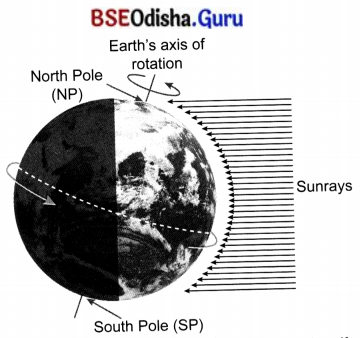
In June, the Northern Hemisphere is tilted towards the Sun.
- Sunlight is more intense: The incident rays of sunlight fall directly and are concentrated over a smaller area.
- Days are longer: The hemisphere receives sunlight for more than 12 hours, resulting in extended daylight duration.
The Southern Hemisphere, on the other hand, is tilted away from the Sun during June.
- Sunlight is less intense: The incident rays of sunlight fall at a slanting angle and are spread over a larger area.
- Days are shorter: The hemisphere receives sunlight for fewer than 12 hours, resulting in reduced daylight duration.
Together, the intense sunlight and the longer duration of daylight make the Northern Hemisphere experience summer and winter in the Southern Hemisphere.
Question 4.
(i) Draw a labelled diagram of a solar eclipse showing the arrangement of the Sun, Earth and the Moon.
(ii) Describe a total solar eclipse and a partial solar eclipse.
Answer:
(i)
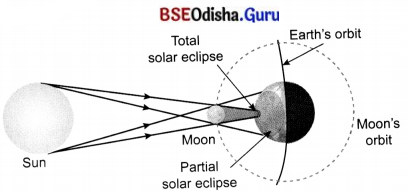
(ii) When the Moon comes between the Sun and the Earth in a way that obstructs the light from the Sun from reaching us. In places where the Moon completely covers the Sun, people see a total solar eclipse. For a few minutes, the day turns into darkness. In places where the Moon blocks only some part of the Sun, a partial solar eclipse is seen.
Earth, Moon, and the Sun Class 7 Case Based Questions
Read the following passages and answer the questions that follow:
Question 1.
Aryan lives in Kolkata, and his cousin Meher lives in Norway, close to the North Pole. In June, Aryan notices that in Kolkata, the Sun rises early and sets late, but there is still a clear night. Meher messages him that in her town, it is bright even at midnight for many days. In December, Aryan feels that days have become shorter and nights longer, but Meher experiences several days when the Sun does not rise at all. Later that year, Aryan’s class watches a solar eclipse using special filters, while a lunar eclipse is watched directly from the school playground.
(i) If Meher lived in Singapore, which is near the Equator, how would the length of day and night compare throughout the year?
Answer:
If Meher lived in Singapore near the Equator, the length of day and night would be almost equal (about 12 hours) for the whole year.
(ii) On some days of the year, Aryan notices that day and night in Kolkata are nearly equal in length. Such a day is called:
(a) Summer solstice
(b) Equinox
(c) Eclipse
(d) Winter solstice
Answer:
(b) Equinox
OR
(ii) Meher’s report of “bright even at midnight” in June and “no sunrise” for many days in December suggests that:
(a) Her town does not rotate with the rest of the Earth.
(b) Her region can remain facing the Sun or turned away from the Sun for long stretches in a year.
(c) The Sun moves closer to her town only in June.
(d) The Moon blocks the Sun every day in December.
Answer:
(b) As Meher’s town is close to the North Pole, which remains tilted towards the Sun during summer, causing sunlight to be received for a longer time during June. Whereas during winters, it remains tilted away from the Sun, causing longer nights.
(iii) Why does Aryan’s class use special filters for watching the solar eclipse, but not for the lunar eclipse?
Answer:
During a solar eclipse, the Sun’s light can still be strong enough to damage the eyes, so special filters or safe viewing methods are needed. In lunar eclipse, we only see the Sun’s reflected light coming from the Moon, which is not intense enough to harm the eyes, so it can be watched directly.
Question 2.
Ravi wakes up early in the morning and goes to the nearby valley to practice Yoga. His uncle has taught him different asanas and their benefits, including Surya Namaskar, which he does every day facing the east, so that the rays of the rising Sun fall on his face. Ravi’s uncle travelled to the United States to give a talk on Yoga and the Patañjali Yoga-sūtra. One day, Ravi called his uncle after coming home from school. To his surprise, while it was daytime in India, it was already night in the United States.
(i) To get the rays of the rising Sun, Ravi faces east while doing Surya Namaskar. What motion of the Earth makes the Sun appear to rise in the east?
Answer:
The rotation of the Earth from west to east makes the Sun appear to rise in the east.
(ii) If the Earth were to move in the opposite direction (east to west), how would the apparent motion of the Sun change?
Answer:
If the Earth rotated in the opposite direction (east to west), the Sun would appear to rise in the west and set in the east.
(iii) Why was it night in the United States while it was daytime in India?
Answer:
It was night in the U.S. while it was daytime in India because the Earth rotates on its axis, and different parts of the Earth face the Sun at different times. So when it is daytime in India, the United States is oriented away from the Sun and experiences night.
OR
(iii) If the Earth stopped rotating, what would happen to the cycle of day and night?
Answer:
If the Earth stopped rotating, one side would experience continuous day while the other side would have continuous night for months. There would be no 24 hours day-night cycle.
Earth, Moon, and the Sun Class 7 Picture Based Questions
Observe the given pictures and answer the questions that follow:
Question 1.
The following diagram shows the Earth at four positions in its orbit around the Sun.
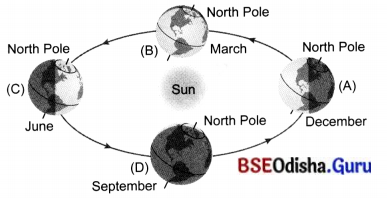
(i) At which labelled positions in the Northern Hemisphere are the days longer than the nights? Name the corresponding seasons in India.
Answer:
In the Northern Hemisphere, the days are longer than the nights at position C (June); at this time, India experiences summer.
OR
(i) At which labelled positions in the Northern Hemisphere are the nights longer than the days? Name the corresponding seasons in India.
Answer:
The nights are longer than the days at position A (December); at this time, India experiences winter.
(ii) Looking at the March and September positions, on about 21 March and 23 September, how long does daytime last, and what are these days called in the Northern Hemisphere?
Answer:
On or around 21 March and 23 September, daytime lasts for about 12 hours (and night also for about 12 hours) at most places on the Earth. In the Northern Hemisphere, these days are called the spring and the autumn equinox, respectively.
(iii) Using the diagram, explain clearly why the Northern and Southern Hemispheres experience opposite seasons at the same time of the year.
Answer:
The Earth’s axis remains tilted in the same direction as the Earth goes around the Sun. When the Northern Hemisphere is tilted towards the Sun, it gets more direct sunlight and longer days, so it experiences summer, while the Southern Hemisphere is tilted away and has winter.
Half a year later, the situation is reversed, the Northern Hemisphere is tilted away from the Sun and experiences winter, and the Southern Hemisphere is tilted towards the Sun and has summer. Therefore, the two hemispheres experience opposite seasons at the same time.
Question 2.
The two pictures (A) and (B) show the Earth’s axis tilted while sunlight falls on it. Four locations are marked as Positions 1, 2, 3 and 4. The bright part of each circle shows the region experiencing day, and the dark part shows night.
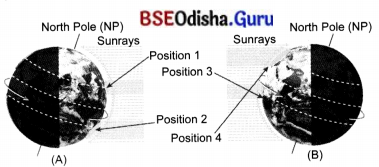
(i) In picture (A), compare Positions 1 and 2. Which position has a longer day and shorter night?
Answer:
In picture (A), Position 1 has a longer day and shorter night than Position 2.
OR
(i) In picture (B), compare Positions 3 and 4. Which position has a longer day and shorter night?
Answer:
In picture (B), Position 3 has a longer day than Position 4.
(ii) In picture (B), imagine a city at Position 3 and another city at the Equator. Whose length of daytime will change more from one season to another?
Answer:
The city at Position 3 will have a bigger change in the length of daytime from one season to another than the city on the Equator. This is because places farther from the Equator receive more varied sunlight during the year as the tilted Earth goes around the Sun, while the Equator receives almost the same amount of sunlight and nearly equal day and night in all seasons.
(iii) Which of the following conclusions can best be drawn by comparing the two pictures?
(a) Every place on the Earth has equal day and night in picture (A), but not in picture (B).
(b) Places farther from the Equator (like Positions 1 and 3) show a bigger change in the length of daytime between the two seasons than places on the Equator.
(c) Position 2 will always have a longer day than Position 3 in every season of the year.
(d) The tilt of the Earth’s axis does not affect the length of day and night; only the distance from the Sun matters.
Answer:
(b) Places farther from the Equator (like Positions 1 and 3) show a bigger change in the length of daytime between the two seasons than places on the Equator.
Earth, Moon, and the Sun Class 7 Activity Based Questions
Read the following activity and answer the questions that follow:
1. Objective: To model how the relative positions of the Sun, Earth and Moon cause solar and lunar eclipses.
Materials required: A bright torch or table lamp, one large ball, one smaller ball fixed on a pencil or stick, and a dark room.
Procedure:
- Step 1: Go to a dark room and place the torch or lamp on a table so that it shines steadily. This represents the Sun.
- Step 2: Ask one student to hold the large ball at some distance in front of the lamp. This ball represents the Earth.
- Step 3: Another student holds the small ball (Moon) on a stick between the lamp and the large ball, all in a straight line. Observe the shadow of the small ball falling on the large ball.
- Step 4: Now move the small ball so that the large ball comes between the lamp and the small ball. Observe the shadow of the large ball on the small ball.
- Step 5: Repeat Steps 3 and 4 slowly, watching carefully how the direction of light and the shadows change.
(i) Identify the type of eclipse being modelled in step 3 of the activity.
Answer:
In Step 3, the Moon is between the Sun and the Earth, so it models a solar eclipse.
OR
(i) Identify the type of eclipse being modelled in step 4 of the activity.
Answer:
In Step 4, the Earth is between the Sun and the Moon, so it models a lunar eclipse.
(ii) In the eclipse shown by Step 3, can people all over the Earth see the eclipse? Explain clearly who can see it and who cannot see it.
Answer:
No, people all over the Earth cannot see the eclipse shown in Step 3. In a solar eclipse, only those people who are in the small region of the Earth where the Moon’s shadow falls can see the Sun covered. People outside this narrow shadow region only see partial solar eclipse or do not see eclipse at all.
(iii) In the eclipse shown by Step 4, can people all over the Earth see the eclipse? Explain.
Answer:
No, only the people on the nighttime side of the Earth can see the eclipse shown in Step 4, provided the Moon is above their horizon, and the sky is clear.
Earth, Moon, and the Sun Extra Questions for Practice
Question 1.
Which pair correctly matches the event and the date in the Northern Hemisphere?
(a) Summer solstice: around 22 December
(b) Winter solstice: around 21 June
(c) Summer solstice: around 21 June
(d) Equinox: around 21 June
Answer:
(c) In the Northern Hemisphere, the longest day occurs around 21 June, known as the summer solstice.
Question 2.
In a long-exposure photo taken in the Northern Hemisphere, star trails form circles. The centre of these circles indicates:
(a) The direction of Earth’s revolution.
(b) The approximate position of the Pole Star.
(c) The position of the Sun at midnight.
(d) The path of the Moon around Earth.
Answer:
(b) In the Northern Hemisphere. Long-exposure photographs show stars forming circular trails because of the Earth’s rotation. The stars seem to move in circles around a nearly fixed point in the sky, which lies close to the Pole Star. Ilence, the centre of the circles shows the Pole Star’s approximate position.
Question 3.
Which of the following statements are correct about Earth’s daily motion?
(i) Earth completes one rotation in about 24 hours.
(ii) This motion causes regular changes between light and darkness.
(iii) All places on Earth experience daylight at the same time.
(iv) Observers on Earth feel as if the sky is moving around them.
(a) (ii) and (iv) only
(b) (i), (ii) and (iv)
(c) (i) and (iii) only
(d) (ii), (iii) and (iv)
Answer:
(b) (i), (ii) and (iv)
Question 4.
Which of the following statements are correct about the observation of stars in the night sky?
(i) Some stars appear to change their position over several hours.
(ii) All stars rise and set at exactly the same time every night.
(iii) The apparent movement of stars can be noticed by careful observation.
(iv) People at the same place see different stars at different times of the year.
(a) (i) and (iii) only
(b) (i), (iii) and (iv)
(c) (ii) and (iv) only
(d) (i), (ii), (iii) and (iv)
Answer:
(b) (i), (iii) and (iv)
Questions 5 and 6 consist of two statements – Assertion (A) and Reason (R). Answer these questions by selecting the correct option:
(a) Both A and R are true and R is the correct explanation of A.
(b) Both A and R are true but R is not the correct explanation of A.
(c) A is true but R is false.
(d) A is false but R is true.
Question 5.
Assertion (A): When the Northern Hemisphere has longer days, the Southern Hemisphere must also have longer days.
Reason (R): Earth’s axis is tilted, so one hemisphere gets a longer duration of daylight while the other gets a shorter duration of daylight.
Answer:
(d) The assertion is false because when the Northern Hemisphere has longer days, the Southern Hemisphere has shorter days.
Question 6.
Assertion (A): Objects in the night sky may appear to move even if they are actually stationary.
Reason (R): The observer on Earth is moving along with the Earth.
Answer:
(a) Both A and R are true and R is the correct explanation of A.
Question7.
What is meant by the apparent motion of stars?
Answer:
It is the movement of stars across the sky as seen from Earth. This movement is not real but appears due to the rotation of the Earth about its axis.
Question 8.
Why does the Sun appear to rise in the east and set in the west?
Answer:
It is because the Earth rotates from west to east about its axis. Due to this rotation, the Sun seems to move across the sky in the opposite direction.
Question 9.
Explain the following:
(i) The equatorial regions experience nearly equal lengths of day and night throughout the year.
(ii) The seasons in the Southern Hemisphere are opposite to those in the Northern Hemisphere.
Answer:
(i) The equatorial regions experience nearly equal lengths of day and night throughout the year because the effect of Earth’s tilt is minimal there, and the illuminated half of the Earth always divides the Equator into nearly equal halves. As a result, the duration of sunlight received there remains almost the same throughout the year.
(ii) The seasons in the Southern Hemisphere are opposite to those in the Northern Hemisphere because Earth’s axis is tilted. When the Northern Hemisphere is tilted towards the Sun and receives longer, more direct sunlight, it experiences summer, while the Southern Hemisphere is tilted away and experiences winter. Later, when the Southern Hemisphere is tilted towards the Sun, the seasons are reversed.
Question 10.
Explain the terms equinox and solstice with suitable examples from the Northern Hemisphere.
Answer:
An equinox is a day when day and night are nearly equal in length at most places on Earth because neither hemisphere is tilted towards or away from the Sun. In the Northern Hemisphere, equinoxes occur around 21 March and 23 September. A solstice is a day when the length of day is either the longest or the shortest in a year in a hemisphere. In the Northern Hemisphere, the summer solstice occurs around 21 June (longest day) and the winter solstice occurs around 22 December (shortest day).
Question 11.
A student observes the same playground at 8 AM, 12 noon, and 5 PM.
- At 8 AM, the shadow of a pole is long and points west.
- At noon, the shadow becomes very short.
- At 5 PM, the shadow becomes long again but points east.
Based on these observations:
(i) Identify the factor responsible for this change.
Answer:
The change in the length and direction of the shadow is due to the apparent movement of the Sun in the sky. which is caused by the rotation of the Earth on its axis.
(ii) Explain why the shadow direction changes during the day.
Answer:
As the Earth rotates from west to east, the Sun appears to move from east to west across the sky. Therefore, the direction of the sunlight. changes during the day, causing the shadow to change its direction.
(iii) Predict the shadow length at sunset.
Answer:
The shadow will be very long, stretching in the eastward direction.
OR
(iii) State one conclusion about the position of the Sun at noon based on the shadow observed.
Answer:
At noon, the Sun is nearly overhead, which causes the shadow of the object to be the shortest.
Question 12.
(i) Define rotation and revolution of the Earth.
Answer:
Rotation is the spinning of the Earth on its own axis. Revolution is the movement of the Earth around the Sun along its orbit.
(ii) State the time taken by the Earth to complete one rotation and one revolution.
Answer:
The Earth takes about 24 hours to complete one rotation. It takes about 365 days and 6 hours to complete one revolution.
(iii) Mention one major effect of rotation and one major effect of revolution on Earth.
Answer:
Rotation causes day and night on Earth. Revolution, along with Earth’s axial tilt, causes scasons.
(iv) Why does the Pole Star appear almost stationary in the sky while other stars seem to move?
Answer:
The Earth’s axis of rotation points very close to the Pole Star in the Northern IIemisphere. Therefore, the Pole Star appears nearly stationary in the sky when viewed from the Earth, while all other stars appear to move around it.