
For better exam readiness, students can include Class 7 Science MCQ and Curiosity Chapter 11 Light: Shadows and Reflections MCQ in their daily study routine.
Class 7 Science Chapter 11 Light: Shadows and Reflections MCQ
Light: Shadows and Reflections MCQ Class 7
MCQ On Light: Shadows and Reflections Class 7
Question 1.
We are able to see a book kept on a table because
(a) the book gives out its own light
(b) light from a source falls on the book and is reflected into our eyes
(c) all the light passes through the book
(d) the book absorbs all the light falling on it
Answer:
(b) light from a source falls on the book and is reflected into our eyes

Question 2.
Which of the following objects will form the darkest shadow when placed in the path of light?
(a) Tracing paper
(b) Clear glass
(c) Thick cardboard
(d) Frosted plastic sheet
Answer:
(b) Clear glass
Question 3.
Which of the following is/are not always necessary to observe a shadow?
(a) Sun
(b) Screen
(c) Source of light
(d) Opaque object
Answer:
(a) Sun
Question 4.
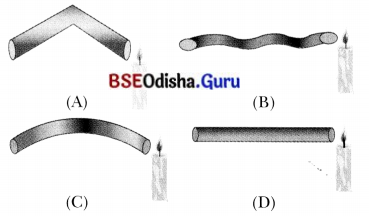
Four students A, B, C and D looked through pipes of different shapes to see a candle flame as shown in the figure below.
Who will be able to see the candle flame clearly?
(a) A
(b) B
(c) C
(d) D
Answer:
(d) Only D is a straight pipe, while others are bent; light cannot bend to follow the curve of a pipe.
Question 5.
Ravi does an experiment with torches, ball, and screen. He places the ball in between the torch and the screen so that a shadow can be formed on the screen. Identify the correct set of observations for the situations.
| Situations | Option A | Option B | Option C | Option D |
| Torch very close to the ball | Smaller shadow | Larger shadow | Smaller shadow | Smaller shadow |
| Torch far away from the ball | Larger shadow | Smaller shadow | Larger shadow | Smaller shadow |
| Two torches used, instead of one | One bright spot | Two shadows | Bright spot | No shadow |
| Screen between ball and torch | Dark shadow | Bright spot on the screen | Multiple shadows | No change |
(a) Option A
(b) Option B
(c) Option C
(d) Option D
Answer:
(b) Option B
Question 6.
A student claims that changing the colour of an opaque object will change the colour of its shadow. Which response best addresses this claim?
(a) The shadow takes the colour of the object
(b) The shadow becomes coloured only under sunlight
(c) Shadows of objects always appear black or grey
(d) Only transparent objects form shadows of different colours
Answer:
(c) A shadow is the region where light is blocked. Since an opaque object stops light, the shadow usually looks black or grey, not the colour of the object.
Question 7.
Which of the following can never form a circular shadow?
(a) A ball
(b) A flat disc
(c) A shoe box
(d) An ice cream cone
Answer:
(c) A shoe box has flat rectangular faces and straight edges, so its shadow can be rectangular or other straight-edged shapes, but not a circle. (A ball, flat disc, and cone can form circular shadows in suitable positions.)
Question 8.
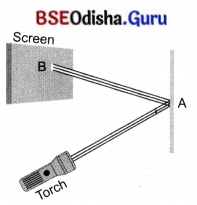
Observe the given figure carefully.
A patch of light is obtained at B, when the torch is lighted as shown. Which of the following is kept at position A to get this patch of light?
(a) A wooden board
(b) A glass sheet
(c) A mirror
(d) A sheet of white paper
Answer:
(c) A mirror
Question 9.
A student makes two setups using a torch and a ball to study (i) formation of shadows and (ii) reflection of light. The table alongside shows some…..
| A mirror |
| A glass sheet |
| A cardboard sheet |
| A tracing paper |
(a) Shadow: glass sheet, Reflection: mirror
(b) Shadow: cardboard sheet, Reflection: mirror
(c) Shadow: tracing paper, Reflection: glass sheet
(d) Shadow: cardboard sheet, Reflection: tracing paper
Answer:
(b) Shadow: cardboard sheet, Reflection: mirror
Question 10.
The word “Xamidea” written on a piece of paper is placed in front of a mirror. Which of the following options correctly represents the image formed by the plane mirror.

Answer:
(d)
Question 11.
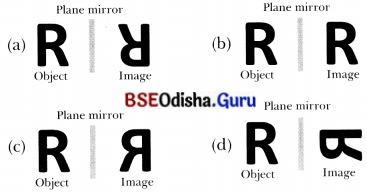
Which of the following represents the correct image formed by a plane mirror?
Answer:
(c)
Question 12.
Which letter’s image on a plane mirror will not appear laterally inverted?
(a) L
(b) P
(c) M
(d) B
Answer:
(c) M
Question 13.
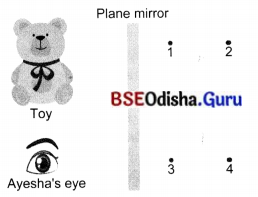
Ayesha places a toy in front of a plane mirror. She then looks at the mirror to see the image of the toy. Image of the toy will form at which point?
(a) Point 1
(b) Point 2
(c) Point 3
(d) Point 4
Answer:
(b) A plane mirror forms an image at the same distance behind the mirror as the object is in front of it.
Question 14.
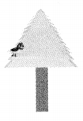
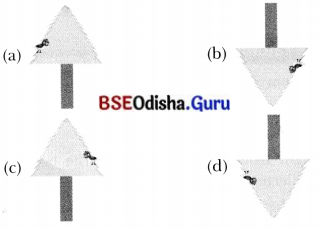
A student observes a tree given in the figure alongside through a pinhole camera. Which of the diagrams given in the options (a) to (d), depicts the image seen by her correctly?
Answer:
(b) The image formed by a pinhole camera is upside down and laterally inverted.
Question 15.
A pinhole camera produces an image that is
(a) erect and of the same size as the object.
(b) erect and enlarged.
(c) inverted and can be obtained on a screen.
(d) inverted but cannot be obtained on a screen.
Answer:
(c) inverted and can be obtained on a screen.
Question 16.
A student observes a tree through a pinhole camera. When she moves the camera closer to the tree (keeping the screen position inside the camera unchanged), she notices that the image on the screen becomes larger. What can be concluded?
(a) Farther the object, larger the erect image.
(b) Farther the object, smaller the erect image.
(c) Closer the object, larger the inverted image.
(d) Closer the object, smaller the inverted image.
Answer:
(c) In a pinhole camera, when the object comes closer, the rays entering the pinhole spread out more, forming a larger image on the screen. The image remains inverted.
Question 17.
If two of the mirrors inside a kaleidoscope are replaced with thick opaque sheets, what will you observe when you look through it?
(a) Colourful patterns will still be seen because light bends inside the kaleidoscope.
(b) The patterns will become clearer because an opaque sheet reflects more light.
(c) The colourful patterns will mostly disappear because the opaque sheets do not produce the repeated reflections needed to form patterns.
(d) The image will become inverted like the image in a pinhole camera.
Answer:
(c) A kaleidoscope forms patterns due to multiple reflections between mirrors. If two mirrors are replaced by opaque sheets, multiple reflections do not occur, so the repeating pattern effect is lost.
Question 18.
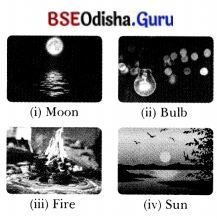
Which of the images shown alongside are luminous objects?
(a) (i) and (ii) only
(b) (i) and (iii) only
(c) (i), (ii) and (iv)
(d) (ii), (iii) and (iv)
Answer:
(d) (ii), (iii) and (iv)
Question 19.
Riya places a ball between a torch and a wall. She first moves the ball closer to the torch, and then closer to the wall. Which statement(s) are true about her observations?
(i) The shadow becomes larger when the ball is moved closer to the torch.
(ii) The shadow becomes smaller when the ball is moved closer to the wall.
(iii) The shape of the shadow changes when the ball is moved, but its size remains constant.
(iv) The sharpness of the shadow does not depend on the distance between the ball and the torch.
(a) (i) and (ii)
(b) (iii) only
(c) (ii) only
(d) (iii) and (iv)
Answer:
(a) The ball is round, so the shape of its shadow remains almost the same, but its size changes when the ball is moved. The sharpness of the shadow can change with position.
Question 20.
A triangular object is placed between a torch and a screen as shown in the figure.
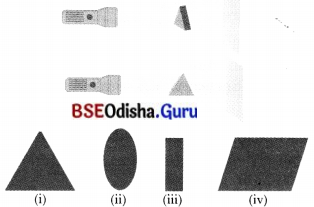
Among the given shapes ((i) to (iv)), identify the shadows that are formed by the object.
(a) (i) and (ii)
(b) (ii) and (iii)
(c) (i) and (iii)
(d) (i) and (iv)
Answer:
(c) (i) and (iii)
Question 21.
Which of the following statement(s) is/are correct?
(i) Image formed by a pinhole camera is inverted.
(ii) Image formed by a plane mirror is laterally inverted.
(iii) Pinhole cameras work on the principle of reflection of light.
(a) (ii) only
(b) (i) and (ii) only
(c) (i), (ii) and (iii)
(d) (ii) and (iii) only
Answer:
(b) Pinhole cameras work on the principle of linear propagation of light.
Light: Shadows and Reflections Class 7 Assertion and Reason Questions
The following questions consist of two statements – Assertion (A) and Reason (R). Answer these questions by selecting the correct option:
(a) Both A and R are true and R is the correct explanation of A.
(b) Both A and R are true but R is not the correct explanation of A.
(c) A is true but R is false.
(d) A is false but R is true.
1. (A): The Moon is a luminous object.
(R): The Moon reflects the sunlight that falls on its surface.
Answer:
(d) A luminous object gives out its own light. The Moon does not produce light. It looks bright only because it reflects sunlight.
2. (A): Light from a flame cannot be seen through a bent pipe, even if the flame is very bright.
(R): Light travels in a straight line.
Answer:
(a) Both A and R are true and R is the correct explanation of A.
3. (A): A shiny steel plate can redirect sunlight onto a wall where sunlight does not fall directly.
(R): A shiny surface changes the direction of light falling on it; this change in direction is called lateral inversion.
Answer:
(c) A shiny plate can send sunlight in another direction because light is reflected from its surface. But the change in direction of light is called reflection, not lateral inversion. Lateral inversion is about left-right reversal in a mirror image.
4. (A): A periscope helps a person to see an object not directly visible.
(R): A periscope uses three plane mirrors to reflect light into the eyes.
Answer:
(c) A simple periscope uses two plane mirrors (fixed at an angle), not three.
5. (A): The image formed in a pinhole camera is inverted.
(R): Light travels in a straight line and crosses at the pinhole, reversing the top and bottom positions of the image.
Answer:
(a) Both A and R are true and R is the correct explanation of A.
6. (A): A periscope will still work if its mirrors are replaced by cardboard sheets.
(R): A periscope works due to reflection of light by plane mirrors.
Answer:
(d) Cardboard is not a shiny reflecting surface like a mirror, so it will not reflect light properly into the eyes; the periscope will not work.
Light: Shadows and Reflections Class 7 Fill in the Blanks
Question 1.
Bioluminescent animals like fireflies (jugnu) and jellyfishes are ………… sources of light.
Answer: natural
Question 2.
Objects that allow some light to pass through but scatter it in different directions, resulting in a blurred or unclear view, are called ………… objects.
Answer: translucent
Question 3.
A cardboard sheet forms a dark shadow on the wall because it is a/an ………… material that blocks light.
Answer: opaque
Question 4.
If a screen is not placed behind an opaque object, the formation of the ………… cannot be observed because there is no surface on which it can be formed.
Answer: shadow
Question 5.
When an object is moved closer to the screen (torch fixed), the shadow generally becomes ……….. and more ………….
Answer: smaller, sharper
Question 6.
The size of the shadow depends on the ………… between the object, the light source and the screen.
Answer: distance
Question 7.
………… is an optical device commonly used in submarines and tanks.
Answer: periscope
Question 8.
………… work on the principle of reflection of reflections.
Answer: Kaleidoscope
Light: Shadows and Reflections Class 7 True or False
1. A fused bulb is a luminous object.
Answer: False: A fused bulb is a non-luminous object because it does not emit light.
2. Non-luminous objects become visible only when light from a luminous object falls on them and is reflected to our eyes.
Answer: True
3. A shadow is formed when a non-luminous object emits light.
Answer: False: A shadow is formed when an object blocks light from a source.
4. Shadows accurately reflect the shape of an object.
Answer: False: A shadow shows only the outline of an object, not its details.
5. An opaque object forms a lighter shadow than a translucent object.
Answer: False: An opaque object forms a darker shadow than a translucent object.
6. The colour of the shadow changes when the colour of the opaque object is changed.
Answer: False: The colour of a shadow does not change when the colour of the opaque object is changed.
7. The image formed by a plane mirror can be obtained on a screen.
Answer: False: The image formed by a plane mirror cannot be obtained on a screen.
8. The image formed by a pinhole camera does not depend on the shape of the hole.
Answer: True
Light: Shadows and Reflections Class 7 Match the Following
Question 1.
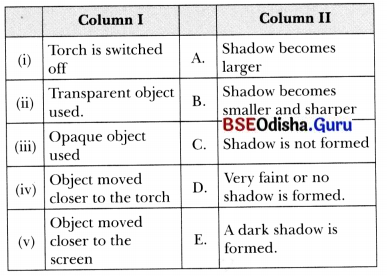
Answer:
| Column I | Column II | ||
| (i) | Torch is switched off | C. | Shadow is not formed |
| (ii) | Transparent object used | D. | Very faint or no shadow is formed. |
| (iii) | Opaque object used | E. | A dark shadow is formed. |
| (iv) | Object moved closer to the torch | A. | Shadow becomes larger |
| (v) | Object moved closer to the screen | B. | Shadow becomes smaller and sharper |
Question 2.
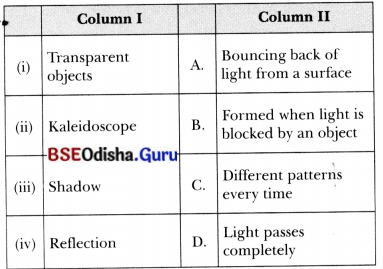
Answer:
| Column I | Column II | ||
| (i) | Transparent objects | D. | Light passes completely |
| (ii) | Kaleidoscope | C. | Different patterns every time |
| (iii) | Shadow | B. | Formed when light is blocked by an object |
| (iv) | Reflection | A. | Bouncing back of light from a surface |