
For effective revision, students can use BSE Odisha Class 6 English Solutions Chapter 9 Our Daily Spices Question Answer to practice textbook exercises.
Class 6 English Our Daily Spices Question Answer
Class 6 English Chapter 9 Question Answer Odia Medium
Let us discuss
Now say at least five names of the spices used for cooking in your home. Share your answers with your classmates and teacher.
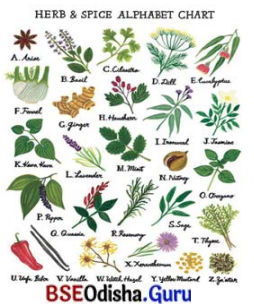
Answer:
- turmeric
- ginger
- black pepper
- cardamom
- coriander
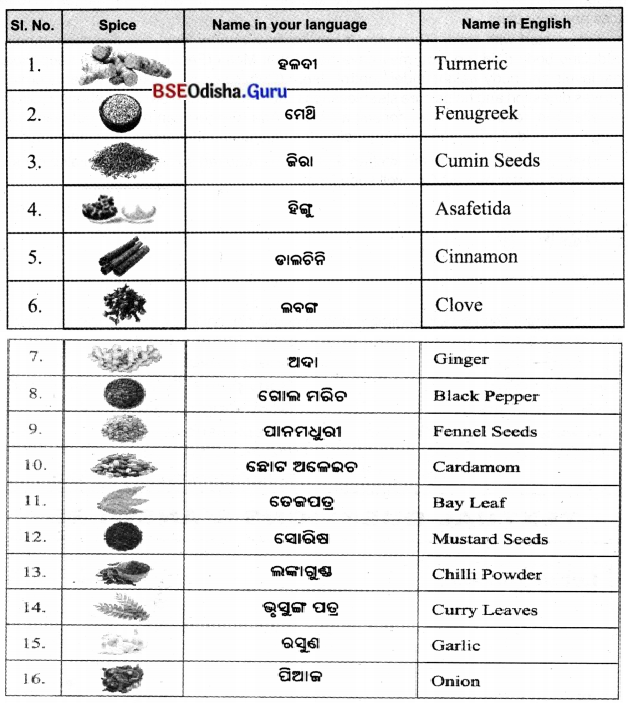
Given below are pictures of some spices. Their names in English are given in the column. Write their names in your home language.
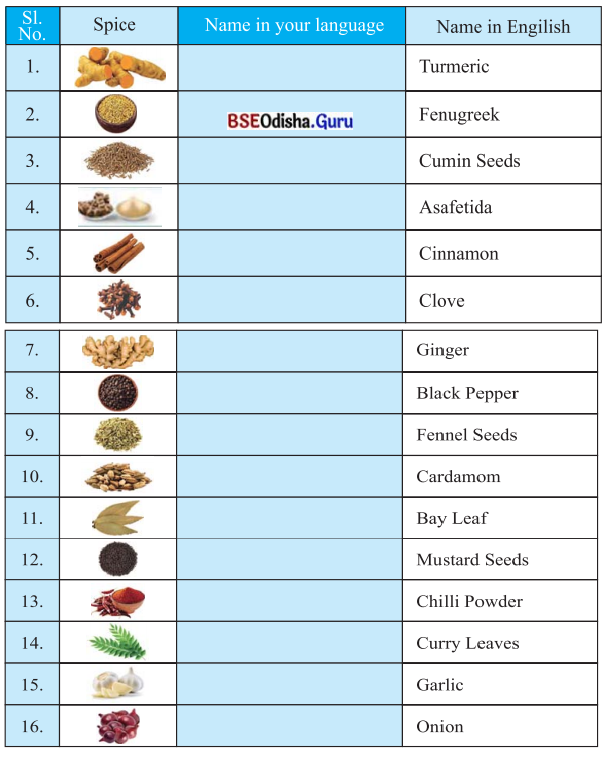
Answer:
Let us think and reflect
Read the given sentences and answer the following questions:
I came to know about your illness. Sudden rain in the winter caused you to suffer from a cough and cold. Because of illness you have become very weak. I told Jeje about you. He suggested using spices from the kitchen.
Question 1.
(a) What should Dugu use from the kitchen to cure his cough and cold?
Answer:
Dugu should use common kitchen spices like ginger, and cloves to cure his cough and cold.
(b) What spice should be used to maintain body weight and sugar level ?
Answer:
To maintain body weight and sugar levels, Dugu should use fenugreek seeds, also known as methi. These seeds should be soaked overnight in water. Drinking this water in the morning helps control sugar levels and weight effectively.

(c) In respiratory trouble what spice should we take ?
Answer:
In respiratory trouble, we should use ginger. Clove is also very helpful for our breathing.
(d) During indigestion one should take ………… and ………….
Answer:
ginger and turmeric.
Question 2.
Give an example of a weather-related illness.
Answer:
An example of a weather-related illness is the common cold or a cough. Sudden rain in winter can cause these illnesses. They often make a person feel very weak and tired.
Question 3.
Dugu soaked methi seeds overnight and drank the water in the morning to manage ……….. and ………….
Answer:
body weight and sugar level
Question 4.
Write the name of the spice which is useful for body pain.
Answer:
According to the chapter, the spice which is useful for body pain is turmeric (haldi). It is also very helpful for healing wounds.
Let us learn
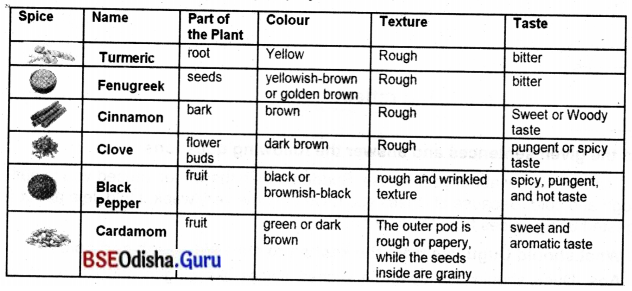
1. You have read the uses of spices in the letter. Complete the following table with the help of your teacher. You may use the words from the box given below.
Part of the plant: root/ bark/ leaves/ flower buds/ fruit/ seeds
Texture: rough/soft/silky
Taste : bitter / sweet / sour / salty / spicy
Question 2.
Read the sentences given below.
(i) You may share the usefulness of spices with your friends.
(ii) You should remember these cures.
(iii) Ginger can help us to control cough and cold.
(iv) You must consult an Ayurvedic doctor before you use them.
(v) I need to soak the methi seeds overnight.
(vi) Siddhi used to take Haldi (turmeric) to improve her energy level.
(a) Read the sentences above. Now, mark the words in bold letters. They are modal auxiliary verbs. Generally, they are not used alone in a sentence. They go with a full verb.
Examples:

The words given in Column ‘A’ are modals (modal auxiliaries). Match the modals in Column ‘A’ with their functions in Column ‘B’. The first one has been done for you.
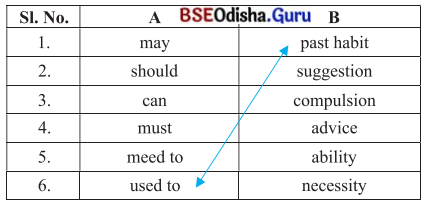
Answer:
| S.No | A | B |
| 1. | may | suggestion |
| 2. | should | advice |
| 3. | can | ability |
| 4. | must | compulsion |
| 5. | need to | necessity |
| 6. | used to | past habit |
Note: There are four-pair modals: will-would, shall-should, can-could, may-might, and five single ones: must, dare, need, ought to, used to
(i) should (used for giving advice)
(ii) must (used for compulsion/necessity to avoid illness)
(iii) can (used to show the ability/possibility of using cures)
(iv) ought to (used for a moral duty or strong recommendation)
(b) Complete the following dialogues with any four modals from the table above. (use a modal only once.)
Siya: Rishu had a fever last week. She (i) ………… take a rest.
Siddhi: Yes, she (ii) ………… or she will fall ill again.
Siya: She (iii) ………… take grandmother’s natural cures.
Siddhi: Yes, we (iv) ………… remember how effective they are.
Answer:
Siya: Rishu had fever last week. She (i) should take a rest.
Siddhi: Yes, she (ii) must or she will fall ill again.
Siya: She (iii) can take grandmother’s natural cures.
Siddhi: Yes, we (iv) ought to remember how effective they are.
Let us listen
You will listen to the benefits of Tulsi (Holy Basil), a common herb, on page 96. As you listen, complete the fact sheet given below. (See the textbook’s transcript page.)
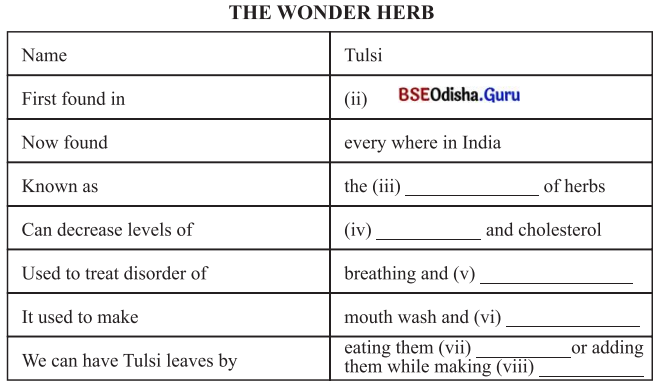
Answer:
| Name | Tulsi |
| First found in | (ii) North Central India |
| Now found | everywhere in India |
| Known as | the (iii) Queen of herbs |
| Can decrease levels of | (iv) glucose and cholesterol |
| Used to treat | breathing and (v) digestion disorders |
| It is used to make | mouth wash and (vi) toothpaste |
| We can have Tulsi leaves by | eating them (vii) raw or adding them while making (viii) tea |
Let us speak
Question 1.
Khusi told Dugu about many spices. Choose one spice and introduce yourself as that spice to the class.
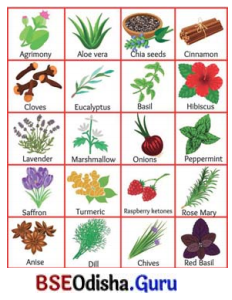
Answer:
Hello everyone! I am Manish, a student of class 6.
I am holding turmeric in my hand.
(Introducing yourself as that spice to the class)
I am turmeric, and I am a very special spice. I come from the root of the plant. You can easily recognize me by my bright yellow colour. My surface feels a bit rough to touch. When you taste me, I am slightly bitter. I am very helpful for your health. I help in healing wounds and I can also reduce body pain. I make your food healthy and colourful!
Question 2.
Before you speak, hold a spice in your hand
Answer:
Student’s activity
Question 3.
Mention the following while speaking.
a. Your name
b. part of the plant
c. colour
d. texture
e. taste
f. benefits
Let us write
Dugu read the letter of Khusi. After reading he kept the letter on the table. A glass of water spilt on it. Some words are washed away. Now, help Dugu complete the letter using the words given in the table.
| Some leaves of basil | For cough | Amount of honey |
| The mixture | For high fever | A piece of fresh ginger |
| You can have it | Grind to get | Home remedy |
Natural Cure for Cough
1. To prepare this home remedy, you just need ginger and honey.
First, take a piece of fresh ginger, grate it, and extract the juice from it. Take about two teaspoons of this juice and add about two and a half teaspoons of honey to it. Mix it properly. Warm the mixture slightly on very low heat for a minute. Then you can have it about three to four times a day to get relief from cough. Have patience to see the effect, as natural cures for coughs using ginger and honey might take some time to show results. To prepare the second home remedy for cough, take about 10 grams each of long pepper, dried ginger, and basil leaves. Add four to six small cardamoms and grind to get a fine powder. If you take this powder with an equal amount of honey, it will give you relief from a cough.
Question 2.
Write a short paragraph on ‘Tulsi’ based on the transcripts given at page no 96.
Answer:
Tulsi is a significant and sacred plant found in most Indian homes, known as the “Queen of Herbs.” The green tulsi leaf has a rough texture and a bitter, yet refreshing taste. It is valued for its medicinal properties, serving as a remedy for cough and cold, helping with fever when boiled in water, and boosting immunity.
Let us explore
Question 1.
Now that you have read about many spices, can you guess the spices based on the riddles given below ?
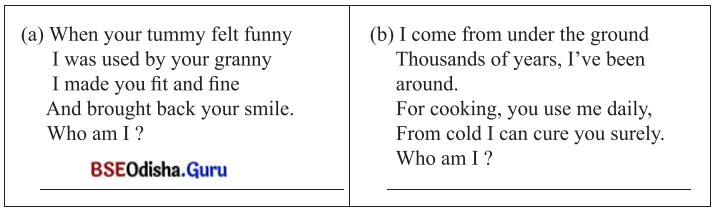
Answer:
(a) Asafoetida (also known as Heeng)
(b) the spice is Ginger
Question 2.
Fill in the blanks to complete the riddles below. Write another riddle of your own and ask your friends to guess the spice.
(a) “I am brownish in colour, and bitter to taste; I help everyone, to manage their weight.
Who am I?
Answer:
Fenugreek (methi)”
(b) “I am golden in hue, and earthy to smell; I heal your wounds, and keep you well.
Who am I?
Answer:
Turmeric (haldi)”
Question 3.
With the help of your teacher and friends, prepare a list of medicinal plants, herbs and spices.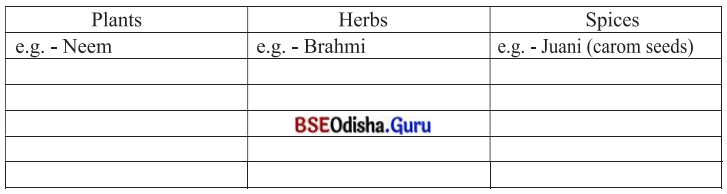
Answer:
| Plants | Herbs | Spices |
| e.g. – Neem | e.g. – Brahmi | e.g. – Juani (carom seeds) |
| Aloe Vera (Skin/Hair) | Tulsi (Cough/Cold) | Turmeric/Haldi (Pain/Healing) |
| Amla (Vitamin C/Hair) | Mint/Pudina (Cooling) | Cinnamon/Dalchini (Weight) |
| Bael (Stomach issues) | Ashwagandha (Energy) | Clove/Lavanga (Toothache) |
| Peepal (Respiration) | Giloy (Immunity) | Ginger/Ada (Cold/Cough) |
Question 4.
Close your eyes and learn about spices by smelling and feeling them. The teacher may also provide a few different spices to try.
Answer:
(Note: Student Activity)
Our Daily Spices Class 6 Summary
Let us read the letter which is written by Khusi to her brother Dugu.
Dear Dugu Bhai
Pranam!
I came to know about your illness. Sudden rain in the winter caused you to suffer from a cough and cold. Because of the illness, you have become very weak. I told Jeje about you. He suggested that you use spices from the kitchen. Here, I am writing the names of some spices and their uses.
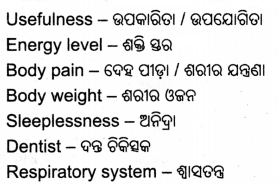
Let us start with Haldi (Turmeric). It can improve energy level and digestion. It helps in reducing body pain too. You may have heard that Methi (Fenugreek) helps keep blood sugar levels and body weight under control. Jeera (Cumin seeds) soaked in water overnight improves digestion and helps cure sleeplessness. Dalchini (Cinnamon) and Labanga (Clove) give relief from toothache till we consult a dentist. Ada (Ginger) can help us get relief from a cough and cold. Elaich (Cardamom) makes the digestive and respiratory systems active.
Bhai, now you can go to the kitchen and find the required spices. You can also consult an Ayurvedic doctor nearby. Get well soon Bhai.
Your loving sister,
Khusi
ପ୍ରିୟ ଦୁଗୁ ଭାଇ,
ପ୍ରଣାମ!
ତୁମର ଅସୁସ୍ଥତା ବିଷୟରେ ଜାଣିବାକୁ ପାଇଲି । ଶୀତଦିନେ ଅଚାନକ ବର୍ଷା ଯୋଗୁଁ ତୁମକୁ କାଶ ଏବଂ ଥଣ୍ଡା ହୋଇଯାଇଛି । ଅସୁସ୍ଥତା କାରଣରୁ ତୁମେ ବହୁତ ଦୁର୍ବଳ ମଧ୍ଯ ହୋଇପଡ଼ିଛ । ମୁଁ ଜେଜେଙ୍କୁ ତୁମ ବିଷୟରେ କହିଥିଲି । ସେ ରୋଷେଇ ଘରେ ଥିବା
ମସଲାଗୁଡ଼ିକୁ ବ୍ୟବହାର କରିବା ପାଇଁ ପରାମର୍ଶ ଦେଇଛନ୍ତି । ମୁଁ ଏଠାରେ ସେହି ମସଲାଗୁଡ଼ିକର ନାମ ଏବଂ ସେଗୁଡ଼ିକର ଉପକାରିତା ବିଷୟରେ ଲେଖୁଛି ।
ପ୍ରଥମେ ହଳଦୀ କଥା ବିଚାରକୁ ନେବା । ହଳଦୀ : ଏହା ଶରୀରର ଶକ୍ତି ବଢ଼ାଇବା ସହ ହଜମ ପ୍ରକ୍ରିୟାରେ ସାହାଯ୍ୟ କରେ । ଏହା ଶରୀରର ବିନ୍ଧାଛିଟା କମାଇବାରେ ମଧ୍ୟ ସହାୟକ ହୋଇଥାଏ । ମେଥ୍ : ତୁମେ ବୋଧହୁଏ ଶୁଣିଥିବ ଯେ ମେଥ୍ ଶରୀରର ଶର୍କରା ସ୍ତର ଏବଂ ଓଜନ ନିୟନ୍ତ୍ରଣ କରିବାରେ ସାହାଯ୍ୟ କରେ । ଜିରା : ରାତିସାରା ପାଣିରେ ଭିଜାଇ ରଖୁବା ଜିରା ହଜମ ଶକ୍ତି ବଢ଼ାଏ ଏବଂ ଅନିଦ୍ରା ସମସ୍ୟାରୁ ମୁକ୍ତି ଦିଏ । ଡାଲଚିନି ଏବଂ ଲବଙ୍ଗ : ଦନ୍ତ ଚିକିତ୍ସକଙ୍କ ପାଖକୁ ଯିବା ପୂର୍ବରୁ, ଏହା ଦାନ୍ତ ବିନ୍ଧାରୁ ଆଶ୍ବସ୍ତି ଦେଇଥାଏ । ଅଦା : ଏହା କାଶ ଏବଂ ଥଣ୍ଡାରୁ ମୁକ୍ତି ପାଇବାରେ ସାହାଯ୍ୟ କରିଥାଏ । ଗୁଜୁରାତି : ଏହା ଆମର ହଜମ ପ୍ରକ୍ରିୟା ଏବଂ ଶ୍ଵାସକ୍ରିୟା ପ୍ରଣାଳୀକୁ ସକ୍ରିୟ ରଖେ । ଭାଇ, ଏବେ ତୁମେ ରୋଷେଇ ଘରକୁ ଯାଇ ଆବଶ୍ୟକ ମସଲାଗୁଡ଼ିକୁ ଖୋଜି ବ୍ୟବହାର କରିପାରିବ । ଏହା ସହିତ ତୁମେ ପାଖରେ ଥିବା କୌଣସି ଆୟୁର୍ବେଦିକ ଡାକ୍ତରଙ୍କ ପରାମର୍ଶ ମଧ୍ୟ ନେଇପାରିବ । ଶୀଘ୍ର
ଭଲ ହୋଇଯାଅ ଭାଇ ।
ତୁମର
ପ୍ରିୟ ଭଉଣୀ,
ଖୁସି
Spices are kind ………… worldwide reputation.
ମସଲାଗୁଡ଼ିକ ହେଉଛି ଏକ ପ୍ରକାରର ମଞ୍ଜି, କାଣ୍ଡ, ଚେର, ବକଳ (ଛାଲି), ପତ୍ର ଏବଂ ଫୁଲ ଯାହା ଆମ ଖାଦ୍ୟକୁ ରଙ୍ଗୀନ, ସୁଗନ୍ଧିତ ଏବଂ ସ୍ବାଦିଷ୍ଟ କରିବା ପାଇଁ ଆବଶ୍ୟକ ହୋଇଥାଏ । ଆମ ଦେଶରେ ମସଲାଗୁଡ଼ିକ ସେମାନଙ୍କର ଔଷଧୀୟ ଗୁଣ ପାଇଁ ମଧ୍ଯ ଜଣାଶୁଣା । ଏହି ମସଲାଗୁଡ଼ିକ ଶତାବ୍ଦୀ ଶତାବ୍ଦୀ ଧରି ଆୟୁର୍ବେଦିକ ଚିକିତ୍ସା ପଦ୍ଧତିରେ ବ୍ୟବହୃତ ହୋଇଆସୁଛି । ଓଡ଼ିଶାର କୋରାପୁଟ, କନ୍ଧମାଳ, ରାୟଗଡ଼ା ଏବଂ ଗଜପତି ଜିଲ୍ଲାରେ ହଳଦୀ, ଅଦା, ଲଙ୍କା, ଧନିଆ, ପିଆଜ, ଗୋଲମରିଚ, ଅଳେଇଚ ଏବଂ ରସୁଣ ବହୁଳ ଭାବରେ ଚାଷ କରାଯାଏ । କନ୍ଧମାଳର ଉଚ୍ଚମାନର ହଳଦୀ ବିଶ୍ବବ୍ୟାପୀ ସୁନାମ ଅର୍ଜନ କରିଛି ।
Our Daily Spices Class 6 Summary in English
This chapter explains how spices are more than just food ingredients. Spices come from different parts of plants like seeds, roots, bark, and flowers. We use them to make our food look colourful and taste delicious. In India, spices are very important because they have medicinal properties. People have used them in Ayurveda for hundreds of years to stay healthy.
In Odisha, many farmers grow spices like turmeric, ginger, garlic, and pepper. These are mostly grown in districts like Koraput, Rayagada, and Gajapati. Kandhamala is especially famous because its high-quality turmeric is known all over the world.
The text also includes a sweet letter from a girl named Khusi to her brother, Dugu. Dugu is feeling weak because he caught a cold after a sudden winter rain. Khusi talks to her grandfather (Jeje), who suggests using kitchen spices as natural medicine. Khusi writes down the benefits of different spices to help her brother recover.
She explains that Haldi (Turmeric) is great for boosting energy and reducing body pain. For digestion and weight control, Methi (Fenugreek) is very helpful. If someone has trouble sleeping or poor digestion, they can soak Jeera (Cumin seeds) in water overnight. For a painful toothache, Dalchini (Cinnamon) and Labanga (Clove) provide quick relief before seeing a doctor. Since Dugu has a cold, Khusi specifically recommends Ada (Ginger). Finally, she mentions that Elaichi (Cardamom) keeps the breathing and digestive systems active.
Khusi encourages her brother to use these common kitchen items and visit an Ayurvedic doctor if needed. The lesson teaches us that nature provides us with “daily spices” that act as natural healers for our bodies.
Our Daily Spices Class 6 Summary in Odisa
ଏହି ଅଧ୍ୟାୟ ବୁଝାଏ ଯେ ମସଲା କେବଳ ଖାଦ୍ୟର ଉପାଦାନ ନୁହେଁ, ତା’ଠାରୁ ଅଧିକ କିଛି । ମସଲାଗୁଡ଼ିକ ଗଛର ବିଭିନ୍ନ ଅଂଶ ଯେପରିକି ମଞ୍ଜି, ଚେର, ଛାଲି ଏବଂ ଫୁଲରୁ ମିଳିଥାଏ । ଆମେ ଆମର ଖାଦ୍ୟକୁ ରଙ୍ଗୀନ ଏବଂ ସ୍ବାଦିଷ୍ଟ କରିବା ପାଇଁ ଏହାକୁ ବ୍ୟବହାର କରୁ । ଭାରତରେ ମସଲାଗୁଡ଼ିକ ଅତ୍ୟନ୍ତ ଗୁରୁତ୍ବପୂର୍ଣ୍ଣ କାରଣ ସେଗୁଡ଼ିକର ଔଷଧୀୟ ଗୁଣ ରହିଛି । ସୁସ୍ଥ ରହିବା ପାଇଁ ଶହ ଶହ ବର୍ଷ ଧରି ଲୋକମାନେ ଆୟୁର୍ବେଦରେ ଏହାର ବ୍ୟବହାର କରିଆସୁଛନ୍ତି ।
ଓଡ଼ିଶାରେ ଅନେକ ଚାଷୀ ହଳଦୀ, ଅଦା, ରସୁଣ ଏବଂ ଗୋଲମରିଚ ଭଳି ମସଲା ଚାଷ କରନ୍ତି । ଏଗୁଡ଼ିକ ମୁଖ୍ୟତଃ କୋରାପୁଟ, ରାୟଗଡ଼ା ଏବଂ ଗଜପତି ଭଳି ଜିଲ୍ଲାରେ ଚାଷ କରାଯାଏ । କନ୍ଧମାଳ ଏହାର ଉଚ୍ଚମାନର ହଳଦୀ ପାଇଁ ବିଶେଷ ପ୍ରସିଦ୍ଧ ଏବଂ ଏହା ସାରା ବିଶ୍ବରେ ପରିଚିତ । ଏହି ପାଠେ ଖୁସି ନାମକ ଜଣେ ଝିଅ ତା’ ଭାଇ ଦୁଗୁକୁ ଲେଖୁଥିବା ଏକ ସୁନ୍ଦର ଚିଠି ମଧ୍ଯ ଅନ୍ତର୍ଭୁକ୍ତ । ହଠାତ୍ ଶୀତଦିନିଆ ବର୍ଷା ପରେ ଥଣ୍ଡା ହେବା କାରଣରୁ ଦୁଗ୍ଧ ଦୁର୍ବଳ ଅନୁଭବ କରୁଛି । ଖୁସି ତା’ର ଜେଜେବାପାଙ୍କ ସହ କଥା ହୁଏ, ଯିଏ ରୋଷେଇ ଘରର ମସଲାକୁ ପ୍ରାକୃତିକ ଔଷଧ ଭାବରେ ବ୍ୟବହାର କରିବାକୁ ପରାମର୍ଶ ଦିଅନ୍ତି । ଖୁସି ତା’ ଭାଇର ଆରୋଗ୍ୟ ପାଇଁ ବିଭିନ୍ନ ମସଲାର ଉପକାରିତା ବିଷୟରେ ଲେଖୁଛି ।
ସେ ବୁଝାଇଛି ଯେ ଶକ୍ତି ବୃଦ୍ଧି ଏବଂ ଶରୀର ଯନ୍ତ୍ରଣା ହ୍ରାସ କରିବା ପାଇଁ ହଳଦୀ ବହୁତ ଭଲ । ହଜମ ପ୍ରକ୍ରିୟା ଏବଂ ଓଜନ ନିୟନ୍ତ୍ରଣ ପାଇଁ ମେଥ୍ ବହୁତ ସହାୟକ ହୋଇଥାଏ । ଯଦି କାହାର ଶୋଇବାରେ ସମସ୍ୟା କିମ୍ବା ହଜମ ପ୍ରକ୍ରିୟା ଖରାପ ଥାଏ, ତେବେ ସେମାନେ ଜିରାକୁ ରାତିସାରା ପାଣିରେ ଭିଜାଇ ରଖୂପାରିବେ । ଦାନ୍ତ ଯନ୍ତ୍ରଣା ପାଇଁ, ଡାକ୍ତରଙ୍କ ପାଖକୁ ଯିବା ପୂର୍ବରୁ ଡାଲଚିନି ଏବଂ ଲବଙ୍ଗ ଶୀଘ୍ର ଆରାମ ଦେଇଥାଏ । ଯେହେତୁ ଦୁଗ୍ଧକୁ ଥଣ୍ଡା ହୋଇଛି, ଖୁସି ବିଶେଷ ଭାବରେ ଅଦା ବ୍ୟବହାର କରିବାକୁ ପରାମର୍ଶ ଦେଇଛି । ଶେଷରେ, ସେ ଉଲ୍ଲେଖ କରିଛି ଯେ ଗୁଜୁରାତି ଶ୍ଵାସକ୍ରିୟା ଏବଂ ହଜମ ପ୍ରକ୍ରିୟାକୁ ସକ୍ରିୟ ରଖେ ।
ଖୁସି ତା’ ଭାଇକୁ ଏହି ସାଧାରଣ ରୋଷେଇ ସାମଗ୍ରୀ ବ୍ୟବହାର କରିବାକୁ ଏବଂ ଆବଶ୍ୟକ ପଡ଼ିଲେ ଜଣେ ଆୟୁର୍ବେଦିକ ଡାକ୍ତରଙ୍କୁ ଦେଖାଇବାକୁ ଉତ୍ସାହିତ କରିଛି । ଏହି ପାଠ ଆମକୁ ଶିକ୍ଷା ଦିଏ ଯେ ପ୍ରକୃତି ଆମକୁ “ଦୈନନ୍ଦିନ ମସଲା” ପ୍ରଦାନ କରିଥାଏ ଯାହା ଆମ ଶରୀର ପାଇଁ ପ୍ରାକୃତିକ ସୁସ୍ଥକାରୀ ଭାବରେ କାର୍ଯ୍ୟ କରେ ।
Notes and Glossary:
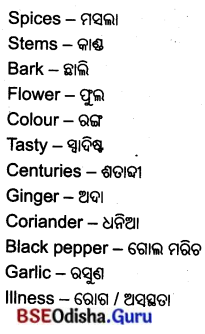
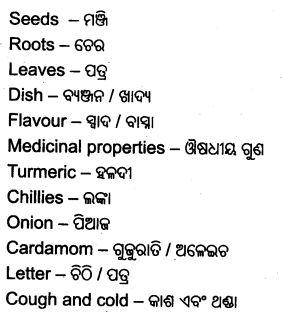
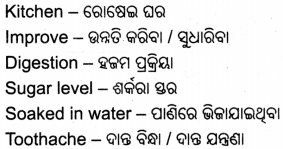
Our Daily Spices Class 6 Extract Based Questions
Spices are a kind of seed, stem, root, bark, leaf, and flower required to make our dishes colourful, flavoured, and tasty. The spices are also known for their medicinal properties in our country. These spices have been used in Ayurvedic practices for centuries. In Odisha turmeric, ginger, chilies, coriander, onion, black pepper, cardamom and garlic are widely grown in the districts of Koraput, Kandhamala, Rayagada and Gajapati. Kandhamala’s high quality turmeric has got worldwide reputation.
Question 1.
What are spices used for in our dishes?
(a) To make them bitter
(b) To make them coloured, flavoured, and tasty
(c) To make them cold
(d) To make them unhealthy
Answer:
(b) To make them coloured, flavoured, and tasty
Question 2.
For how long have spices been used in Ayurvedic practices ?
(a) For a few years
(b) For decades
(c) For centuries
(d) For one month
Answer:
(c) For centuries
Question 3.
Find the word from the passage which means-‘a substance made from a plant-used to add flavor, aroma, or colour to food.
Answer: ‘spices’
Question 4.
Write whether the following statements are True or False.
(i) Spices are only used to make our dishes look colourful and do not have any medicinal properties.
Answer: False
(ii) Spices have been used in Ayurvedic practices for many centuries.
Answer: True
(iii) The district of Kandhamala is famous worldwide for its high-quality turmeric.
Answer: True
II. Let us start with Haldi (Turmeric). It can improve energy level and digestion. It helps in reducing body pain too. You may have heard that Methi(Fenugreek) helps sugar level and body weight in control. Jeera (Cumin seeds) soaked in water overnight improves digestion and helps cure sleeplessness. Dalchini (Cinnamon) and Labanga (Clove) provide relief from a toothache until we can consult a dentist. Ada (Ginger) can help us get relief from cough and cold. Elaich (Cardamom) makes the digestive and respiratory systems active.
Question 1.
According to the text, which spice is beneficial for improving energy levels and reducing body pain?
(a) Ada (Ginger)
(b) Haldi (Turmeric)
(c) Jeera (Cumin seed)
(d) Labanga (Clove)
Answer:
(b) Haldi (Turmeric)
Question 2.
Which spice helps in keeping sugar levels and body weight under control?
(a) Methi (Fenugreek)
(b) Elaichi (Cardamom)
(c) Dalchini (Cinnamon)
(d) Haldi (Turmeric)
Answer:
(a) Methi (Fenugreek)
Question 3.
Find the word from the passage which means – ‘A person who treats problems related to the teeth, gums, and other parts of the mouth’.
Answer: ‘dentist’
Question 4.
Write whether the following statements are True or False.
(a) Jeera (Cumin seed) should be boiled in water to help cure sleeplessness. (True/False)
Answer: (a) False
(b) Dalchini (Cinnamon) and Labanga (Clove) are used to provide relief from toothaches. (True/False)
Answer: (b) True
(c) Elaichi (Cardamom) is helpful for both the digestive and respiratory systems. (True/False)
Answer: (c) False
Our Daily Spices Class 6 MCQ
Question 1.
Which district’s turmeric has a worldwide reputation?
(a) Koraput
(b) Kandhamala
(c) Rayagada
(d) Gajapati
Answer:
(b) Kandhamala
Question 2.
Which part of a plant can be used as a spice ?
(a) Seeds and stems
(b) Roots and bark
(c) Leaves and flowers
(d) All of the above
Answer:
(d) All of the above
Question 3.
Which of the following spices is NOT mentioned as being grown in Odisha districts like Koraput ?
(a) Ginger
(b) Cardamom
(c) Saffron
(d) Black pepper
Answer:
(c) Saffron
Question 4.
What special property are spices known for in our country?
(a) Electrical properties
(b) Medicinal properties
(c) Magnetic properties
(d) Cooling properties
Answer:
(b) Medicinal properties
Question 5.
To help cure sleeplessness, how should Jeera (Cumin seed) be prepared?
(a) Fried in oil
(b) Mixed with honey
(c) Soaked in water overnight
(d) Ground into a dry powder
Answer:
(c) Soaked in water overnight
Question 6.
Which two spices are mentioned as temporary remedies for a toothache?
(a) Haldi and Ada
(b) Jeera and Methi
(c) Dalchini and Labanga
(d) Elaichi and Dalchini
Answer:
(c) Dalchini and Labanga
Question 7.
If a person is suffering from a cough and cold, which spice is recommended in the extract?
(a) Labanga (Clove)
(b) Ada (Ginger)
(c) Methi (Fenugreek)
(d) Jeera (Cumin seed)
Answer:
(b) Ada (Ginger)
Question 8.
What is the specific benefit of consuming Elaichi (Cardamom)?
(a) It cures toothaches instantly.
(b) It helps in reducing body weight.
(c) It makes the digestive and respiratory systems active.
(d) It improves sleep quality.
Answer:
(c) It makes the digestive and respiratory systems active.
Our Daily Spices Class 6 Very Short Answer Questions
Question 1.
What are spices?
Answer:
Spices are different parts of plants like seeds, stems, roots, bark, and flowers used in cooking and medicine.
Question 2.
Why do we add spices to our food?
Answer:
We add spices to our dishes to make them more colourful, flavoured, and tasty for everyone to enjoy.
Question 3.
Which district in Odisha is famous for its turmeric?
Answer:
Kandhamala is the district in Odisha that is famous worldwide for producing very high-quality turmeric.
Question 4.
Where are spices used besides cooking?
Answer:
Besides cooking, spices have been used for medicinal purposes in Ayurvedic practices for many centuries in our country.
Question 5.
How does Haldi or Turmeric help our body?
Answer:
Haldi improves our energy levels and helps with digestion. It is also very useful for reducing body pain.
Question 6.
Which spice should be used for cough and cold?
Answer:
According to the extract, Ada or Ginger can help us get relief from a cough and cold.
Question 7.
What are the benefits of Methi?
Answer:
Methi, or Fenugreek, is beneficial because it helps keep our sugar levels and body weight under control.
Question 8.
Which spices give relief from a toothache?
Answer:
Dalchini and Labanga give temporary relief from a toothache until we are able to consult a dentist.
Our Daily Spices Class 6 Short Answer Questions
Question 1.
List the names of spices grown in Odisha according to the text.
Answer:
According to the text, the spices grown in Odisha are turmeric, ginger, chillies, coriander, onion, black pepper, cardamom, and garlic. They are grown in several districts.
Question 2.
Name the districts in Odisha where spices are widely grown.
Answer:
The districts in Odisha famous for growing spices are Koraput, Kandhamala, Rayagada, and Gajapati. These regions provide the right environment for these valuable crops to grow.
Question 3.
What is the significance of Kandhamala turmeric?
Answer:
Kandhamala turmeric is significant because it is of very high quality. It has gained a worldwide reputation, making Odisha famous for this specific medicinal spice.
Question 4.
How do spices help in Ayurveda?
Answer:
Spices help in Ayurveda because they have strong medicinal properties. They have been used for centuries to treat illnesses and keep people healthy using natural plant parts.
Question 5.
How should Jeera be used to improve health?
Answer:
Jeera should be soaked in water overnight. Drinking this water improves our digestion and also helps cure sleeplessness.
Question 6.
What is the role of Elaichi in our body?
Answer:
Elaichi, or Cardamom, is a powerful spice. It works by making both our digestive system and our respiratory system more active and healthy.
Question 7.
Why is Haldi considered a multipurpose spice?
Answer:
Haldi is multipurpose because it does more than just add colour. It boosts energy, helps the stomach digest food, and acts as a natural painkiller.
Question 8.
Which spices help the digestive system according to the text?
Answer:
According to the text, Haldi, Jeera, and Elaichi all help the digestive system. Jeera is specifically mentioned for use after being soaked overnight.
Our Daily Spices Class 6 Long Answer Questions
Question 1.
Describe the different parts of plants that can be used as spices and their uses.
Answer:
Spices come from many parts o a plant, such as seeds, stems, roots, bark leaves, and flowers. For example, turmeri is a root and cinnamon is bark. We us these parts to make our food look colourful and taste better. They also have medicinal properties that help us stay fit and are used in ancient Ayurvedic treatments.
Question 2.
Discuss the cultivation of spices in the state of Odisha based on the extract.
Answer:
Odisha is a major producer of various spices like ginger, garlic, cardamom, and black pepper. These are grown mainly in the districts of Koraput, Kandhamala, Rayagada, and Gajapati. Among these, Kandhamala is the most famous for its high-quality turmeric. The state is known for producing these spices which are used both for flavouring food and for medicine.
Question 3.
Describe how different spices help us manage specific health problems like pain and sleeplessness.
Answer:
Different spices act as natural medicines for various problems. For body pain, we can use Haldi. If someone suffers from a toothache, Dalchini and Labanga provide quick relief. For those who cannot sleep, Jeera soaked in water is the best cure. These kitchen spices help us manage small health issues easily and naturally at home.
Question 4.
Explain the benefits of Methi, Ada, and Elaichi as mentioned in the extract.
Answer:
Each of these spices has a special job. Methi helps people manage their body weight and blood sugar levels. Ada is the ! est remedy for common illnesses like coughs and colds. Finally, Elaichi is very important because it keeps our breathing and digestive systems active. Together, these spices ensure that our body functions properly every day.
Question 5.
What should we use from the kitchen to cure a cough and cold?
Answer:
We should use common kitchen spices like ginger, black pepper, cinnamon, and cloves to cure a cough and cold. These spices are often boiled in water with tulsi leaves to make a soothing drink called kadha. Additionally, mixing turmeric in warm milk is a helpful remedy. Using honey with these ingredients further soothes the throat.
Our Daily Spices Class 6 Competency Based Questions
Question 1.
How do spices contribute to both the culinary and medicinal traditions of India according to the text?
Answer:
Spices are versatile plant parts like seeds, roots, and bark that enhance food by adding colour, flavour, and taste. Beyond cooking, they hold a vital place in India’s medicinal history, having been used in Ayurvedic practices for centuries. This shows that Indian spices are not just kitchen ingredients but are valued as natural remedies for various health issues.
Question 2.
Discuss the significance of Odisha in the production of spices and highlight a specific example of its global impact.
Answer:
Odisha is a significant hub for spice cultivation, particularly in districts like Koraput, Kandhamala, Rayagada, and Gajapati. These regions grow a wide variety of spices including ginger, garlic, and black pepper. A key example of its impact is Kandhamala’s turmeric, which has earned a worldwide reputation for its high quality, showcasing Odisha’s importance on the global trade map.