
Students can refer to BSE Odisha Class 6 Math Solution and Ganita Prakash Chapter 2 Lines and Angles Class 6 Question Answer to understand textbook questions step by step.
Class 6 Maths Chapter 2 Lines and Angles Solutions
Ganita Prakash Class 6 Chapter 2 Solutions
Class 6 Maths Ganita Prakash Chapter 2 Solutions Lines and Angles
Question 1.
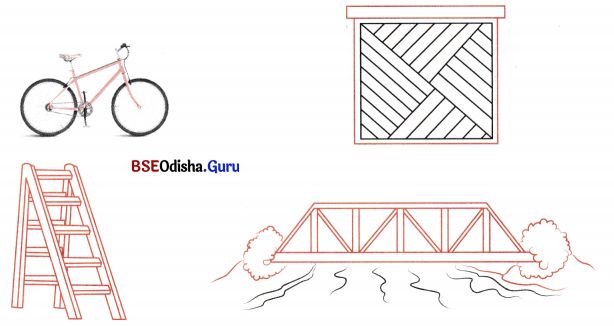
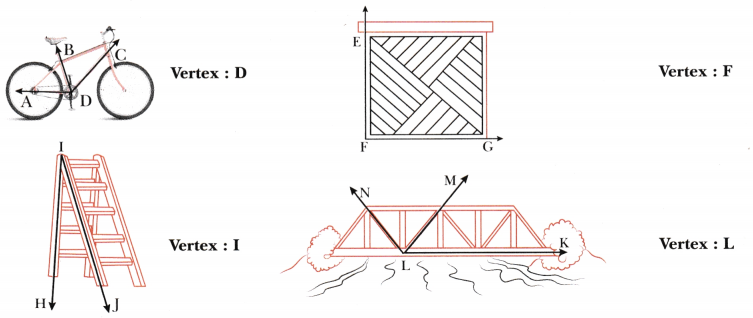
Can you find the angles in the given pictures? Draw the rays forming any one of the angles and name the vertex of the angle.
Solution:
Yes,

Question 2.
Mark any four points on your paper so that no three of them are on one line. Label them A, B, C and D. Draw all possible lines going through pairs of these points. How many lines do you get? Name them. How many angles can you name using A, B, C and D? Write them all down and mark each of them with a curve.
Solution:
A, B, C and D are four points.
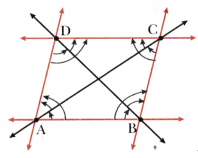
The six possible lines are \(\overleftrightarrow{A B}\), \(\overleftrightarrow{B C}\), \(\overleftrightarrow{C D}\), \(\overleftrightarrow{A D}\), \(\overleftrightarrow{A C}\) and \(\overleftrightarrow{B D}\).
And, 12 possible angles arc ∠BAC, ∠CAD, ∠BAD, ∠ADB, ∠BDC, ∠ADC, ∠DCA. ∠ACB, ∠DCB, ∠ABD, ∠DBC, and ∠ABC.
Question 3.
Find out the number of acute angles in each of the figures below.
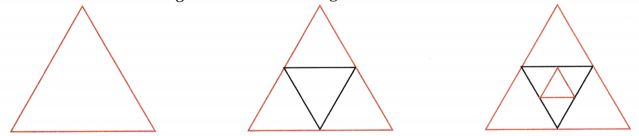
What will be the next figure and how many acute angles will it have? Do you notice any pattern in the numbers?
Solution:
First figure: There are three acute angles in the first figure.
Second figure: There are 12 acute angles in second figure (each of the 4 smaller triangles has 3 acute angles).
Third figure: There are 21 acute angles in the third figure (each of the 7 smaller triangles has 3 acute angles).
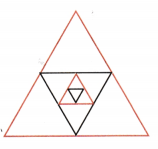
The next figure is given alongside. And, it has 30 acute angles.
The number of acute angles: 3, 12, 21, 30, …
Pattern: number of acute angles increase by 9 in each step.
Question 4.
Angles in a clock
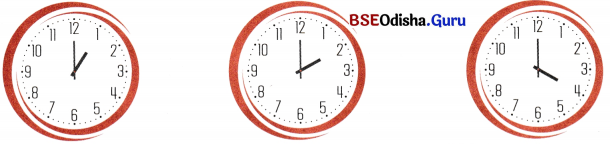
(a) The hands of a clock make different angles at different times. At 1 o’clock, the angle between the hands is 30°. Why?
(b) What will be the angle at 2 o’clock? And at 4 o’clock? 6 o’clock?
(c) Explore other angles made by the hands of a clock.
Solution:
(a) The clock is divided into 12 hours, so each hour mark is 30° apart, (\(\frac{360^{\circ}}{12}\) = 30°)
Therefore, at 1 o’clock the hour hand is at 1 and the minute hand is at 12, forming a 30° angle.
(b) At 2 o’clock, it is 60° (i.e. 30° × 2 = 60°),
At 4 o’clock, it is 120° (i.e. 30° × 4 = 120°)
At 6 o’clock, it is 180° (i.e. 30° × 6 = 180°)
(c) The angle increases by 30° for each hour. Other angle includes 90° at 3 o’clock, 150° at 5 o’clock and so on. ‘ Thus, on multiplying the hour by 30°, we can find the angle at any hour.
Question 5.
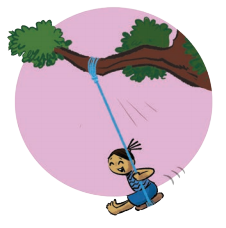
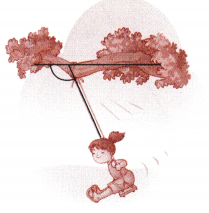
Vidya is enjoying her time on the swing. She notices that the greater the angle with which she starts the swinging, the greater is the speed she achieves on her swing. But where is the angle? Are you able to see any angle?
Solution:
Yes, the angle is visible, and it is formed between the rope and the tree branch.
Question 6.
Observe the images below where there is an insect and its rotated version. Can angles be used to describe the amount of rotation?
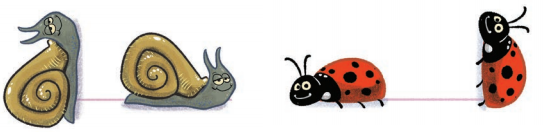
How? What will be the arms of the angle and the vertex?
Solution:
Yes, angles can he used to show the amount of rotation.
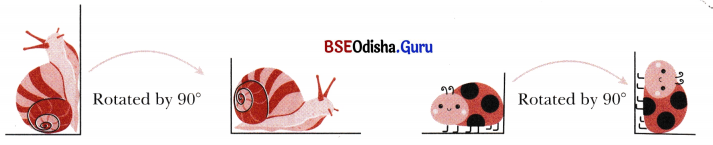
One arm of the angle is the horizontal line that the insects are on, and the other arm is the line that meets it at a corner point. The point where the two lines meet is the vertex of the angle.
Question 7.
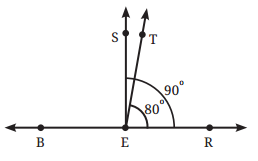
In this figure, ∠TER = 80°. What is the measure of ∠BET? What is the measure of ∠SET?
Solution:
Given, ∠TER = 80° and ∠SER = 90°
Now, ∠SET = ∠SER – ∠TER = 90° – 80° = 10°; ∠BET = ∠BES + ∠SET = 90° + 10° = 100°
Question 8.
Draw the letter ‘M’ such that the angles on the sides are 40° each and the angle in the middle is 80°.
Solution:
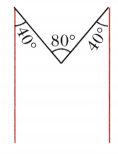
Note: In NCERT, the middle angle is given as 60°, which is not possible with side angles as 40°.
Question 9.
Draw the letter Y such that the three angles formed are 150°, 60° and 150°.
Solution:
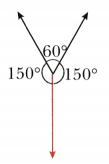
Question 10.
The Ashoka Chakra has 24 spokes. What is the degree measure of the angle between two spokes next to each other? What is the largest acute angle formed between two spokes?

Solution:
The angle between two spokes is 15° (i.e. \(\frac{360^{\circ}}{24}\)) because the Ashoka Chakra is a circle and dividing 360° by the number of spokes 24 gives the angle between two adjacent spokes.
Now, each pair of spokes can form different angles depending on how many spokes apart they are:
1 spoke apart → 15°;
2 spokes apart → 30°;
3 spokes apart → 45° ;
4 spokes apart → 60°;
5 spokes apart → 75°;
6 spokes apart → 90° → Not acute
7 spokes apart → 105° → Not acute (but obtuse)
So, the largest acute angle formed between two spokes = 75°.
InText Questions
Question 1.
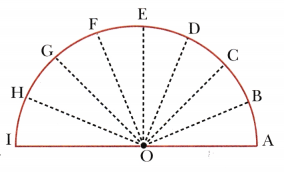
In given figure, we have ∠AOB = ∠BOC = ∠COD = ∠DOE = ∠EOF = ∠FOG = ∠GOH = ∠HOI = ______. Why?
Solution:
In the figure, it is shown that a straight angle is divided into 8 equal angles:
∠AOB, ∠BOC, ∠COD, ∠DOE, ∠EOF, ∠FOG, ∠GOH, and ∠HOI.
A straight angle around a point measures 180°.
Since all 8 angles are equal, we divide 180° equally among them:
∠AOB = ∠BOC = … = ∠HOI = \(\frac{180^{\circ}}{8}\) = 22.5°
Lines and Angles Class 6 Extra Questions
Lines and Angles Class 6 Very Short Question Answer
Question 1.
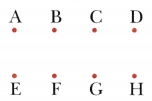
In the figure, 8 points are given. Join the points A to E, E to F, F to B, B to G, G to C, C to H, H to D and D to C. How many line segments are formed?
Solution:
While joining the points A to E, E to F, F to B, B to G, G to C, C to H, H to D and D to C, we get the figure given alongside.
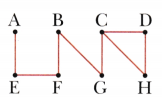
From the figure, the line segments are \(\overline{A E}, \overline{E F}, \overline{F B}, \overline{B G}, \overline{G C}, \overline{C H}, \overline{H D}\) and \(\overline{D C}\).
So, 8 line segments are formed.
Question 2.
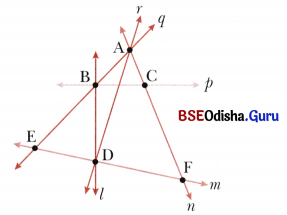
In the given figure, write concurrent lines and their points of concurrence.
Solution:
We know that three or more lines that pass through the same point are called concurrent lines.
| Concurrent Lines | Point of Concurrence |
| line n, line q, line r | A |
| line l, line p, line q | B |
| line l, line m, line r | D |
Question 3.
Complete the statements given in Column I using the appropriate statements from Column II.
| Column I | Column II | ||
| (i) | Three or more points are collinear | (a) | part of line having two endpoints. |
| (ii) | Through a point | (b) | can be either parallel or intersecting. |
| (iii) | Line segment is a | (c) | more than one line can pass. |
| (iv) | Through two points | (d) | if they lie on the same line. |
| (v) | Two lines in a plane | (e) | only one line can pass. |
Solution:
We know that,
Three or more points are collinear if they lie on the same line.
Through a point more than one line can pass.
Line segment is a part of line having two endpoints. Through two points only one line can pass.
Two lines in a plane can be either parallel or intersecting.
∴ (i) – (d), (ii) – (c), (iii) – (a), (iv) – (e), (v) – (b)
Question 4.
Match the expressions in Column I with their correct descriptions from Column II.
| Column I | Column II | ||
| (i) | \(\overrightarrow{P Q}\) | (a) | Line PQ |
| (ii) | \(\overrightarrow{Q P}\) | (b) | Line segment PQ |
| (iii) | \(\overleftrightarrow{P Q}\) | (c) | A ray with starting point P |
| (iv) | \(\overline{P Q}\) | (d) | A ray with starting point Q |
Solution:
Here,
(i) \(\overrightarrow{P Q}\) represents a ray with starting point P.
(ii) \(\overrightarrow{Q P}\) represents a ray with starting point Q.
(iii) \(\overleftrightarrow{P Q}\) represents a line PQ.
(iv) \(\overline{P Q}\) represents a line segment PQ.
∴ (i) – (c), (ii) – (d), (iii) – (a), (iv) – (b)
Question 5.
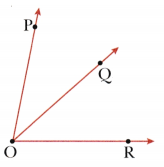
Write the name of the angles in the given figure.
Solution:
In the given figure, the possible angles are as follows:
| Vertex | Arms | Name of angle |
| O | \(\overrightarrow{O P}\) and \(\overrightarrow{O Q}\) | ∠POQ or ∠QOP |
| O | \(\overrightarrow{O P}\) and \(\overrightarrow{O R}\) | ∠POR or ∠ROP |
| O | \(\overrightarrow{O Q}\) and \(\overrightarrow{O R}\) | ∠ROQ or ∠QOR |
Question 6.
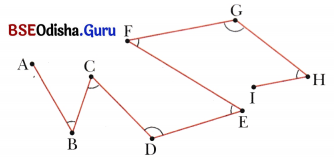
How many acute angles are present in the given figure? Also, name them.
Solution:
We know that acute angles measure less than 90°.
In the given figure,
Acute angles: ∠ABC, ∠BCD, ∠DEF, ∠EFG and ∠GHI
So, 5 acute angles are present in the given figure.
Question 7.
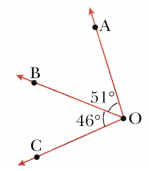
In the figure, find ∠AOC.
Solution:
Given, ∠AOB = 51° and ∠BOC = 46°
Now, ∠AOC = ∠AOB + ∠BOC = 51° + 46° = 97°
Question 8.
In the figure, find the missing angle.
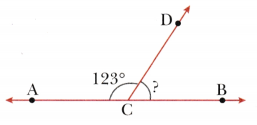
Solution:
From figure, ∠ACB is a straight angle.
∴ ∠ACB = 180°
⇒ ∠ACD + ∠BCD = 180° ,
⇒ 123° + ∠BCD = 180°
⇒ ∠BCD = 180°- 123° = 57°
Question 9.
Find the measure of the angle POQ given below using a protractor.
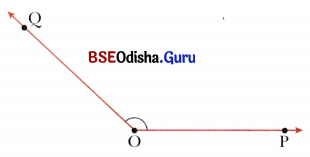
Solution:
Using protractor, we get ∠POQ = 137°.
Question 10.
Find the degree measures of ∠POR, ∠QOR and ∠QOS in the below figure.
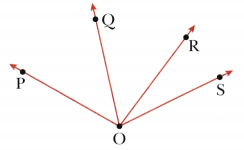
Solution:
Using protractor, we get
∠POR = 98°, ∠QOR = 50°, ∠QOS = 76°
Question 11.
In the figure, find the missing angle.
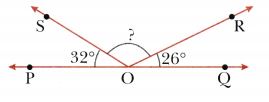
Solution:
From the figure, ∠POQ is a straight angle.
∴ ∠POQ = 180°
⇒ ∠QOR + ∠ROS + ∠SOP = 180°
⇒ 26° + ∠ROS + 32° = 180°
⇒ ∠ROS + 58° = 180°
⇒ ∠ROS = 180°-58° = 122°
Question 12.
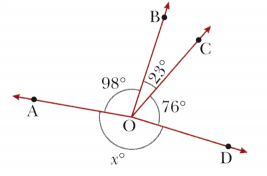
In the figure given below, find the value of x°.
Solution:
We know that the complete angle at a point measures 360°
∴ ∠AOB + ∠BOC + ∠COD + ∠AOD = 360°
⇒ 98° + 23° + 76° + x° = 360°
⇒ 197° + x° = 360°
⇒ x° = 360°- 197° = 163°
Lines and Angles Class 6 Short Question Answer
Question 1.
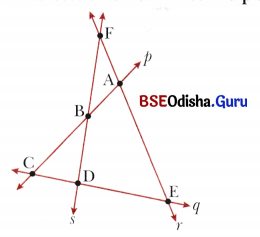
What is the maximum and minimum number of points of intersection of four lines in a plane?
Solution:
When four lines intersect each other in such a way that each pair of lines meet at a different point, we get the maximum number of intersecting points.
Let the four lines be p, q, r and s. Then, the lines can intersect as shown in the figure to give the maximum number of points of intersection.
So, the maximum number of points of intersection of four lines in a plane is six.
Formula to confirm the answer:
Maximum number of points of intersection of n lines = \(\frac{n(n-1)}{2}\)
If all four lines are parallel, then they will not intersect at any point.
So, the minimum number of points of intersection of four lines in a plane is zero.
Question 2.
Lines l, m and n are concurrent. Also, lines p, m and n are concurrent. State whether lines p, l, m and n are concurrent or not.
Solution:
Three or more lines that pass through one common point is called concurrent lines. We are told that:
Lines l, m, and n are concurrent. So, they all meet at a point, let’s call it point A. Also, lines p, m, and n are concurrent. That means these lines also meet at point A. Now, let’s look at all the lines:
Line l goes through point A.
Line p goes through point A.
Line m goes through point A.
Line n goes through point A.
So, all four lines (l, m, n, and p) go through the same point A.
That means they are all concurrent.
Question 3.
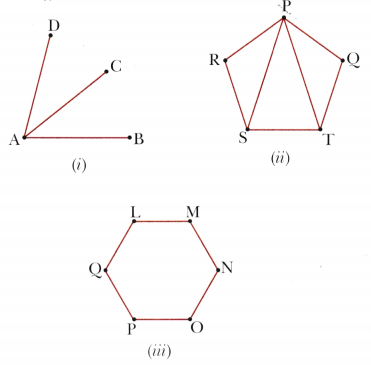
Name all the line segments in each of the following figures.
Solution:
All the line segments in figure (i) are \(\overline{A B}\), \(\overline{A C}\) and \(\overline{A D}\).
All the line segments in figure (ii) are \(\overline{P Q}\), \(\overline{P T}\), \(\overline{P S}\), \(\overline{P R}\), \(\overline{Q T}\), \(\overline{S R}\) and \(\overline{S T}\).
All the line segments in figure (iii) are \(\overline{L M}\), \(\overline{M N}\), \(\overline{N O}\), \(\overline{O P}\), \(\overline{P Q}\) and \(\overline{Q L}\).
Question 4.
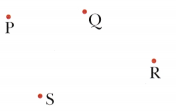
There are four non-collinear points as shown in the figure. Draw lines through these points taking two at a time. Name the lines. How many such different lines can be drawn?
Solution:
The lines through the given points taking two at a time are \(\overleftrightarrow{P Q}, \overleftrightarrow{P R}, \overleftrightarrow{P S}, \overleftrightarrow{Q R}, \overleftrightarrow{Q S}\) and \(\overleftrightarrow{R S}\)
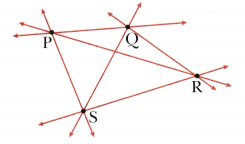
So, 6 different lines can be drawn from the given four non-collinear points.
Question 5.
In the given figure, name
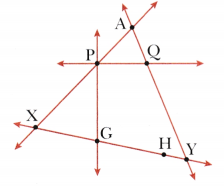
(i) lines containing the point P.
(ii) lines passing through the point Q.
(iii) line on which H lies.
(iv) three pairs of intersecting lines.
Solution:
(i) Lines containing the Point P are \(\overleftrightarrow{P Q}\), \(\overleftrightarrow{A X}\) and \(\overleftrightarrow{P G}\).
(ii) Lines through the point Q are \(\overleftrightarrow{A Y}\) and \(\overleftrightarrow{P Q}\).
(iii) Line on which lines is \(\overleftrightarrow{X Y}\).
(iv) Three pairs of intersecting hues are \(\overleftrightarrow{P Q}\) and \(\overleftrightarrow{P G}\); \(\overleftrightarrow{A X}\) and \(\overleftrightarrow{X Y}\); \(\overleftrightarrow{A Y}\) and \(\overleftrightarrow{X Y}\).
Question 6.
Identify and name the line segments and rays in each of the following figures.
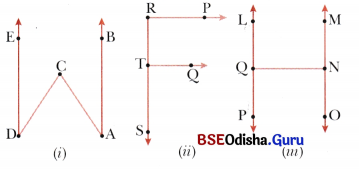
Solution:
We know that the shortest path from point A to point B (including A and B) is called the line segment AB. It is denoted by either \(\overline{A B}\) or \(\overline{B A}\).
And a ray is a portion of a line that starts at one point (called the starting point or initial point of the ray) and goes on endlessly in a direction.
| Figure Number | Line Segment | Ray |
| (i) | \(\overline{A C}\), \(\overline{D E}\), \(\overline{A B}\) and \(\overline{C D}\) | \(\overrightarrow{A B}\) and \(\overrightarrow{D E}\) |
| (ii) | \(\overline{R T}\), \(\overline{R P}\), \(\overline{T Q}\), \(\overline{R S}\) and \(\overline{T S}\) | \(\overrightarrow{R P}\), \(\overrightarrow{T Q}\), \(\overrightarrow{R S}\) and \(\overrightarrow{T S}\) |
| (iii) | \(\overline{O N}\), \(\overline{Q L}\), \(\overline{Q P}\), \(\overline{L P}\), \(\overline{M N}\), \(\overline{N O}\) and \(\overline{M O}\) | \(\overrightarrow{Q L}\), \(\overrightarrow{N M}\), \(\overrightarrow{N O}\) and \(\overrightarrow{Q P}\) |
Question 7.
In the given figure, name the point(s):
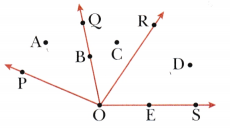
(i) in the interior of ∠POQ.
(ii) in the interior of ∠POR.
(iii) in the exterior of ∠QOR.
(iv) in the exterior of ∠QOS. ..
(v) on ∠POS.
(vi) on ∠ROS.
Solution:
(i) Point A is in the interior of ∠POQ.
(ii) Points A, B, Q and C are in the interior of ∠POR.
(iii) Points A, P, D. E and S are in the exterior of ∠QOR.
(iv) Points A and P arc in the exterior of ∠QOS.
(v) Points P, O, E and S are on ∠POS.
(vi) Points R, O, E and S are on ∠ROS.
Question 8.
Compare two angles given below using superimposition and find which angle is smaller?
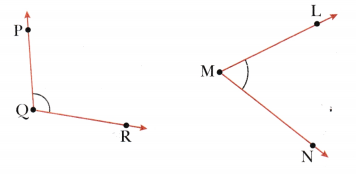
Solution:
Suppose we have a transparent circular paper which can be moved and placed from one figure to another figure.
Let us place the circular paper on the ∠PQR
The circular paper is placed in such a way that its centre is on the vertex of the angle i.e. Q. Mark the points A and B on the edge of circular paper at the points where the arms of the angle PQR pass through the circular paper.
After that put it on the other given angle ∠LMN, such that B lies on the arm MN and check which is smaller.
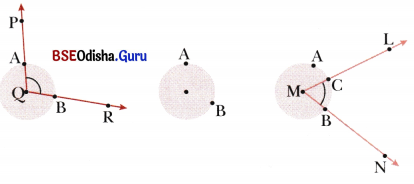
Hence, ∠LMN is smaller than ∠PQR.
Question 9.
In the figure, write another name for:
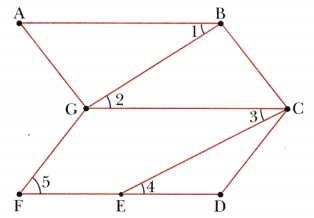
(i) ∠1
(ii) ∠2
(iii) ∠3
(iv) ∠4
(v) ∠5
Solution:
(i) Arms of’ the ∠1 are BA and BC and its vertex is B.
So. another name for ∠1 is ∠ABG or ∠GBA.
(ii) Aims of tIme ∠2 are GB amid GC and its vertex is G.
So, another name for ∠2 is ∠BGC or ∠CGB.
(iii) Arms of the ∠3 are CG and CE and its vertex is C.
So, another name for ∠3 is ∠GCE or ∠ECG.
(iv) Arms of the ∠4 arc ED and EC and its vertex is E.
So. another name for ∠4 is ∠CED or ∠DEC.
(v) Arms of the ∠5 are FE and FG and its vertex is F.
So, another name for ∠5 is ∠EFG or ∠GFE.
Question 10.
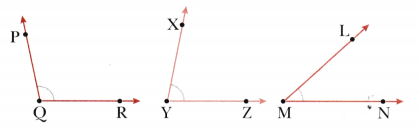
In each case, determine which angle is greater and why?
(i) ∠PQR or ∠XYZ
(ii) ∠XYZ or ∠LMN
(iii) ∠PQR or ∠LMN
Solution:
On comparing by superimposition, we get
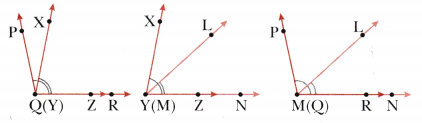
(i) ∠PQR is greater than ∠XYZ because the amount of rotation of ∠PQR is greater than the amount of rotation of ∠XYZ.
(ii) ∠XYZ is greater than ∠LMN because the amount of rotation of ∠XYZ is greater than the amount of rotation of ∠LMN.
(iii) ∠PQR is greater than ∠LMN because the amount of rotation of ∠PQR is greater than the amount of rotation of ∠LMN.
Question 11.
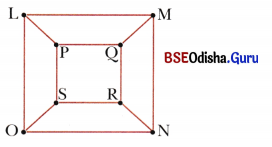
How many acute and obtuse angles are present in the given figure? Also, name them.
Solution:
We know that acute angles measure less than 90° and obtuse angles measure more than 90° but less than 180°.
In the given figure,
Acute angles: ∠OLP, ∠MLP, ∠LMQ, ∠NMQ, ∠MNR, ∠ONR, ∠NOS and ∠LOS
Obtuse angles: ∠LPS, ∠LPQ, ∠MQP, ∠MQR, ∠NRQ, ∠NRS, ∠OSR and ∠OSP
So, 8 acute angles and 8 obtuse angles are present in the given figure.
Question 12.
Classify the following angles (acute, obtuse, right, straight, complete):
(i) 80°
(ii) 90°
(iii) 180°
(iv) 175°
(v) 360°
Solution:
The given angles can be classified as follows:
(i) 80°: Acute angle
(ii) 90°: Right angle
(iii) 180°: Straight angle
(iv) 175°: Obtuse angle
(v) 360°: Complete angle
Question 13.
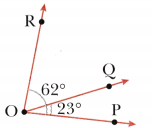
In the figure, if ∠POQ = 23° and ∠POR = 62°, then find ∠QOR.
Solution:
Given,
∠POQ = 23° and ∠POR = 62°
From the figure, ∠POR = ∠POQ + ∠QOR
⇒ 62° = 23° + ∠QOR
Subtracting 23° from both sides, we get
62° – 23° = 23° + ∠QOR – 23°
⇒ ∠QOR = 39°
Question 14.
Construct an angle of 115° using a protractor.
Solution:
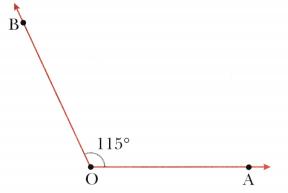
To draw an angle of 115° using a protractor, we follow the steps laid down below:
Step 1: Draw a ray \(\overrightarrow{O A}\).
Step 2: Place the protractor in such a way that its centre is exactly on the point 0 and the base line lies along \(\overrightarrow{O A}\).
Step 3: Starting from 0° on the right, move and look for the mark 115° mark on the protractor.
Step 4: Mark a point B against this 115° mark.
Step 5: Remove the protractor and draw the ray \(\overrightarrow{O B}\).
Thus, ∠AOB is the required angle whose measure is 115°.
Question 15.
How many degrees are there in:
(i) \(\frac{1}{2}\) of a straight angle?
(ii) \(\frac{3}{4}\) of a right angle?
Solution:
(i) \(\frac{1}{2}\) of a straight angle = \(\frac{1}{2}\) × 180° = 90°
(ii) \(\frac{3}{4}\) of right angle = \(\frac{3}{4}\) × 90°
= 3 × 22.5° = 67.5°
Question 16.
Measure the following angles with the help of a protractor and write the measure in degrees.
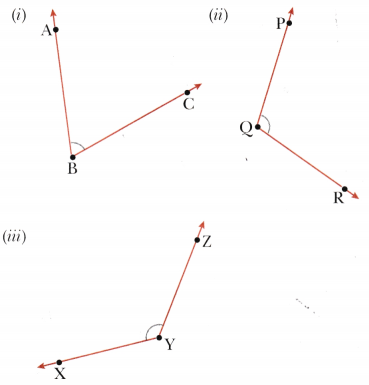
Solution:
(i) Using protractor, we get ∠ABC = 68°.
(ii) Using protractor, we get ∠PQR = 109°.
(iii) Using protractor, we get ∠XYZ = 125°.
Question 17.
Name the different angles and write their degree measures.
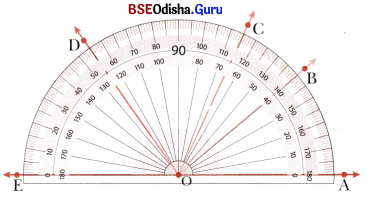
Solution:
All the possible angles are as follows: ;
∠AOB, ∠AOC, ∠AOD, ∠AOE, ∠BOC, ∠BOD, ∠BOE, ∠COD, ∠COE, ∠DOE
Now, ∠AOB = 40°; ∠AOC = 65°; ∠AOD = 125°; ∠AOE = 180°
∠BOC = ∠AOC – ∠AOB = 65° – 40° = 25°
∠BOD = ∠AOD – ∠AOB = 125°- 40° = 85°
∠BOE = ∠AOE – ∠AOB = 180° – 40° = 140°
∠COD = ∠AOD – ∠AOC = 125° – 65° = 60°
∠COE = ∠AOE – ∠AOC = 180° – 65°= 115°
∠DOE = ∠AOE – ∠AOD = 180°- 125°= 55°
Question 18.
Draw a line segment PQ of length 8 cm. Take a point R on PQ such that PR = 5 cm. At point R, draw SR ⊥ PQ.
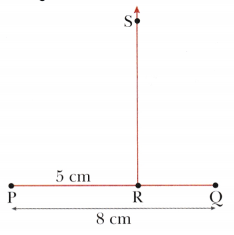
Solution:
To draw a required perpendicular line using a protractor, we follow the steps laid down below:
Step 1: Draw a line segment PQ of length 8 cm.
Step 2: Mark a point R on the line segment PQ such that PR = 5 cm.
Step 3: Draw SR perpendicular to PQ at R using protractor.
Thus, SR ⊥ PQ at point R.
Question 19.
State the type (obtuse, reflex, complete) of each of the following angles with their measure.
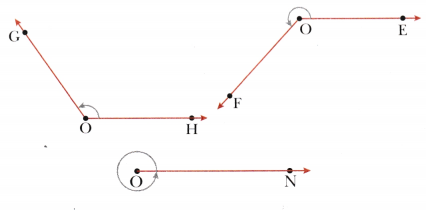
Solution:
Using protractor, we find
∠HOG = 125° (Obtuse angle)
∠EOE = 133°
⇒ Reflex of ∠EOE = 360°- 133° = 227° (Reflex angle)
∠NON = 360° (Complete angle)
Question 20.
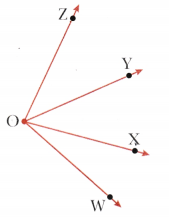
Find the degree measures of ∠XOW, ∠XOY, ∠XOZ and ∠YOZ in the below figure.
Solution:
We need to find the measures of ∠XOW, ∠XOY, ∠XOZ and ∠YOZ.
So, we place the protractor in such-a way that its centre coincide with the vertex 0 of the given angles and the base line lies along \(\overrightarrow{O W}\).
Starting from 0° on the right on inner scale, \(\overrightarrow{O X}\) passes through the 26° mark, \(\overrightarrow{O Y}\) passes through the 65° mark and \(\overrightarrow{O Z}\) passes through the 106° mark.
So, ∠XOW = 26°, ∠WOY = 65° and ∠WOZ = 106°
Now, ∠XOW = 26°
∴ ∠XOY = ∠WOY – ∠WOX = 65° – 26° = 39° [∵ ∠XOW = ∠WOX]
Also, ∠XOZ =∠WOZ – ∠WOX = 106° – 26° = 80°
And, ∠YOZ = ∠WOZ – ∠WOY = 106° – 65° = 41°
Lines and Angles Class 6 Long Question Answer
Question 1.
In the given figure, name
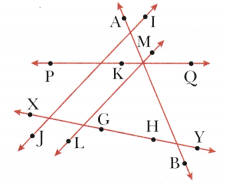
(i) Five pairs of intersecting lines.
(ii) Four collinear points.
(iii) Three collinear points.
(iv) Three concurrent lines.
Solution:
(i) Five pairs of intersecting lines are \(\overleftrightarrow{A B}\) and \(\overleftrightarrow{I J}\) ; \(\overleftrightarrow{P Q}\) and \(\overleftrightarrow{I J}\) ; \(\overleftrightarrow{X Y}\) and \(\overleftrightarrow{I J}\) ; \(\overleftrightarrow{X Y}\) and \(\overleftrightarrow{L M}\) ; \(\overleftrightarrow{X Y}\) and \(\overleftrightarrow{A B}\).
(ii) Four collinear points are X, G, H and Y.
(iii) Three collinear points are P, K and Q. As X, G, H and Y are collinear points, we can select any three points from X, G, H and Y as well for three collinear points.
(iv) Three concurrent lines are \(\overleftrightarrow{A B}\), \(\overleftrightarrow{L M}\) and \(\overleftrightarrow{P Q}\).
Question 2.
Consider the line XV in the adjoining figure. Find whether the given statements are true or false.
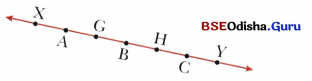
(i) B is a point on \(\overrightarrow{G Y}\).
(ii) A is a point on \(\overrightarrow{H Y}\).
(iii) G, B and H are points on the line segment GC.
(iv) \(\overrightarrow{H Y}\) is same as \(\overrightarrow{G Y}\).
(v) \(\overrightarrow{B X}\) is different from \(\overrightarrow{B Y}\).
(vi) A, B, C, G, H, X and Y are points on the line XY.
Solution:
(i) True
From the figure, the point B lies between the points G and Y.
Therefore, B is a point on \(\overrightarrow{G Y}\).
(ii) False
From the figure, the point A does not lie between the points H and Y.
Therefore, A is not a point on \(\overrightarrow{H Y}\).
(iii) True
From the figure, the point G is one endpoint of the line segment GC and the points B and H lie between points G and C.
Therefore, G, B and H are points on the line segment GC.
(iv) False
From the figure, the initial points of \(\overrightarrow{H Y}\) and \(\overrightarrow{G Y}\) are different.
Therefore, \(\overrightarrow{H Y}\) is not the same as \(\overrightarrow{G Y}\).
(v) True
From the figure, the initial points of the \(\overrightarrow{B X}\) and \(\overrightarrow{B Y}\) are same but they are moving in different directions.
Therefore, \(\overrightarrow{B X}\) is different from \(\overrightarrow{B Y}\).
(vi) True
From the figure, the points A, B, C, G, H, X and F lie on the line \(\overrightarrow{X Y}\).
Therefore, A, B, C, G, H, X and Y are points on the line \(\overrightarrow{X Y}\).
Question 3.
Draw rough diagrams of two angles for the condition which is possible.
(i) Vertex in common.
(ii) One arm in common.
(iii) Two arms in common.
(iv) Three points in common.
Solution:
Rough diagrams of two angles for the given condition are as follows:
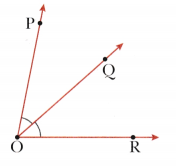
(i) In the figure, ∠POQ and ∠XOY have vertex O in common.
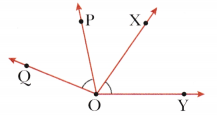
(ii) In the figure, ∠POO and ∠QOR have arm \(\overrightarrow{O Q}\) in common.
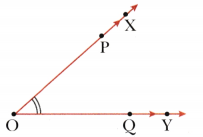
(iii) In the figure, ∠POQ and ∠XOY have two arms in common.
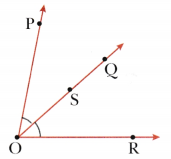
(iv) In the figure, ∠POQ and ∠QOR have three points O, S and Q in common.
Question 4.
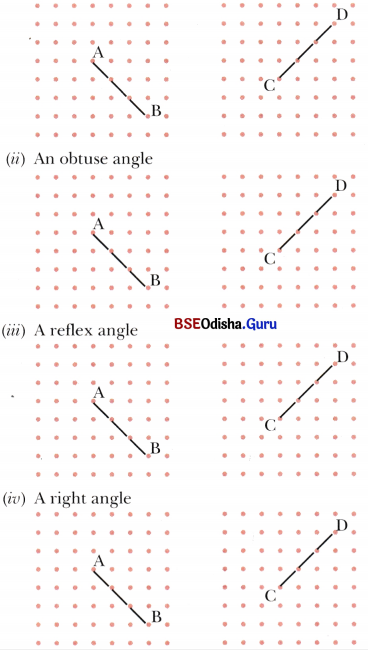
In each of the grids, join A to other grid points in the figure by a straight line to get:
(i) An acute angle
Solution:
(i) We know that an acute angle is greater than 0° and less than 90°.
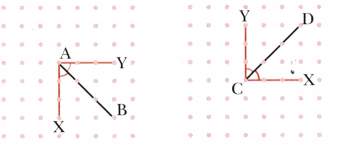
Here, ∠BAX, ∠BAY, ∠DCX and ∠DCY are acute angles.
(ii) We know that an obtuse angle is greater than 90° and less than 180°.
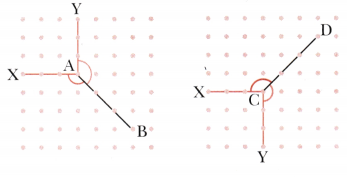
Here, ∠BAX, ∠BAY, ∠DCX and ∠DCY are obtuse angles.
(iii) We know that an obtuse angle is greater than 180° and less than 360°.
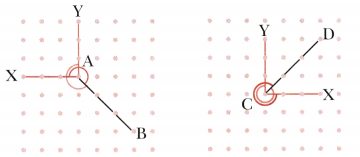
Here, ∠BAX, ∠BAY, ∠DCX and ∠DCY are reflex angles.
(iv) We know that a right angle is equal to 90°
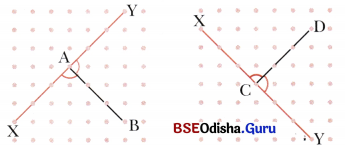
Here, ∠BAX, ∠BAY, ∠DCX and ∠DCY are right angles.
Question 5.
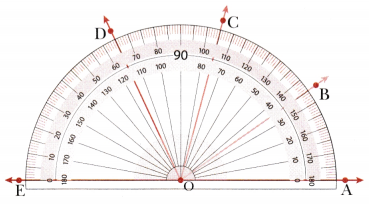
Find, the degree measures of ∠AOB, ∠BOE, ∠BOD, ∠COE and ∠COD.
Solution:
For ∠AOB, \(\overrightarrow{O A}\) is at 0° mark on the right and \(\overrightarrow{O B}\) passes through the 35° mark from right.
Therefore, ∠AOB = 35°
For ∠BOE, \(\overrightarrow{O E}\) is at 0° mark on the left and \(\overrightarrow{O B}\) passes through the 145° mark from left.
Therefore, ∠BOE = 145°
For ∠COE, \(\overrightarrow{O E}\) is at 0° mark on the left and \(\overrightarrow{O C}\) passes through the 105° mark from left.
Therefore, ∠COE = 105°
For ∠BOD, we have
∠BOD = ∠BOE – ∠DOE …….. (i)
For ∠DOE, \(\overrightarrow{O E}\) is at 0° mark on the left and \(\overrightarrow{O D}\) passes through the 65° mark from left.
Therefore, ∠DOE = 65°
From (i), ∠BOD = 145° – 65° = 80° [∵ ∠BOE = 145° and ∠DOE = 65°]
For ∠COD, we have
∠COD = ∠COE – ∠DOE = 105°- 65° = 40°
Question 6.
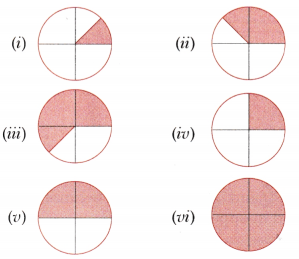
Identify the types of angles represented by shaded portion in each:
Solution:
(i) As the angle is less than quarter of a full turn, it is an acute angle.
(ii) As the angle is greater than quarter of a full turn but less than half of a full turn, it is an obtuse angle.
(iii) As the angle is greater than half of a full turn but less than a full turn, it is a reflex angle.
(iv) As the angle is equal to quarter of a full turn, it is a right angle.
(v) As the angle is equal to half of a full turn, it is a straight angle.
(vi) As the angle is equal to a full turn, it is a complete angle.
Lines and Angles Class 6 Case Based Questions
Question 1.
The Ashoka Chakra, found at the centre of the Indian national flag, is a symbol of righteousness and progress. It consists of 24 equally spaced spokes.
Based on the above information, answer the following questions:
(i) What is the angle between any two consecutive spokes of the Ashoka Chakra?
(ii) What is the largest acute angle that can be formed between any two spokes of the Ashoka Chakra?
(iii) What is the largest obtuse angle that can be formed between any two spokes of the Ashoka Chakra?
(iv) What is the smallest reflex angle that can be formed between any two spokes of the Ashoka Chakra?
Solution:
There are 24 spokes in the Ashoka Chakra.
(i) Since the spokes divide the circle into 24 equal parts, the angle between any two consecutive spokes is calculated by dividing the complete angle of a circle (360°) by 24. Thus, the angle between two consecutive spokes is \(\frac{360^{\circ}}{24}\) = 15°.
(ii) The largest acute angle that can be formed between any two spokes would be the greatest multiple of 15° that is still less than 90°.
The largest multiple of 15° and less than 90° is 75°.
Therefore, the largest acute angle between any two spokes is 75°.
(iii) The largest obtuse angle that can he formed between two spokes is the greatest multiple of 15°, which is greater than 90° but less than 1.80°.
The multiples of 15° (between 90° and 180°) are 105°, 120°, 135°, 150°, 165°.
Thus, the largest obtuse angle between any two spokes is 165°.
(iv) The smallest reflex angle that can be formed between two spokes is the smallest angle multiple of 15° greater than 180°, which would be 195° (since 180° + 15° = 195°).
Question 2.
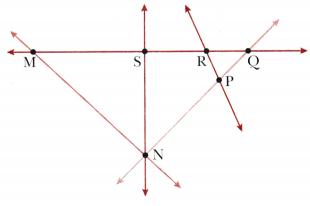
Priya drawn a figure in her notebook as shown.
Based on the above information, answer the following questions:
(i) Write the collinear points.
(ii) Write the concurrent lines.
(iii) How many lines are concurrent at point N?
(iv) How many lines have point Q as the point of intersection?
Solution:
(i) Three or more points that lie on the same straight line are known as collinear points.
From the figure, N, P and O are collinear points.
And, M, S, R and Q are collinear points.
(ii) We know that three or more lines in a plane that pass through one point are known as concurrent lines.
From the figure, \(\overleftrightarrow{M N}\), \(\overleftrightarrow{S N}\) and \(\overleftrightarrow{Q N}\) are concurrent lines.
(iii) From the figure, we can see that three lines \(\overleftrightarrow{M N}\), \(\overleftrightarrow{S N}\) and \(\overleftrightarrow{Q N}\) are concurrent at point N.
(iv) From the figure, we can see that two lines. \(\overleftrightarrow{M Q}\) and \(\overleftrightarrow{N Q}\) intersect at point Q.