
Students can refer to BSE Odisha Class 8 Math Solution and Ganita Prakash Chapter 7 Proportional Reasoning 1 Class 8 Question Answer to understand textbook questions step by step.
Class 8 Maths Chapter 7 Proportional Reasoning 1 Solutions
Ganita Prakash Class 8 Chapter 7 Solutions
Class 8 Maths Ganita Prakash Chapter 7 Solutions Proportional Reasoning 1
1. PROBLEM SOLVING WITH PROPORTIONAL REASONING
Figure it Out (Page 165 – 167) :
Question 1.
Circle the following statements of proportion that are true.
(i) 4 : 7 :: 12 : 21
(ii) 8 : 3 :: 24 : 6
(iii) 7 : 12 :: 12 : 7
(iv) 21 : 6 :: 35 : 10
(v) 12 : 18 – 28 : 12
(vi) 24 : 8 :: 9 : 3
Answer:
(i) Given statement is 4 : 7 :: 12 : 21.
This is true if \(\frac{4}{7}\) = \(\frac{12}{21}\) or if \(\frac{4}{7}\) = \(\frac{4}{7}\), which is true.
∴ The given statement is true.
(ii) Given statement is 8 : 3 :: 24 : 6.
This is true if \(\frac{8}{3}\) = \(\frac{24}{6}\) or if \(\frac{8}{3}\) = 4, which is false.
∴ The given statement is not true.
(iii) Given statement is 7 : 12 :: 12 : 7.
This is true if \(\frac{7}{12}\) = \(\frac{12}{7}\) which is false.
∴ The given statement is not true.
(iv) Given statement is 21 : 6 :: 35 : 10.
This is true if \(\frac{21}{6}\) = \(\frac{35}{10}\) or if \(\frac{7}{2}\) = \(\frac{7}{2}\), which is true.
∴ The given statement is true.
(v) Given statement is 12 : 18 :: 28 : 12.
This is true if \(\frac{12}{18}\) = \(\frac{28}{12}\) or if \(\frac{2}{3}\) = \(\frac{7}{3}\) or 2 = 7, which is false.
∴ The given statement is not true.
(vi) Given statement is 24 : 8 :: 9 : 3.
This is true if \(\frac{24}{8}\) = \(\frac{9}{3}\) or if 3 = 3, which is true.
∴ The given statement is true.
Question 2.
Give 3 ratios that are proportional to 4 : 9.
__________ : ____________ __________ : ____________ __________ : ____________
Answer:
To find ratios proportional to 4 : 9, we multiply both terms by the same number:
4 × 2 : 9 × 2 = 8 : 18.
4 × 3 : 9 × 3 = 12 : 27.
4 × 5 : 9 × 5 = 20 : 45.
So, three ratios proportional to 4 : 9 are 8 : 18; 12 : 27 and 20 : 45.

Question 3.
Fill in the missing numbers for these ratios that are proportional to 18 : 24.
3 : ________, 12 : ________ ,20 : ________ , 27 : ________
Answer:
(i) Given ratio is 18 : 24.
Let 18 : 24 : : 3 : x
∴ \(\frac{18}{24}\) = \(\frac{x}{3}\) or \(\frac{3}{4}\) = \(\frac{3}{x}\) or x = 4
∴ 24 X or 4 = X or x = 4
∴ Missing number in the ratio : 3 _________ is 4.
(ii) Let 18 : 24 : : 12 : x.
∴ \(\frac{18}{24}\) = \(\frac{12}{x}\) or \(\frac{3}{4}\) = \(\frac{12}{x}\)
or 3x = 48 or x = \(\frac{48}{3}\) = 16
∴ Missing number in the ratio 12 : _________ is 16.
(iii) Let 18 : 24 : : 20 : x.
∴ \(\frac{18}{24}\) = \(\frac{20}{x}\) or \(\frac{3}{4}\) = \(\frac{20}{x}\)
or 3x = 80 or x = \(\frac{80}{3}\)
Missing number in the ratio 20 : ___________ is \(\frac{80}{3}\)
(iv) Let 18 : 24 : : 27 : x.
∴ \(\frac{18}{24}\) = \(\frac{27}{x}\) or \(\frac{3}{4}\) = \(\frac{27}{x}\)
or 3x = 108 or x = \(\frac{108}{3}\) = 36
∴ Missing number in the ratio 27 : ____________ is 36.
Question 4.
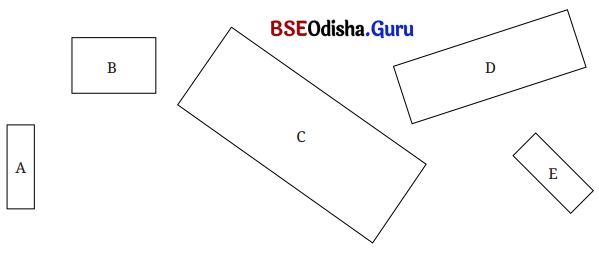
Look at the following rectangles. Which rectangles are similar to each other? You can verify this by measuring the width and height using a scale and comparing their ratios.
Answer:
| Rectangle | Width | Height | Ratio |
| A | 0.5 cm | 1.5 cm | 0.5 : 1.5 = 1 : 3 |
| B | 1.5 cm | 1 cm | 1.5 : 1 = 3 : 2 |
| C | 4.5 cm | 2 cm | 4.5 : 2 = 9 : 4 |
| D | 3.5 cm | 1 cm | 3.5 : 1 = 7 : 2 |
| E | 0.5 cm | 1.5 cm | 0.5 : 1.5 = 1 : 3 |
Since rectangles A and E have the same simplified ratio 1 : 3. So, they are similar to each other.
Question 5.
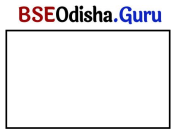
Look at the following rectangle. Can you draw a smaller rectangle and a bigger rectangle with the same width to height ratio in your notebooks? Compare your rectangles with your classmates’ drawings.
Are all of them the same? If they are different from yours, can you think why? Are they wrong?
Answer:
For the given rectangle;
Width = 32 mm and height = 18 mm
∴ Ratio is 32 : 18.
We shall draw smaller and bigger rectangles and similar to the given rectangle by considering different ‘factors of change’.
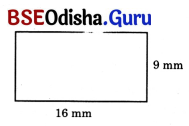
Let the factor of change be \(\frac{1}{2}\).
∴ New width = \(\frac{1}{2}\) × 32 = 16 mm
and New height = \(\frac{1}{2}\) × 18 = 9 mm
A new, similar rectangle is shown in the figure.
Let ‘factor of change’ be 2.
∴ New width = 2 × 32 = 64 mm and new height = 2 × 18 = 36 mm
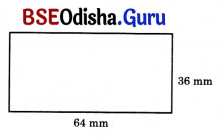
A new, similar rectangle is shown in the figure. The rectangles drawn by other classmates are all different, but they are all similar to the given rectangle.
Question 6.
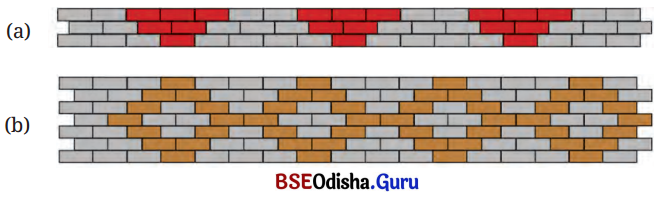
The following figure shows a small portion of a long brick wall with patterns made using coloured bricks. Each wall continues this pattern throughout the wall. What is the ratio of grey bricks to coloured bricks? Try to give the ratios in their simplest form.
Answer:
(a) We consider one set of patterns in the given wall.
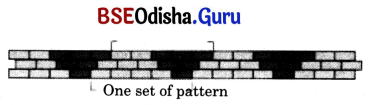
Number of grey bricks in one set of pattern = 2 + 3 + 4 = 9
Number of coloured bricks in one set of pattern = 3 + 2 + 1 = 6
∴ Ratio of grey bricks to coloured bricks = 9 : 6
We have 9 : 6 = 3 : 2
∴ Ratio in the simplest form = 3 : 2
(b) We use one set of patterns on the given wall
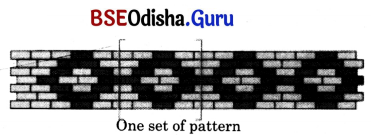
One set of pattern
Number of grey bricks in one set of pattern
= (\(\frac{1}{2}\) + 1 + 1 + \(\frac{1}{2}\)) + (1 + 1) + (\(\frac{1}{2}\) + 1 + \(\frac{1}{2}\)) + (1 + 1) + (\(\frac{1}{2}\) + 1 + \(\frac{1}{2}\)) + (1 + 1) + (\(\frac{1}{2}\) + 1 + 1 + \(\frac{1}{2}\))
= 3 + 2 + 2 + 2 + 2 + 2 + 3 = 16
Number of coloured bricks in one set of pattern
= 1 + (1 + 1) + (1 + 1) + (1 + 1) + (1 + 1) + (1 + 1) + 1
= 1 + 2 + 2 + 2 + 2 + 2 + 1 = 12
∴ Ratio of grey bricks to coloured bricks = 16 : 12
We have 16 : 12 = 4 : 3
∴ Ratio in the simplest form = 4 : 3.
Question 7.
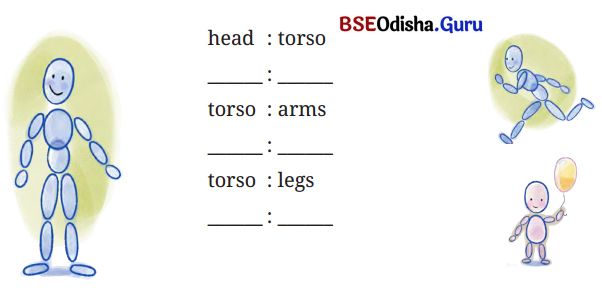
Let us draw some human figures. Measure your friend’s body-the lengths of their head, torso, arms, and legs. Write the ratios as mentioned below-
Answer:
My friend’s body measurements :
(i) Head = 22 cm
(ii) Torso (neck to hip) = 50 cm
(iii) Arms (shoulder to fingertip) = 60 cm
(iv) Legs (hip to foot) = 80 cm
1. Head : Torso = 22 : 50
Simplify by dividing both by 2 → 11 : 25.
2. Torso : Arms = 50 : 60
Simplify by dividing both by 10 → 5 : 6.
3. Torso : Legs = 50 : 80
Simplify by dividing both by 10 → 5 : 8.
So the ratios are:
- Head : Torso = 11 : 25
- Torso : Arms = 5 : 6
- Torso : Legs = 5 : 8
Figure it Out (Page 170 – 171) :
Question 1.
The Earth travels approximately 940 million kilometres around the Sun in a year. How many kilometres will it travel in a week?
Answer:
We know that:
1 million = 10 lakh = 10,00,000
and 1 year = \(\frac{365}{7}\) weeks.
940 million kilometres, i.e., 940 × 10,00,000 kilometres, are travelled by the Earth in 1 year, i.e., in \(\frac{365}{7}\) weeks.
Let the fiarth travel x kilometres in 1 week
∴ The ratios 940 × 10,00,000 : \(\frac{365}{7}\) and x : 1 are
in proportion.
⇒ \(\frac{940 \times 10,00,000}{\frac{365}{7}}\) = \(\frac{x}{1}\)
⇒ x = \(\frac{940 \times 10,00,000 \times 7}{365}\)
⇒ x = \(\frac{188 \times 70,00,000}{73}\)
⇒ x = 1,80,27,397 (nearly)
∴ In 1 week, Earth travels nearly 1,80,27,397 kilometres around the Sun.
Question 2.
A mason is building a house in the shape shown in the diagram. He needs to construct both the outer walls and the inner wall that separates two rooms. To build a wall of 10-feet, he requires approximately 1450 bricks. How many bricks would he need to build the house? Assume all walls are of the same height and thickness.
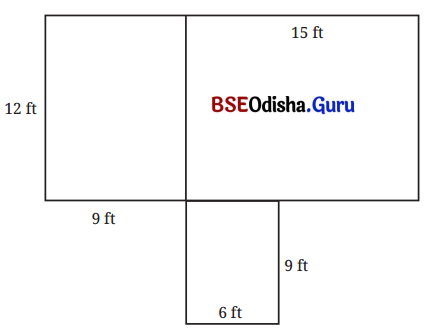
Answer:
Number of bricks required for a 10ft wall =1450
∴ Ratio of length of wall to number of bricks = 10 : 1450
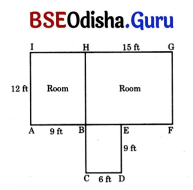
Total length of walls = AI + CH + DE + FG + IG + AF + CD
= 12 + (9 + 12) + 9 + 12 + (9 + 15) + (9 + 15) + 6 = 108 ft
Let x bricks be required for a 108 ft long wall.
∴ Ratio of length of wall to number of bricks = 108 : x
These ratios are in proportion.
∴ 10 : 1450 :: 108 : x
⇒ \(\frac{10}{1450}\) = \(\frac{108}{x}\)
⇒ \(\frac{1}{145}\) = \(\frac{108}{x}\)
⇒ x = 145 × 108 = 15,660
∴ Number of required bricks = 15,660.
Figure it Out (Page 175) :
Question 1.
Divide ₹4,500 into two parts in the ratio 2 : 3.
Answer:
Given ratio = 2 : 3
Amount to be divided = ₹ 4,500
∴ First part = \(\frac{2}{2 + 3}\) × 4,500
= \(\frac{2}{5}\) × 4,500 = 2 × 900 = ₹ 1,800
∴ Second part= \(\frac{3}{2 + 3}\) × 4,500 = \(\frac{3}{5}\) × 4,500
= 3 × 900 = ₹ 2,700
∴ Two parts are ₹ 1,800 and ₹ 2,700.
Verification:
1,800 : 2,700 = \(\frac{1,800}{2,700}\)
\(\frac{18}{27}\) = \(\frac{2}{3}\) = 2 : 3 and 1,800 + 2,700 = 4,500.
Question 2.
In a science lab, acid and water are mixed in the ratio of 1 : 5 to make a solution. In a bottle that has 240 mL of the solution, how much acid and water does the solution contain?
Answer:
Ratio of acid and water = 1 : 5
Quantity of solution = 240 mL
∴ Quantity of acid = \(\frac{1}{1 + 5}\) × 240
= \(\frac{1}{6}\) × 240 = 40 mL
∴ Quantity of water = \(\frac{1}{1 + 5}\) × 240
= \(\frac{5}{6}\) × 240 = 200 mL
∴ Quantities of acid and water in the solution are 40 mL and 200 mL.
Verification: 4Q
40 : 200 = \(\frac{40}{200}\)
\(\frac{1}{5}\) = 1 : 5 and 40 + 200 = 240.
Question 3.
Blue and yellow paints are mixed in the ratio of 3 : 5 to produce green paint. To produce 40 mL of green paint, how much of these two colours are needed? To make the paint a lighter shade of green, I added
20 mL of yellow to the mixture. What is the new ratio of blue and yellow in the paint?
Answer:
Ratio of blue and yellow paints = 3 : 5
Quantity of green paint = 40 mL
∴ Quantity of blue paint = \(\frac{3}{3 + 5}\) × 40
= \(\frac{3}{8}\) × 40 = 15 mL
∴ Quantity of yellow paint = \(\frac{5}{3 + 5}\) × 40
= \(\frac{5}{8}\) × 40 = 25 mL
Addition of yellow paint to the mixture = 20 mL
∴ New quantity of blue paint =15 mL
∴ New quantity of yellow paint = 25 mL + 20 mL = 45 mL
∴ New ratio of blue and yellow paints
= 15 : 45 = 1 : 3.
Question 4.
To make soft idlis, you need to mix rice and urad dal in the ratio of 2 : 1. If you need 6 cups of this mixture to make idlis tomorrow morning, how many cups of rice and urad dal will you need?
Answer:
Ratio of rice and urad dal = 2 : 1
Total number of cups of mixture = 6
∴ Number of cups of rice = \(\frac{2}{2 + 1}\) × 6
= \(\frac{2}{3}\) × 6 = 4
∴ Number of cups of urad dal = \(\frac{1}{2 + 1}\) × 6
= \(\frac{1}{3}\) × 6 = 2
∴ 4 cups of rice and 2 cups of urad dal are to be mixed.
Question 5.
I have one bucket of orange paint that I made by mixing red and yellow paints in the ratio of 3 : 5. I added another bucket of yellow paint to this mixture. What is the ratio of red paint to yellow paint in the new mixture?
Answer:
Let the capacity of one bucket be x L.
Ratio of red paint and yellow paint = 3 : 5
∴ Quantity of red paint in the bucket = \(\frac{3}{3 + 5}\) × x = \(\frac{3 x}{8}\)
∴ Quantity of yellow paint in the bucket = \(\frac{5}{3 + 5}\) × x = \(\frac{5 x}{8}\)
One bucket of yellow paint is added to the mixture.
∴ New quantity of red paint in the mixture = \(\frac{3 x}{8}\)
∴ New quantity of yellow paint in the mixture = \(\frac{5 x}{8}\)
+ x = \(\frac{13 x}{8}\)
∴ New ratio of red paint and yellow paint in the mixture = \(\frac{3 x}{8}\) : \(\frac{13 x}{8}\) = 3 : 13
Figure it Out (Page 176 – 177) :
Question 1.
Anagh mixes 600 mL of orange juice with 900 mL of apple juice to make a fruit drink. Write the ratio of orange juice to apple juice in its simplest form.
Answer:
Quantity of orange juice = 600 mL
Quantity of apple juice = 900 mL
∴ Ratio of orange juice to apple juice = 600 : 900
Ratio in the simplest form = 600 : 900 = 2:3
Question 2.
Last year, we hired 3 buses for the school trip. We had a total of 162 students and teachers who went on that trip and all the buses were full. This year we have 204 students. How many buses will we need? Will all the buses be full?
Answer:
Number of buses for 162 students and teachers = 3
Since the buses were full, the capacity of 1 bus = \(\frac{162}{3}\) = 54
∴ Ratio of number of seats to the number of buses is 54 : 1.
We have
54 : 1 = 2(54) : 2(1) = 108 : 2
54 : 1 = 3(54) : 3(1) = 162 : 3
54 : 1 = 4(54): 4(1) = 216 : 4
∴ Capacity of 4 buses = 216
∴ For 204 students, we shall need 4 buses.
Since 216 – 204 = 12, we have 12 vacant seats in the buses.
Question 3.
The area of Delhi is 1,484 sq. km and the area of Mumbai is 550 sq. km. The population of Delhi is approximately 30 million and that of Mumbai is 20 million people. Which city is more crowded? Why do you say so?
Answer:
Area of Delhi = 1,484 sq.km
Population of Delhi = 30 million
Area of Mumbai = 550 sq. km
Population of Mumbai = 20 million
∴ Ratio of area to population for Delhi = 1484 : 30
∴ Ratio of area to population for Mumbai = 550 : 20
Factor of change of area = \(\frac{550}{1484}\) = 0.371 (nearly)
Factor of change of population = \(\frac{20}{30}\) = 0.667 (nearly)
Since 0.667 > 0.371, Mumbai is more crowded than Delhi.
Alternative Method:
Ratio of area to population for Delhi = 1484 : 30
Let the density of Delhi and Mumbai be the same, and there be x people in Mumbai.
∴ The ratios 1,484 : 30 and 550 : x are in proportion.
∴ \(\frac{1,484}{30}\) = \(\frac{550}{x}\)
⇒ 1484x = 30 × 550 = 16,500
⇒ x = \(\frac{16500}{1484}\) = 11.118
There should be 11.118 million people in Mumbai. But the population of Mumbai is 20 million.
∴ Mumbai is more crowded than Delhi.
Question 4.
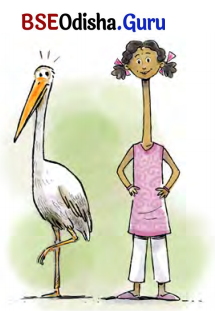
A crane of height 155 cm has its neck and the rest of its body in the ratio 4 : 6. For your height, if your neck and the rest of the body also had this ratio, how tall would your neck be?
Answer:
The ratio of the height of the neck and the height of the rest of the body of a crane is 4 : 6. My height is 65 inches, i.e., 165 cm.
Let the ratio of the height of my neck and the height of the rest of my body also be 4 : 6.
∴ Height of my neck = (\(\frac{4}{4 + 6}\) × 165)cm = 66 cm
Question 5.
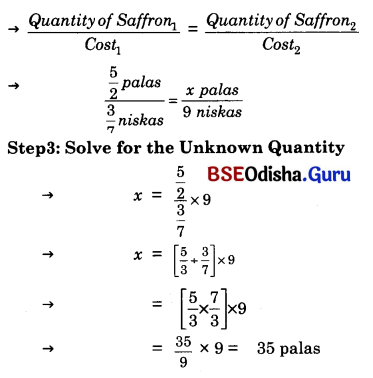
Let us try an ancient problem from Lilavati. At that time weights were measured in a unit named palas and niskas was a unit of money. “If 2\(\frac{1}{2}\) palas of saffron costs \(\frac{3}{7}\) niskas, O expert businessman! tell me quickly what quantity of saffron can be bought for 9 niskas?”
Answer:
A proportional relationship between the quantity of saffron and its cost is described. The cost of a known quantity of saffron is provided, and the quantity of saffron that can be purchased for a different amount of money is to be determined.
Step 1: Convert Mixed Numbers to Improper Fractions
= The given quantity of saffron, 2\(\frac{1}{2}\) palas, converted to an improper fraction:
→ 2\(\frac{1}{2}\) = \(\frac{2 \times 2+1}{2}\) = \(\frac{5}{2}\)
= The given cost, \(\frac{3}{7}\) niskas.
Step 2 : Set Up the Proportion
A proportion is established relating the quantity of saffron to its cost. Let x be the unknown quantity of saffron.
Question 6.
Harmain is a 1-year-old girl. Her elder brother is 5 years old. What will be Harmain’s age when the ratio of her age to her brother’s age is 1 : 2?
Answer:
The current ages are given as Harmain being 1 year old and her brother being 5 years old.
→ The age difference = 5 – 1 = 4 years.
= The difference will remain constant over time.
= Let x be the number of years that pass untill the desired ratio is achieved.
= After x years, Harmain age will be 1 + x years
= After x years, her brother’s age will be 5 + x years
= Ratio is given as 1 : 2.
Can be expressed as \(\frac{1 + x}{5 + x}\) = \(\frac{1}{2}\)
→ 2(1 + x) = 1(5 + x)
→ 2 + 2x = 5 + x
→ 2x – x = 5 – 2
→ x = 3
= Harmain’s age when the ratio is 1 : 2 is found by adding * to her current age.
→ 1 + 3 = 4 years.
Harmain’s age will be 4 years when the ratio of her age to her brother’s age is 1 : 2
Question 7.
The mass of equal volumes of gold and water are in the ratio 37 : 2. If 1 litre of water is 1 kg in mass, what is the mass of 1 litre of gold?
Answer:
The given ratio of the mass of the gold to the mass of water for equal Volumes is 37 : 2
This Can be expressed as \(\frac{\text { Mass of gold }}{\text { Mass of water }}\) = \(\frac{37}{2}\)
= It is stated that 1 litre of water has a mass of 1kg.
Mass of 1 litre of gold = 1kg × \(\frac{37}{2}\)
= \(\frac{37}{2}\) kg = 18.5 kg
= The mass of 1 litre of gold is 18.5 kg.
= Mass of 1L of water is given as 1kg.
= Ratio to find the mass of 1L of gold
= Ratio of mass of equal volumes of gold to water is 37 : 2
\(\frac{\text { Mass of gold }}{\text { Mass of water }}\) = \(\frac{37}{2}\)
= Mass of Gold = Mass of water × \(\frac{37}{2}\)
= Mass of Gold = \(\frac{37}{2}\)kg = 18.5 kg.
So… Mass of 1 litre of gold is 18.5 kg.
Question 8.
It is good farming practice to apply 10 tonnes of cow manure for 1 acre of land. A farmer is planning to grow tomatoes in a plot of size 200 ft by 500 ft. How much manure should he buy? (Please refer to the section on Unit Conversions earlier in this chapter).
Answer:
Let’s Calculate the area of the plot in square feet.
Area = Length × width
Area = 500ft × 200ft = 100,000ft2
Convert the area from Square feet to acres we knew 1 acre = 43560ft2
Area in acres = \(\frac{100000 f^2}{43560 f^2}\) = 2.2956 acres
Calculate the total amount of manure required.
Manure required = 2.2956 acres × 10 tonnes/acres
= 22.956 tonnes.
Question 9.
A tap takes 15 seconds to fill a mug of water. The volume of the mug is 500 mL. How much time does the same tap take to fill a bucket of water if the bucket has a 10-litre capacity?
Answer:
Time taken by the tap for 500 mL of water = 15 seconds
∴ Ratio of volume to time = 500 : 15
We know 1 litre = 1,000 mL
10 litre = 10 × 1,000 = 10,000 mL
Let the time taken to fill a bucket of 10,000 mL be x seconds.
∴ Ratio of volume to time = 10,000 : x
These ratios are proportional.
∴ 500 : 15 :: 10,000 : x
⇒ \(\frac{500}{15}\) = \(\frac{10,000}{x}\)
⇒ 500x = 1,50,000
⇒ x = 300
∴ Time to fill bucket = 300 seconds \(\frac{300}{60}\) = minutes = 5 minutes.
Question 10.
One acre of land costs ₹15,00,000. What is the cost of 2,400 square feet of the same land?
Answer:
We know that 1 acre = 43,560 square feet.
∴ Cost of 43,560 sq. ft. land = ₹15,00,000
∴ Ratio of area of land to cost = 43,560 : 15,00,000
Let the cost of 2,400 sq. ft. of land be ₹x.
∴ Ratio of area of land to cost = 2,400 : x
These ratios are proportional.
∴ 43,560 : 15,00,000 :: 2,400 : x
⇒ \(\frac{43,560}{15,00,000}\) = \(\frac{2,400}{x}\)
⇒ 43,560x = 2,400 × 15,00,000
⇒ x = \(\frac{2,400 \times 15,00,000}{43,560}\)
⇒ x = 82,664.63
∴ Cost of land = ₹82,664.63.
Question 11.
A tractor can plough the same area of a field 4 times faster than a pair of oxen. A farmer wants to plough his 20-acre field. A pair of oxen takes 6 hours to plough an acre of land. How much time would it take if the farmer used a pair of oxen to plough the field? How much time would it take him if he decides to use a tractor instead?
Answer:
Ratio of efficiency of a tractor to a pair of oxen = 4 : 1
Time taken by a pair of oxen to plough 1 acre of field = 6 hours
∴ Time taken by a tractor to plough 1 acre field = \(\frac{6}{4}\) = 1.5 hours
∴ Time taken by a pair of oxen to plough 20 20- acre field = 20 × 6 = 120 hours
∴ Time taken by a tractor to plough a 20-acre field = 20 × 1.5 = 30 hours
Question 12.
The ₹10 coin is an alloy of copper and nickel called ‘cupro-nickel’. Copper and nickel are mixed in a 3 : 1 ratio to get this alloy. The mass of the coin is 7.74 grams. If the cost of copper is ₹906 per kg and the cost of nickel is ₹1,341 per kg, what is the cost of these metals in a ₹10 coin?
Answer:
Ratio of copper and nickel in ₹10 coin = 3 : 1
Mass of one ₹10 coin = 7.74 grams
∴ Mass of copper in one ₹10 coin = \(\frac{3}{3 + 1}\) × 7.74
\(\frac{3}{4}\) × 7.74 = 5.805 grams
Maas of nickel in one ₹10 coin = \(\frac{1}{3 + 1}\) × 7.74
= \(\frac{1}{4}\) × 7.74 = 1.935 grams
Cost of 1 kg copper = ₹ 906
∴ Cost of 1000 grams of copper = ₹ 906
∴ Cost of 5.805 grams copper = \(\frac{906}{1000}\) × 5.805
= ₹5.26
Cost of 1 kg nickel = ₹1341
∴ Cost of 1000 grams of nickel = ₹1341
∴ Cost of 1.935 grams nickel = \(\frac{1341}{1000}\) × 1.935
= ₹2.59
∴ In one ₹10 coin, the cost of copper and the cost of nickel are respectively ₹5.26 and ₹2.59.
Proportional Reasoning 1 Class 8 Extra Questions
Multiple Choice Questions
Question 1.
The ratio 72 : 96 in its simplest form is:
(a) 2 : 3
(b) 3 : 4
(c) 2 : 5
(d) 1 : 2
Solution:
HCF of 72 and 96 = 24
Now, \(\frac{72}{96}\) = \(\frac{72 \div 24}{95 \div 24}\) = \(\frac{3}{4}\)
(b) 3 : 4
Question 2.
The equivalant ratio, for the ratio 2 : 3 in the simplest form, is :
(a) 24 : 48
(b) 13 : 39
(c) 50 : 75
(d) 36 : 90
Solution:
HCF of 50 and 75 = 25
∴, \(\frac{50}{75}\) = \(\frac{50 \div 25}{75 \div 25}\) = \(\frac{2}{3}\)
∴, equivalant ratio of 2 : 3 is 50 : 75
Question 3.
If 14 : 21 :: 2 : x, then the value of x is :
(a) 1
(b) 2
(c) 14
(d) 3
Solution:
Since, 14 : 21 in the simplest form is 2 : 3.
Hence, x = 3
(d) 3
Question 4.
If 24 : x :: 48 : 72, then the value of x is:
(a) 36
(b) 30
(c) 48
(d) 32
Solution:
For 24 : x : : 48 : 72, we write
\(\frac{24}{x}\) = \(\frac{48}{72}\) ⇒ \(\frac{24}{x}\) = \(\frac{2}{3}\) ⇒ 2x = 2 × 3
⇒ x = \(\frac{24 \times 3}{2}\) ⇒ x = 36
(a) 36
Question 5.
If 15 : 35 = x : y, then x : y is :
(a) 5 : 7
(b) 3 : 7
(c) 1 : 3
(d) 3 : 4
Solution:
Hence, 15 : 35 = \(\frac{15}{35}\) = \(\frac{3}{7}\) = 3 : 7
(b) 3 : 7
Assertion and Reasoning
(a) Assertion (A) and Reason (R) both are true and Reason (R) is the correct explanation for the Assertion (A).
(b) Assertion (A) and Reason (R) both are true but Reason (R) is not the correct explanation for the Assertion (A).
(c) Assertion (A) is true but Reason (R) is false.
(d) Assertion (A) is false but Reason (R) is true.
Question 1.
Assertion (A) : The ratio 60 : 40 can be written as 3 : 2 in simplest form.
Reason (R) : To get the ratio in simplest form we divide both numerator and denominator by the HCF of them.
Solution:
\(\frac{60}{40}\) = \(\frac{60 \div 20}{40 \div 20}\) = \(\frac{3}{2}\) (HCF (60, 40) = 20)
(a) Assertion (A) and Reason (R) both are true and Reason (R) is the correct explanation for the Assertion (A).
Question 2.
Assertion (A) : 15 : 20 : : 12 : 16
Reason (R) : a : b :: c : d ⇔ \(\frac{a}{b}\) = \(\frac{c}{d}\)
Solution:
If \(\frac{x}{y}\) = \(\frac{z}{u}\), then x : y and z : u are in proportion.
Hence, x : y : : z : u
(a) Assertion (A) and Reason (R) both are true and Reason (R) is the correct explanation for the Assertion (A).
Case Based Questions
Question 1.
For the mid-day meal in a school with 600 students, the cook usually makes 75 kg of rice. On a certain day, only 120 students came to school.

(i) How much rice in grams is cooked for each student?
(ii) How much rice will be cooked if 120 students came to school?
(iii) What is the factor of change in the first term of 600 : 75 : 120:?
(iv) If on a certain day 180 students came to school, then how much rice will be cooked on that day?
Answer:
(i) Since, 75 kg of rice is cooked for 600 students Hence, for 1 student the amount of rice cooked 
(ii) If 120 students come to school, then the amount of rice to be cooked 15. 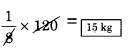
(iii) Factor of change in the first term is : \(\frac{120}{600}\) = \(\frac{1}{5}\)
(iv) If 180 students come to school, then the amount of rice to be cooked on that day = \(\frac{1}{8}\) × 180 kg = 22.5 kg