
Regular revision with Class 7 Maths MCQ with Answers and Ganita Prakash Class 7 Maths Chapter 2 Arithmetic Expressions MCQ improves accuracy in objective exams.
MCQ on Arithmetic Expressions Class 7
Arithmetic Expressions MCQ Class 7
Class 7 Maths Arithmetic Expressions MCQ
Question 1.
The value of expression 8 + 7 + 6 is:
(a) 21
(b) 19
(c) 20
(d) 17
Solution:
(a) 21
We have, 8 + 7 + 6 = 15 + 6 = 21
Question 2.
Compare and choose the correct option to fill the box: 24 + 16 ☐ 56 – 16.
(a) >
(b) <
(c) =
(d) None of these
Solution:
(c) =
Given, 24 + 16 ☐ 56 – 16
Left hand side (LHS) = 24 + 16 = 40
Right hand side (RHS) = 56 – 16 = 40
Clearly, LHS = RHS So, 24 + 16 = 56 – 16
Question 3.
Compare and choose the correct option to fill the box: 4 × 3 ☐ 78 ÷ 6.
(a) >
(b) <
(c) =
(d) None of these
Solution:
(b) <
Left hand side (LHS): 4 × 3 = 12
Right hand side (RHS): 78 ÷ 6 = 13
Clearly, 12 < 13 ⇒ 4 × 3 < 78 ÷ 6

Question 4.
In a sweet shop, Meena packed 12 laddoos in one box and 4 in another. Kunal packed 10 laddoos in one big box and none in the second. Who packed more laddoos?
(a) Meena
(b) Kunal
(c) Both packed the same number
(d) Depends on the sweetness
Solution:
(a) Meena
Laddoos packed by Meena = 12 + 4= 16
Laddoos packed by Kunal = 10 + 0= 10
Thus, Meena packed more laddoos.
Question 5.
The number of terms in the expression 40 – 7 × 3 + 8 ÷ 2 – 4is:
(a) 2
(b) 3
(c) 4
(d) 5
Solution:
(c) 4
We have, 40 – 7 × 3 + 8 ÷ 2 – 4

So, there are 4 terms in the given expression.
Question 6.
The value of the expression 100 – {25 – (10 × 5)} is:
(a) 125
(b) 115
(c) 120
(d) 130
Solution:
(a) 125
We have, 100 – {25 – (10 × 5)}
We know, on removing the brackets preceded by a minus sign, the signs of all the terms inside the brackets change.
Thus, 100 – {25 – (10 × 5)}
= 100 – 25 + (10 × 5)
= 100 – 25 + 50 = 150 – 25 = 125
Question 7.
The value of the expression 240 – [60 – (30 – 8 ÷ 2) + 10] is:
(a) 192
(b) 194
(c) 196
(d) 198
Solution:
(c) 196
240 – [60 – (30 – 8 ÷ 2) + 10]
= 240 – [60 – (30 – 4) + 10]
= 240 – [60 – 26 + 10]
= 240 – 44 = 196
Question 8.
Which of the following is equal to the expression ‘53 – 17 + 4’?
(a) 53 – (17 + 4)
(b) 53 + (17 – 4)
(c) 53 – (17 – 4)
(d) 4 + (17 – 53)
Solution:
(c) 53 – (17 – 4)
We know, on removing the brackets preceded by a minus sign, the signs of all the terms inside the brackets change.
So, 53 – (17 – 4) = 53 – 17 + 4
Question 9.
Which of the following expressions are the arithmetic expressions?
(i) 12 + (2 × 4 – 6)
(ii) 7x + 2y – 3
(iii) 18 ÷ 3 + 7
(iv) 4xy – 11
Choose the correct option from the following:
(a) (i) and (iii) only
(b) (ii) and (iv) only
(c) (i), (ii), (iii) and (iv)
(d) None of these
Solution:
(a) (i) and (iii) only
We know, an arithmetic expression is a
mathematical sentence that contains numbers and operations like addition (+), subtraction (-), multiplication (×) or division (÷).
So, 12 + (2 × 4 – 6) and 18 ÷ 3 + 7 are arithmetic expressions.
And, 7x + 2y – 3 and 4xy – 11 are not arithmetic expressions because x and y are not numbers.
Question 10.
Which of the following are correct?
(i) The signs ‘>’, ‘=’ and ‘<’ are used to compare the values of two expressions.
(ii) 276- 19 < 275- 18 (iii) 366 – 20 = 380 – 34 (iv) 490 – 20 > 396 – 30
Choose the correct option from the following:
(a) (i) and (iii) only
(b) (ii) and (iv) only
(c) (i), (ii) and (iii)
(d) (i), (iii) and (iv)
Solution:
(d) (i), (iii) and (iv)
(i) Yes, the signs ‘>’, ‘=’ and ‘<’ are used to compare the values of two expressions.
So, (i) is correct.
(ii) Left-hand side (LHS): 276 – 19 = 257
Right-hand side (RHS): 275 – 18 = 257
Clearly, 276- 19 = 275- 18.
So, (ii) is incorrect.
(iii) Left-hand side (LHS): 366 – 20 = 346
Right-hand side (RHS): 380 – 34 = 346
Clearly, 366 – 20 = 380 – 34.
So, (iii) is correct.
(iv) Left-hand side (LHS): 490 – 20 = 470
Right-hand side (RHS): 396 – 30 = 366
Clearly, 470 > 366
⇒ 490 – 20 > 396 – 30
So, (iv) is correct.
Arithmetic Expressions Class 7 Assertion and Reason Questions
The following questions are Assertion and Reason based questions. Two statements are given, one labelled as Assertion (A) and the other is labelled as Reason (R). Select the correct answer to these questions from the codes (a), (b), (c) and (d) as given below.
(a) Both A and R are true and R is the correct explanation of A.
(b) Both A and R are true but R is not the correct explanation of A.
(c) A is true but R is false.
(d) A is false but R is true.
Question 1.
(A): 110 – 27 > 112 – 27
(R): When the same number is subtracted from two different numbers, the difference is greater for the larger number.
Solution:
(d) A is false but R is true.
We know, when the same number is subtracted
from two different numbers, the difference is greater for the larger number.
Since 112 is larger than 110,
110 – 27 < 112 – 27 Therefore, Assertion (A) is false, but Reason (R) is true.
Question 2.
(A): 568 + 247 > 572 + 248
(R): If a < b and c < d, then a + c < b + d, where a, b, c and d are numbers.
Solution:
(d) A is false but R is true.
If a < b and c < d, then a + c < b + d, where a,
b, c and d are numbers.
Clearly, 568 < 572 and 247 < 248
So, 568 + 247 < 572 + 248
Therefore, Assertion (A) is false, but Reason (R) is true.
Question 3.
(A): 5 – 2 ≠ 5 + (-2)
(R): Subtracting a number is the same as adding its additive inverse.
Solution:
(d) A is false but R is true.
We know that subtracting a number is the same
as adding its additive inverse.
∴ 5 – 2 = 5 + (- 2) as – 2 is additive inverse of 2.
Therefore, Assertion (A) is false and Reason (R) is true.
Question 4.
(A) : 16 – (- 7 + 19) = 16 – 7 + 19
(R) : On removing the brackets preceded by a plus “ + ’ sign, the signs of all the terms inside the brackets remain same.
Solution:
(d) A is false but R is true.
We know, on removing the brackets preceded by a ‘+’ sign, the signs of all the terms inside the brackets remains same.
But in expression ‘16 – (-7 + 19)’, brackets are preceded by minus sign.
Therefore, 16 – (- 7 + 19) = 16 + 7 – 19
Therefore, Assertion (A) is false, but Reason (R) is true.
Arithmetic Expressions Class 7 Fill in the Blanks
Question 1.
Fill in the blanks with the correct sign: ‘<’ , ‘>’ or ‘=’:
(i) 111 – 28 _____ 85
(ii) 55 ÷ 11 ____ 5
Solution: <, =
(i) LHS: 111 – 28 = 83
RHS: 85
Clearly, 83 < 85 ⇒ 111 – 28 < 85
(ii) LHS: 55 ÷ 11 = 5
RHS: 5
Clearly, LHS = RHS ⇒ 55 – 11 = 5
Question 2.
Fill in the blanks to make the expressions equal on both sides of the ‘ = ’ sign:
(i) 19 + 6 = ____ + 9
(ii) 9 × _____ = 72 ÷ 2
Solution: 16, 4
(i) 19 + 6 = 16 + 9
[∵ 19 + 6 = 25 and 16 + 9 = 25]
(ii) 9 × 4 = 72 ÷ 2
[∵ 72 ÷ 2 = 36 and 9 × 4 = 36]
Question 3.
In the blanks below, fill ‘<’, ‘>’ or ‘=’ after analysing the expressions on the LHS and RHS. Use reasoning and understanding of terms and brackets to figure this out, and not by evaluating the expressions.
(i) (12 – 7) × 36 _____ (7 – 12) × 36
(ii) 20 + 6 × 15 _____ (20 + 6) × 15
Solution: <, <
(i) LHS : (12 – 7) × 36 = Positive number × 36 → Positive number
RHS : (7 – 12) × 36 = Negative number × 36 → Negative number
We know, a positive number is always greater than a negative number.
Thus, LHS > RHS
Hence, (12 – 7) × 36 > (7 – 12) × 36
(ii) RHS : (20 + 6) × 15
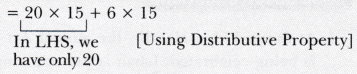
Thus, LHS < RHS
Hence, 20 + 6 × 15 < (20 + 6) × 15
Question 4.
Fill in the blanks with numbers and boxes with operation signs such that the expressions on both sides are equal.
(i) 21 + (___ ☐ ____) = 21 + 12 – 5
(ii) 32 – (3 + 8) = 32 ☐ 3 – _____
(iii) 25 – (11 ☐ 7) = 25 – 11 + 7
(iv) 19 – (17 – 12) = 19 ☐ 17 ☐ 12
Solution: 12 – 5, 8, -, -, +
(i) 21 + ( 12 – 5) = 21 + 12 – 5
(ii) 32 – (3 + 8) = 32 – 3 – 8
(iii) 25 – (11 – 7) = 25 – 11 + 7
(iv) 19 – (17 – 12) = 19 – 17 + 12