
Regular revision with Class 7 Maths MCQ with Answers and Ganita Prakash Class 7 Maths Part 2 Chapter 3 Finding Common Ground MCQ improves accuracy in objective exams.
MCQ on Finding Common Ground Class 7
Finding Common Ground MCQ Class 7
Class 7 Maths Finding Common Ground MCQ
Question 1.
The correct prime factorisation of 168 is:
(a) 2 × 2 × 2 × 21
(b) 2 × 4 × 3 × 7
(c) 2 × 2 × 6 × 7
(d) 2 × 2 × 2 × 3 × 7
Solution:
(c) 2 × 2 × 6 × 7
Prime factorisation of number 168 using division method:
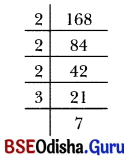
Thus, 168 = 2 × 2 × 2 × 3 × 7
Hence, the prime factorisation of 168 is 2 × 2 × 2 × 3 × 7
Question 2.
If the number 198 can be written as product of prime numbers as 198 = 2 × 3 × 11 × ______. The
missing prime factor is:
(a) 1
(b) 2
(c) 3
(d) 11
Solution:
(c) 3
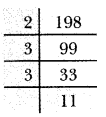
Prime factorisation of number 198 using division method:
Thus, 198 = 2 × 3 × 3 × 11
Hence, the missing prime factor is 3.
Question 3.
The multiple of 5 × 3 × 7 is:
(a) 41
(b) 420
(c) (5 × 3 × 7) × 2
(d) Both (b) and (c)
Solution:
(d) Both (b) and (c)
The multiple of 5 × 3 × 7 is a number that contains all its factors.
Here, (5 × 3 × 7) × 2 and (5 × 3 × 7) × 4 i.e. 420, are multiples of 5 × 3 × 7.

Question 4.
21 mango trees, 42 apple trees and 56 orange trees have to be planted in rows such that each row contains the same number of trees of one variety only. Minimum number of rows in which the trees may be planted is:
(a) 3
(b) 15
(c) 17
(d) 20
Solution:
(c) 17
Maximum number of plants in each row
= HCF of 21, 42 and 56 = 7
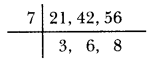
Number of rows of mango trees = 21 ÷ 7 = 3
Number of rows of apple trees = 42 ÷ 7 = 6
Number of rows of orange trees = 56 ÷ 7 = 8
∴ Required number of rows = 3 + 6 + 8
= 17
Question 5.
All the factors of the number 96 are:
(a) 1, 2, 3, 4, 6, 8, 12, 16, 24, 32, 48
(b) 1, 2, 3, 4, 6, 8, 12, 16, 24, 32, 48, 96
(c) 1, 2, 4, 8, 16, 32, 64
(d) 1, 2, 3, 6, 8, 12, 24, 48, 96
Solution:
(b) 1, 2, 3, 4, 6, 8, 12, 16, 24, 32, 48, 96
Prime factorisation of 96 is given as
96 = 2 × 2 × 2 × 2 × 2 × 3
Taking combinations of prime factors, all factors of 96 are:
1, 2, 3, 4, 6, 8, 12, 16, 24, 32, 48, 96
Question 6.
The HCF of numbers 144, 216 and 360 is:
(a) 72
(b) 24
(c) 36
(d) 12
Solution:
(a) 72
Prime factorisations of 144, 216 and 360 are:
144 = 2 × 2 × 2 × 2 × 3 × 3
216 = 2 × 2 × 2 × 3 × 3 × 3
360 = 2 × 2 × 2 × 3 × 3 × 5
∴HCF (144, 216, 360) = 2 × 2 × 2 × 3 × 3 = 72
Question 7.
The LCM of 57 and 84 is:
(a) 1584
(b) 1596
(c) 4688
(d) 4788
Solution:
(b) 1596
Using prime factorisation method, we have
57 = 3 × 19 and
84 = 2 × 2 × 3 × 7
∴ LCM = 2 × 2 × 3 × 7 × 19 = 1596
Question 8.
The LCM and HCF of 117, 693 and 819 are:
(a) LCM = 9007, HCF = 9
(b) LCM = 9009, HCF = 7
(c) LCM = 9009, HCF = 9
(d) LCM = 9007, HCF = 7
Solution:
(c) LCM = 9009, HCF = 9
Prime factorisations of 117, 693 and 819 are:
117 = 3 × 3 × 13
693 = 3 × 3 × 7 × 11
819 = 3 × 3 × 7 × 13
Thus, HCF = 3 × 3 = 9
The LCM is the product of the highest occurrence of each prime factor, i.e.
LCM = 3 × 3 × 7 × 11 × 13 = 9009
Question 9.
The HCF of two numbers is 40, and their LCM is 8400. If one of the numbers is 240, what is the other number?
(a) 1200
(b) 1400
(c) 1600
(d) 1800
Solution:
(b) 1400
Let the unknown number be x.
We know,
Product of two numbers = HCF × LCM
⇒ 240 × x = 40 × 8400
⇒ x = \(\frac{40 \times 8400}{240}=\frac{8400}{6}\) = 1400
Question 10.
The HCF of two numbers is 8. Which one of the following can never be their LCM?
(a) 24
(b) 48
(c) 56
(d) 60
Solution:
(d) 60
We know, LCM of numbers is a multiple of their HCF.
Since 60 is not a multiple of 8, it can never be the LCM.
Question 11.
There are some sweets in a jar. The sweets can be put into boxes of 3 or 7 with no sweets left over. When the sweets are put into boxes of 20, there are 5 sweets left over. What is the smallest possible number of sweets in the jar?
(a) 48
(b) 105
(c) 125
(d) 165
Solution:
(b) 105
If the sweets can be packed in boxes of 3 or 7 with no remainder, then the number of sweets in the jar is a multiple of LCM of 3 and 7, i.e. 21.
Clearly, the required number is multiple of 21 which leaves a remainder of 5 when divided by
20, i.e. 105.
Question 12.
Which of the following statements are correct?
(i) Prime factorisation of 120 is 2 × 2 × 2 × 3 × 5.
(ii) 18 is a factor of 120.
(iii) Prime factorisation of 126 is 2 × 3 × 3 × 11.
(iv) 42 is a factor of 126.
Choose the correct option from the following:
(a) (i) and (iv)
(b) (ii) and (iii)
(c) (iii) and (iv)
(d) (ii) and (iv)
Solution:
(a) (i) and (iv)
(i) Prime factorisation of 120 is given as:
120 = 2 × 2 × 2 × 3 × 5
∴ (i) is correct.
(ii) Prime factorisation of 18 is 2 × 3 × 3
For 18 to be a factor of 120, the product 2 × 3 × 3 must be the part of the prime factorisation of 120.
Since 3 × 3 does not appear in the prime factorisation of 120, 18 is not a factor of 120.
∴ (ii) is not correct.
(iii) Prime factorisation of 126 is given as:
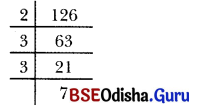
Thus, 126 = 2 × 3 × 3 × 7
∴ (iii) is not correct.
(iv) All factors of 126 are 1,2, 3,6, 7,9, 14, 18, 21, 42, 63 and 126.
∴ (iv) is correct.
Question 13.
A rectangular plot measures 168 metres by 196 metres. Find which of the following correctly represent the side length (in metres) of possible square tile that can be used to pave the entire plot without cutting any tiles.
(i) 3
(ii) 14
(iii) 28
(iv) 6
Choose the correct option from the following:
(a) (i) and (iv)
(b) (ii) and (iv)
(c) (i) and (iii)
(d) (ii) and (iii)
Solution:
(d) (ii) and (iii)
The possible square tiles that can be used to pave the entire plot without cutting any tiles includes HCF of the dimensions of the rectangular plot and its all factors.
HCF of 168 and 196 using common factor method:
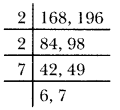
∴ HCF (168, 196) = 2 × 2 × 7
All the factors of 28 are 1, 2, 4, 7, 14 and 28.
Thus, 14 and 28 are the possible tile sizes to cover the floor completely.
Question 14.
Which of the following statements are correct?
(i) 14 and 20 have exactly three common factors.
(ii) The LCM of 14 and 20 is 140.
(iii) 4 × 5 × 7 is a multiple of both 14 and 20.
(iv) 40 is a factor of LCM (4, 5, 10).
Choose the correct option from the following:
(a) (i) and (iv) only
(b) (i), (iii) and (iv)
(c) (ii) and (iii) only
(d) (i), (ii) and (iii)
Solution:
(c) (ii) and (iii) only
(i) As 14 = 2 × 7; 20 = 2 × 2 × 5
Common factors of 14 and 20 are 1 and 2 only.
(ii) We have, 14 = 2 × 7; 20 = 2 × 2 × 5
LCM of 14 and 20 = 2 × 2 × 5 × 7 = 140
(iii) As, 14 = 2 × 7 and 20 = 2 × 2 × 5
4 × 5 × 7 is the LCM of 14 and 20.
Thus, it is a multiple of both 14 and 20.
(iv) Prime factorisations of 4, 5 and.10 are:
4 = 2 × 2; 5 = 5; 10 = 2 × 5
The LCM is the product of the highest occurrence of each prime factor, i.e.
LCM (4, 5, 10) = 2 × 2 × 5 = 20
So, 40 is a multiple of 20 (not a factor).
Hence, statements (ii) and (iii) are correct.
Finding Common Ground Class 7 Assertion and Reason Questions
The following questions are Assertion and Reason based questions. Two statements are given, one labelled as Assertion (A) and the other is labelled as Reason (R). Select the correct answer to these questions from the codes (a), (b), (c) and (d) as given below.
(a) Both A and R are true and R is the correct explanation of A.
(b) Both A and R are true but R is not the correct explanation of A.
(c) A is true but R is false.
(d) A is false but R is true.
Question 1.
(A): The HCF of numbers 31 and 43 is 1.
(R): HCF of two prime numbers is always 1.
Solution:
(a) Both A and R are true and R is the correct explanation of A.
We know that a prime number has two factors only i.e. 1 and the number itself.
∴ HCF of two prime numbers is always 1.
Here, 31 and 43 are prime numbers.
∴ HCF(31, 43) = 1
Thus, both Assertion (A) and Reason (R) are true, and Reason (R) is the correct explanation of Assertion (A).
Question 2.
(A): The HCF of numbers 313 and 314 is 1.
(R): The HCF of any two consecutive numbers is always 1.
Solution:
(a) Both A and R are true and R is the correct explanation of A.
We know, the HCF of two consecutive natural numbers is always 1 because they have no common factor other than 1.
∴ HCF (313, 314) = 1
Thus, both Assertion (A) and Reason (R) are true, and Reason (R) is the correct explanation of Assertion (A).
Question 3.
(A): Two traffic lights change simultaneously every 60 seconds and 90 seconds. They will both change together again after 6 minutes.
(R): The time after which repeating events coincide is a multiple of the LCM.
Solution:
(a) Both A and R are true and R is the correct explanation of A.
Prime factorisations of 60 and 90 are:
60 = 2 × 2 × 3 × 5; 90 = 2 × 3 × 3 × 5
LCM is the product of the highest occurrence of each prime factor, i.e.
LCM (60, 90) = 2 × 2 × 3 × 3 × 5 = 180
So, both traffic lights will change together again after 180 seconds, i.e. 3 minute.
Thus, both lights will change together again after 3 minutes, 6 minutes, 9 minutes… (Multiples of 3).
Hence, both Assertion (A) and Reason (R) are true, and Reason (R) is the correct explanation of Assertion (A).
Question 4.
(A): If two numbers are co-prime, their HCF is 1 and their LCM is equal to their product.
(R): Co-prime numbers have no common factors except 1.
Solution:
(a) Both A and R are true and R is the correct explanation of A.
When two numbers are co-prime, they do not their highest common factor (HCF) is 1.
Since there are no common factors to be shared by two numbers, all the prime factors of both numbers, taken to their highest occurrence, are included while finding the LCM. As a result, the LCM becomes equal to the product of the two numbers.
Hence, both Assertion (A) and Reason (R) are true, and Reason (R)
Finding Common Ground Class 7 Fill in the Blanks
Question 1.
The HCF (336, 378) has the prime factorisation: 2 × 3 × ________ .
Solution: 7
Prime factorisations of 336 and 378 using division method:
336 = 2 × 2 × 2 × 2 × 3 × 7
378 = 2 × 3 × 3 × 3 × 7
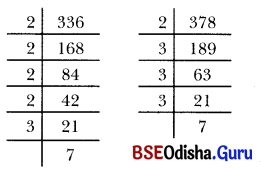
∴ HCF (336, 378) = 2 × 3 × 7
Question 2.
Three mugs contain 145 mL, 235 mL and 495 mL of water respectively. The maximum capacity of a mug that can exactly measure the water of three mugs is _______ mL.
Solution: 5
We have, 145 = 5 × 29 ; 235 = 5 × 47 ;
495 = 5 × 9 × 11
Required capacity = HCF of 145, 235 and 495 = 5
Hence, the maximum capacity of a mug that can exactly measure the water of three mugs is 5 mL.
Question 3.
546 = 2 × 3 × ________ × 13.
Solution: 7
Prime factorisation of 546 is given as
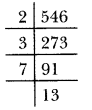
Thus, 546 = 2 × 3 × 7 × 13
Question 4.
If the LCM of x and y is 720, their HCF is 12, and x is 144, then y is _____ .
Solution: 60
We know, product of two numbers = HCF × LCM
⇒ x × y = HCF × LCM
⇒ 144 × y = 12 × 720
⇒ y = \(\frac{12 \times 720}{144}\) ⇒ y = \(\frac{720}{12}\) = 60
Question 5.
_______ is the smallest number which, when divided by 12 and 18, leaves a remainder of 5 in each case.
Solution: 41
Required smallest number = LCM(12, 18) + 5
The LCM of 12 and 18 using prime factorisation method:
12 = 2 × 2 × 3
18 = 2 × 3 × 3
The LCM is the product of the highest occurrence of each prime factor.
Hence, LCM (12, 18) = 2 × 2 × 3 × 3 = 36
Thus, the smallest number = 36 + 5 = 41
Question 6.
If the product of two numbers is 600 and their HCF is 10, then their LCM is ______.
Solution: 60
Let two numbers be A and B, then according to question A × B = 600 and HCF =10.
Using the property: A × B = HCF × LCM
⇒ 600 = 10 × LCM
⇒ LCM = \(\frac{600}{10}\) = 60