
Students can refer to BSE Odisha Class 6 Math Solution and Ganita Prakash Chapter 6 Perimeter and Area Class 6 Question Answer to understand textbook questions step by step.
Class 6 Maths Chapter 6 Perimeter and Area Solutions
Ganita Prakash Class 6 Chapter 6 Solutions
Class 6 Maths Ganita Prakash Chapter 6 Solutions Perimeter and Area
Question 1.
A rectangle having sidelengths 5 cm and 3 cm is made using a piece of wire. If the wire is straightened and then bent to form a square, what will be the length of a side of the square?
Solutions:
Given, length of rectangle = 5 cm and breadth of rectangle = 3 cm
We know that perimeter of rectangle = 2 × (length + breadth) = 2 × (5 + 3) = 16 cm
Now, if we bend the wire to form a square, the total length of the wire (16 cm) will be divided equally among the four sides of the square.
So, each side of the square = \(\frac{\text { Perimeter }}{4}\) = \(\frac{16}{4}\) = 4 cm

Question 2.
A piece of string is 36 cm long. What will be the length of each side, if it is used to form:
(a) Square
(b) Equilateral Triangle
(c) Regular Hexagon
Solutions:
Given, total length of string = 36 cm
(a) For a square. each side of the square = \(\frac{\text { Total length of string }}{4}\) = \(\frac{36}{4}\) = 12 cm
(b) For a triangle with all si(les of edila! length. each side of the triangle = \(\frac{\text { Total length of string }}{3}\) = \(\frac{36}{3}\) = 12 cm
(c) For a hexagon wit h all sides oI’egual length, each sidle oÍ the hexagon = \(\frac{\text { Total length of string }}{6}\) = \(\frac{36}{6}\) = 6 cm
InText Questions
Question 1.
Deep Dive: In races, usually there is a common finish line for all the runners. Here are two square running tracks with the inner track of 100 m each side and outer track of 150 m each side. The common finishing line for both runners is shown by the flags in the figure which are in the center of one of the sides of the tracks. If the total race is of 350 m, then we have to find out where the starting positions of the two runners should be on these two tracks so that they both have a common finishing fine after they run for 350 m. Mark the starting points of the runner on the inner track as ‘A’ and the runner on the outer track as ‘B’.
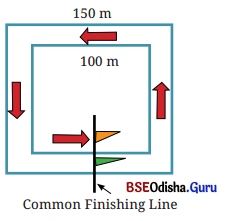
Solution:
For the inner square track, each side is 100 m.
For the outer square track, each side is 150 m.
So, inner track perimeter = 4 × side = 4 × 100 m = 400 m
Outer track perimeter = 4 × side = 4 × 150 m = 600 m
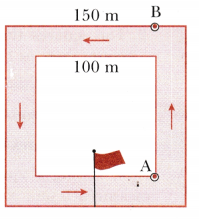
Both runners start at different points and run along their respective square tracks, possibly completing full or partial laps. The finish line is fixed at the middle of one side.
The total race distance is 350 m for both runners.
Therefore, each runner must start 350 m before the finish line, in the direction of the run.
Runner A runs on the inner track (400 m) and runner B runs on the outer track (600 m).
Now, we calculate how far before the finish line each runner should start:
Start Point A: 400 m – 350 m = 50 m
Thus, position A is 50 m behind the finish line (in the direction of the run) on the inner track.
Start Point B: 600 m – 350 m = 250 m
Thus, position B is 250 m behind the finish line (in the direction of the run) on the outer track.
Thus, mark point A on the inner track, 50 m behind the flag (finish line), and point B on the outer track, 250 m behind the flag, both measured in the direction of the run.
Question 2.
Look at the figures below and guess which one of them has a larger area.
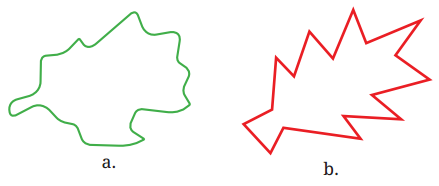
Solution:
We can estimate the area of any simple closed shape by using a sheet of squared paper or graph paper where every square measures 1 unit X 1 unit or 1 square unit.
To estimate the area, we can trace the shape onto a piece of transparent paper and place the same on a piece of squared or graph paper and then follow the below conventions:
- Count all the full squares inside the figure. Area of each is 1 square unit.
- For squares that are more than half filled, count them as 1 square unit.
- For squares that are exactly half filled, count them as \(\frac{1}{2}\) square unit.
- Ignore squares that are less than half filled.
Now, adding a square grid, where every square measures 1 unit × 1 unit, we get the following figure.
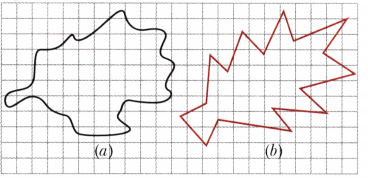
In figure (a): Number of full squares inside the figure = 31
Number of squares that are more than half filled = 13
Area of figure (a) = 31 × 1 + 13 × 1
= 31 + 13 = 44 sq. units
In figure (b): Number of full squares inside the figure = 16
Number of squares that are more than half filled = 20
Area of figure (b) = 16 × 1 + 20 × 1
= 16 + 20 = 36 sq. units
Thus, figure (a) has a larger area.
Question 3.
Use your understanding from, previous grades to calculate the area of any closed figure using grid paper and
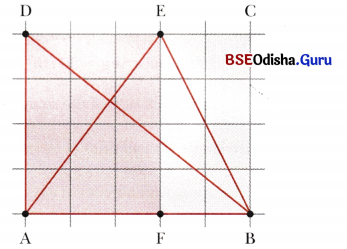
(a) Find the area of triangle BAD. _________
(b) Find the area of triangle ABE. _________
Solution:
From the given figure,
Area of rectangle A BCD = 20 sq. units
Area of rectangle AFED = 12 sq. units
Area of rectangle FBCE = 8 sq. units
(a) Area of triangle BAD
= \(\frac{1}{2}\) × Area of rectangle ABCD
= \(\frac{1}{2}\) × 20 sq. units = 10 sq. units
(b) Area of triangle ABE
= Area of triangle AFE + Area of triangle BEE
= \(\frac{1}{2}\) × Area of rectangle AFED + \(\frac{1}{2}\) × Area of rectangle FBCE
= \(\frac{1}{2}\) × 12 sq. units + \(\frac{1}{2}\) × 8 sq. units
= 6 sq. units + 4 sq. units = 10 sq. units
Question 4.
Using 9 unit squares, solve the following.
(a) What is the smallest perimeter possible?
(b) What is the largest perimeter possible?
(c) Make a figure with a perimeter of 18 units.
(d) Can you make other shaped figures for each of the above three perimeters, or is there only one shape with that perimeter? What is your reasoning?
Solution:
(a) The smallest perimeter possible is 12 units.
This occurs when the 9 unit squares are arranged to form a 3 × 3 square.
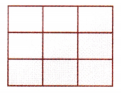
Side length = 3 units
Perimeter = 4 × 3 = 12 units
(b) The largest perimeter possible is 20 units.
This occurs when the 9 unit squares are arranged in a single straight line to form 1 × 9 or 9 × 1 rectangle.

Perimeter of rectangle = 2 × (9 + 1) = 20 units
(c) A figure with a perimeter of 18 units is given alongside:
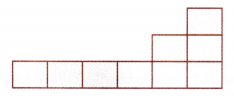
(d) Yes, we can make multiple different shapes for each of the three perimeter values 12, 18 and 20 units as long as the number of external sides (edges not shared with another square) adds up to the correct perimeter.
Reasoning: Each square has 4 edges.
Every time two squares are placed adjacent to each other, they share an edge, reducing the total perimeter by 2 units (1 edge from each square).
By changing how the 9 squares are joined linear, block, zig-zag, L-shape, etc. we can vary how many edges are shared and hence control the perimeter.
The number of shared sides determines the final perimeter, not the specific shape.
Question 5.
Let’s do something tricky now! We have^ a figure below having perimeter 24 units.
Without calculating all over again, observe, think and find out what will be the change in the perimeter if a new square is attached as shown on the right.
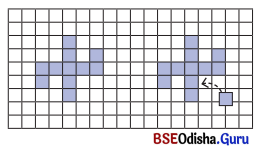
Experiment placing this new square at different places and think what the change in perimeter will be. Can you place the square so that the perimeter: (a) increases; (b) decreases; (c) stays the same?
Solution:
When a new square is attached to an existing figure:
If it shares one full side with the existing figure, the perimeter increases by 2 units. (Because one new side is hidden in the shared boundary, and 3 new sides are exposed.
So, net change = + 3 – 1 = + 2).
If it shares two sides (like being inserted into a corner), the perimeter stays the same. (2 new sides added, but 2 sides of the previous figure are now internal and not counted: + 2 – 2 = 0).
If it shares three sides (nestled into a concave corner), the perimeter decreases by 2 units. (Only 1 side added is exposed, 3 sides of the previous figure are hidden: + 1 – 3 = – 2).
(a) Perimeter increases when the new square is added such that only one side touches the original figure.
(b) Perimeter decreases when the square is placed within a corner, sharing three sides with the original figure.
(c) Perimeter stays the same when the square is added in such a way that two sides are shared with the original figure (like being placed into an edge corner).
Perimeter and Area Class 6 Extra Questions
Perimeter and Area Class 6 Very Short Question Answer
Question 1.
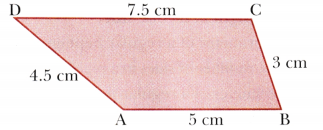
Find the perimeter of the given quadrilateral.
Solution:
We know that the perimeter of a polygon is the sum of the lengths of its all sides.
So, the perimeter of given quadrilateral
= AB + BC + CD + DA
= 5 cm + 3 cm + 7.5 cm + 4.5 cm
= 20 cm
Question 2.
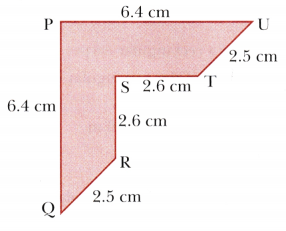
Find the perimeter of the following figure:
solution:
We know that the perimeter of a closed figure is the sum of the lengths of its all sides.
So, the perimeter of given figure
= PQ + QR + RS + ST + TU + UP
= 6.4 cm + 2.5 cm + 2.6 cm + 2.6 cm + 2.5 cm + 6.4 cm
= 23 cm
Question 3.
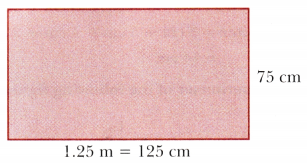
Find the perimeter of a rectangle whose length and breadth are 1.25 m and 75 cm, respectively.
Solution:
Given, length of the rectangle = 1.25 m = 125 cm [∵ 1 m = 100 cm]
Breadth of the rectangle = 75 cm We know,
Perimeter of the rectangle = 2 (Length + Breadth)
= 2 (125 cm + 75 cm) = 2 × 200 cm = 400 cm
Question 4.
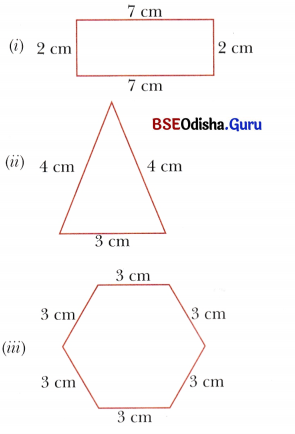
Find the perimeter of the following figures:
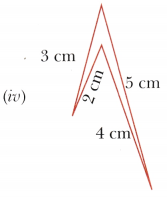
Solution:
We know that the perimeter of a polygon is the sum of the lengths of its all sides.
(i) Perimeter = 2 cm + 7 cm + 2 cm + 7 cm = 18 cm
(ii) Perimeter = 4 cm + 4 cm + 3 cm = 11 cm
(iii) Perimeter = 3 cm + 3 cm + 3 cm + 3 cm + 3 cm + 3 cm = 18 cm
(iv) Perimeter = 3 cm + 5 cm + 4 cm + 2 cm = 14 cm
Question 5.
Find the perimeter of the following figure:
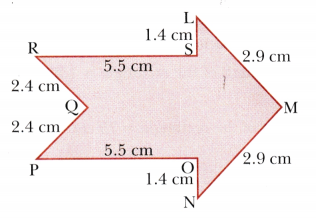
Solution:
We know that the perimeter of a closed figure is the sum of the lengths of its all sides.
So, the perimeter of given figure = LM + MN + NO + OP + PCI + QR + RS + SL
= 2.9 cm + 2.9 cm + 1.4 cm + 5.5 cm + 2.4 cm + 2.4 cm + 5.5 cm + 1.4 cm
= 24.4 cm
Question 6.
The lengths of two sides of a triangle are 15 cm and 21 cm. The perimeter of the triangle is 46 cm. Find the length of its third side.
Solution:
Given, the perimeter of a triangle is 46 cm.
Length of first side =15 cm
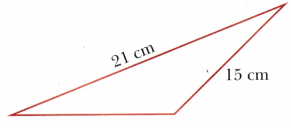
Length of second side = 21 cm
We know, the perimeter of a triangle
= Sum of the lengths of all sides of the triangle
⇒ 46 cm = Length of first side + Length of second side + Length of third side
⇒ 46 cm =15 cm + 21 cm 4 Length of third side
⇒ 46 cm = 36 cm 4 Length of third side
⇒ Length of third side = 46 cm – 36 cm = 10 cm
Question 7.
If the perimeter of a regular heptagon is 63 cm, find the length of its one side.
Solution:
Given, perimeter of a regular heptagon is 63 cm.
We know, number of sides in a regular heptagon = 7
And, perimeter of a regular polygon = Number of sides × Length of one side
So, the perimeter of given regular heptagon
= 7 × Length of one side
⇒ 63 cm = 7 × Length of one side
⇒ Length of one side = \(\frac{63}{7}\) cm = 9 cm
Question 8.
A rectangular carpet has an area of 72 sq. m and a width of 6 m. What is its length?
Solution:
Given, width (breadth) of a rectangular carpet = 6 m
And, area of a rectangular carpet = 72 sq. m
We know, area of the rectangular carpet = Length × breadth
⇒ 72 sq. m = Length × 6 m
⇒ Length = \(\frac{72}{6}\) = 12 m
Thus, the length of the rectangular carpet is 12 m.
Question 9.
If rectangle ABCD has area 42 sq. units, then find the area of triangle ABC, cut along the diagonal of the rectangle ABCD.
Solution:
Given, the area of rectangle ABCD is 42 sq. units.
We know that if a rectangle is cut along one of its diagonals, then the area of each resulting triangle is half the area of the rectangle.
∴ Area of triangle ABC
= \(\frac{1}{2}\) × Area of rectangle ABCD
= \(\frac{1}{2}\) × 42 sq. units = 21 sq. units
Perimeter and Area Class 6 Short Question Answer
Question 1.
The perimeter of a rectangle is 72 cm and its breadth is 8 cm. Find its length.
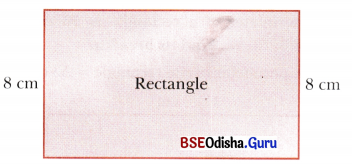
Solution:
Given, perimeter of the rectangle = 72 cm
Breadth of the rectangle = 8 cm
We know,
Perimeter of the rectangle = 2 (Length + Breadth )
⇒ 72 cm = 2(Length + 8 cm)
⇒ 2(Length + 8 cm) = 72
⇒ Length + 8 cm = \(\frac{72}{2}\) = 36 cm
⇒ Length = 36 cm – 8 cm = 28 cm
Question 2.
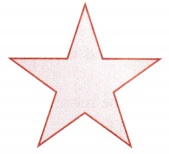
In the adjoining figure, the length of each side is 2.75 cm. Find the perimeter of the figure.
Solution:
Given figure is a polygon and the length of its each side is 2.75 cm.
Also, the number of sides is 10.
So, the perimeter of given polygon
= 10 × Length of one side
= 10 × 2.75 cm
= 27.5 cm
Question 3.
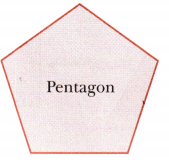
If the perimeter of a regular pentagon is 55 cm, find the length of its one side.
Solution:
Given, perimeter of a regular pentagon is 55 cm.
We know, the number of sides in a regular pentagon is 5.
And, perimeter of a regular polygon
= Number of sides × Length of each side
So, the perimeter of regular pentagon = 5 × Length of each side
⇒ 55 cm = 5 × Length of each side
⇒ Length of each side = \(\frac{55}{5}\) cm = 11 cm
Question 4.
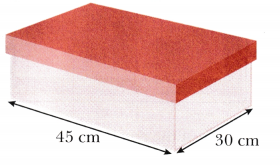
The lid of a rectangular box of length 45 cm and breadth 30 cm is sealed all around with tape. Find the required length of tape.
Solution:
Given, length of the rectangular box is 45 cm.
Breadth of the rectangular box is 30 cm.
And, the lid of the rectangular box is sealed all around with tape.
Therefore, length of the tape
= Perimeter of the rectangle
= 2(Length + Breadth)
= 2(45 cm + 30 cm)
= 2 × 75 cm = 150 cm
Question 5.
A wire is in the shape of an equilateral triangle of side 26 cm. It is rebent into the shape of rectangle whose length is 23 cm, find its breadth.
Solution:
Given, length of the side of an equilateral triangle is 26 cm.
Therefore, length of the wire = Perimeter of the equilateral triangle of side 26 cm
= 3 × 26 cm [∵ Number of sides in an equilateral triangle is 3.]
= 78 cm
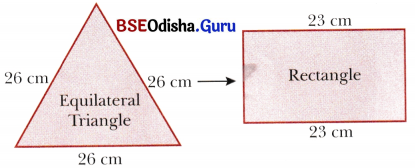
Given that the wire is rebent into the shape of rectangle whose length is 23 cm.
∴ Perimeter of the rectangle = Length of wire
⇒ 2(Length + Breadth) = 78 cm
⇒ 2(23 cm + Breadth) = 78 cm
⇒ 23 cm + Breadth = \(\frac{78}{2}\) = 39 cm
⇒ Breadth = 39 cm – 23 cm = 16 cm
Question 6.
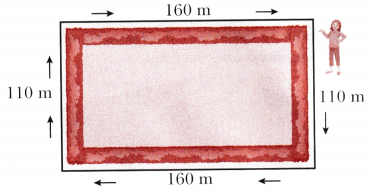
Priya went to a rectangular field 160 m long and 110 m wide. She took 4 complete rounds on its boundary. Find the distance covered by her.
Solution:
Given, length of the rectangular field = 160 m
Breadth of the rectangular field = 1 10 m
∴ Distance covered by Priya in one round
= Perimeter of the rectangular field
= 2(Length + Breadth)
= 2(160 m + 110 m)
= 2 × 270 m = 540 m
Since she took 4 complete rounds on its boundary,
Distance covered by Priya in four rounds
= 4 × Distance covered by Priya in one round
= 4 × 540 m = 2160 m
Thus, Priya covers 2160 m distance in 4 rounds.
Question 7.
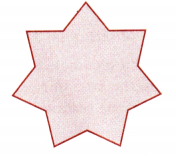
In below figure, the length of each side is 3.25 cm. Find the perimeter of the figure.
Solution:
In the given figure, number of sides is 14.
Also, the length of each side is 3.25 cm.
So, the perimeter of given polygon = 14 × Length of one side = 14 × 3.25 cm = 45.5 cm
Question 8.
The perimeter of a rectangle is 56 cm and its length is 20 cm. Find its breadth.
Solution:
Given, perimeter of the rectangle = 56 cm
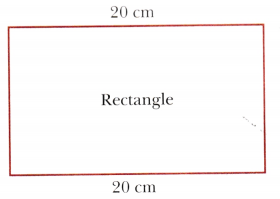
Length of the rectangle = 20 cm
We know, perimeter of the rectangle = 2 (Length 4- Breadth)
⇒ 56 cm = 2(20 cm + Breadth)
⇒ 28 cm = 20 cm + Breadth
⇒ Breadth = 28 cm – 20 cm = 8 cm
Question 9.
A rectangular piece of land measures 0.95 km by 0.65 km. Each side of the land is to be fenced with 5 rows of wires. Find the required length of the wire.
Solution:
Given, length of the rectangular piece of land = 0.95 km
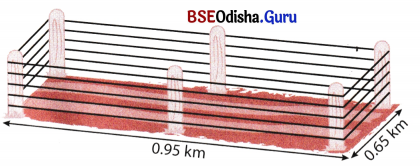
Breadth of the rectangular piece of land = 0.65 km
∴ Perimeter of the rectangular piece of land
= 2(Length + Breadth)
= 2(0.95 km + 0.65 km)
= 2 × 1.60 km = 3.20 km
Since each side of the land is to he fenced with 5 rows of wires, length of the wire is five times the perimeter of the land.
∴ Required length of wire = 5 × 3.20 km = 16 km
Question 10.
Find the perimeter of a rectangular field whose length is 345 cm and which has an area equal to 56925 sq. cm.
Solution:
Given, length of rectangular field = 345 cm and area of the field = 56925 sq. cm
We know, area of rectangular field
= Length × Breadth
⇒ 56925 sq. cm = 345 cm × Breadth
⇒ Breadth = \(\frac{56925}{345}\) = 165 cm
So, breadth of the field is 165 cm.
Hence,
perimeter of the field = 2 (Length + Breadth)
= 2 (345 cm + 165 cm) = 2 × 510 cm = 1020 cm
Thus, the perimeter of the rectangular field is 1020 cm.
Question 11.
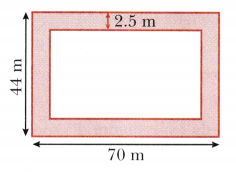
In the figure, find the area of the path which is 2.5 m wide all around.
Solution:
Given, length of outer rectangle = 70 m
Breadth of outer rectangle = 44 m
As the path is 2.5 m wide,
Length of inner rectangle = 70 m – 2.5 m – 2.5 m
= 65 m
Breadth of inner rectangle = 44 m – 2.5 m – 2.5 m
= 39 m
Now, the area of path = Area of outer rectangle – Area of inner rectangle
= 70 m × 44 m – 65 m × 39 m
= 3080 sq. m – 2535 sq. m = 545 sq. m
Thus, the area of the path is 545 sq. m
Question 12.
Four square tiles of side 2.5 m each are placed together without any gaps. What is the total area covered?
Solution:
Given, the side of a square tile is 2.5 m.
We know, area of a square = Side × Side
∴ Area of a square tile = 2.5 m × 2.5 m
= 6.25 sq. m
As four square tiles are placed together without any gaps,
Total covered area = 4 × Area of one square tile
= 4 × 6.25 sq. m = 25 sq. m
Thus, total area covered by the four square tiles of side 2.5 m is 25 sq. m.
Question 13.
A floor measuring 15 m by 9 m is covered with a carpet of size 12 m × 8 m. Find the area that remains uncovered.
Solution:
Given, length of the floor = 15 m,
Breadth of the floor = 9 m,
Length of the carpet = 12 m
and breadth of the carpet = 8 m
Therefore, area of the floor
= Length of the floor × Breadth of the floor
= 15 m × 9 m = 135 sq. m
And, area of the carpet
= Length of the carpet × Breadth of the carpet
= 12 m × 8 m = 96 sq. m
Thus, area that remains uncovered = Area of the floor – Area of the carpet
= 135 sq. m – 96 sq. m = 39 sq. m
Question 14.
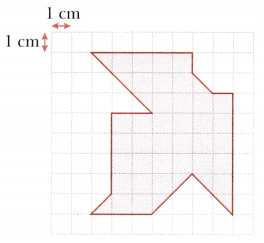
Find the area of the given shaded region (figure alongside) drawn on a square paper, taking the area of each square as 1 cm2.
Solution:
The figure drawn on square paper contains 35 complete squares and 9 half squares.
∴ Area of given closed figure = Area of 35 complete squares + Area of 9 half squares
= 35 × 1 cm2 + 9 × \(\frac{1}{2}\) cm2
= 35 cm2 + 4.5 cm2 = 39.5 cm2
Perimeter and Area Class 6 Long Question Answer
Question 1.
A wire is 39 cm long. What will be the length of each side if the wire is used to form
(i) an equilateral triangle?
(ii) a regular hexagon?
Solution:
Given, a wire is 39 cm long.
(i) The wire is used to form an equilateral triangle.
We know that there are 3 equal sides in an equilateral triangle.
∴ Perimeter of equilateral triangle = Length of wire
⇒ 3 × Length of side = 39 cm
⇒ Length of side = \(\frac{39}{3}\) cm = 13 cm
(ii) The wire is used to form a regular hexagon.
We know that there are 6 equal sides in a regular hexagon.
∴ Perimeter of regular hexagon = Length of wire
⇒ 6 × Length of side = 39 cm
⇒ Length of side = \(\frac{39}{6}\) cm = 6.5 cm
Question 2.
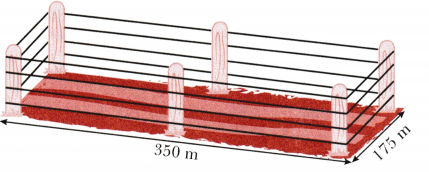
A farmer has a rectangular field of length 350 m and breadth 175 m. He wants to fence it with 4 rounds of rope as shown in the figure. If cost of rope is ₹ 4.5 per metre, then find the cost of fencing the field.
Solution:
Given, length of the rectangular field = 350 m
Breadth of the rectangular field = 175 m
∴ Perimeter of the rectangular field = 2(Length + Breadth)
= 2(350 m + 175 m)
= 2 × 525 m = 1050 m
Since the farmer wants to fence the field with 4 rounds of rope, length of the rope is four times the perimeter of the field.
∴ Required length of rope = 4 × 1050 m = 4200 m
Given, the cost of 1 m rope is ₹ 4.5.
∴ Total cost of 4200 m rope = ₹ 4.5 × 4200
= ₹ 18,900
Thus, the cost of fencing the field is ₹ 18,900.
Question 3.
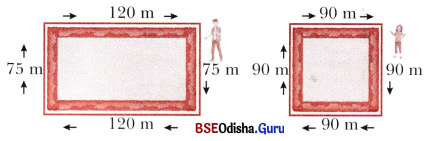
Priya runs around a square field of side 90 m. Rishi runs around a rectangular field of length 120 m and breadth 75 m. Who covers more distance and by how much in one round?
Solution:
Given, Priya runs around a square field of side 90 m.
∴ Distance covered by Priya in one round
= Perimeter of the square field
= 4 × length of a side of the square field
= 4 × 90 m = 360 m
And, Rishi runs around a rectangular field of length 120 m and breadth 75 m.
∴ Distance covered by Rishi in one round
= Perimeter of the rectangular field
= 2(Length + Breadth)
= 2(120 m + 75 m) = 2 × 195 m = 390 m
So, difference in the distance covered in one round = 390 m – 360 m = 30 m
Thus, Rishi covers more distance by 30 m in one round.
Question 4.
A rectangle, having side lengths 19 cm and 13 cm, is made using a piece of wire. If the wire is straightened and then bent to form a square, what will be the length of a side of the square?
Solution:
Given, length of the rectangle is 19 cm.
Breadth of the rectangle is 13 cm.
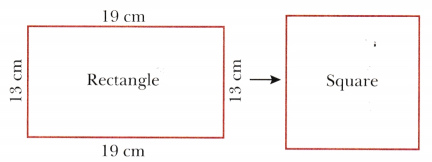
Therefore, length of the wire
= Perimeter of the rectangle
= 2(Length + Breadth)
= 2(19 cm + 13 cm)
= 2 × 32 cm = 64 cm
Given that the wire is rebent into the shape of a square.
∴ Perimeter of the square = Length of wire
⇒ 4 × Length of side = 64 cm
⇒ Length of side = \(\frac{64}{4}\) cm = 16 cm
Question 5.
A wire is 39 cm long. What will be the length of each side if the wire is used to form
(i) a square?
(ii) a regular pentagon?
Solution:
Given, a wire is 39 cm long.
(i) The wire is used to form a square.
We know that there are 4 equal sides in a square.
∴ Length of wire = 4 × Length of side
⇒ 39 cm = 4 × Length of side
⇒ Length of side = \(\frac{39}{4}\) cm = 9.75 cm
(ii) The wire is used to form a regular pentagon.
We know that there are 5 equal sides in a regular pentagon.
∴ Length of wire = 5 × Length of side
⇒ 39 cm = 5 × Length of side
⇒ Length of side = \(\frac{39}{5}\) cm = 7.8 cm
Question 6.
The length of a rectangular field is four times its breadth. A man runs around it 4 times and covered a distance of 5 km. What is the length of the field?
Solution:
Given, the length of a rectangular field is four times its breadth.
∴ Length = 4 × Breadth ……. (i)
And, a man runs around the field 4 times and covered a distance of 5 km.
∴ Distance covered in 4 rounds
= 4 × Perimeter of the field
⇒ 5 km = 4 × 2 (Length + Breadth)
⇒ 5000 m = 8 × (4 × Breadth + Breadth) [From (i)] [∵ 1 km = 1000 m]
⇒ 5000 m = 8 × 5 × Breadth
⇒ 5000 m = 40 × Breadth
⇒ Breadth = \(\frac{5000 \mathrm{~m}}{40}\) = 125 m
Substituting I he value of breadth in (I). we gel
Length = 4 × 125 m = 500 m
Thus, the length of the field is 500 m.
Question 7.
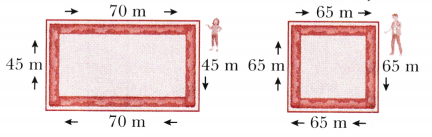
Seema runs 6 times around a rectangular park with length 70 m long and breadth 45 m while Ramesh runs 5 times around a square park of side 65 m. Who covers more distance and by how much?
Solution:
Given, Seema runs around a rectangular park of length 70 m and breadth 45 m.
∴ Distance covered by Seema in one round
= Perimeter of the rectangular park
= 2(Length + Breadth)
= 2(70 m + 45 m) = 2 × 115 m = 230 m
So, distance covered by Seema in 6 rounds
= 6 × Distance covered by Seema in one round
= 6 × 230 m = 1380 m
And Ramesh runs around a square park of side 65 m.
∴ Distance covered by Ramesh in one round
= Perimeter of the square park
= 4 × length of a side of the square park
= 4 × 65 m = 260 m
So, distance covered by Ramesh in 5 rounds
= 5 × Distance covered by Ramesh in one round
= 5 × 260 m = 1300 m
So, difference in the distance covered
= 1380 m- 1300 m = 80 m
Thus, Seema covers 80 m more distance than Ramesh.
Question 8.
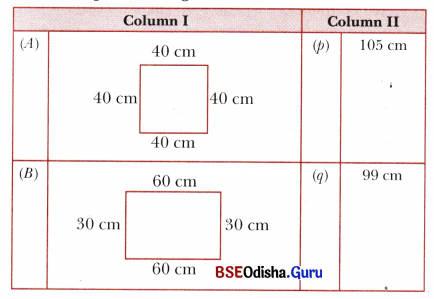
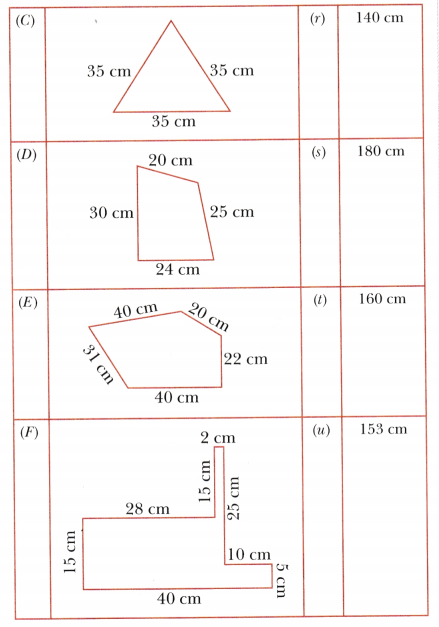
Match the closed figure given in Column I with their perimeter given in Column II.
Solution:
We know that the perimeter of a polygon/closed figure is the sum of the lengths of its all sides.
(A) Perimeter = 40 cm + 40 cm + 40 cm + 40 cm = 160 cm
(B) Perimeter = 30 cm + 60 cm + 30 cm + 60 cm = 180 cm
(C) Perimeter = 35 cm + 35 cm + 35 cm = 105 cm
(D) Perimeter = 30 cm + 20 cm + 25 cm + 24 cm = 99 cm
(E) Perimeter = 31 cm + 40 cm + 20 cm + 22 cm + 40 cm = 153 cm
(F) Perimeter = 15 cm + 28 cm + 15 cm + 2 cm + 25 cm + 10 cm + 5 cm + 40 cm = 140 cm
Thus, (A) – (t), (B) – (s), (C) – (p), (D) – (q), (E) – (u), (T) – (r)
Question 9.
Rishi wants to cover the floor of a room 4 m wide & 8 m long by square tiles. If each square tile is of side 0.4 m, then find the number of tiles required.
Solution:
Given, length of the room = 8 m and breadth of the room = 4 m
As the room is in rectangular shape,
Area of the room = Length × Breadth
= 8 m × 4 m = 32 sq. m
And, side length of each square tile = 0.4 m
∴ Area of each tile = Side × Side
= 0.4 m × 0.4 m = 0.16 sq. m
Now, number of tiles = \(\frac{\text { Area of floor of the room }}{\text { Area of one tile }}\)
= \(\frac{32}{0.16}\) = 200
Thus, the number of required tiles is 200.
Question 10.
A square and a rectangle have equal area. If the side of the square is 36 cm and the length of the rectangle is 54 cm, then find:
(i) the breadth of the rectangle)
(ii) the perimeter of die rectangle.
Solution:
(i) Given, side of the square
= 36 cm and length of the rectangle
= 54 cm
∴ Area of the square = Side × Side
= 36 cm × 36 cm = 1296 sq. cm
As area of the rectangle = area of the square
⇒ Length × Breadth = 1296 sq. cm
⇒ 54 cm × Breadth = 1296 sq. cm
⇒ Breadth = \(\frac{1296}{54}\) = 24 cm
Thus, the breadth of the rectangle is 24 cm.
(ii) We know, perimeter of the rectangle
= 2 (Length + Breadth)
= 2 (54 cm + 24 cm)
= 2 × 78 cm = 156 cm
Question 11.
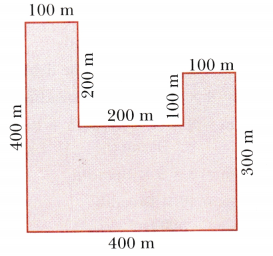
Find the area of the given figure.
Solution:
To find the required area, we divide the enclosed region of given figure into rectangles and squares as shown in the figure.
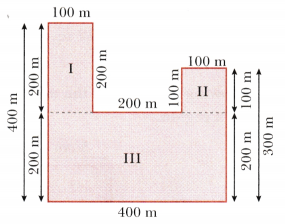
Part I is a rectangle of length 200 m and breadth 100 m.
Part II is a square of side length 100 m.
Part III is a rectangle of length 400 m and breadth 200 m.
Now, area of part I = 200 m × 100 m = 20000sq. m
Area of part II = 100 m × 100 m = 10000 sq.m
And area of part III = 400 m × 200 in = 80000 sq. m
Total area of given closed figure
= 20000 sq. m + 10000 sq. m + 80000 sq. m
= 110000 sq.m
Question 12.
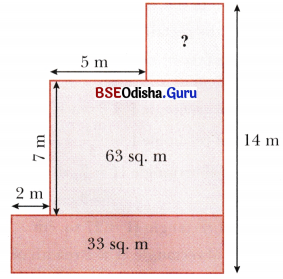
In the following figure, find the missing value of the area of a region.
Solution:
We name the given figure as shown.
Here,
breadth of the rectangle II = 7 m
And area of the rectangle II = 63 sq. m
∴ Length of rectangle II × Breadth of rectangle
II = 63 sq. m
⇒ Length of rectangle II × 7 m = 63 sq. m
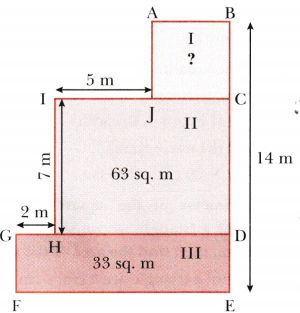
⇒ Length of rectangle II = \(\frac{63}{7}\) = 9 m
= IG = HD
So, JC = IC – IJ = 9m – 5m = 4 m
GD = GH + HD = 2m + 9m = 11m
Now, area of rectangle III = 33 sq. m
∴ Length of rectangle III × Breadth of rectangle III = 33 sq. m
⇒ GD × Breadth of rectangle III = 33 sq. m
⇒ 11 m × Breadth of rectangle III = 33 sq. m
⇒ Breadth of rectangle III = \(\frac{33}{11}\) = 3 m
= FG = DE
Given, BE = 14 m
⇒ BC + CD + DE = 14 m
⇒ BC + 7 m + 3 m = 14 m
⇒ BC = 14 m – 7 m – 3 m = 4 m = AJ
As AJ = JC = 4 m, ABCJ is a square.
∴ Area of square I = AJ × JC = 4 × 4
= 16 sq. m.
Question 13.
A square and a rectangle have equal area. If the side of the square is 27 cm and length of rectangle is 81 cm, then find:
(i) the breadth of the rectangle.
(ii) the perimeter of the rectangle.
Solution:
(i) Given, side of the square = 27 cm
and length of the rectangle = 81 cm
∴ Area of the square = Side × Side
= 27 cm × 27 cm
= 729 sq. cm
As area of the rectangle = Area of the square
⇒ Length × Breadth = 729 sq. cm
⇒ 81 cm × Breadth = 729 sq. cm
⇒ Breadth = \(\frac{729}{81}\) = 9 cm
Thus, the breadth of the rectangle is 9 cm.
(ii) We know, perimeter of the rectangle
= 2 (Length + Breadth)
= 2 (81 cm + 9 cm)
= 2 × 90 cm = 180 cm
Question 14.
If the perimeter of the square is thrice the perimeter of a triangle whose sides are 3 cm, 4 cm and 5 cm, then find the area of the square.
Solution:
Given, sides of a triangle are 3 cm, 4 cm and 5 cm.
∴ Perimeter of the triangle
= 3 cm + 4 cm + 5 cm = 12 cm
As the perimeter of the square is thrice the perimeter of a triangle,
Perimeter of the square = 3 × Perimeter of the triangle
⇒ 4 × Side = 3 × 12 cm
⇒ Side = \(\frac{3 \times 12}{4}\) = 9 cm 4
Now, area of the square = Side × Side
= 9 cm × 9 cm
= 81 sq. cm
Thus, the area of the square is 81 sq. cm.
Question 15.
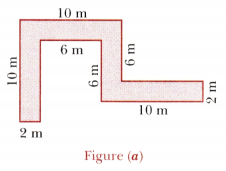
Find the area of the given figure (a) alongside.
Solution:
To find the required area, we divide the enclosed region of given figure into rectangles as shown in the figure.
Part I is a rectangle of length 10 m and breadth 2 m.
Part II is a rectangle of length 6 m and breadth 2 m.
Part III is a rectangle of length 6 m and breadth 2 m.
Part IV is a rectangle of length 10 m and breadth 2 m.
Now, area of part I = 10 m × 2 m = 20 sq. m
Area of part II = 6 m × 2 m = 12 sq. m
Area of part III = 6 m × 2 m = 12 sq. m
And area of part IV = 10m × 2m = 20 sq. m
Total area of given dosed figure
= 20 sq. m + 12 sq. m + 12 sq. m + 20 sq. m
= 64 sq. m
Question 16.
In the following figure, find the missing value of the area of a region.
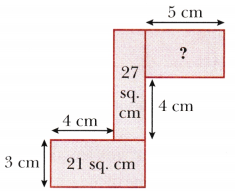
Solution:
To find the required area, we divide the enclosed region of given figure into squares and rectangles as shown in the figure.
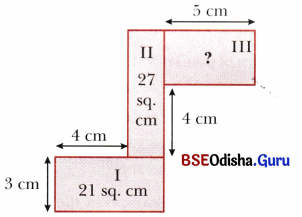
Now, breadth of the rectangle I = 3 cm
And area of the rectangle I = 21 sq. cm
∴ Length of rectangle I × Breadth of rectangle I
= 21 sq. cm
⇒ Length of rectangle I × 3 cm = 21 sq. cm
⇒ Length of rectangle I = \(\frac{21}{3}\) = 7 cm
So, Breadth of rectangle II = 7 cm – 4 cm
= 3 cm
Now, area of rectangle II = 27 sq. cm
∴ Length of rectangle II × Breadth of rectangle
II = 27 sq. cm
⇒ Length of rectangle II × 3 = 27 sq. cm
⇒ Length of rectangle II = \(\frac{27}{3}\) = 9 cm
So, breadth of region III = 9 cm – 4 cm
= 5 cm
Now, area of square III
= Side length × Side length
= 5 cm × 5 cm = 25 sq. cm
Question 17.
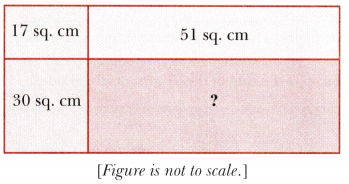
In the following figure, find the missing value of the area of a region.
Solution:
We name the given figure as shown.
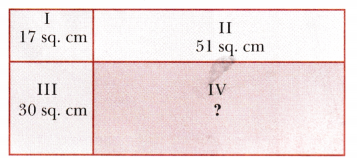
Area of the rectangle I is 17 sq. cm, which can be written as 1 cm × 17 cm or 17 cm × 1 cm.
And area of the rectangle II is 51 sq. cm, which can be written as 3 cm × 17 cm or 17 cm × 3 cm.
Front figure, we can see that the breadth of the rectangles I and II are equal.
Therefore,
Length of rectangle I = 1 cm
Breadth of rectangle I = 17 cm
Length of rectangle II = 3 cm
Breadth of rectangle II = 17 cm
For rectangle III, length = 1 cm
Now, area of rectangle III = 30 sq. cm [Given]
⇒ Length of rectangle III × Breadth of rectangle III = 30 sq. cm
⇒ 1 cm × Breadth of rectangle III = 30 sq. cm
⇒ Breadth of rectangle III = 30 cm
So, length of rectangle IV = 3 cm and breadth of rectangle IV = 30 cm
∴ Area of rectangle IV = 3 cm × 30 cm
= 90 sq. cm
Question 18.
Find the area of the given figure.
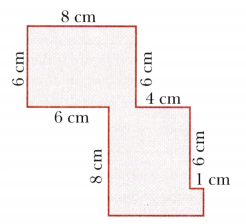
Solution:
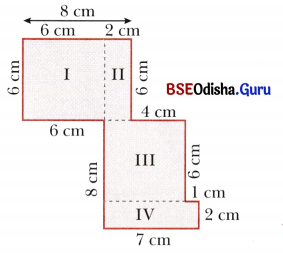
To find the required area, we divide the enclosed region of given figure into rectangles and squares as shown in the figure.
Part I is a square of side 6 cm.
Part II is a rectangle of length 6 cm and breadth 2 cm.
Part III is a square of side 6 cm.
Part IV is a rectangle of length 7 cm and breadth 2 cm.
Now, area of part I = 6 cm × 6 cm = 36 sq. cm
Area of part II = 6 cm × 2 cm = 12 sq. cm
Area of part III = 6 cm × 6 cm = 36 sq. cm
And area of part IV = 7 cm × 2 cm = 14 sq. cm
Total area of given closed figure
= 36 sq. cm + 12 sq. cm + 36 sq. cm + 14 sq. cm
= 98 sq. cm
Perimeter and Area Class 6 Case Based Questions
Question 1.
Priya and Rishi start running along the rectangular tracks as shown in the figure. Rishi runs along the outer track. Priya runs along the inner track. Now, they are wondering who ran more.
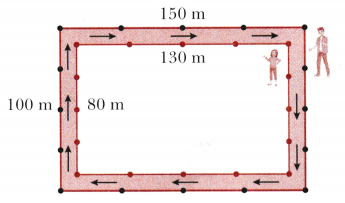
Based on the above information, answer the following questions:
(i) Find the distance covered by Priya in one round.
(ii) Find the distance covered by Rishi in one round.
(iii) Find out who ran the longer distance when Rishi runs 6 rounds and Priya runs 7 rounds.
Solution:
(i) Given, Priya runs along the rectangular track of length 130 m and breadth 80 m.
∴ Distance covered by Priya in one round
= Perimeter of the inner rectangular track
= 2(Length + Breadth)
= 2(130 m + 80 m) = 2 × 210 m = 420 m
(ii) Given, Rishi runs along the rectangular track of length 150 m and breadth 100 m.
∴ Distance covered by Rishi in one round
= Perimeter of the outer rectangular track
= 2(Length + Breadth)
= 2(150 m + 100 m) = 2 × 250 m = 500 m
(iii) Distance covered by Rishi in 6 rounds
= 6 × Distance covered by Rishi in one round
= 6 × 500 m = 3000 m
And, distance covered by Priya in 7 rounds
= 7 × Distance covered by Priya in one round
= 7 × 420 m = 2940 m
So, difference in the distance covered = 3000 m – 2940 m = 60 m
Thus, Rishi covers 60 m more distance than Priya.
Question 2.
Look at the plan of a house build on a rectangular plot as shown in the below figure.
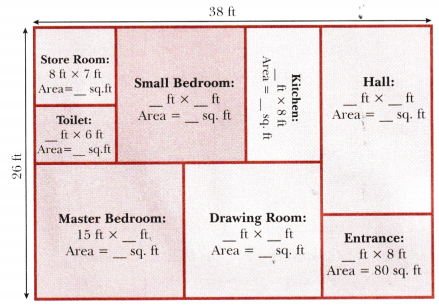
Based on the above information, answer the following questions:
(i) Find the missing measurements.
(ii) Compare areas of the small bedroom & kitchen. Which one has a bigger area? By how much?
(iii) Compare areas of small bedroom & drawing room. Which one has a bigger area? By how much?
Solution:
(i) For store room, length = 8 ft and breadth = 7 ft
∴ Area of store room = 8 ft × 7 ft = 56 sq. ft
For toilet:
Length = Length of store room = 8 ft
And breadth = 6 ft
∴ Area of toilet = 8 ft × 6 ft = 48 sq. ft
For master bedroom:
Length = 15 ft
Breadth = 26 ft – Breadth of store room – Breadth of toilet
= 26 ft – 7 ft – 6 ft = 13 ft
∴ Area of master bedroom = 15 ft × 13 ft
= 195 sq. ft
For entrance:
Breadth = 8 ft
And, Area = 80 sq. ft
⇒ Length × Breadth = 80 sq. ft
⇒ Length × 8 ft = 80 sq. ft
⇒ Length = \(\frac{80}{8}\) = 10 ft
For drawing room:
Breadth = Breadth of master bedroom = 13 ft
Length = 38 ft – Length of master bedroom – Length of entrance
= 38 ft – 15 ft – 10 ft = 13 ft
∴ Area of drawing room = 13 ft × 13 ft = 169 sq. ft
For hall:
Breadth = Length of entrance =10 ft
Length = 26 ft – Breadth of entrance = 26 ft – 8 ft = 18 ft
∴ Area of hall = 18 ft × 10 ft = 180 sq. ft
For kitchen:
Breadth = 8 ft
Length = 26 ft – Breadth of drawing room
= 26 ft – 13 ft = 13 ft
∴ Area of kitchen = 13 ft × 8 ft = 104 sq. ft
For small bedroom:
Length = Length of kitchen = 13 ft
Breadth = 38 ft – Length of toilet – Breadth of kitchen – Breadth of hall ,
= 38 ft – 8 ft – 8 ft – 10ft = 12ft
∴ Area of small bedroom = 13 ft × 12 ft = 156 sq. ft
(ii) Area of small bedroom =156 sq. ft
Area of kitchen =104 sq. ft
Difference of areas = 156 sq. ft – 104 sq. ft = 52 sq. ft
Thus, the small bedroom has 52 sq. ft more area than the kitchen.
(iii) Area of small bedroom = 156 sq. ft
Area of drawing room = 169 sq. ft
Difference of areas = 169 sq. ft – 156 sq. ft = 13 sq. ft
Thus, the drawing room has 13 sq. ft. area more than small bedroom.