
Students can refer to BSE Odisha Class 6 Math Solution and Ganita Prakash Chapter 5 Prime Time Class 6 Question Answer to understand textbook questions step by step.
Class 6 Maths Chapter 5 Prime Time Solutions
Ganita Prakash Class 6 Chapter 5 Solutions
Class 6 Maths Ganita Prakash Chapter 5 Solutions Prime Time
Question 1.
Who am I?
(a) I am a number less than 40. One of my factors is 7. The sum of my digits is 8.
(b) I am a number less than 100. Two of my factors are 3 and 5. One of my digits is 1 more than the other.
Solution:
(a) The numbers less than 40 whose one of the factor is 7 are 7, 14, 21, 28, 35. Out of these numbers the sum of digits of 35 is 8.
Hence, the number less than 40 whose one of the factors is 7 and sum of digits equals to 8 is 35.
(b) The number less than 100 whose two factors 3 and 5 are 15, 30, 45, 60, 75, 90. Out of these numbers, the number 45 has one of its digits 1 more than the other.
Hence, the number less than 100 whose two factors are 3 and 5 and one of its digits is 1 more than the other is 45.

Question 2.
In the diagram below, Guna has erased all the numbers except the common multiples. Find out what those numbers could be and fill in the missing numbers in the empty regions.
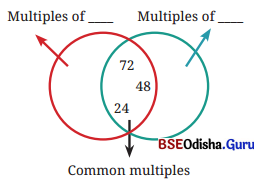
Solution:
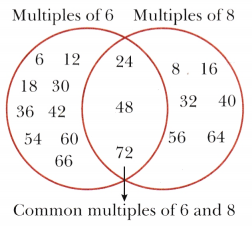
Factors of 24 are 1, 2, 3, 4, 6, 8, 12 and 24.
Factors of 48 are 1, 2, 3, 4, 6, 8, 12, 16, 24 and 48.
Factors of 72 are 1, 2, 3, 4, 6, 8, 9, 12, 18, 24, 36 and 72.
Common factors of 24, 48 and 72 are 1, 2, 3, 4, 6, 8, 12, 24.
So, in multiples of 6 and 8, common multiples are 24, 48 and 72.
Other possibilities of the numbers are 3 and 8, 3 and 24, 4 and 6, 4 and 24, 6 and 24, etc.
Question 3.
Find the smallest number that is a multiple of all the numbers from 1 to 10.
Solution:
To find the smallest number that is a multiple of all numbers from 1 to 10, we need to determine least common multiple (LCM) of the numbers from 1 to 10.
Prime factorisation of numbers from 1 to 10.
1 = 1; 2 = 2; 3 = 3; 4 = 2 × 2; 5 = 5; 6 = 2 × 3; 7 = 7; 8 = 2 × 2 × 2; 9 = 3 × 3; 10 = 2 × 5
LCM (1 to 10) = 2 × 2 × 2 × 3 × 3 × 5 × 7 = 2520 Thus, the required smallest number is 2520.
Question 4.
Write three pairs of prime numbers less than 20 whose sum is a multiple of 5.
Solution:
Prime numbers less than 20 are 2, 3, 5, 7, 11, 13, 17 and 19.
Now, 2 + 3 = 5 (multiple of 5)
2 + 13 = 15 (multiple of 5)
7 + 13 = 20 (multiple of 5)
Thus, three pairs are (2, 3), (2, 13) and (7, 13).
Question 5.
The numbers 13 and 31 are prime numbers. Both these numbers have same digits 1 and 3 . Find such pairs of prime numbers up to 100.
Solution:
Pairs of prime numbers having same digits upto 100 are:
17 and 71 (both have digits 1 and 7);
37 and 73 (both have digits 3 and 7)
79 and 97 (both have digits 7 and 9)
Question 6.
Twin primes are pairs of primes having a difference of 2. For example, 3 and 5 are twin primes. So are 17 and 19. Find the other twin primes between 1 and 100.
Solution:
Twin primes between 1 and 100 are
(3, 5) → 5 – 3 = 2;
(5, 7) → 7 – 5 = 2;
(17, 19) → 19- 17 = 2;
(29, 31) → 31 – 29 = 2;
(59, 61) → 61 – 59 = 2;
(71, 73) → 73 – 71 = 2
Question 7.
Observe that 3 is a prime number and 2 × 3 + 1 = 7 is also a prime. Are there other primes for which doubling and adding 1 give another prime? Find atleast five such examples.
Solution:
Five such examples are:
2 × 2+ 1 = 5 (prime number)
2 × 5 + 1 = 11 (prime number)
2 × 11 + 1 = 23 (prime number)
2 × 23 + 1 = 47 (prime number)
and 2 × 29 + 1 = 59 (prime number)
Question 8.
What is the smallest number whose prime factorisation has
(a) three different prime numbers?
(b) four different prime numbers?
Solution:
(a) The smallest three prime numbers are 2, 3 and 5.
Thus, the smallest number with exactly three different prime factors = 2 × 3 × 5 = 30
(b) The smallest four prime numbers are 2, 3, 5 and 7.
Thus, the smallest number with exactly four different prime factors = 2 × 3 × 5 × 7 = 210
Question 9.
The first number has prime factorisation 2 × 3 × 7 and the second number has prime factorisation 3 × 7 × 11. Are they co-prime? Does one of them divide the other?
Solution:
Prime factorisation of two numbers are 2 × 3 × 7 and 3 × 7 × 11.
Both the numbers have common factors 3 and 7. Therefore, they are not co-prime.
Since the prime factors of one number are not the prime factors of another number, therefore one of them does not divide the other.
Question 10.
Find the largest and smallest 4-digit numbers that are divisible by 4 and are also palindromes.
Solution:
The smallest 4-digit palindrome is 1001 .
Checking divisibility by 4:
1001 (not divisible by 4);
1111 (not divisible by 4);
1221 (not divisible by 4)
1331 (not divisible by 4);
1441 (not divisible by 4);
1551 (not divisible by 4);
1661 (not divisible by 4);
1771 (not divisible by 4);
1881 (not divisible by 4);
1991 (not divisible by 4);
2002 (not divisible by 4);
2112 (divisible by 4)
Therefore, die smallest 4-digit palindromic number divisible by 4 is 2112 .
The largest 4-digit palindrome is 9999.
Checking divisibility by 4:
9999 (not divisible by 4);
9669 (not divisible by 4);
9339 (not divisible by 4);
9009 (not divisible by 4):
9889 (not divisible by 4);
9559 (not divisible by 4);
9229 (not divisible by 4);
8998 (not divisible by 4);
9779 (not divisible by 4);
9449 (not divisible by 4);
9119 (not divisible by 4);
8888 (divisible by 4)
Therefore, the largest 4 -digit palindromic number divisible by 4 is 8888.
Question 11.
The teacher asked if 14560 is divisible by all of 2, 4, 5, 8 and 10. Guna checked for divisibility of 14560 by only two of these numbers and then declared that it was also divisible by all of them. What could those two numbers be?
Solution:
If a number is divisible by 8 and 5, then it will also be divisible by 2, 4 and 10.
Divisibility by 8 ensures it is always divisible by 2 and 4.
Divisibility by 5 ensures it ends with 0 or 5. But since the number also needs to be divisible by 8 then it must end with 0.
A number ending with 0 is also divisible by 10.
Therefore, 8 and 5 are the required numbers.
InText Questions
Question 1.
Look at the table below. What do you notice?
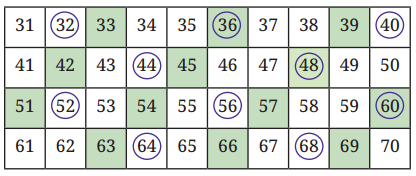
(i) Is there anything common among the shaded numbers?
(ii) Is there anything common among the circled numbers?
(iii) Which numbers are both shaded and circled? What are these numbers called?
Solution:
(i) All shaded numbers are multiples of 3.
(ii) All circled numbers are multiples of 4.
(iii) Numbers (both shaded and circled) are 36, 48 and 60.
They are called ‘common multiples of 3 and 4’.
Question 2.
Grumpy and Jumpy are playing treasure finding game. Treasures are kept on two numbers. Jumpy gets the treasures only if he is able to reach both the numbers with the same jump size. Also, a jump size of 1 is not allowed.
Where should Grumpy place the treasures so that Jumpy cannot reach both the treasures? Check if these pairs are safe:
(a) 15 and 39
(b) 4 and 15
(c) 18 and 29
(d) 20 and 55
Solution:
Grumpy should place the treasures at co-prime numbers.
(a) Pair (15 and 39) is not safe because 15 and 39 are not co-prime as 3 is their common factor.
(b) Pair (4 and 15) is safe because 4 and 15 are co-prime.
(c) Pair (18 and 29) is safe because 18 and 29 are co-prime.
(d) Pair (20 and 55) is not safe because 20 and 55 are not co-prime as 5 is their common factor.
Question 3.
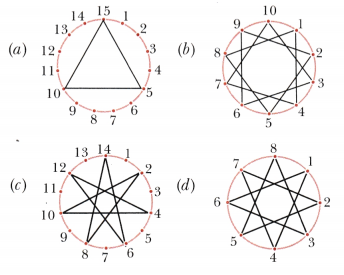
Observe the following thread art. The first diagram has 12 pegs and the thread is tied to every fourth peg (we say that the thread-gap is 4). The second diagram has 13 pegs and the thread- gap is 3. What about the other diagrams? Observe these pictures, share and discuss your findings in class. In some diagrams, the thread is tied to every peg. In some, it is not. Is it related to the two numbers (the number of pegs and the thread- gap) being co-prime?
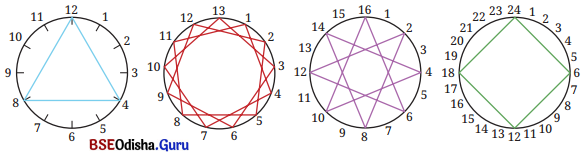
Make such pictures for the following:
(a) 15 pegs, thread-gap of 10
(b) 10 pegs. thread-gap of’ 7
(c) 14 pegs, thread-gap of 6
(d) 8 pegs, thread -gap of 3
Solution:
Yes, when two numbers are co-prime, the thread is tied to every peg.
Question 4.
Find numbers between 330 and 340 that are divisible by 4. Also, find numbers between 1730 and 1740, and 2030 and 2040, that are divisible by 4. What do you observe?
Solution:
Numbers between 330 and 340 that are divisible by 4 are 332 and 336
Numbers between 1730 and 1740 that are divisible by 4 are 1732 and 1736
Numbers between 2030 and 2040 that are divisible by 4 are 2032 and 2036
We observe that if number formed by last two digits of a number is divisible by 4, then the number is divisible by 4.
Question 5.
Find numbers between 120 and 140 that are divisible by 8. Also find numbers between 1120 and 1140, and 3120 and 3140, that are divisible by 8. What do you observe?
Solution:
Numbers between 120 and 140 that are divisible by 8 are 128 and 136.
Numbers between 1120 and 1140 that are divisible by 8 are 1128 and 1136.
Numbers between 3120 and 3140 that are divisible by 8 are 3128 and 3136.
We observe that if last three digits of a number is divisible by 8, then the number is divisible by 8.
Question 6.
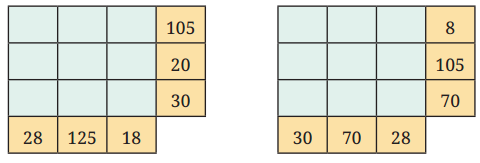
Fill the grid with prime numbers only so that the product of each row is the number to the right of the row and the product of each column is the number below the column.
Solution:
(i)
| 7 | 5 | 3 | 105 |
| 2 | 5 | 2 | 20 |
| 2 | 5 | 3 | 30 |
| 28 | 125 | 18 |
(ii)
| 2 | 2 | 2 | 8 |
| 3 | 5 | 7 | 105 |
| 5 | 7 | 2 | 70 |
| 30 | 70 | 28 |
Prime Time Class 6 Extra Questions
Prime Time Class 6 Very Short Question Answer
Question 1.
Write all factors of each of the following numbers:
(i) 24
(ii) 32
Solution:
(i) We can write 24 = 1 × 24 = 2 × 12 = 3 × 8 = 4 × 6
∴ 1,2,3, 4, 6, 8, 12 and 24 are the factors of 24.
(ii) We can write 32 = 1 × 32 = 2 × 16 = 4×8
1, 2, 4, 8, 16 and 32 are the factors of 32.
Question 2.
Write first five multiples of each of the following numbers.
(i) 9
(ii) 13
Solution:
(i) To obtain first five multiples of 9, we multiply it by 1,2, 3, 4 and 5 respectively.
9 × 1 = 9;
9 × 2 = 18;
9 × 3 = 27;
9 × 4 = 36;
9 × 5= 45
Hence, the first five multiples of 9 are 9, 18, 27, 36 and 45.
(ii) To obtain first five multiples of 13, we multiply it by 1, 2, 3, 4 and 5 respectively.
13 × 1 = 13;
13 × 2 = 26;
13 × 3 = 39;
13 × 4 = 52;
13 × 5 = 65
Hence, the first five multiples of 13 are 13, 26, 39, 52 and 65.
Question 3.
Show that 17 is a factor of 170017 without actual division.
Solution:
We can write
170017 = 170000 + 17 = 17 × 10000 + 17 × 1 = 17 × (10000 + 1) = 17 × 10001
Hence, 17 is a factor of 170017.
Question 4.
Write any three numbers that are multiples of 15 but not of 30.
Solution:
Multiples of 15 are 15, 30, 45, 60, 75, 90, … Multiples of 30 are 30, 60, 90, …
Thus, three numbers that are multiples of 15 but not of 30 are 15, 45 and 75.
Question 5.
Find the common factors of 16 and 28.
Solution:
We can write 16 = 1 × 16 = 2 × 8 = 4 × 4
∴ The factors of 16 are 1, 2, 4, 8 and 16.
And, 28 = 1 × 28 = 2 × 14 = 4 × 7
∴ The factors of 28 are 1, 2, 4, 7, 14 and 28.
Hence, the common factors of 16 and 28 are 1, 2 and 4.
Question 6.
Write five prime triplets such that the difference between the greatest and the smallest prime number is 6.
Solution:
{7, 11, 13}, (11, 13, 17}, {13, 17, 19}, {17, 19, 23} and {37, 41, 43}.
Question 7.
Write all prime numbers less than 100.
Solution:
The prime numbers less than 100 are 2, 3, 5, 7, 11, 13, 17, 19, 23, 29, 31, 37, 41, 43, 47, 53, 59, 61, 67, 71, 73, 79, 83, 89 and 97.
Question 8.
Write five pairs of co-prime numbers.
Solution:
Two numbers are said to be co-prime if they do not have a common factor other than 1. Thus, five pairs of co-primes are (2, 3), (4, 5), (5, 6), (9, 10), (10, 21).
Question 9.
Write two numbers whose product is 10000. The two numbers should not have 0 as the units digit.
Solution:
We can write 10000 = 100 × 100
= (2 × 2 × 5 × 5) × (2 × 2 × 5 × 5)
= (2 × 2 × 2 × 2) × (5 × 5 × 5 × 5)
= 16 × 625
Question 10.
Check the divisibility 100100 by 10:
Solution:
Since 100100 ends with the digit 0, it is divisible by 10.
Question 11.
Check the divisibility 412030 by 10:
Solution:
Since 412030 ends with the digit 0, it is divisible by 10.
Question 12.
Check the divisibility 718005 by 10:
Solution:
Since 718005 does not end with the digit 0, it is not divisible by 10.
Question 13.
Check the divisibility 123456 by 4:
Solution:
The number formed by the last two digits of 123456 is 56.
Since 56 = 4 × 14, it is divisible by 4.
∴ 123456 is divisible by 4.
Question 14.
Check the divisibility 725976 by 4:
Solution:
The number formed by the last two digits of 725976 is 76.
Since 76 = 4 × 19, it is divisible by 4.
∴ 725976 is divisible by 4.
Question 15.
Check the divisibility 985442 by 4:
Solution:
The number formed by the last two digits of 985442 is 42.
Clearly, 42 is not divisible by 4.
∴ 985442 is not divisible by 4.
Question 16.
Give an example of a number which is divisible by 2 but not by 4
Solution:
6
Question 17.
Give an example of a number which is divisible by 4 but not by 8.
Solution:
20
Question 18.
Give an example of a number which is divisible by both 4 and 8 but not by 32.
Solution:
48
Question 19.
Express each of the following as a sum of three unique prime numbers.
(i) 10
(ii) 25
(iii) 35
(iv) 49
Solution:
(i) 10 = 2 + 3 + 5
(ii) 25 = 5 + 7 + 13
(iii) 35 = 5 + 7 + 23
(iv) 49 = 13 + 17 + 19
Question 20.
Express each of the following as a sum of two unique prime numbers:
(i) 15
(ii) 30
(iii) 54
(iv) 80
Solution:
(i) 15 = 2 + 13
(ii) 30 = 7 + 23
(iii) 54 = 13 + 41
(iv) 80 = 19 + 61
Question 21.
Express each of the following as a sum of twin primes:
(i) 12
(ii) 36
(iii) 60
(iv) 84
Solution:
(i) 12 = 5 + 7
(ii) 36 = 17 + 18
(iii) 60 = 29 + 31
(iv) 84 = 41 + 43
Question 22.
Check the divisibility of the following numbers by 5:
(i) 235965
(ii) 783120
(iii) 415812
Solution:
(i) Since 235965 ends with the digit 5, it is divisible by 5.
(ii) Since 783120 ends with the digit 0, it is divisible by 5.
(iii) Since 415812 does not end with the digits 0 or 5, it is not divisible by 5.
Prime Time Class 6 Short Question Answer
Question 1.
Write all factors of each of the following numbers:
(i) 60
(ii) 420
Solution:
(i) We can write
60 = 1 × 60 = 2 × 30 = 3 × 20 = 4 × 15
= 5 × 12 = 6 × 10
∴ 1, 2, 3, 4, 5, 6, 10, 12, 15, 20, 30 and 60 are the factors of 60.
(ii) We can write
420 = 1 × 420 = 2 × 210 = 3 × 140 = 4 × 105 = 5 × 84 = 6 × 70 = 7 × 60 = 10 × 42
= 12 × 35 = 14 × 30 = 15 × 28 = 20 × 21
∴ 1, 2, 3, 4, 5, 6, 7, 10, 12, 14, 15, 20, 21, 28, 30, 35, 42, 60, 70, 84, 105, 140, 210 and 420 are the factors of 420.
Question 2.
The product of two numbers is 42. Their sum is 17. What are the numbers?
Solution:
We can write 42 = 1 × 42 = 2 × 21 = 3 × 14 = 6 × 7.
∴ 1, 2, 3, 6, 7, 14, 21 and 42 are the factors of 42.
Out of all the above factors, only 3 and 14 add up to a total of 17.
Hence, the required numbers are 3 and 14.
Question 3.
Find the smallest number that is a multiple of all the numbers from 1 to 10 except 7.
Solution:
We know, 8 is a multiple of 1, 2, 4 and 8.
9 is a multiple of 1, 3 and 9.
8 × 9 is a multiple of 6.
5 × 8 × 9 is a multiple of 5 and 10.
[As 5 × 8 = 40 is a multiple of 5 and 10.]
∴ Required smallest number is 5 × 8 × 9 = 360.
Question 4.
Find the common factors of 12, 18 and 24.
Solution:
We can write 12 = 1 × 12 = 2 × 6 = 3 × 4
∴ The factors of 12 are 1, 2, 3, 4, 6 and 12.
18 = 1 × 18 = 2 × 9 = 3 × 6
∴ The factors of 18 are 1, 2, 3, 6, 9 and 18.
24 = 1 × 24 = 2 × 12 = 3 × 8 = 4 × 6
∴ The factors of 24 are 1,2, 3, 4, 6, 8, 12 and 24.
Hence, the common factors of 12, 18 and 24 are 1, 2, 3 and 6.
Question 5.
Find the common multiples of 6, 9 and 12.
Solution:
The multiples of 6 are 6, 12, 18, 24, 30, 36, 42, 48, 54, 60, 66, 72, …
The multiples of 9 are 9, 18, 27, 36, 45, 54, 63, 72, ……
The multiples of 12 are 12, 24, 36, 48, 60, 72, 84, ………
Hence, the common multiples of 6, 9 and 12 are 36, 72, 108, … .
Question 6.
A number is divisible by both 6 and 14. By which other number will that number be always divisible?
Solution:
Since the number is divisible by 6 and 14, the number is a common multiple of 6 and 14. So, the number will always be divisible by the smallest common multiple of 6 and 14.
Now, the multiples of 6 are 6, 12, 18, 24, 30, 36, 42, 48, … .
And, the multiples of 14 are 14, 28. 42, 56, 70, 84,
So, the common multiples of 6 and 14 are 42, 84, 126,….
∴ The smallest common multiple of 6 and 14 is 42.
Hence, 42 is the required number.
Question 7.
How many numbers between 1 and 100 have exactly three factors?
Solution:
As we know, prime numbers have exactly two factors, 1 and itself. So, squares of prime numbers will have exactly three factors.
22 = 4 has factors 1, 2 and 4.
32 = 9 has factors 1,3 and 9. .
52 = 25 has factors 1,5 and 25.
72 = 49 has factors 1, 7 and 49.
Thus, four numbers i.e. 4, 9, 25 and 49 between 1 and 100 have exactly three factors.
Question 8.
The product of two numbers is 36. Their difference is 9. What are the numbers?
Solution:
We can write 36 = 1 × 36 = 2 × 18 = 3 × 12 = 4 × 9 = 6 × 6.
∴ 1, 2, 3, 4, 6, 9, 12, 18 and 36 are the factors of 36.
The difference between factors 12 and 3 is 9.
Hence, the required numbers are 3 and 12.
Note: The difference between factors 18 and 9 is also 9, but their product is not equal to 36.
Question 9.
Without actual division, show that 13 is a factor of each of the following numbers:
(i) 1313
(ii) 13013
(iii) 131313
Solution:
(i) We can write
1313 = 1300 + 13 = 13 × 100 + 13× 1 = 13(100 + 1) = 13 × 101
Hence, 13 is a factor of 1313.
(ii) We can write
13013 = 13000 + 13 = 13 × 1000 + 13 × 1 = 13(1000 + 1) = 13 × 1001
Hence, 13 is a factor of 13013.
(iii) We can write
131313 = 130000 + 1300 + 13 = 13 × 10000 + 13 × 100 + 13 × 1
= 13(10000 + 100 + 1) = 13 × 10101
Hence, 13 is a factor of’ 131313.
Question 10.
Find the common factors of:
(i) 12 and 18
(ii) 35 and 63
(iii) 60 and 210
Solution:
(i) We can write 12 = 1 × 12 = 2 × 6 = 3 × 4
∴ The factors of 12 are 1, 2, 3, 4, 6 and 12.
And, 18 = 1 × 18 = 2 × 9 = 3 × 6
∴ The factors of 18 are 1,2, 3, 6, 9 and 18.
Hence, the common factors of 12 and 18 are 1, 2, 3 and 6.
(ii) We can write 35 = 1 × 35 = 5 × 7
∴ The factors of 35 are 1, 5, 7 and 35.
And, 63 = 1 × 63 = 3 × 21 = 7 × 9
∴ The factors of 63 are 1. 3, 7, 9, 21 and 63.
Hence, the common factors of 35 and 63 are 1 and 7.
(iii) We can write 60 = 1 × 60 = 2 × 30 = 3 × 20 = 4 × 15 = 5 × 12 = 6 × 10
∴ The factors of 60 are 1, 2, 3, 4, 5, 6, 10, 12, 15, 20, 30 and 60.
210 = 1 × 210 = 2 × 105 = 3 × 70 = 5 × 42 = 6 × 35 = 7 × 30 = 10 × 21 = 14 × 15
∴ The factors of 210 are 1, 2, 3, 5, 6, 7, 10, 14, 15, 21, 30, 35, 42, 70, 105 and 210.
Hence, the common factors of 60 and 210 are 1, 2, 3, 5, 6, 10, 15 and 30.
Question 11.
Find first three common multiples of:
(i) 10 and 20
(ii) 25 and 50
(iii) 40 and 60
Solution:
(i) The multiples of 10 are 10, 20, 30, 40, 50, 60,
The multiples of 20 are 20, 40, 60, 80, …
Hence, the first three common multiples of 10 and 20 are 20, 40 and 60.
(ii) The multiples of 25 are 25, 50, 75, 100, 125, 150, …
The multiples of 50 are 50, 100, 150, 200, …
Hence, the first three common multiples of 25 and 50 are 50, 100 and 150.
(iii) The multiples of 40 are 40; 80, 120, 160, 200, 240, 280, 320, 360 …
The multiples of 60 are 60, 120, 180, 240, 300, 360 …
Hence, the first three common multiples of 40 and 60 are 120, 240 and 360.
Question 12.
A number is divisible by both 8 and 12. By which other numbers will that number be always divisible?
Solution:
Since the number is divisible by 8 and 12, the number is a common multiple of 8 and 12. So, the number will always he divisible by the smallest common multiple of 8 and 12.
Now, the multiples of 8 are 8, 16, 24, 32, 40, 48, 56, 64, 72 …
The multiples of 12 are 12, 24, 36, 48, 60, 72, …
So, the common multiples of 8 and 12 are 24, 48, 72, …
∴ The smallest common multiple of 8 and 12 is 24.
Hence, the number is divisible by 24 and hence by all factors of 24, i.e., 1, 2, 3, 4, 6, 8, 12 and 24.
Question 13.
Write all pairs of twin primes between 1 and 100.
Solution:
The prime numbers less than 100 are 2, 3, 5, 7, 11, 13, 17, 19, 23, 29, 31, 37, 41, 43, 47, 53, 59, 61, 67, 71, 73, 79, 83,89 and 97.
The required pairs of twin primes are (3, 5), (5, 7), (11, 13), (17, 19), (29, 31), (41, 43), (59, 61) and (71, 73).
Question 14.
Write all pairs of prime numbers less than 30 whose sum is a multiple of 5.
Solution:
The prime numbers less than 30 are 2, 3, 5, 7, 11, 13, 17, 19, 23 and 29.
Now, 2 + 3 = 5, 2 + 13 = 15, 2 + 23 = 25, 3 + 7=10,
3 + 17 = 20, 7 + 13 = 20, 7 + 23 = 30, 11 + 19 = 30,
11 + 29 = 40, 13 + 17 = 30, 17 + 23 = 40
∴ The required pairs are (2, 3), (2, 13), (2, 23), (3, 7), (3, 17), (7, 13), (7, 23), (1 1, 19), (11, 29), (13, 17) and (17, 23).
Question 15.
Determine the prime factorisation of the following numbers:
(i) 3094
(ii) 5082
(iii) 10010
Solution:
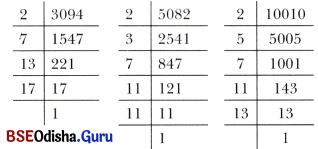
(i) The prime factorisation of 3094 is 2 × 7 × 13 × 17.
(ii) The prime factorisation of 5082 is 2 × 3 × 7 × 11 × 11.
(iii) The prime factorisation of 10010 is 2 × 5 × 7 × 11 × 13.
Question 16.
Find prime factorisation of the following numbers without multiplying first:
(i) 48 × 60
(ii) 56 × 75
(iii) 81 × 25
Solution:
(i) Prime factorisation of 48 = 2 × 2 × 2 × 2 × 3
Prime factorisation of 60 = 2 × 2 × 3 × 5
Thus, prime factorisation of 48 × 60 is 2 × 2 × 2 × 2 × 2 × 2 × 3 × 3 × 5.
(ii) Prime factorisation of 56 = 2 × 2 × 2 × 7
Prime factorisation of 75 = 3 × 5 × 5
Thus, prime factorisation of 56 × 75 is 2 × 2 × 2 × 3 × 5 × 5 × 7.
(iii) Prime factorisation of 81 = 3 × 3 × 3 × 3
Prime factorisation of 25 = 5 × 5
Thus, prime factorisation of 81 × 25 is 3 × 3 × 3 × 3 × 5 × 5.
Question 17.
The first number has prime factorisation 2 × 5 × 7 and the second number has prime factorisation 5 × 7 × 11. Are they co-prime? Does one of them divide the other?
Solution:
Since 5 and 7 are the common prime factors of two numbers, they are not co-prime.
Clearly, 2 is a prime factor of first number but not a prime factor of second number.
Hence, second number is not divisible by first number.
And, 1 1 is a prime factor of second number but not a prime factor of first number.
Hence, first number is not divisible by second number. So, none of them divide the other number.
Question 18.
Check the divisibility of the following numbers by 8:
(i) 6245826
(ii) 2727272
(iii) 2491664
Solution:
(i) The number formed by the last three digits of 6245826 is 826.
Clearly, 826 is not divisible by 8.
∴ 6245826 is not divisible by 8.
(ii) The number formed by the last three digits of 2727272 is 272.
Since 272 = 8 x 34, it is divisible by 8.
∴ 2727272 is divisible by 8.
(iii) The number formed by the last three digits of 2491664 is 664.
Since 664 = 8 X 83, it is divisible by 8.
∴ 2491664 is divisible by 8.
Prime Time Class 6 Long Question Answer
Question 1.
Who am I?
(i) I am a number less than 50. One of my factors is 11. The sum of my digits is 8.
(ii) I am an even number less than 100. One of my factors is 7. One of my digits is 1 more than the other.
Solution:
(i) Numbers less than 50 and having 11 as a factor are
11 × 1 = 11, 11 × 2 = 22, 11 × 3 = 33, 11 × 4 = 44
Out of these numbers, only 44 is the number whose sum of digits is 8.
Hence, the required number is 44.
(ii) Even numbers less than 100 and having 7 as a factor are
7 × 2 = 14, 7 × 4 = 28, 7 × 6 = 42, 7 × 8 = 56, 7 × 10 = 70, 7 × 12 = 84, 7 × 14 = 98
Out of these numbers, only 56 and 98 are the numbers whose one digit is 1 more than the other.
Hence, the required number is either 56 or 98.
Question 2.
Using prime factorisation, check whether the following pairs of numbers are co-prime or not:
(i) 154 and 195
(ii) 132 and 225
(iii) 357 and 286
Solution:
(i) Prime factorisations of 154 and 195 are as follows:
154 = 2 × 7 × 11 and 195 = 3 × 5 × 13
Since there are no common prime factors, 154 and 195 are co-prime.
(ii) Prime factorisations of 132 and 225 are as follows:
132 = 2 × 2 × 3 × 11 and 225 = 3 × 3 × 5 × 5
Since 3 is a common prime factor, 132 and 225 are not co-prime.
(iii) Prime factorisations of 357 and 286 are as follows:
357 = 3 × 7 × 17 and 286 = 2 × 11 × 13
Since there are no common prime factors, 357 and 286 are co-prime.
Question 3.
Using prime factorisation method, determine whether the first number is divisible by the second number or not:
(i) 420 and 105
(ii) 693 and 78
(iii) 990 and 90
Solution:
(i) Prime factorisations of 420 and 105 are as follows:
420 = 2 × 2 × 3 × 5 × 7 and 105 = 3 × 5 × 7
Clearly, all prime factors of 105 are prime factors of 420 and prime factorisation of 105 is included in the prime factorisation of 420.
We can write, 420 = (3 × 5 × 7) × 2 × 2 = 105 × 4
Hence, 420 is divisible by 105.
(ii) Prime factorisations of 693 and 78 are as follows:
693 = 3 × 3 × 7 × 11 and 78 = 2 × 3 × 13 Clearly, 13 is a prime factor of 78 but not a prime factor of 693.
Hence, 693 is not divisible by 78.
(iii) Prime factorisations of 990 and 90 are as follows:
990 = 2 × 3 × 3 × 5 × 11 and 90 = 2 × 3 × 3 × 5
Clearly, all prime factors of 90 are prime factors of 990 and prime factorisation of 90 is included in the prime factorisation of 990.
We can write, 990 = (2 × 3 × 3 × 5) × 11 = 90 × 11
Hence, 990 is divisible by 90.
Question 4.
Using prime factorisation, check whether the following pairs of numbers are co-prime or not:
(i) 308 and 585
(ii) 396 and 450
(iii) 1071 and 1430
Solution:
(i) Prime factorisations of 308 and 585 are as follows:
308 = 2 × 2 × 7 × 11 and 585 = 3 × 3 × 5 × 13
Since there are no common factors in these prime factorisations, 308 and 585 are co-prime.
(ii) Prime factorisations of 396 and 450 are as follows:
396 = 2 × 2 × 3 × 3 × 11 and 450 = 2 × 3 × 3 × 5 × 5
Since 2 and 3 are common factors in these prime factorisations, 396 and 450 are not co-prime.
(iii) Prime factorisations of 1071 and 1430 are as follows:
1071 = 3 × 3 × 7 × 17 and 1430 = 2 × 5 × 11 × 13
Since there are no common factors in these prime factorisations, 1071 and 1430 are co-prime.
Question 5.
Using prime factorisation method, determine whether the first number is divisible by the second number or not:
(i) 1260 and 315
(ii) 7623 and 198
(iii) 3780 and 126
Solution:
(i) Prime factorisations of 1260 and 315 are as follows:
1260 = 2 × 2 × 3 × 3 × 5 × 7 and 315 = 3 × 3 × 5 × 7
Clearly, all prime factors of 315 are prime factors of 1260 and prime factorisation of 315 is included in the prime factorisation of 1260.
We can write, 1260 = (3 × 3 × 5 × 7) × 2 × 2 = 315 × 4
Hence, 1260 is divisible by 315.
(ii) Prime factorisations of 7623 and 198 are as follows:
7623 = 3 × 3 × 7 × 11 × 11 and 198 = 2 × 3 × 3 × 11
Clearly, 2 is a prime factor of 198 but not a prime factor of 7623.
Hence, 7623 is not divisible by 198.
(iii) Prime factorisations of 3780 and 126 are as follows:
3780 = 2 × 2 ×3 × 3 × 3 × 5 × 7 and 126 = 2 × 3 × 3 × 7
Clearly, all prime factors of 126 are prime factors of 3780 and prime factorisation of 126 is included in the prime factorisation of 3780.
We can write,
3780 = (2 × 3 × 3 × 7) × 2 × 3 × 5 = 126 × 30
Hence, 3780 is divisible by 126.
Question 6.
State whether the following statements are true or false. Give reasons.
(i) If a number is divisible by 4, then it must be divisible by 8.
(ii) If a number is divisible by 8, then it must be divisible by 4.
(iii) If a number exactly divides the sum of two numbers, it must exactly divide the numbers separately.
(iv) The sum of two consecutive odd numbers is always divisible by 4.
(v) Sum of two even numbers gives a multiple of 4.
(vi) Sum of two odd numbers gives a multiple of 4.
Solution:
(i) False.
For example, 28 is divisible by 4 but not by 8.
(ii) True.
If a number is divisible by 8, then it must be divisible by 4 because 4 is a factor of 8.
(iii) False.
For example, let us take 14 and 6. Their sum, 14 + 6 = 20, is divisible by 4. But neither 14 nor 6 are divisible by 4.
(iv) True.
Let 2n + 1 and 2n + 3 be two consecutive odd numbers, where n = 0, 1,2,3, … .
Then, their sum,
(2n + 1) + (2n + 3) = 4n + 4 = 4(n + 1), is divisible by 4.
For example, 3 and 5 are two consecutive odd numbers, whose sum is 8 and 8 is divisible by 4.
(v) False.
For example, 12 and 6 are even numbers but their sum 18 is not a multiple of 4.
(vi) False.
For example, 13 and 5 are odd numbers but their sum 18 is not a multiple of 4.
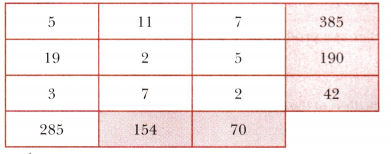
Question 7.
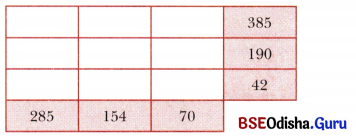
Solve the prime puzzle given below:
Solution:
385 = 5 × 7 × 11;
190 = 2 × 5 × 19;
42 = 2 × 3 × 7;
285 = 3 × 5 × 19;
154 = 2 × 7 × 11;
70 = 2 × 5 × 7
∴ Solution of given prime puzzle is as follows:
Question 8.
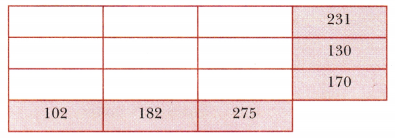
Solve the prime puzzle given below:
Solution:
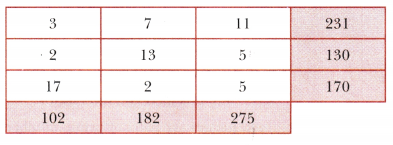
Prime factorisations of the given numbers are as follows:
231 = 3 × 7 × 11;
130 = 2 × 13 × 5;
170 = 2 × 5 × 17;
102 = 3 × 2 × 17;
182 = 2 ×7 × 13;
275 = 5 × 5 × 11
∴ Solution of given prime puzzle is as follows:
Question 9.
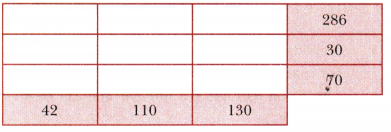
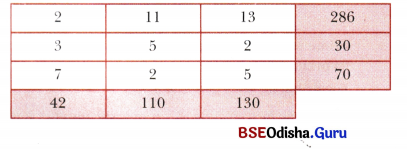
Solve the prime puzzle given below:
Solution:
Prime factorisations of the given numbers are as follows:
286 = 2 × 11 × 13;
30 = 2 × 3 × 5;
70 = 2 × 5 × 7;
42 = 2 × 3 × 7;
110 = 2 × 5 × 11;
130 = 2 × 5 × 13
∴ Solution of given prime puzzle is as follows:
Prime Time Class 6 Case Based Questions
Question 1.
A Greek mathematician Eratosthenes, who lived around 2200 years ago, gave a method to list the prime numbers. The method is called the Sieve of Eratosthenes. In the given figure, encircled numbers arc prime numbers.
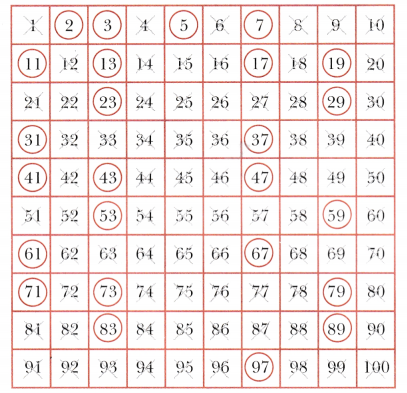
Based on the above information, answer the following questions:
(i) How many prime numbers are there between 1 and 100?
(ii) Which digits can never appear in the units place of a prime number?
(iii) Which digit most frequently appears in the units place of prime numbers less than 100?
(iv) Write live consecutive composite numbers less than 100 so that there is no prime number between them.
Solution:
(i) There are 25 prime numbers between 1 and 100.
(ii) 0, 4, 6 and 8 never appear in the unit place of a prime number.
(iii) Digit 3 appears 7 times in the units place of prime numbers less than 100.
(iv) 24, 25, 26, 27, 28 or 32, 33, 34, 35, 36 or 48, 49, 50, 51, 52 or 54, 55,56,57, 58 or 62, 63, 64, 65, 66 or 74, 75, 76, 77, 78 or 84, 85, 86, 87, 88
or 90, 91,92, 93, 94 or 91,92, 93, 94, 95 or 92, 93, 94, 95,96
Question 2.
The school gardening club has 210 marigold plants and 150 sunflower plants. The club members want to create equal rows for each type of flower such that each row contains the same number of one kind of plant and no plants are left unused.
Based on the above information, answer the following questions:
(i) Can they arrange the marigold plants in rows of 2, 5 or 7?
(ii) What is the largest number of plants per row they can use for each type so that all plants are used and plants in each row are equal?
(iii) They decide to pack the flowers into minimum flower boxes, and each box must contain the same number of plants. Which number less than 10 can they choose so that both 210 and 150 divide evenly by it?
(iv) Perform prime factorisation of 150 and 210 and find the common prime factors.
Solution:
(i) It is given that the school gardening club has 210 marigold plants. For 210 marigold plants to be arranged in rows of 2, 5 or 7, 210 must be divisible by 2, 5 or 7.
As 210 ends with 0, it is divisible by 2 and 5 both.
Now, 210 ÷ 7 = 30. Thus, 210 is also divisible by 7.
Thus, the marigold plants can be arranged in rows of 2, 5 or 7.
(ii) We need the largest number of plants of the same type per row such that
- Each row has the same number of plants.
- There are no leftover plants.
- Thus, we are looking for the largest number that can:
- Evenly divide 210 (so marigold plants are used up completely)
- Evenly divide 150 (so sunflower plants are used up completely)
This number will be the highest common factor of 210 and 150.
Now, the factors of 210 are 1, 2, 3, 5, 6, 7, 10, 14, 15, 21, 30, 35, 42, 70, 105 and 210.
And, the factors of 150 are 1, 2, 3, 5, 6, 10, 15, 25, 30, 50, 75 and 150.
The highest common factor is 30. Thus, if we use 30 plants in each row we get 210 ÷ 30 = 7 rows of marigold plant and 150 ÷ 30 = 5 rows of sunflower plant and no plants are left.
(iii) It is given that each flower box must contain equal number of plants and the number must be less than 10. Thus, we need to find the common factors of 150 and 210 which are less than 10.
Now, the factors of 210 are 1, 2, 3, 5, 6, 7, 10, 14, 15, 21, 30, 35, 42, 70, 105 and 210.
And, the factors of 150 are 1, 2, 3, 5, 6, 10, 15, 25, 30, 50, 75 and 150.
Thus, the common factors less than 10 are 1,2, 3, 5 and 6. ‘
For minimum boxes, the club members must place maximum plants in each box.
Thus, club members can keep 6 plants in each box, so that the flower boxes are minimum and there are equal plants in each box.
(iv) Prime factorisation of 210 = 2 × 3 × 5 × 7.
Prime factorisation of 150 = 2 × 3 × 5 × 5.
Thus, the common prime factors of 210 and 150 are 2, 3 and 5.