
For better exam readiness, students can include Class 7 Science MCQ and Curiosity Chapter 2 Exploring Substances Acidic Basic and Neutral MCQ in their daily study routine.
Class 7 Science Chapter 2 Exploring Substances Acidic Basic and Neutral MCQ
Exploring Substances Acidic Basic and Neutral MCQ Class 7
MCQ On Exploring Substances Acidic Basic and Neutral Class 7
Choose the correct option.
Question 1.
A student understands that a litmus solution has a purple colour in distilled water. What colour is likely to be observed when it is placed in an acidic solution?
(a) Blue
(b) Green
(c) Purple
(d) Red
Answer:
(d) Red
Question 2.
A scientist tests a soil sample from an uncultivated field and concludes that the soil is highly basic in nature. She suggests that adding organic matter in the soil could improve the quality of the soil. How does organic matter improve the quality of the soil?
(a) It releases acids which neutralises the soil.
(b) It traps water vapour and increases the moisture content.
(c) It makes the soil lighter so that it can be easily transported.
(d) It acts as food for the organisms already present in the soil.
Answer:
(a) It releases acids which neutralises the soil.

Question 3.
Which of the following set of substances contain acids?
(a) Grapes, lime water
(b) Vinegar, soap
(c) Curd, milk of magnesia
(d) Curd, vinegar
Answer:
(d) Curd, vinegar
Question 4.
In a science experiment, a student was provided with two solutions, P and Q, and the natures of both the solutions were tested via the litmus test as shown in the image alongside:
Based on the experiment, which of the following statements cannot be true?
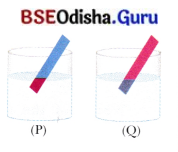
(a) Solution P could be an orange juice, while solution Q could be a soap solution.
(b) Solution P cannot turn the red rose indicator red.
(c) Solution P does not change the colour of the turmeric indicator, while solution Q turns the turmeric indicator red.
(d) Solution P could be a curd, while solution Q could be a detergent solution.
Answer:
(b) Solution P is acidic as it turns blue litmus paper red. Whereas solution Q is basic, as it turns red litmus paper blue. Hence, solution P turns the red rose indicator to a shade of red.
Question 5.
Pulkit was experimenting in the science lab to understand acid-base indicators. Initially, when he added a few drops of red litmus solution to the lime water solution, the colour of the solution turned blue. When he added an excess of lemon juice to this test tube, the colour of the solution eventually changed from blue to red. Which of the following statements is the correct conclusion to the above observation?
(a) The resultant solution is basic, as lemon juice and lime water both are bases.
(b) The resultant solution is neutral, which is why the blue litmus solution turned red.
(c) The resultant solution is acidic, as lemon juice is acidic in nature.
(d) The resultant solution is neutral, as lemon juice is neutral in nature.
Answer:
(c) When a few drops of red litmus solution were added to the lime water solution, the colour of the solution turned blue as lime water is basic in nature. However, upon the addition of an excess of lemon juice, the colour of the solution eventually changed from blue to red. Hence, the resultant solution became acidic, as lemon juice is acidic in nature.
Question 6.
A neutralisation reaction is represented as follows:
Base + X → Y + Water
Based on the above reaction, which of the following statements is true?
(a) X can turn blue litmus paper red.
(b) X is salt, while Y is acid.
(c) X can turn the red rose indicator green.
(d) Neither X nor Y changes the colour of either red or blue litmus paper.
Answer:
(a) The given reaction is represented as follows:

Hence, X, i.e., the acid, can turn blue litmus paper red. Y represents the salt formed in the reaction. X, being an acid, cannot turn the red rose indicator green. Y being neutral, does not change the colour of red or blue litmus paper.
Question 7.
During a class discussion, a class 7 student, Vamika, claimed that any sour substance will turn the turmeric indicator red. Her statement is
(a) Correct, as only acidic substances turn the turmeric indicator red.
(b) Incorrect, as only neutral substances turn the turmeric indicator red.
(c) Incorrect, as only basic substances turn the turmeric indicator red.
(d) Correct, as both acidic as well as basic substances turn the turmeric indicator red.
Answer:
(c) The claim made by the student is incorrect, as acidic substances are sour in taste and they cannot turn the turmeric indicator red. Rather, the basic substances which are bitter in taste, turn the turmeric indicator red.
Question 8.
On the occasion of Mother’s Day, Kartik wrote a message for her mother on a white sheet of paper. First, he applied a turmeric paste all over the paper. Once the paste dried, he wrote his message using a solution X . From the given options, what could be solution X?
(a) Sugar solution
(b) Soap solution
(c) Lemon juice
(d) Amla juice
Answer:
(b) From the given solutions, solution X could be a soap solution, as being basic in nature, it turns the turmeric indicator red. Hence, the message written by Kartik will appear red.
Question 9.
Sheena, a class 7 student, was bitten by an ant while playing in the playground. Her father suggested her to apply a substance, P, to get quick relief from the pain. Select the option that correctly identifies substance P and the reason for applying P.
(a) P could be curd, as it is acidic in nature.
(b) P could be lime water, as it is neutral in nature.
(c) P could be vinegar, as it is acidic in nature.
(d) P could be moist baking soda, as it is basic in nature.
Answer:
(d) When an ant bites, it injects formic acid into the skin. The effect of an ant bite is therefore neutralised by applying a mild basic substance onto the skin. Therefore P could be moist baking soda as it is a mild base, and when rubbed onto the skin, provides relief to the affected area by neutralising the injected acid.
Question 10.
Pawan’s mother used amla juice while cooking to make the gravy sour. Here, the amla juice contains which of the following substances?
(a) Ascorbic acid
(b) Lactic acid
(c) Oxalic acid
(d) Tartaric acid
Answer:
(a) Ascorbic acid
Question 11.
A solution X changes the colour of the red rose indicator to a shade of red. While a solution Y changes the colour of turmeric paper to red. Solutions X and Y can be, respectively:
(a) Soap solution and detergent solution
(b) Salt solution and vinegar
(c) Tamarind juice and curd
(d) Amla juice and baking soda solution
Answer:
(d) Since the solution X turns the red rose indicator to a shade of red, it must be acidic in nature. As solution Y changes the colour of the turmeric paper to red, it must be basic in nature.
Question 12.
The colour of the red rose extract changes to P in a lemon juice solution, and to Q in a lime water solution. Based on this information, select the option that correctly identifies P and Q.
(a) P – Green, Q – Pink
(b) P – Yellow, Q – Red
(c) P – Red, Q – Green
(d) P – Red, Q – Blue
Answer:
(c) The colour of the red rose extract changes to to a shade of red in a lemon juice solution, as it is acidic. While the colour of the red rose extract changes to green in lime water, as it is basic.
Question 13.
A reaction between two solutions, A and B, results in the formation of salt and water along with the evolution of heat. From the given options, select the correct pair of A and B.
(a) Lemon juice and amla juice
(b) Distilled water and sugar solution
(c) Vinegar and baking soda solution
(d) Soap solution and lime water
Answer:
(c) Since the reaction between solutions A and B results in the formation of salt and water, one of these solutions will be acidic, while the other will be basic. Among the given options, only option (c) consists of an acid (vinegar) and a base (baking soda solution).
Question 14.
Ratika, a class 7 student, tested a solution X using blue and red litmus papers as shown in the given picture:
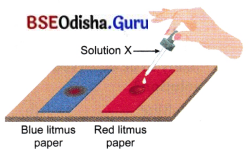
Which of the following statements is true based on this activity?
(a) Solution X must be basic in nature, and it will change the colour of the turmeric indicator to red.
(b) Solution X must be neutral in nature, and it will retain the odour of an onion strip.
(c) Solution X must be basic in nature, and it will change the colour of the red rose extract to red.
(d) Solution X must be acidic in nature, and it will not cause any change in the colour of the turmeric indicator.
Answer:
(d) Since solution X turns blue litmus paper red and does not change the colour of red litmus paper, it must be acidic in nature. Acidic solutions do not cause any change in the colour of the turmeric indicator.
Question 15.
Sanjana, a class 7 student, dipped three turmeric paper strips into three different solutions as shown below:
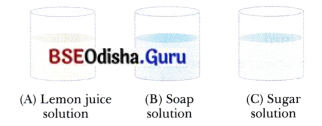
Which of the following statements is correct?
(a) The strips dipped in solutions A and B will turn red.
(b) The strip dipped in solution C will turn red.
(c) The strip dipped in solution B will turn red.
(d) The strips dipped in solutions A and C will turn red.
Answer:
(c) Only the strip dipped in solution B will turn red, as soap solution is basic in nature and turmeric paper turns red in basic solutions.
Question 16.
When a substance X is added to the red rose extract solution, the colour change occurs as shown in the image given alongside. Based on the given colour change, select the correct statements about X.
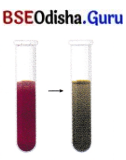
(i) Substance X could be lemon juice, as it is acidic in nature.
(ii) Substance X could be curd, as it is basic in nature.
(iii) Substance X also turn the turmeric indicator red.
(iv) Substance X does not affect the turmeric indicator.
(v) Substance X could be a detergent solution, as it is basic in nature.
(a) (ii) and (iii)
(b) (iii) and (v)
(c) (i) and (iv)
(d) (iv) and (v)
Answer:
(b) Since substance X turns the red rose indicator green, it is basic in nature. Hence, it could not be lemon juice or curd, as both are acidic, and will turn the red rose indicator to a shade of red. However, X could be a detergent solution, as a detergent solution, being basic, will turn the red rose indicator green. The solution X will therefore also turn the turmeric indicator red.
Question 17.
In daily life, neutralisation can be observed in which of the following situations?
(i) Applying moist baking soda on an ant bite
(ii) Using lime water to treat acidic soil
(iii) Adding vinegar to make pickles sour
(iv) Treating basic soil with compost or manure
(a) (i) and (ii) only
(b) (ii) and (iii) only
(c) (i), (ii) and (iv)
(d) (i), (iii) and (iv)
Answer:
(c) An ant bite injects formic acid thus, moist baking soda can be applied to neutralise it. Acidic soil due to fertilisers can be neutralised by treating it with lime water (a base). Basic soil can be neutralised by adding compost or manure, which release acids. In contrast, adding vinegar to pickles only increases acidity, so no neutralisation reaction is taking place.
Question 18.
Which of the following statement(s) is/are correct regarding a neutralisation reaction?
(i) An acid reacts with a base to form salt and water.
(ii) Heat is generally released during the process.
(iii) Heat is required for the reaction to take place.
(iv) When an excess acid is mixed with a base, the resultant solution is neutral in nature.
(a) (i) only
(b) (i) and (ii) only
(c) (i) and (iii) only
(d) (i), (ii) and (iv)
Answer:
(b) The reaction in which an acid and a base combine to form a corresponding salt and water, with the release of heat, is called a neutralisation reaction. When an excess acid is mixed with a base, the resultant solution is acidic in nature.
Question 19.
Which of the following statements are correct?
(i) A soap solution turns the red rose indicator to a shade of red.
(ii) No heat is evolved in a neutralisation reaction.
(iii) Turmeric indicator cannot be used to distinguish between amla juice and sugar solution.
(iv) The colour of a blue litmus solution changes to red when a few drops of lemon juice are added to it.
(a) (ii) and (iv)
(b) (i) and (iii)
(c) (iii) and (iv)
(d) (i) and (ii)
Answer:
(c) A soap solution turns the red rose indicator green. Heat is evolved in a neutralisation reaction.
Question 20.
During a class discussion, four students of class 7 were discussing the nature of various substances, and they gave the following statements:
Arun: Lemon juice and amla juice, being acidic, turn the turmeric indicator red.
Arjun: A detergent solution is neutral, and therefore does not affect either red or blue litmus paper.
Akriti: Soap solution, being basic, turns red litmus paper blue.
Aman: Curd and tamarind juice, being acidic, turn the blue litmus paper red.
Students who gave the correct statements are:
(a) Arjun and Aman
(b) Akriti and Aman
(c) Arun and Arjun
(d) Arjun and Akriti
Answer:
(b) Lemon juice and amla juice, being acidic, do not change the colour of turmeric indicator. A detergent solution is basic; therefore, it turns red litmus paper blue. However, it will not affect the blue litmus paper.
Question 21.
Observe the following flowcharts:
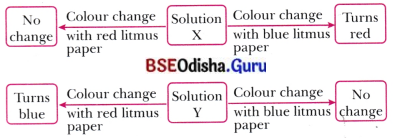
Based on the above flowcharts, select the correct statements from the following:
(i) When sufficient quantities of solutions X and Y are mixed, no heat is evolved in the reaction.
(ii) Solution X can be a baking soda solution, and it turns the turmeric indicator red.
(iii) Solution X is acidic, while solution Y is basic in nature.
(iv) Solution X is basic, while solution Y is acidic in nature.
(v) Solution Y can be lime water, and it also turns the red rose indicator green.
(a) (i) and (ii) only
(b) (i), (iii) and (v)
(c) (ii) and (iv) only
(d) (iii) and (v) only
Answer:
(d) Since solution X does not affect the red litmus paper, but turns the blue litmus paper red, it is acidic in nature. Hence, solution X cannot be a baking soda solution, as it is basic in nature. Whereas, solution Y turns red litmus paper blue, but does not affect the blue litmus paper, hence it is basic in nature. Therefore, solution Y can be lime water, and it also turns the red rose indicator green.
Exploring Substances Acidic Basic and Neutral Class 7 Assertion and Reason Questions
The following questions consist of two statements – Assertion (A) and Reason (R). Answer these questions by selecting the correct option:
(a) Both A and R are true and R is the correct explanation of A.
(b) Both A and R are true but R is not the correct explanation of A.
(c) A is true but R is false.
(d) A is false but R is true.
Question 1.
(A): Turmeric paper indicator can be used to test both acidic and basic solutions.
(R): The yellow colour of turmeric paper turns red in basic solutions, but remains unchanged in acidic and neutral solutions.
Answer:
(d) Turmeric paper indicator can only be used to test basic solutions.
Question 2.
(A): Applying moist baking soda on an ant bite will relieve the pain caused by the injected formic acid.
(R): Baking soda is a base that neutralises the formic acid.
Answer:
(a) Both A and R are true and R is the correct explanation of A.
Question 3.
(A): Lemon juice turns blue litmus paper red.
(R): Lemon juice is basic in nature.
Answer:
(c) Lemon juice is acidic in nature, thus, it turns blue litmus paper red.
Question 4.
(A): Onion is an olfactory indicator.
(R): The smell of an onion strip is retained in a soap solution.
Answer:
(c) The smell of an onion strip is not retained in a basic solution like soap solution.
Question 5.
(A): Sugar solution is acidic in nature.
(R): A sugar solution does not change the colour of red or blue litmus paper.
Answer:
(d) Sugar solution is neutral in nature.
Question 6.
(A): The colour of the red rose extract changes to a shade of red in a vinegar solution.
(R): Red rose extract is a visual, natural indicator.
Answer:
(b) Both A and R are true but R is not the correct explanation of A.
Question 7.
(A): Turmeric indicator turns red in distilled water.
(R): Distilled water is neutral in nature.
Answer:
(d) Turmeric indicator does not change its colour in distilled water.
Exploring Substances Acidic Basic and Neutral Class 7 Fill in the Blanks
1. Turmeric indicator can distinguish between neutral and ………… substances.
Answer: basic
2. Blue litmus turns red in an/a …………solution.
Answer: acidic
3. Indicators whose odour change in an acidic or basic medium are called ………… indicators.
Answer: olfactory
4. …………acid is present in vinegar.
Answer: Acetic
5. The colour of red rose extract changes to …………in a basic solution, and to …………in an acidic solution.
Answer: green, red
6. …………are the substances that generally have a bitter taste and feel soapy (slippery) to the touch.
Answer: Bases
7. Turmeric and litmus are ………… acid-base indicators.
Answer: natural
8. When an acidic solution is mixed with a basic solution, they …………each other forming …………and water.
Answer: neutralise, salt
9. The colour of the turmeric paper changes to …………in a lime water solution.
Answer: red
10. In acidic soil, the colour of the hydrangea flowers is …………, while in basic soil, the colour of these flowers is ………….
Answer: blue, pink/red
11. The onion smell is not retained in a/an ………..solution.
Answer: basic
Exploring Substances Acidic Basic and Neutral Class 7 True or False
1. Applying vinegar to an ant bite is an effective home remedy.
Answer:
False: An ant bite injects formic acid into the skin. Vinegar is also acidic, therefore, it will only worsen the effect of formic acid. A mild base like moist baking soda should be applied onto the skin.
2. The acidic factory waste can be neutralised by adding an acid-base indicator before releasing it into the lake.
Answer:
False: The acidic factory waste can be neutralised by adding basic substances before releasing it into the lake.
3. The acidic nature of the soil can be treated by adding organic manure to it.
Answer:
False: Organic matter releases acidic substances, which will increase the acidity of the soil. It should be treated by adding a base such as lime water.
4. The colour of the red rose indicator changes to red when a few drops of tamarind juice are added to it.
Answer:
True
5. Lemon juice tastes sour because it is basic in nature.
Answer:
False: Lemon juice tastes sour because it is acidic in nature.
6. A neutralisation reaction is accompanied by the release of heat.
Answer:
True
7. Lime water is acidic in nature, while lemon juice is basic in nature.
Answer:
False: Lime water is basic in nature, while lemon juice is acidic in nature.
8. A washing powder solution turns red litmus blue, while an orange juice turns blue litmus red.
Answer:
True
9. Litmus is a synthetic indicator obtained from lichens.
Answer:
False: Limtus is a natural indicator obtained from lichens.
Exploring Substances Acidic Basic and Neutral Class 7 Match the Following
Question 1.
Match column I with column II.
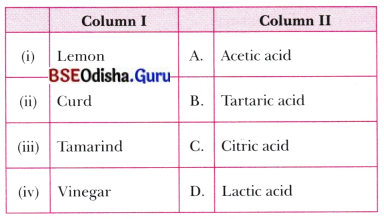
Answer:
| Column I | Column II | ||
| (i) | Lemon | C. | Citric acid |
| (ii) | Curd | D. | Lactic acid |
| (iii) | Tamarind | B. | Tartaric acid |
| (iv) | Vinegar | A. | Acetic acid |
Question 2.
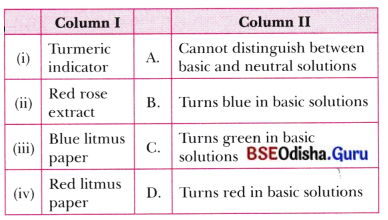
Answer:
| Column I | Column II | ||
| (i) | Turmeric indicator | D. | Turns red in basic solutions |
| (ii) | Red rose extract | C. | Turns green in basic solutions |
| (iii) | Blue litmus paper | A. | Cannot distinguish between basic and neutral solutions |
| (iv) | Red litmus paper | B. | Turns blue in basic solutions |