
Go through BSE Odisha Class 7 Science Solutions and Class 7 Science Chapter 6 Adolescence: A Stage of Growth and Change Question Answer to understand textbook questions more clearly.
Class 7 Science Curiosity Chapter 6 Question Answer
Science Curiosity Class 7 Chapter 6 Question Answer
Adolescence: A Stage of Growth and Change Class 7 Questions and Answers
Let Us Enhance Our Learning
Question 1.
Ramesh, an 11-year-old boy, developed a few pimples on his face. His mother told him that this is because of ongoing biological changes in his body.
(i) What could be the possible reasons for the development of these pimples on his face?
(ii) What can he do to get some relief from these pimples?
Answer:
(i) The development of pimples on Ramesh’s face could be due to the hormonal changes and oily secretions from the skin that occur during adolescence.
(ii)
- Avoid squeezing or picking the pimples.
- Maintain good body hygiene.
- Drink plenty of water.
- Use a gentle cleanser for the face.

Question 2.
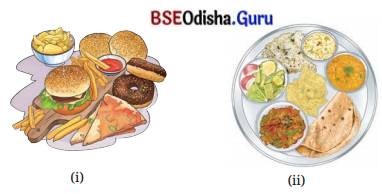
Which of the following food groups would be a better option for adolescents and why?
Answer:
The food group (B), would be a better choice for adolescents because it contains sources of all essential nutrients, i.e., carbohydrates, proteins, fats, vitamins, and minerals that are necessary for supporting the rapid growth and development occurring during this period. On the other hand, food group (A) contains various junk foods that are high in fats and sugar but low in essential nutrients.
Question 3.
Unscramble the underlined word in the following sentences:
(i) The discharge of blood in adolescent girls which generally occurs every 28-30 days is nstmnoiaretu.
(ii) The hoarseness in the voice of adolescent boys is due to enlarged iceov xob.
(iii) Secondary sexual characteristics are natural signs that the body is preparing for adulthood and mark the onset of urtypeb.
(iv) We should say NO to lahoclo and srugd as they are addictive.
Answer:
(i) nstmnoiaretu – menstruation
(ii) iceov xob – voice box
(iii) urtypeb – puberty
(iv) lahoclo – alcohol, srugd – drugs
Question 4.
Shalu told her friend, “Adolescence brings only physical changes, like growing taller or developing body hair.” Is she correct? What would you change in this description of adolescence?
Answer:
No, Shalu is partially correct because adolescence not only brings physical changes like growing taller or the appearance of body hair, but also includes internal (biological) changes indicating reproductive capability, as well as emotional and behavioural changes.
Question 5.
During a discussion in the class, some of the students raised the following points. What questions would you ask them to check the correctness of these points?
(i) Adolescents do not need to worry about behavioural changes.
(ii) If someone tries a harmful substance once, they can stop anytime they want.
Answer:
The following questions can be asked to check the correctness of points made by the students:
(i)
- Can ignoring certain behavioural changes affect mental health or social relationships later on?
- Why do you think it is important for adolescents to adapt to changes in a positive way rather than worrying about them?
- Are behavioural changes during adolescence linked to hormonal changes, and how can one handle these changes?
(ii)
- Can harmful substances like tobacco and alcohol cause addiction, and is it easy to stop using them once a person becomes dependent?
- How does peer pressure or emotional state influence the ability to stop using a substance?
- Has any research shown that people can easily quit using harmful substances after trying them just once?
Question 6.
Adolescents sometimes experience mood swings. On some days, they feel very energetic and happy, while on other days, they may feel low. What other behavioural changes are associated with this age?
Answer:
Adolescents undergo several behavioural changes, such as:
- A strong desire for independence, developing their own identity, and personal decision making.
- A desire to explore new interests and engage in varied activities like music, dance, or sports.
- Increased influence of peers, attraction to them, and trying to mimic their behaviour.
- Intense emotions, frequent mood swings and increased sensitivity.
- Getting involved in social work and initiatives to support the needy and the disadvantaged.
Question 7.
While using a toilet, Mohini noticed that used sanitary pads were scattered near the bin. She got upset and shared her feelings with her friends. They discussed the importance of menstrual hygiene and healthy sanitary habits. What menstrual hygiene and sanitary habits would you suggest to your friends?
Answer:
The following menstrual hygiene and sanitary habits should be followed:
- Properly disposing used sanitary pads by wrapping them in paper and disposing them in a dustbin.
- Using clean, reusable cloth pads or sanitary napkins.
- Washing hands with soap and water before and after handling sanitary products.
- Cleaning the pubic area regularly to maintain hygiene and prevent bacterial or fungal infections.
Question 8.
Mary and Manoj were classmates and good friends. On turning 11, Mary developed a little bulge on the front of her neck. She visited the doctor who gave her medication and asked to take iodine-rich diet. Similarly, a bump was developed on the front of Manoj’s neck when he turned 12. However, the doctor told him that it was a part of growing up. According to you, what could be the possible reason for advising Mary and Manoj differently?
Answer:
The doctor advised Mary and Manoj differently because the causes of their neck bulges were different.
- In Mary’s case, the bulge on her neck was likely due to goitre, a condition caused by iodine deficiency. Iodine is essential for performing physical and mental activities efficiently. When the body lacks iodine, it leads to a disease called goitre and a prominent bulge or swelling on the front of the neck is a characteristic symptom of this disease. Therefore, the doctor advised her to take an iodine-rich diet and prescribed required medication.
- On the other hand, in Manoj’s case, the bulge on his neck was due to the natural growth of the voice box during puberty. This results in the formation of the Adam’s apple, which is a normal part of male development and also causes the voice to become deeper and hoarse.
Question 9.
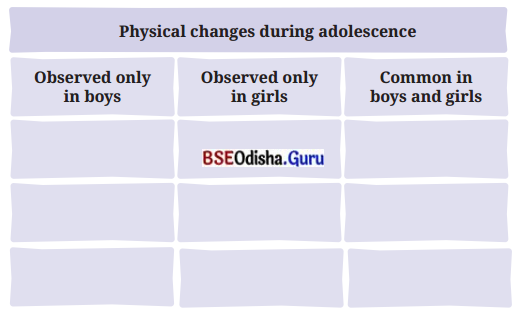
During adolescence, the boys and girls undergo certain physical changes, a few of which are given below.
(i) Change in voice
(ii) Development of breasts
(iii) Growth of moustache
(iv) Growth of facial hair
(v) Pimples on the face
(vi) Growth of hair in the pubic region
(vii) Growth of hair in armpits
Categorise these changes in the table given below:
Answer:
| Physical changes during adolescence | ||
| Observed only in boys | Observed only in girls | Common in boys and girls |
| Change in voice | Development of breasts | Pimples on the face |
| Growth of moustache | Growth of hair in the pubic region | |
| Growth of facial hair | Growth of hair in armpits | |
Question 10.
Prepare a poster mentioning the tips for adolescents to live a healthy lifestyle.
Answer:
The students should prepare the poster themselves.
Class 7 Curiosity Chapter 6 Question Answer
InText Questions
Question 1.
What changes are most commonly seen during adolescence? [Page 75]
Answer:
Commonly observable changes during adolescence are:
- Increase in height and weight
- Appearance of hair in different parts of the body, like the armpits and pubic region
- Change in voice (more prominent in boys)
- Oily secretions from the skin causing pimples on the face
Question 2.
Is adolescence just about physical changes or changes associated with reproductive capability? [Page 78]
Answer:
No, adolescence also brings about significant emotional and behavioural changes along with other changes.
Question 3.
Does an ideal nutritious diet for adolescents mean consuming only protein and carbohydrate-rich foods? [Page 79]
Answer:
For proper growth and to perform well in studies and sports, we not only require proteins and carbohydrates, but also an adequate amount of fats, vitamins, and minerals, along with a proper intake of dietary fibre and water.
Question 4.
In what ways do nutrients support our growth and development? [Page 79]
Answer:
Nutrients such as proteins, fats, carbohydrates, vitamins and minerals play a crucial role in keeping our body healthy. These nutrients are obtained from foods like milk, curd, cheese, spinach, millets, kidney beans, and dried fruits such as raisins and figs.
These nutrients help our body in the following ways:
- Support the growth and development of bones and muscles
- Increase strength and help build a healthy body
- Aid in the formation of blood
- Improve energy levels
Question 5.
Adolescents, especially girls, may suffer from blood-related health problems due to a deficiency of iron or vitamin B12. Name and describe such health problem(s). [Page 80]
Answer:
Anaemia is a blood-related health problem caused by a deficiency of iron or vitamin B12. It leads to low haemoglobin levels, resulting in weakness, fatigue, and pale skin. Adolescent girls are more prone to anaemia due to rapid growth and blood loss during menstruation.
Question 6.
How can we manage iron deficiency in our body? [Page 80]
Answer:
Iron deficiency can be prevented and managed by including iron-rich foods in our diet, such as beans, nuts, dried apricots, spinach, lentils, legumes, broccoli, and fortified cereals. In some cases, doctors may also recommend iron supplements to maintain healthy iron levels in the body.
Question 7.
What are some sources of vitamin B12? [Page 80]
Answer:
Vitamin B12 is mainly obtained from foods such as eggs, meat, liver, fish, cheese, milk, fortified cereals, nutritional yeast, and green leafy vegetables.
Question 8.
List some government schemes that aim to prevent deficiency diseases like anaemia. [Page 80]
Answer:
In India, the Adolescent Anaemia Control Programme focuses on reducing the prevalence and severity of anaemia among adolescents and supports the government’s Anaemia Mukt Bharat initiative under the National Health Mission.
The Weekly Iron and Folic Acid Supplementation (WIFS) programme is a key component of the Anaemia Mukt Bharat strategy. It involves the supervised weekly consumption of Iron and Folic Acid (IFA) tablets by both school-going and outof-school adolescents to prevent iron-deficiency anaemia.
Question 9.
Why do changes occur during the adolescent life stage? [Page 84]
Answer:
Many changes during adolescence, including menstruation and other signs of puberty, are primarily due to the production of certain chemicals in our bodies called hormones.