
For better exam readiness, students can include Class 7 Science MCQ and Curiosity Chapter 10 Life Processes in Plants MCQ in their daily study routine.
Class 7 Science Chapter 10 Life Processes in Plants MCQ
Life Processes in Plants MCQ Class 7
MCQ On Life Processes in Plants Class 7
Question 1.
Neha passed by a dairy factory on her way to school. She wondered what is the equivalent of a food factory in plants. Help her identify the correct plant part.
(a) Root
(b) Flower
(c) Leaf
(d) Seed
Answer:
(a) Root

Question 2.
A student takes a green leaf from the plant and boils it in an alcohol bath for removal of chlorophyll. After this treatment, the student adds a few drops of iodine to the boiled leaf using syringe dropper. After some time, the student observes that the leaf turns blue-black in colour. What can be evaluated from this?
(a) The iodine reacts with the starch present in the leaf that indicates the occurrence of photosynthesis.
(b) The iodine reacts with water present in the leaf that indicates the occurrence of photosynthesis.
(c) The iodine reacts with the oxygen present in the leaf that indicates the occurrence of photosynthesis.
(d) The iodine reacts with carbon dioxide present in the leaf that indicates the occurrence of photosynthesis.
Answer:
(a) The iodine reacts with the starch present in the leaf that indicates the occurrence of photosynthesis.
Question 3.
Daniel sealed a healthy potted plant inside a box for a few hours. After some time, he measured the air composition inside the box and found that the level of carbon dioxide had increased even though sunlight was absent. What does this observation show?

(a) Plants respire all the time and release carbon dioxide.
(b) Plants release carbon dioxide only at night.
(c) Plants do not use oxygen during the day.
(d) Respiration stops at night.
Answer:
(a) Plants respire throughout the day; as the plant did not receive sunlight, it could not perform photosynthesis, leading to increased carbon dioxide concentration inside the box.
Question 4.
What are the reactants for photosynthesis and respiration, respectively?
(a) Photosynthesis → Carbon dioxide and water Respiration → Glucose and oxygen
(b) Photosynthesis → Light energy and Chlorophyll Respiration → Carbon dioxide and water
(c) Photosynthesis → Glucose and Oxygen Respiration → Carbon dioxide and water
(d) Photosynthesis → Light and Carbon dioxide Respiration → Glucose and Oxygen
Answer:
(a) Photosynthesis → Carbon dioxide and water Respiration → Glucose and oxygen
Question 5.
The image shows the structure of stomata on the leaf.
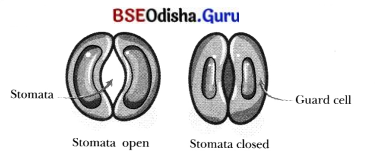
What will be the likely effect on the plant, if stomata remains closed for a prolonged period of time?
(a) It will allow the plant to store more food in the leaves.
(b) It will allow the plant to absorb more minerals from the roots.
(c) It will prevent the entry of water in the plant for photosynthesis.
(d) It will prevent the entry of carbon dioxide in the plant for photosynthesis.
Answer:
(d) If stomata remain closed for a prolonged period, the plant will be unable to take in carbon dioxide, which is necessary for photosynthesis.
Question 6.
How do plants that lack chlorophyll to perform photosynthesis prepare their food?
(a) They obtain simple food from animals.
(b) They obtain raw materials from their surroundings.
(c) They obtain food in the form of energy from sunlight.
(d) They obtain readymade food from photosynthetic plants.
Answer:
(d) They obtain readymade food from photosynthetic plants.
Question 7.
The Sun provides energy for all living things. Gurmeet wrote two statements to explain the above fact.
Statement 1: All autotrophs prepare their own food in the presence of sunlight.
Statement 2: ……………..
Which of the following should be Statement 2?
(a) All autotrophs are plants.
(b) All heterotrophs are animals.
(c) All autotrophs contain chlorophyll pigment.
(d) All heterotrophs get energy directly or indirectly from autotrophs.
Answer:
(d) All other living organisms are heterotrophs, as they cannot make food themselves; all heterotrophs get energy directly or indirectly from autotrophs.
Question 8.
An experiment was conducted by a student to determine the role of soil water in the transportation of material in plants. Plant A was watered daily for a month however, plant B was not watered for a month. It was observed by the student that the plant that was watered daily was healthy and fresh, while plant B was dead. What could be the reason for observing this difference?
(a) Adding water into the soil aids transportation of materials in plants.
(b) Adding water into the soil introduces important nutrients to the soil.
(c) Adding water into the soil reduces the water loss in plants during transportation.
(d) Adding water into the soil increases the relative humidity of the atmosphere that allows the plant to remain cool.
Answer:
(a) Without water, plants cannot carry out vital life processes, leading to wilting, damage, and eventually death.
Question 9.
Presence of starch in leaves is indicated by:
(a) Safranin test
(b) Copper sulphate test
(c) Iodine test
(d) Lime water test
Answer:
(c) Starch-containing regions turn blue-black upon treatment with Iodine solution.
Question 10.
Krish claims that, ‘Plants do not respire because they do not move’. Select the option that best corrects his statement.
(a) Plants respire through leaves once photosynthesis is completed.
(b) Respiration happens only in animals.
(c) Plants release oxygen, so they do not respire.
(d) Respiration occurs in all living organisms, even without visible movement.
Answer:
(d) Respiration occurs in all living organisms, even without visible movement.
Question 11.
Bani wants to find out which part(s) of a plant prepare food. She collects three samples from a potted plant – a leaf, a piece of root, and a flower. She then tests them by boiling each part in water, then in alcohol, and finally adds iodine solution to each. After the test, only the leaf turns blue-black. Which conclusions can be correctly drawn from this observation?
(i) Chlorophyll must be present in a plant part for it to prepare food.
(ii) All plant parts prepare food, but only leaves store it as starch.
(iii) Roots prepare food but do not store starch; hence, the sample did not turn blue-black.
(iv) The flower did not receive adequate sunlight to prepare food.
(v) The test shows that plants prepare and store food in the form of carbohydrate.
(a) (i), (ii) and (v) only
(b) (i) and (v) only
(c) (ii), (iii), (iv) and (v)
(d) (ii), (iii) and (iv) only
Answer:
(b) The leaf contains chlorophyll, which is why it prepares food and stores it in the form of starch, a carbohydrate. Roots and flowers lack chlorophyll.
Question 12.
Some of the following events are part of photosynthesis, identify them:
(i) Chlorophyll captures sunlight
(ii) Water serves as a raw material
(iii) Release of carbon dioxide
(iv) Carbon dioxide is converted into glucose
(a) Only (iv) is correct
(b) (i), (ii) and (iii) are correct
(c) (i), (ii), and (iv) are correct
(d) All are correct
Answer:
(c) (i), (ii), and (iv) are correct
Question 13.
The following is a list of some events:
(i) Synthesis of glucose
(ii) Release of carbon dioxide during respiration
(iii) Absorption of water and minerals
(iv) Release of oxygen
(v) Transport of water and minerals
How many of these are performed by leaves?
(a) (i) and (iv) only
(b) (i), (ii) and (iv) only
(c) (ii) and (iii) only
(d) All of these
Answer:
(b) Roots absorb water and minerals from the soil, and their transport in plants is carried out through the xylem.
Question 14.
Yashi studied that plants break down the food produced by a process called respiration. Given below are some statements about how this life process occurs in plants. Select the incorrect statements.
(i) Respiration releases energy needed for various life activities in plants.
(ii) Respiration occurs only during the night.
(iii) Carbon dioxide is produced as a by-product during respiration.
(iv) Respiration stops when photosynthesis begins.
(a) (ii) and (iv) only
(b) (i) and (iii) only
(c) (i), (ii) and (iii)
(d) (ii), (iii) and (iv)
Answer:
(a) Respiration in plants happens throughout the day.
Question 15.
Which of the following statements is/are correct?
(i) All green plants can prepare their food.
(ii) Some animals are autotrophs.
(iii) Carbon dioxide is not required for photosynthesis.
(iv) Oxygen is liberated during photosynthesis.
Choose the correct answer from the options below:
(a) (i) and (iv)
(b) (ii) only
(c) (ii) and (iii)
(d) (i) and (ii)
Answer:
(a) Animals are heterotrophs; carbon dioxide is an essential raw material for photosynthesis.
Question 16.
A student collected different coloured leaves from his garden. Which of these leaves perform photosynthesis?
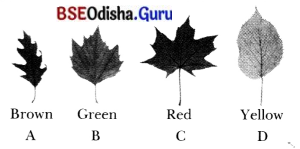
(a) A and B
(b) B and C
(c) C and D
(d) A, B, C and D
Answer:
(d) Plants with leaves other than green colour also perform photosynthesis as chlorophyll is present in them too, but masked by other pigments.
Life Processes in Plants Class 7 Assertion and Reason Questions
The following questions consist of two statements – Assertion (A) and Reason (R). Answer these questions by selecting the correct option:
(a) Both A and R are true and R is the correct explanation of A.
(b) Both A and R are true but R is not the correct explanation of A.
(c) A is true but R is false.
(d) A is false but R is true.
1. (A): Only upper surface of leaf possess tiny pores known as stomata.
(R): Stomata help in the exchange of gases.
Answer:
(d) Stomata are present on both surfaces of the leaves, however, they are more in number on the lower surface.
2. (A): Movement of water in plants is multidirectional.
(R): Xylem forms a continuous channel that helps in the movement of water and minerals.
Answer:
(d) Movement of water through xylem is unidirectional (from roots to all aerial plant parts).
3. (A): Respiration involves release of energy.
(R): Nitrogen is obtained from soil by plants for respiration.
Answer:
(c) Nitrogen is not required by plants for respiration.
4. (A): Leaves are the primary site for photosynthesis.
(R): It is possible for plants to germinate without light but for further growth, sunlight is required.
Answer:
(b) Both A and R are true but R is not the correct explanation of A.
5. (A): Plants stop respiring during the day, and photosynthesis supplies all the required energy.
(R): Respiration in plants is independent of sunlight.
Answer:
(d) Plants respire throughout the day and energy is liberated during this process.
Life Processes in Plants Class 7 Fill in the Blanks
Question 1.
The ………… colour observed in iodine test confirms the presence of ………… in the leaf.
Answer:
blue-black, starch
Question 2.
Lack of water causes ………… in plants.
Answer:
wilting (dehydration)
Question 3.
Food prepared in ………… is transported to growing and storage parts of the plant through ………….
Answer:
leaves, phloem
Question 4.
The roots of a plant take up oxygen from the ………… trapped between the ………… particles.
Answer:
air, soil
Question 5.
………… are responsible for exchange of gases, ………… and ………….
Answer:
Stomata, carbon dioxide, oxygen
Question 6.
………… is a raw material for photosynthesis obtained from soil.
Answer:
Water
Life Processes in Plants Class 7 True or False
1. Non-green patches of a leaf may fail to show the presence of starch even if the plant is kept in sunlight.
Answer:
True
2. Oxygen released during photosynthesis can be tested with lime water.
Answer:
False Carbon dioxide released during respiration can be tested with lime water.
3. Water is a by-product of respiration.
Answer:
True
4. Sodium hydroxide helps in the decolourisation of leaves for the starch test.
Answer:
False Alcohol helps in the decolourisation of leaves for the starch test.
5. Plants utilise nitrogen and release energy during the process of respiration.
Answer:
False Plants break down glucose, a type of carbohydrate, and release energy during the process of respiration.
Life Processes in Plants Class 7 Match the Following
Question 1.
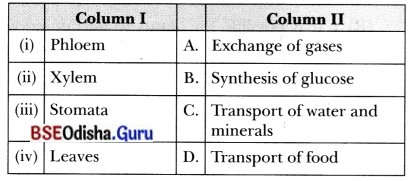
Answer:
| Column I | Column II | ||
| (i) | Phloem | D. | Transport of food |
| (ii) | Xylem | C. | Transport of water and minerals |
| (iii) | Stomata | A. | Exchange of gases |
| (iv) | Leaves | B. | Synthesis of glucose |
Question 2.
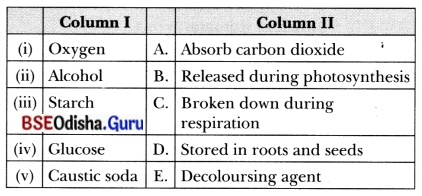
Answer:
| Column I | Column II | ||
| (i) | Oxygen | B. | Released during photosynthesis |
| (ii) | Alcohol | E. | Decolourising agent |
| (iii) | Starch | D. | Stored in roots and seeds |
| (iv) | Glucose | C. | Broken down during respiration |
| (v) | Caustic soda | A. | Absorb carbon dioxide |