
For better exam readiness, students can include Class 7 Science MCQ and Curiosity Chapter 8 Measurement of Time and Motion MCQ in their daily study routine.
Class 7 Science Chapter 8 Measurement of Time and Motion MCQ
Measurement of Time and Motion MCQ Class 7
MCQ On Measurement of Time and Motion Class 7
Choose the correct option.
Question 1.
Ravi studies for 3 hours from 7 PM to 10 PM. A sundial cannot be used to measure these study hours because:
(a) hours cannot be measured using a sundial.
(b) the moonlight is too bright to make a shadow.
(c) sundials work only on cloudy days.
(d) the Sun is not visible at night.
Answer:
(d) A sundial needs sunlight to form a shadow; at night, the Sun isn’t visible.
Question 2.
A floating-bowl water clock takes exactly 24 minutes for the bowl to sink. A monastery used 5 sinkings for announcing prayers. One day, due to wear and tear, the hole in the bowl becomes slightly larger, causing it to sink in only 18 minutes. How will this affect the schedule?
(a) Announcements will happen later than usual.
(b) Announcements will happen earlier than usual.
(c) No change, because the total number of sinkings stays the same.
(d) Time measurement becomes more accurate.
Answer:
(b) If the bowl sinks in 18 min instead of 24 min. each “sinking” happens sooner, so announcements come earlier.

Question 3.
Two students made water flowing out-type water clocks.
Clock A → small hole; Clock B → larger hole Both clocks start with the same amount of water. Which is the correct scientific conclusion?
(a) Clock A measures time faster because water exits slowly.
(b) Clock B measures time more slowly because water flows quickly.
(c) Clock B gives shorter intervals because water drains faster.
(d) Both give identical intervals.
Answer:
(c) With a larger hole, water drains faster, so Clock B marks shorter time intervals than Clock A (for the same starting water).
Question 4.
A group of students is comparing different instruments as given below to measure time for their science project.
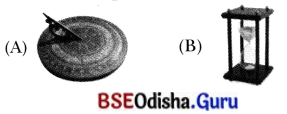
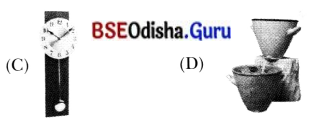
Which instrument should they choose for the most accurate measurement of time?
(a) A
(b) B
(c) C
(d) D
Answer:
(c) C
Question 5.
A pendulum completes 15 oscillations in 30 seconds. How many oscillations will it complete in 2 minutes?
(a) 30
(b) 45
(c) 60
(d) 90
Answer:
(c) 15 oscillations in 30 s means 30 oscillations in 60 s. In 2 minutes (120 s), it completes 60 oscillations.
Question 6.
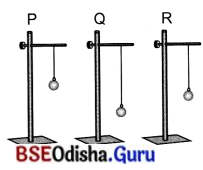
A student sets up three simple pendulums (P, Q, and R) in the school laboratory as shown in the figure. The student wants to compare the time periods of the three pendulums. Which of the following conclusions is scientifically correct?
(a) The time period of P is the greatest among the three.
(b) The time period of R is greater than that of Q.
(c) The time period of Q is the greatest among the three.
(d) All three pendulums will have the same time period since their masses are equal.
Answer:
(c) The time period of a simple pendulum increases with its length. Q has the greatest length, so it has the greatest time period.
Question 7.
A student observes a simple pendulum swinging between its two extreme positions P and R, with Q as the mean position. She notes that the bob moves from P → Q → R in 3 seconds. What is the time period of the pendulum?
(a) 1.5 seconds
(b) 3 seconds
(c) 1 second
(d) 6 seconds
Answer:
(d) Motion from one extreme (P) to the other extreme (R) is half an oscillation. So if P → Q → R takes 3 s, the full time period is 2 × 3=6 s
Question 8.
The correct symbol to represent the speed of an object is ………………
(a) 5 m/s
(b) 5 mp
(c) 5m /s-1
(d) 5 s/m
Answer:
(a) 5 m/s
Question 9.
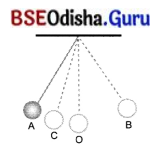
The figure shows an oscillating pendulum. Time taken by the bob to move from A to C is t1 and from C to O is t2. The time period of this simple pendulum.
(a) (t1+t2)
(b) 2(t1+t2)
(c) 3(t1+t2)
(d) 4(t1+t2)
Answer:
(d) Time from A (extreme) to O (mean position) is one-quarter of a complete oscillation. Since A→O takes (t1+t2) time, the time period T=4(t1+t2).
Question 10.
A simple pendulum makes 80 oscillations in 160 s. Later, its length is increased so that its time period becomes twice the original. The number of oscillations it will complete in 160 s now is
(a) 20
(b) 40
(c) 80
(d) 160
Answer:
(b) 80 oscillations in 160 s means the original time period is 2 s. If the time period doubles to 4 s, then in 160 s the number of oscillations is \(\frac{160}{4}\)= 40.
Question 11.
Two clocks A and B are shown in the figure. Clock A has an hour and a minute hand, whereas clock B has an hour hand, minute hand as well as a second hand. Which of the following statements is correct for these clocks?
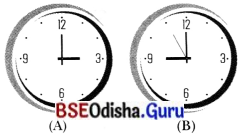
(a) A time interval of 30 seconds can be measured by clock A.
(b) A time interval of 30 seconds cannot be measured by clock B.
(c) Time interval of 5 minutes can be measured by both A and B.
(d) Time interval of 4 minutes 10 seconds can be measured by clock A.
Answer:
(c) Both clocks have a minute hand, so they can measure minutes. Clock A cannot measure seconds because it has no second hand, while Clock B can.
Question 12.
Nancy takes 25 minutes from her house to reach her school on a bicycle. The bicycle has a speed of 2 m/s, the distance between her house and the school is:
(a) 3 km
(b) 2 km
(c) 2.5 km
(d) 4 km
Answer:
Time =25 min=25 × 60=1500s
Distance =Speed × Time
=2 m/s × 1500s
=3000m=3km
Question 13.
A person starts riding at 9:00 am to reach a location X, which is about 175 km away from the starting point. He drives at an average speed of 70 km/h. When is the person likely to reach the destination?
(a) 10:00 am
(b) 10:30 am
(c) 11:00 am
(d) 11:30 am
Answer:
(d) Time taken = \(\frac{\text { Distance }}{\text { Speed }} \) \(\frac{175}{70}\) = 2.5 h = 2h 30min.
Starting at 9:00 am, arrival time
=9: 00+2: 30=11: 30 am
Question 14.
Boojho walks to his school which is at a distance of 3 km from his home in 30 minutes. On reaching he finds that the school is closed and comes back by a bicycle with his friend and reaches home in 20 minutes. His average speed in km/h is
(a) 8.3
(b) 7.2
(c) 5
(d) 3.6
Answer:
(b) Total distance travelled =3 km (to school) +3 km (back home) =6km
Total time 30min+20 min = 50 min
=\(\frac{50}{60}\) h= \(\frac{5}{6}\) h
Average speed = \(\frac{\text { Total distance travelled }}{\text { Total time taken }} \)
=\(\frac{6}{\left(\frac{5}{6}\right)}\)=6 × \(\left(\frac{6}{5}\right)\)
= \(\frac{36}{5}\) =7.2 km/h
Question 15.
The school organised an educational tour for the students. They arranged a bus scheduled to leave for the trip at around 8:00 am. The odometer reading (in km) of the bus at the start and end of the trip is provided in the table.
| Time | Odometer Reading | |
| Start | 08:00 am | 247344 |
| End | 11:00 am | 247554 |
What was the speed of the bus during the trip?
(a) 30 km/h
(b) 70 km/h
(c) 90 km/h
(d) 210 km/h
Answer:
(b) The distance travelled by the bus is the change in the odometer reading:
247554-247344=210 km.
The time taken from 8:00 am to 11:00 am is 3 hours.
So, speed = \(\frac{\text { distance }}{\text { time }}\)=\(\frac{210}{3}\)=70 km/h
Question 16.
Two vehicles, A and B, start at the same time.
Vehicle A: Speedometer shows 72 km/h for 30 minutes, then 48 km/h for the next 30 minutes.
Vehicle B: Odometer shows an increase of 55 km in 1 hour.
Which statement is correct?
(a) Vehicle A is faster
(b) Vehicle B is faster
(c) Both have the same average speed
(d) Speed comparison is not possible
Answer:
(a) In first 30 min, distance =72 × 0.5=36 m
In next 30 min, distance =48 × 0.5=24 km
Total distance covered by vehicle A in 1 hour is 60 km.
Thus, the average speed is =60 km/h.
Vehicle B covers 55 km in 1 hour, so its average speed =55 km/h
Therefore, Vehicle A is faster.
Question 17.
The positions of a car after every one minute are shown in the image below. The car covers a total distance of 3 km in 3 minutes.
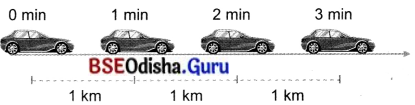
What can be concluded from the position of the car?
(a) It is in uniform linear motion as it covers equal distances in equal intervals of time.
(b) It is in non-uniform motion with a varying speed.
(c) It is in uniform linear motion as it covers unequal distances in equal intervals of time.
(d) It is in non-uniform motion as it covers 3 km in 3 minutes.
Answer:
(a) It is in uniform linear motion as it covers equal distances in equal intervals of time.
Question 18.
Consider the following statements:
(i) In a sundial, time is determined by the changing position of the shadow of an object during the day.
(ii) In the water flowing out-type of water clock, the flow rate remains constant, so it is very accurate.
(iii) In the Ghatika-yantra, each sinking of the bowl corresponds to a fixed time interval.
(iv) In an hourglass, time is measured using the flow of water between two bulbs.
Which of the above statements are correct?
(a) (i) and (iii) only
(b) (ii) and (iv) only
(c) (i), (ii), and (iii)
(d) (i), (iii), and (iv)
Answer:
(a) In a water flowing out-type clock, the flow rate does not remain exactly constant as the water level falls. In an hourglass, time is measured by the flow of sand between two bulbs.
Question 19.
Vaibhav made a pendulum using a string and a stone as the bob. He then increased the length of the string. Consider the following statements:
(i) The time period of the pendulum increases when its length is increased.
(ii) The pendulum oscillates faster when its length is increased.
(iii) The time period of a pendulum depends on its length.
(iv) The time period of a pendulum depends on the mass of the bob.
Which of the above statements are correct?
(a) (i) and (iii) only
(b) (i), (ii), and (iii)
(c) (ii) and (iv) only
(d) (iii) and (iv) only
Answer:
(a) If the time period increases, the pendulum oscillates more slowly, not faster. For a simple pendulum, the time period depends on its length (and not on the bob’s mass).
Question 20.
Consider the following statements:
(i) All clocks, old or modern, are based on some process that repeats continuously and marks equal intervals of time.
(ii) Quartz clocks measure time using very rapid vibrations of a quartz crystal.
(iii) The SI unit of time is the minute, written with the symbol “min”.
(iv) Writing “sec” for second and “hrs” for hour is incorrect in SI notation.
Which of the above statements are correct?
(a) (i) and (ii) only
(b) (i), (ii), and (iv)
(c) (iii) and (iv) only
(d) (i) and (iii) only
Answer:
(b) The SI unit of time is the second, not minute.
Question 21.
While watching a road race, students discuss the motion of vehicles. Consider the following statements made by the students:
(i) Speed is the distance travelled per unit time.
(ii) An object covering more distance in the same time has a higher speed.
(iii) Speed can never change during motion.
(iv) Speed can be expressed in km/h or m/s.
Which of the above statements are correct?
(a) (i) and (ii) only
(b) (i), (ii), and (iv)
(c) (ii) and (iii) only
(d) (i), (iii), and (iv)
Answer:
(b) Speed can change during motion.
Measurement of Time and Motion Class 7 Assertion and Reason Questions
The following questions consist of two statements- Assertion (A) and Reason (R). Answer these questions by selecting the correct option:
(a) Both A and R are true and R is the correct explanation of A.
(b) Both A and R are true but R is not the correct explanation of A.
(c) A is true but R is false.
(d) A is false but R is true.
Question 1.
(A): In non-uniform motion, distances travelled in equal time intervals are always equal.
(R): The speed keeps changing in non-uniform motion.
Answer:
(d) In non-uniform motion, distances in equal time intervals are not equal.
Question 2.
(A): A sundial like the Samrat Yantra at Jaipur shows Indian Standard Time (IST) directly without any need of correction.
(R): A sundial measures local solar time based on the position of the Sun.
Answer:
(d) A sundial shows local solar time, which may differ from IST, so it does not show IST directly without correction.
Question 3.
(A): The pendulum swings faster if the bob is heavier.
(R): The time period of a simple pendulum of a given length remains constant at a place.
Answer:
(d) A heavier bob does not make the pendulum swing faster; for a given length at the same place, the time period remains the same.
Question 4.
(A): If two pendulums have the same length but different masses, they will have the same time period at the same place.
(R): The time period of a simple pendulum depends on its length but not on the mass of the bob.
Answer:
(a) Both A and R are true and R is the correct explanation of A.
Question 5.
(A): A quartz clock is more accurate than a pendulum clock.
(R): Quartz clocks use vibrations of a quartz crystal to measure time.
Answer:
(b) Both A and R are true but R is not the correct explanation of A.
Measurement of Time and Motion Class 7 Fill in the Blanks
1. Devices like hourglasses and candle clocks were made to measure smaller ………… of time within a day.
Answer:
intervals
2. The heavy metallic ball of a simple pendulum is called its ………….
Answer:
bob
3. The pendulum at rest is said to be in its………… position.
Answer:
mean
4. Quartz clocks use very rapid vibrations of a ………… crystal to measure time.
Answer:
quartz
5. The instrument fitted in a vehicle to show its speed is called a ………….
Answer:
speedometer
6. A body travelling in a straight line is said to be in ………… motion, if it covers unequal distances in equal intervals of time.
Answer:
non-uniform
7. A train covers 120 km in 2 hours and then 90 km in the next 2 hours. Its motion is ………….
Answer:
non-uniform
Measurement of Time and Motion Class 7 True or False
Write true or false. Rewrite the false statements correctly.
1. All clocks and watches, whether digital or analogue, ultimately use some process that repeats irregularly.
Answer:
False: All clocks and watches, whether digital or analogue, use some process that repeats regularly to mark equal intervals of time.
2. A sand clock can tell the time of the day.
Answer:
False: A sand clock (hourglass) measures a fixed time interval; it cannot tell the exact time of the day.
3. For a fixed distance, if the time taken for a journey increases, the speed of the object decreases.
Answer:
True
4. The resting position of the bob of a pendulum is called the mean position.
Answer:
True
5. The symbols of all SI units are written in plural.
Answer:
False: Symbols of SI units are not written in plural; they remain the same in singular and plural (e.g., m, s, kg).
6. Two runners cover the same distance. The one who takes more time is slower.
Answer:
True
7. In a floating-bowl water clock, making a larger hole at the bottom of the bowl will make the bowl take a longer time to sink.
Answer:
False: In a floating-bowl water clock, making a larger hole makes the bowl sink faster (in a shorter time).
Measurement of Time and Motion Class 7 Match the Following
Question 1.
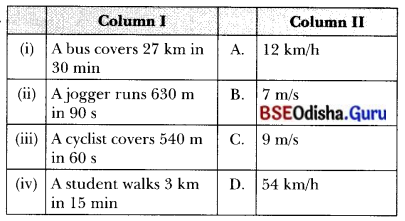
Match column I with column II.
Answer:
| Column I | Column II | ||
| (i) | A bus covers 27 km in 30 min | D. | 54 km/h |
| (ii) | A jogger runs 630 m in 90 s | B. | 7 m/s |
| (iii) | A cyclist covers 540 m in 60 s | C. | 9 m/s |
| (iv) | A student walks 3 km in 15 min | A. | 12 km/h |
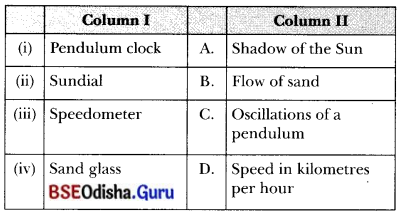
Question 2.
Answer:
| Column I | Column II | ||
| (i) | Pendulum clock | C. | Oscillations of a pendulum |
| (ii) | Sundial | A. | Shadow of the Sun |
| (iii) | Speedometer | D. | Speed in kilometres per hour |
| (iv) | Sand glass | B. | Flow of sand |