
Go through BSE Odisha Class 8 Science Solutions Chapter 10 Light: Mirrors and Lenses Question Answer to understand textbook questions more clearly.
Class 8 Science Curiosity Chapter 10 Question Answer
Class 8 Science Ch 10 Light: Mirrors and Lenses Question Answer
Class 8 Science Chapter 10 Light: Mirrors and Lenses Question Answer
Probe and Ponder Questions
Question 1.
Can we make mirrors which can give enlarged or diminished images?
Answer:
Yes, we can make mirrors that produce ehnlarged or diminished images. Specially, concave mirrors can form both enlarged and diminished images depending on the object’s distance from the mirror, while convex mirrors always produce diminished images. Concave mirrors give magnified images when the object is close (between the pole and the focal point) and diminished images when the object is far (beyond the centre of curvature). Convex mirrors always form virtual, erect and similar images.
Question 2.
On side-view mirrors of vehicles, there is a warning that says “Objects in mirror are closer than they appear”. Why is this warning written there?
Answer:
The warning “Objects in mirror are closer than they appear” is written on the side-view mirrors of vehicles because these mirrors are typically convex. Convex mirrors make objects appear smaller and therefore seem farther away than they really are. The warning reminds drivers to allow extra distance when judging how near other vehicles or objects are.

Question 3.
Why is there a curved line on some reading glasses?
Answer:
The curved line on reading glasses is due to the convex shape of the lens. These lenses are thicker in the middle and thinner at the edges, causing light rays to converge (bend inward) and improve near vision for individuals with presbyopia. This curvature is essential for correcting the vision by focusing light properly on the retina.
Question 4.
Share your questions ………….
Answer:
Here are some fun questions you might think of from the chapter:
- How does a magnifying glass make things look bigger?
- Why do spoons act like funny mirrors?
- Can lenses in our eyes change shape?
- What happens if you use a concave mirror to focus sunlight?
InText Questions
Question 1.
How can we distinguish between concave and convex mirrors? (Page 155)
Answer:
To distinguish between concave and convex mirrors, observe how they reflect light and the images they form. Concave mirrors curve inward, causing parallel light rays to converge at a focal point and can form both real (inverted) and virtual (erect) images depending on object distance.
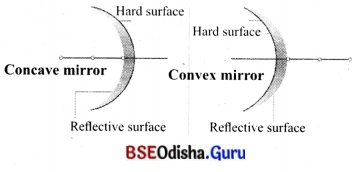
Convex mirror curve outward, causing parallel light rays to diverge and always form virtual, erect and diminished images. A simple test is to hold the mirror near an object and move it; a concave mirror can magnify objects when close while a convex mirror always makes them appear smaller.
Question 2.
Do you remember learning about the use of telescope in the chapter ‘Beyond Earth’ in Curiosity, Grade 6? (Page 156)
Answer:
Yes, some laws govern image formation by mirrors, including plane, concave and convex mirrors. These laws are based on the laws of reflection, which state that the angle of incidence (the angle at which light hits the mirror) is equal to the angle of reflection (the angle at which light bounces off the mirror). Additionally, the incident ray, the reflected ray, and the normal (an imaginary line perpendicular to the mirror’s surface at the point of incidence) all lie in the same plane.
Question 3.
We have observed images formed by three types of mirrors-plane, concave, and convex. But are there any laws which govern the image formation? (Page 157)
Answer:
Yes, the two laws of reflections which govern the image formation.
Question 4.
Are laws of reflection applicable to spherical mirrors also? (Page 160)
Answer:
Yes, the laws of reflection apply to spherical mirrors. The same rules-angle of incidence equals angle of reflection and the incident ray, reflected ray and normal lie in the same plane – hold at every point on a spherical mirror’s surface. Using these laws and simple geometry we can predict where an image will form for concave and convex spherical mirrors.
Question 5.
We explored the images of an object formed by curved mirrors. But how do objects look when viewed through transparent materials with curved surfaces? (Page 162)
Answer:
When we view the printed letters by a magnifying glass which is a convex lens, it appear bigger in size. In case of concave lens the image is smaller than object.
Question 6.
What changes can be seen in the objects when viewed through lenses? (Page 163)
Answer:
Image formed by a convex lens can be enlarged, diminished or of the same size as the object and it may be erect or inverted, depending upon the distance of the object from the lens. But image formed by a concave lens is always erect and diminished in size.
Question 7.
Do lenses also converge or diverge the light beam? Can it also burn a paper ? (Page 163)
Answer:
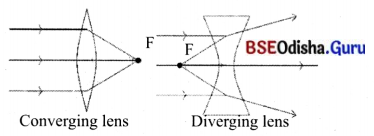
Yes, lenses can both converge and diverge light beams. Convex (convering) lenses bring parallel rays together at a focus, while concave (diverging) lenses cause parallel rays to spread out as if they came from a virtual focus.
Question 8.
Since a convex lens converges a light beam, can it also burn a paper? (Page 164)
Answer:
Yes. A convex lens can concentrate sunlight to a small spot and raise the temperature there enough to scorch or even ignite paper. This is the same principle used in a magnifying glass to focus sunlight.
Question 9.
Where all are the lenses used ? (Page 165)
Answer:
Lenses are used in many devices such as eyeglasses, cameras, microscopes, telescopes, projectors, magnifying glasses and medical instruments. Different lens types (convex or concave) are chosen depending on whether the light needs to be converged or diverged.
Light: Mirrors and Lenses Class 8 Questions and Answers
Keep the Curiosity Alive (Pages 166-169)
Question 1.
What is the angle made by the reflected ray with the mirror?
(i) 40°
(ii) 50°
(iii) 45°
(iv) 60°
Answer:
(ii) If the incident ray makes a 40° angle with the normal, then :
Angle of incidence (i) =40°
According to the law of reflection,
Angle of reflection (r) = Angle of incidence
(i) = 40°
Now, Angle between reflected ray and mirror = 90° angle of reflection
= 90°-40°=50°
Question 2.
The figure shows three different situations where a light ray falls on a mirror:
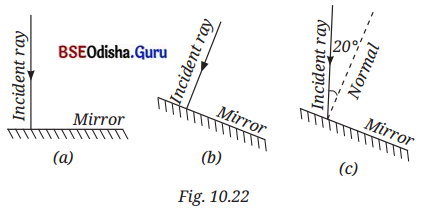
(i) The light ray falls along the normal.
(ii) The mirror is tilted, but the light ray still falls along the normal to the tilted surface.
(iii) The mirror is tilted, and the light ray falls at an angle of 20° from the normal.
Draw the reflected ray in each case (Use a ruler and protractor for accurate drawing). What is the angle of reflection in each case?
Answer:
(i) Light ray falls along the normal Angle of incidence = 0°
Angle of incidence =0°
Angle of reflection =0°
The ray retraces its path. It reflects straight back along the same line.
(ii) The mirror is tilted, but the light ray still falls along the normal to the tilted surface.
Even though the mirror is tilted, the ray is still perpendicular to the surface.
Angle of incidence = 0°
Angle of reflection = 0°
The ray again retraces its path – the tilt doesn’t affect the reflection if the ray is normal to the surface.
(iii) The mirror is tilted, and the light ray falls at 20° from the normal.
Angle of incidence =20°
By the law of reflection:
Angle of reflection =20°
The reflected ray will make a 20° angle with the normal, on the opposite side.
Question 3.
In the figure, the cap of a sketch pen is placed in front of three types of mirrors.
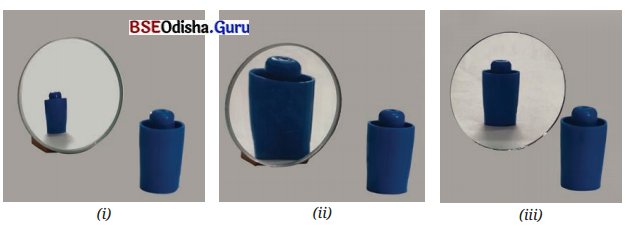
Match each image with the correct mirror.
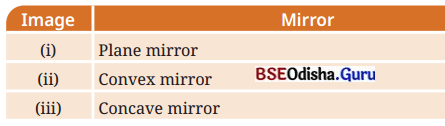
Answer:
| Image | Mirror |
| (i) (ii) (iii) |
Convex mirror Concave mirror Plane mirror |
Question 4.
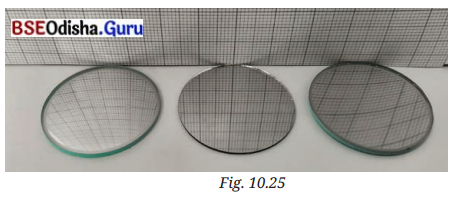
In the Figure, the cap of a sketch pen is placed behind a convex lens, a concave lens, and a flat transparent glass piece- all at the same distance.
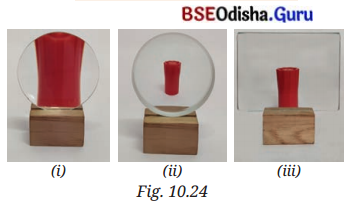
Match each image with the correct type of lens or glass.
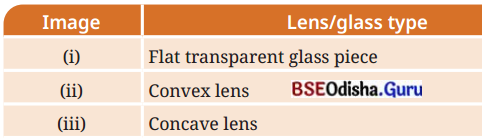
Answer:
| Image | Lens/glass type |
| (i) (ii) (iii) |
Convex lens Concave lens Flat transparent glass piece |
Question 5.
When the light is incident along the normal on the mirror, which of the following statements is true:
(i) Angle of incidence is 90°
(ii) Angle of incidence is 0°
(iii) Angle of reflection is 90°
(iv) No reflection of light takes place in this case
Answer:
(ii) When light hits a surface at a 90° angle (perpendicular), it is considered to be incident normally.
Angle of incidence = Angle of reflection: In reflection, the angle of the reflected light is always equal to the angle of the incident light. Since the light is hitting the mirror normally (at a 0° angle of incidence), the reflected light will also be at a 0° angle of reflection.
Question 6.
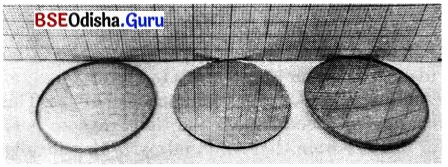
Three mirrors-plane, concave, and convex, are placed in the figure. Based on the images of the graph sheet formed in the mirrors, identify the mirrors and write their names above the mirrors.
Answer:
Question 7.
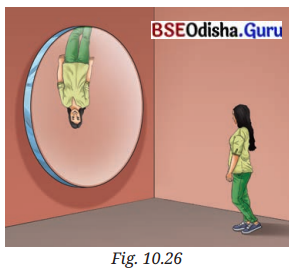
In a museum, a woman walks towards a large convex mirror (Figure). She will see that :
(i) her erect image keeps decreasing in size.
(ii) her inverted image keeps decreasing in size.
(iii) her inverted image keeps increasing in size, and eventually it becomes erect and magnified.
(iv) her erect image keeps increasing in size.
Answer:
The correct answer is (i) her erect image keeps decreasing in size. Because a convex mirror always forms a virtual, erect, and diminished image.
Question 8.
Hold a magnifying glass over the text and identify the distance at which you can see the text bigger than they are written. Now move it away from the text. What do you notice? Which type of lens is a magnifying glass?
Answer:
A magnifying glass uses a convex lens to make text appear larger. When we hold the magnifying glass close to the text and then slowly move it away, the image of the text will first appear larger and sharper, then progressively get larger and more blurred, and finally invert and appear smaller again.
Question 9.
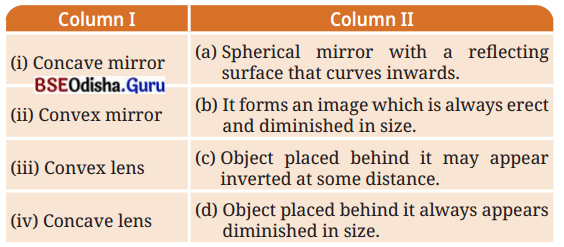
Match the entries in Column I with those in Column II.
Answer:
| Column I | Column II |
| (i) Concave mirror | (a) Spherical mirror with a reflecting surface that curves inwards. |
| (ii) Convex mirror | (b) It forms an image which is always erect and diminished in size. |
| (iii) Convex lens | (c) An object placed behind it may appear inverted at some distance. |
| (iv) Concave lens | (d) The object placed behind it always appears diminished in size. |
Question 10.
The following question is based on Assertion/Reason.
Assertion: Convex mirrors are preferred for observing the traffic behind us.
Reason: Convex mirrors provide a significantly larger view area than plane mirrors.
Choose the correct option:
(i) Both Assertion and Reason are correct, and Reason is the correct explanation for Assertion.
(ii) Both Assertion and Reason are correct, but Reason is not the correct explanation for Assertion.
(iii) Assertion is correct, but Reason is incorrect.
(iv) Both Assertion and Reason are incorrect.
Answer:
(i) Both Assertion and Reason are correct, and Reason is the correct explanation for Assertion.
Question 11.
In the Figure, note that O stands for object, M for mirror, and I for image.
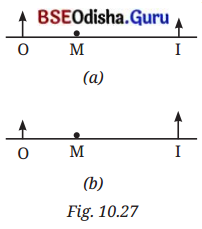
Which of the following statements is true?
(i) Figure (a) indicates a plane mirror, and Figure (b) indicates a concave mirror.
(ii) Figure (a) indicates a convex mirror and Figure (b) indicates a concave mirror.
(iii) Figure (a) indicates a concave mirror and Figure (b) indicates a convex mirror.
(iv) Figure (a) indicates a plane mirror, and Figure (b) indicates a convex mirror.
Answer:
(ii) Figure (a) indicates a convex mirror and Figure (b) indicates a concave mirror.
Question 12.
Place a pencil behind a transparent glass tumbler (Figure a). Now fill the tumbler halfway with water (Figure b). How does the pencil appear when viewed through the water? Explain why its shape appears changed.
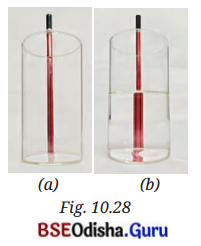
Answer:
When we place a pencil behind a transparent glass tumbler and fill the tumbler halfway with water, the pencil will appear to be bent or broken at the point where it enters the water. The submerged portion of the pencil might also appear slightly thicker or shifted from its actual position. This phenomenon is called refraction of light.
Why it Happens
Change in medium: Light travels at different speeds in different materials (media). Air is an optically rarer medium, meaning light travels faster in it, compared to water, which is an optically denser medium where light travels more slowly.
Bending of Light (Refraction): When light rays from the pencil travel from the water (denser medium) into the air (rarer medium) and then into our eyes, their speed changes. This change in speed causes the light rays to bend or deviate from their original path. Specifically, when light goes from a denser medium to a rarer medium, it bends away from the normal (an imaginary line perpendicular to the surface at the point where light enters the new medium).
Apparent Position: Because our brains interpret light rays as traveling in straight lines, the bending of light at the water-air interface makes the submerged part of the pencil appear to be at a different location than its actual position, creating the illusion of a bent or broken pencil.
The extent of this bending depends on the angle at which we view the pencil and the difference in optical density between the two media (water and air). If we view the pencil straight from above, we won’t observe the bending as the light rays would be traveling perpendicular to the surface, and refraction would be minimal.
Class 8 Science Chapter 10 Question Answer
Activity 1.
Let us explore
Aim: To study the image of an object formed by a curved reflecting surface.
Materials Required: A highly polished large stainless steel spoon.
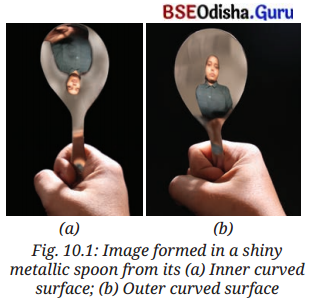
Procedure:
- Take a highly polished large stainless steel spoon and hold its curved surface close to your face. Can you see your image in it?
- You will notice that the image of your face is different from the image you see in a plane mirror.
- Now, observe the image, by moving spoon slowly away from your face. Do you observe any change in the image?
- Repeat the same steps by flipping the spoon.
Observations:
- When we looked at the inner side of spoon which is curved inwards, we observed that the image was inverted.
- When we looked at the outer side of the spoon which is bulges outwards, the image of our face was erect but smaller in size.
Inferences:
- Curved mirrors are a part of hollow glass sphere.
- The reflecting surface of the spherical mirror may be curved inwards or outwards.
Activity 2.
Let us distinguish
Aim: To distinguish between concave and convex mirror.
Materials Required: A concave mirror, a convex mirror.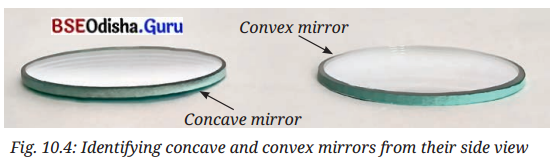
Procedure:
- Keep a concave and a convex mirrors on a table whose reflecting surfaces facing upwards.
- Now look at them from the side, keeping your eye at their level, so that you can identify whether the reflecting surface is curved inwards or outwards.
Observations:
- The Reflecting surface of one mirror is curved inwards.
- The Reflecting surface of other mirror is curved outwards.
Inference:
| Concave mirror | Convex mirror |
| 1. Reflecting surface is curved inwards. | 1. Reflecting surface is curved outwards. |
| 2. A thin layer of aluminium is coated on outer curved surface. | 2. A thin layer of aluminium is coated on inner curved surface. |
| 3. It forms both type of images: erect and inverted. | 3. It forms only erect images at all distances. |
Activity 3.
Let us explore
Aim: To study the characteristics of images formed by spherical mirrors.
Materials Required: A concave mirror, a convex mirror, two small wooden blocks, a small toy or some other object.
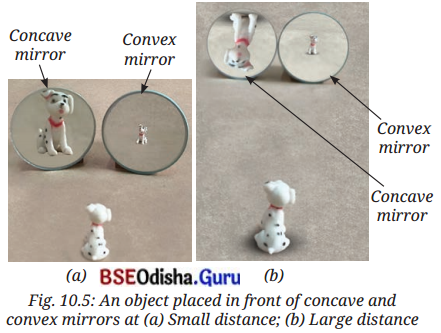
Procedure:
- Take two mirrors and hold them side by side in an upright position on a table.
- Keep the object in front of them at a small distance (3-4 cm away) as shown in Figure (a).
- What kind of images do you see in each mirror? Are the images of the same size as the object? Are they erect? Do you see lateral inversion in the images?
- Note down your observation.
- Now, move the object gradually from the mirror.
- What changes do you see in the images in both the mirrors? Do the images become smaller or larger? Do they continue to be erect? Again, note down your observations.
- Repeat the above steps with each mirror separately.
Observations:
1. When object is close to the mirror.
| Concave | Convex |
| (i) Enlarged size (Larger) | (i) Diminished size (Smaller) |
| (ii) Erect | (ii) Erect |
| (iii) Lateral inversion is seen. | (iii) Lateral inversion is seen. |
2. When object is moved away:
| Concave | Convex |
| (i) The size decreases as the distance increases. | (i) Smaller at all distance. |
| (ii) Inverted | (ii) Remains erect |
| (iii) Lateral inversion is seen. | (iii) Lateral inversion is seen. |
Inference :
For a Convex Reflecting Surface:
- An erect and smaller image is formed.
- The image remains erect and smaller at all distances.
For a Concave Reflecting Surface:
- At smaller distance, the image is erect and enlarged.
- At larger distances, the image formed is inverted. The size of the image decreases as the distance from the spoon increases.
Conclusion: Common in Both: Lateral inversion (left-right reversal) is observed in the images.
Activity 4.
Let us experiment
Aim: To verify the first laws of reflection.
Materials Required: A drawing board, a white sheet of paper, a comb, a torch, a strip of plane mirror.
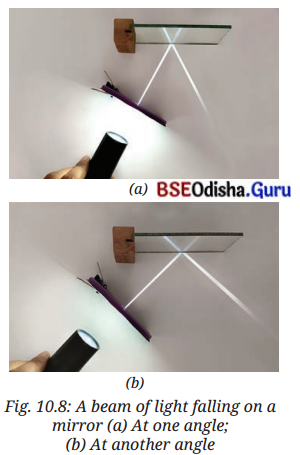
Procedure:
- Fix a white sheet of paper on a drawing board.
- Take a comb and close all its openings except one in the middle.
- Hold the comb perpendicular to the sheet of paper.
- Throw light from a torch through the opening of the comb from one side. With slight adjustment of the torch and the comb you will see a ray of light along the paper on the other side of the comb.
- Keep the comb and the torch steady.
- Place a strip of plane mirror in the path of the light ray.
- What do you observe ?
After striking the mirror, the ray of light is reflected in another direction. - After striking the mirror, the ray of light is reflected in another direction. The light ray, which strikes any surface, is called the incident ray. The ray that comes back from the surface after reflection is known as the reflected ray.
- Daw lines showing the position of the plane mirror, the incident ray and the reflected ray on the paper. Remove the mirror and the comb. Draw a line making an angle of 90° to the line representing the mirror at the point where the incident ray strikes the mirror. This line is known as the normal to the reflecting surface at that point.
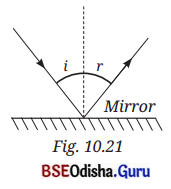
- The angle between the normal and incident ray is called the angle of incidence (∠i). The angle between the normal and the reflected ray is known as the angle of reflection (∠r).
- Measure the angle of incidence and the angle of reflection.
- Repeat the activity several times by changing the angle of incidence.
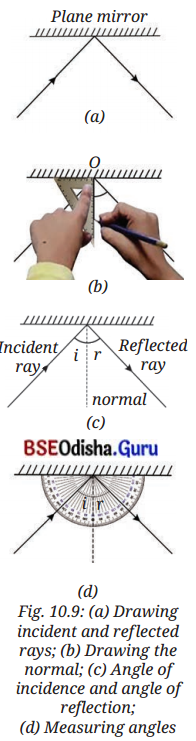
Observations:
| S.No | Angle of incidence (∠i) | Angle of Reflection (∠r) |
| 1. | 30° | 30° |
| 2. | 35° | 35° |
| 3. | 45° | 45° |
| 4. | 50° | 50° |
| 5. | 60° | 60° |
Inference: Angle of incidence is always equal to the angle of reflection. This is known as the law of reflection.
Incident ray of light: Ray of light which falls on a polished surface.
Reflected ray of light: Ray of light which gets reflected from a polished surface.
Normal is a line at right angle to the reflecting surface at the point of incidence.
Angle of incidence: Angle made by incident ray with the normal.
Angle of reflection: Angle made by reflected ray with the normal.
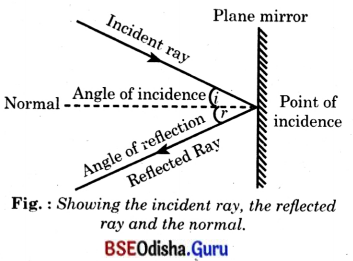
Laws of Reflection: There are two laws of reflection :
Law 1: The angle of reflection (∠r) is equal to the angle of incidence (∠i)
Law 2: The incident ray, the reflected ray and the normal at the point of incidence all lie in the same plane.
Activity 5.
Let us experiment
Aim: To verify the second law of reflection, i.e. the Incident ray, Reflected ray and the normal all lie in the same plane.
Materials Required: A mirror strip, holder, ray box.
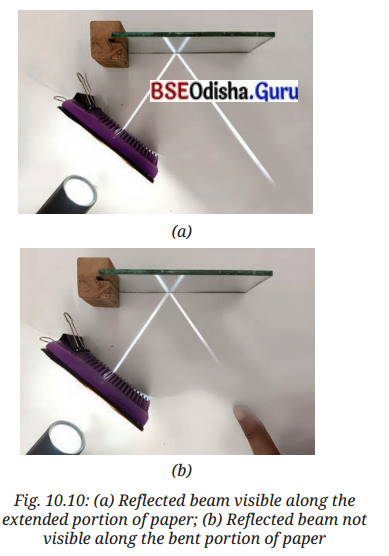
Procedure:
- Fix a white sheet of paper on a drawing board in such a way that a small portion of it project a little beyond the edge of the drawing board.
- Place the plane mirror strip on the sheet of paper and hold it vertically with a mirror stand.
- Throw a ray of light on the mirror using a ray box.
- Look at the reflected ray. The reflected ray extends the projected portion of the paper.
- Make a cut in the middle of the projected portion of the sheet.
- Bend that portion of the projected sheet on which the reflected light falls.
- The reflected ray of light is not seen on the bent portion of the sheet.
Inference: The entire sheet fixed on to the drawing board represents a plane. The incident, reflected ray and the normal lie in the plane of paper.
Activity 6.
Let us explore
Aim: To observe the reflection of multiple parallel rays fall on the plane mirror and spherical mirrors.
Materials Required: A plane mirror, a concave mirror, a convex mirror, stands for mirrors, a torch, a comb, a paper clip.
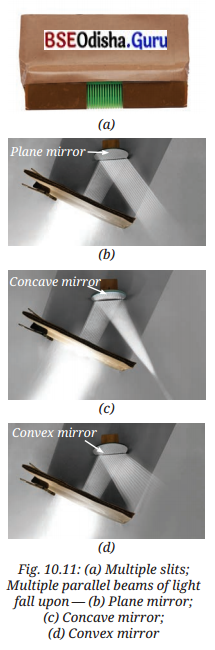
Procedure:
- Arrange the setup as mentioned in Activity 4 again.
- Instead of a single slit, you have to leave many opening of the comb uncovered so that you may obtain multiple parallel beams of light.
- Now, we will fall these multiple parallel beams of light upon the plane mirror, concave mirror, and convex mirror, respectively. Observe the reflected beams. Is your observation same as what is shown in figure (b), (c) and (d)?
Observations:
Case I: Multiple reflected beams are also parallel [Figure (b)].
Case II: When multiple beams of light fall upon a concave mirror, the multiple refiected beams get closer, that is, they converge [Figure (c)].
Case III: In the case of a convex mirror, the multiple reflected beams spread, that is, they diverge [Figure (d)].
Inference:
- Spherical mirror also follows the laws of reflection.
- A concave mirror converge (get closer) the multiple beam of light after reflection.
- A convex mirror diverge (spread) the multiple beam of light after reflection.
- But in a plane mirror multiple reflected beam of light remains parallel.
Activity 7.
Let us explore
Aim: To show that concave mirror is a converging mirror.
Materials Required: A concave mirror, a sheet of thin paper or newspaper.
Procedure:
1. Take a concave mirror and move its reflecting surface towards the Sun. Let the light of the Sun be reflected by the mirror on the sheet of paper.
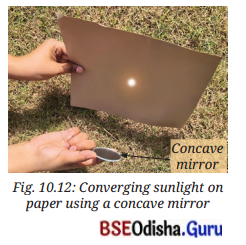
2. We should adjust the distance of the paper so that you can get a sharp bright spot on it see in figure.
3. You must hold the mirror and the sheet of paper contineously for a few minutes. Does the paper start to burn producing smoke?
Observation: The bright spot is formed on the paper and paper get ignited after few minutes.
Inference:
- Bright spot is due to concentration of reflected light from the sun. i.e., reflected light converged at a point after reflection.
- This produce sufficient heat at this point which can ignite the paper.
- Bright spot is actually the image of the sun.
Precaution:
- You should always perform this activity under the guidance of a teacher or an adult.
- We should not look towards the Sun or into the mirror reflecting the Sun.
- We should focus the reflected light only on a piece of paper, not towards anyone’s face or eyes.
Activity 8.
Let us explore
Aim: To read the printed letters through glass/plastic strip.
Materials Required: A flat strip of glass or clear plastic, such as a flat scale, few drops of oil, dropper, water and a paper or book.
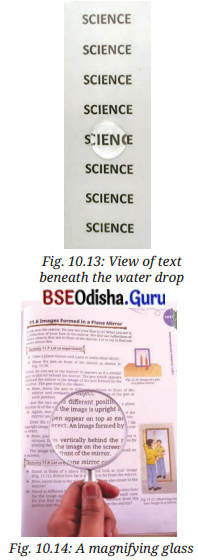
Procedure:
- Take a glass or plastic strip.
- Spread few drops of oil on it and rub it to leave a very thin coating. We can also use wax instead of oil.
- Now with the help of a dropper or our finger, put a few drop of water on the oiled/waxed spot. (The oil/wax will help the water form a nice round drop.)
- Observe the water drop. What is the shape of its surface? Is it flat or curved inward or curved outward?
- Now, observe the paper underneath the glass/plastic strip. The paper or book should be directly under the water drop (see figure).
- Now, look down through the water drop at the text below. Do you find some change in the size of the letters just below the water drop? Do they look enlarged or smaller?
Observation:
- The surface of the water drop is curved outside.
- The letters under the water drop appear than the letters nearby.
Inference:
- The curved drop of water acts like a simple lens.
- This is similar to magnifying glass which is also a lens that helps in reading small print making the letters appear larger.
Activity 9.
Let us experiment
Aim: To show the formation of images by a lens when the objects are placed at different distances.
Materials Required: A convex lens, a concave lens, a lens holder or stand and a smaller object.
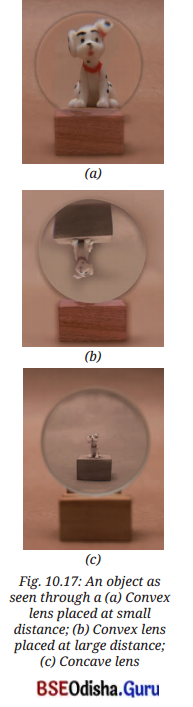
Procedure:
(A) For a convex lens
- Take a convex lens and mount it on a lens stand. Place it on a table.
- Place a lighted candle at a known distance (say 50 cm) from the lens.
- Place a white paper screen on the other side of the lens.
- Move the screen towards or away from the lens to get a sharp image of the candle flame.
- Since the image is obtained on the screen, therefore the image formed is real. Note down the positions of the lens, the candle, and that of the screen.
- Now move the candle by 10 cm towards the lens and try to obtain its image on the screen by moving the screen. Note down the positions of the lens, the candle and the screen.
- Repeat the experiment by changing the position of the candle and that of the screen.
Observation:
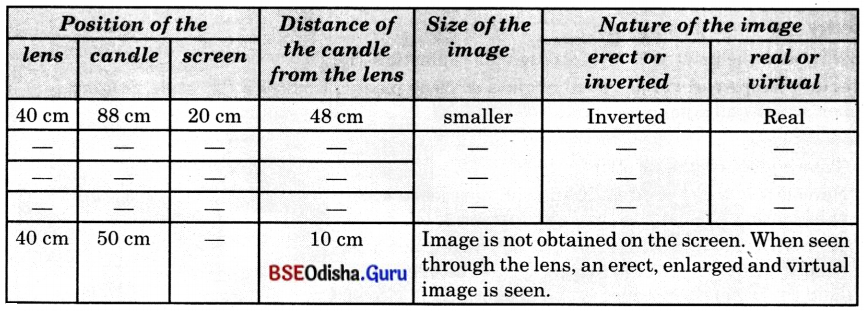
Inference:
- Convex lens forms a real and inverted image of the object when placed away from the lens.
- Convex lens forms virtual and erect image when the object is placed very near to the lens.
Procedure:
- Mount a concave lens on a lens stand and keep it on a table.
- Place a lighted candle at a known distance (say 50 cm) from the lens.
- Place white paper sheet on the other side of the lens.
- Move the screen towards or away from the lens and look for the image of the candle flame. Image of the candle flame is not seen on the screen.
- Now fix the position of the screen and move the candle towards the lens. Image of the candle flame is not seen on the screen.
- Remove the screen and look into the concave lens from that side. An erect virtual and smaller image is seen through the concave lens.
- Look into the concave lens for different distances from the lens and record your observations.
(i) When the object is far off from the lens.
(ii) When the object is nearer to the lens.
Observations and Inference:
- The image formed by a concave lens cannot be obtained on a screen. Therefore, the images formed by a concave lens are virtual.
- The image formed by a concave lens for all distances from the lens is erect and smaller in size than the object.
Activity 10.
Let us investigate
Aim: To show that convex lens is a congerging lens and concave lens is a diverging lens.
Materials Required: A thin transparent glass plale, a convex lens, a concave lens, a torch and a comb, a paper clip, two books of same size, white sheet of paper.
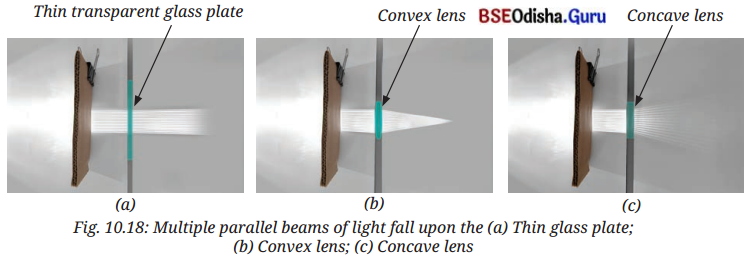
Procedure:
- Hold a comb upright with a paper clip to obtain multiple parallel beams of light.
- With the help of two books placed adjacent to each other, fix the glass plate or lens upright in between them see in figure and spread paper sheets on both books.
- Now pass the multiple parallel beams of light through the thin glass plate, convex lens, and concave lens one by one as shown in figure. Does the parallel beam of light pass through without any change in its direction in all three cases?
- Note down and analyse your observations.
Observation:
- The beam of light passes through the thin glass place without any deviation (i.e., no change in its path).
- In the convex lens, beam of light converges after passing through it (i.e., come closer).
- In concave lens, beam of light diverges after passing through it (i.e., beam spread).
Inference: A convex lens is called a converging lens and a concave lens is called a diverging lens. We draw the following figures for above Activity-10.

Activity 11.
Let us investigate
Aim: To show that a convex lens converges sunlight at a point and can burn a piece of paper.
Materials Required: A convex lens, a sheet of thin paper or newspaper.
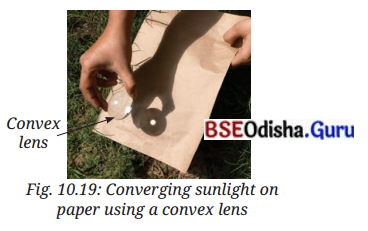
Procedure:
- Hold a comb upright with a paper clip to obtain multiple parallel beams of light.
- With the help of two books placed adjacent to each other, fix the glass plate or lens upright in between them see in figure and spread paper sheets on both books.
- Now pass the multiple parallel beams of light through the thin glass plate, convex lens, and concave lens one by one as shown in figure. Does the parallel beam of light pass through without any change in its direction in all three cases?
- Note down and analyse your observations.
Observation:
- The beam of light passes through the thin glass place without any deviation (i.e., no change in its path).
- In the convex lens, beam of light converges after passing through it (i.e., come closer).
- In concave lens, beam of light diverges after passing through it (i.e., beam spread).
Inference:
- Bright spot is due to concentration of reflected light from the sun. i.e., reflected light converged at a point after reflection.
- This produce sufficient heat at this point which can ignite the paper.
- Bright spot is actually the image of the sun.
Precautions: Do not look at the Sun directly or through the lens as it may damage your eyes.
Light: Mirrors and Lenses Class 8 Extra Questions and Answers
Short Answer Type Questions
Question 1.
State the characteristics of the image formed by a plane mirror.
Answer:
- Plane mirror forms an erect image.
- It forms a virtual image.
- Size of the image is same as that of the object.
- Image gets formed at the same distance behind the mirror as the object stands in front of it.
- Image formed is a laterally inverted image. i.e. right hand side of the object seems to be the left hand side and vice versa.
Question 2.
What is a virtual image ? Give one situation where a virtual image is formed.
Answer:
The image which cannot be taken on a screen is called a virtual image. When some object is placed very close to the concave mirror we do not get any image of that object on the white screen placed in front of the mirror. Such image is called a virtual image.
Question 3.
What is the difference between virtual images produced by concave, plane and convex mirrors ?
Answer:
Virtual image produced by concave mirror is magnified, that produced by plane mirror is of the same size and the virtual image produced by convex mirror is diminished.
Question 4.
State one way in which the image formed in a convex mirror is similar to that in plane mirror and one way in which it is different.
Answer:
Similarity: Both convex mirror and plane mirror always form a virtual and erect image of an object.
Difference: Convex mirror always forms an image which is smaller than the object but a plane mirror always forms an image which is of the same size as the object.
Question 5.
Which type of mirror is used as a shaving mirror ? Support your answer with reason.
Answer:
Concave mirrors are used as shaving mirrors to see a large image of the face. This is because when the face is held within the focus of a concave mirror, then an enlarged image of the face is seen in the concave mirror. This helps in making a smooth shave.
Long Answer Type Questions
Question 1.
How can you distinguish between plane mirror, convex mirror and concave mirror by merely looking at the image formed in each case ?
Answer:
To distinguish between a plane mirror, a convex mirror and a concave mirror, the given mirror is held near the face and the image is seen.
- If the image is upright and same size as the object and, so it does not change in size when the mirror is moved, then the mirror is a plane mirror.
- If the image is upright magnified and it becomes inverted when the mirror is moved away from the face, then the mirror is a concave mirror.
- If the image is upright and diminished and it remains upright when the mirror is moved away from the face, then the mirror is a convex mirror.
Question 2.
Write the uses of solar concentrator.
Answer:
- Solar concentrators are devices which can concentrate sunlight to a small area with the help of mirrors and lenses.
- The concentrated sunlight is utilised to heat a liquid to produce steam which can be used to generate electricity or for providing heat for various purposes, such as large scale cooking or for solar furnaces.
- Solar furnaces are even used for melting steel! Do you remember learning in an earlier chapter, about electric furnaces for melting steel?
Case-Study Based Questions
1. Read the following passage carefully and answer the questions that follow :
If the reflecting surface of a spherical mirror is concave, it is called a concave mirror. If the reflecting surface is convex, then it is a convex mirror. The inner surface of a spoon acts like a concave mirror, while its outer surface acts like a convex mirror. The image of an object formed by a plane mirror cannot be obtained on a screen. Let us investigate if it is also true for the image formed by a concave mirror. The image formed by a plane mirror could not be obtained on a screen. Such an image is called a virtual image.
(i) Which of the following can be used to form a real image ?
(a) Concave mirror only
(b) Plane mirror only
(c) Convex mirror only
(d) Both concave and convex mirrors
Answer:
(a) Concave mirror only
(ii) Which of the statement is ture :
(a) If reflecting surface is convex then this a covex mirror
(b) Inner surface of spoon acts like concave
(c) Outer surface is spoon acts like convex mirror
(d) All of these
Answer:
(d) All of these
(iii) Which of the statement is false :
(a) The image formed by plane mirror can be obtained on screen
(b) Plane mirror image can not be obtained on screen
(c) An inverted image can be obtained by plan mirror
(d) None of these
Answer:
(b) Plane mirror image can not be obtained on screen
(iv) A spherical mirror having reflecting surface curved outward is a :
(a) plane mirror
(b) concave mirror
(c) convex mirror
(d) either concave or convex
Answer:
(c) convex mirror
Picture Based Questions
I. Observe the following picture and answer the questions.
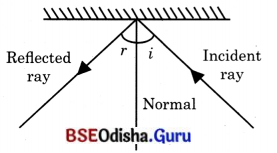
(i) Angle of incidence is equal to angle of reflection. This is one of the :
(a) law of refraction
(b) normal law
(c) both (a) and (b)
(d) angle of reflection
Answer:
(d) angle of reflection
(ii) The angle between the normal and the reflected ray is called :
(a) angle of refraction
(b) angle
(c) angle of incidence
(d) angle of reflection
Answer:
(d) angle of reflection
(iii) Define angle of incidence?
Answer:
The angle between the normal and the incident ray is called angle of incidence.
Light: Mirrors and Lenses Class 8 MCQ
Multiple Choice Questions (Mcqs)
Question 1.
A virtual image: ………..
(a) can be formed on the screen
(b) cannot be formed on the screen
(c) is formed only by the plane mirror
(d) is formed only by the convex mirror
Answer:
(b) cannot be formed on the screen
Question 2.
Which of the following would you prefer to use while reading small letters found in a dictionary ?
(a) A concave mirror
(b) A concave lens
(c) A convex mirror
(d) A convex lens
Answer:
(d) A convex lens
Question 3.
The image of an object formed by a plane mirror is:
(a) virtual
(b) real
(c) diminished
(d) upside down
Answer:
(a) virtual
Question 4.
A diverging mirror is:
(a) a plane mirror
(b) a convex mirror
(c) a concave mirror
(d) none of the above
Answer:
(b) a convex mirror
Question 5.
The image formed by spherical mirror is virtual. The mirror will be:
(a) concave
(b) convex
(c) either concave or convex
(d) none of the above
Answer:
(c) either concave or convex
Assertion and Reasoning
These questions consist of two statements, each printed as Assertion (A) and Reason (R). While answering these questions, you are required to choose any one of the following four responses.
(a) Assertion (A) and Reason (R) both are correct and reason is correct explanation for assertion.
(b) Assertion (A) and Reason (R) both are correct and reason is not correct explanation for assertion.
(c) Assertion (A) is correct but the Reason (R) is wrong.
(d) Assertion (A) is wrong but the Reason (R) is correct.
1. Assertion (A): When the object is placed very close to the lens, the image formed is virtual, erect and magnified.
Reason (R): This happens because the convex lens can form real and inverted image when the object place very close.
Answer:
(a) Assertion (A) and Reason (R) both are correct and reason is correct explanation for assertion.
2. Assertion (A): The light ray, which strikes any surface, is called the incident ray.
Reason (R): The ray that comes back from the surface after reflection is known as the reflected ray.
Answer:
(b) Assertion (A) and Reason (R) both are correct and reason is not correct explanation for assertion.
Fill in the blanks
1. An image that cannot be obtained on a screen is called ………….
Answer:
virtual image
2. Light travels in ………… lines.
Answer:
straight
3. Convex mirrors are ………… in the middle than at the edges whereas concave lenses are ………… in the middle than at the edges.
Answer:
thicker, thinner
4. The rear view mirror/side mirror in automobiles is a ………… mirror.
Answer:
convex
5. The inner surface of a steel spoon acts as a ………… mirror.
Answer:
concave
True or False
1. A concave lens can be used to produce an enlarged and erect image.
Answer:
False
2. A convex lens always produces a real image.
Answer:
False
3. The sides of an object and its image formed by a concave mirror are always interchanged.
Answer:
True
4. An object can be seen only if it emits light.
Answer:
False
5. A concave mirror can not be used as a magnifying mirror.
Answer:
False