
Regular revision with Class 7 Maths MCQ with Answers and Ganita Prakash Class 7 Maths Chapter 5 Parallel and Intersecting Lines MCQ improves accuracy in objective exams.
MCQ on Parallel and Intersecting Lines Class 7
Parallel and Intersecting Lines MCQ Class 7
Class 7 Maths Parallel and Intersecting Lines MCQ
Question 1.
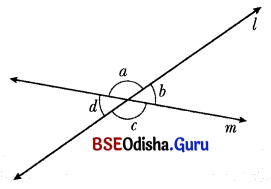
How many angles are formed when two lines intersect?
(a) 2
(b) 3
(c) 4
(d) 6
Solution:
(c) 4
When two lines intersect, they form four angles at the point of intersection.
Question 2.
The sum of a linear pair of angles formed by intersecting lines is:
(a) 360°
(b) 180°
(c) 90°
(d) 45°
Solution:
(b) 180°
A linear pair of angles is formed when two angles are adjacent and their non-common arms form a straight line. This means the two angles lie on a straight line.
So, their sum is always 180°.
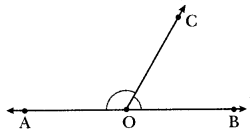
∠AOC + ∠BOC = 180°
So, they form linear pairs.
Question 3.
Which of the following is true about perpendicular lines?
(a) They form acute angles.
(b) They form obtuse angles.
(c) They do not intersect.
(d) They form four right angles.
Solution:
(d) They form four right angles.
When two lines are perpendicular, they form four right angles at the point of intersection .

Question 4.
If the complement of an angle is 42°, then the angle is:
(a) 28°
(b) 48°
(c) 138°
(d) 148°
Solution:
(b) 48°
We know that complement of angle x° is (90° – x°).
∴ Complement of 42° = 90° – 42° = 48°
Thus, the angle is 48°.
Question 5.
If the supplement of an angle is 42°, then the angle is:
(a) 28°
(b) 48°
(c) 138°
(d) 148°
Solution:
(c) 138°
We know that supplement ot’x0 is (180° – x°).
∴ Supplement of 42° = 180° – 42° = 138°.
Question 6.
When a transversal cuts two lines, how many angles are formed in total?
(a) 4
(b) 6
(c) 8
(d) 10
Solution:
(c) 8
When a transversal cuts across two lines (whether parallel or not), it intersects each line and forms 4 angles with first line and 4 angles with second line.
So, total of 8 angles are formed when a transversal cuts two lines.
Question 7.
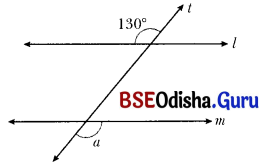
In the given figure, the parallel lines l and m are intersected by a transversal t. The value of ∠a is:
(a) 50°
(b) 80°
(c) 120°
(d) 130°
Solution:
(d) 130°
In the given figure, ∠a and 130° are alternate exterior angles.
We know that alternate exterior angles formed by a transversal intersecting a pair of parallel lines are always equal to each other.
So, ∠a = 130°
Question 8.
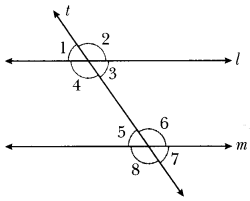
In the given figure, which pair of angles forms alternate interior angles?
(a) ∠1 and ∠5
(b) ∠2 and ∠6
(c) ∠4 and ∠5
(d) ∠3 and ∠5
Solution:
(d) ∠3 and ∠5
We know that alternate interior angles lie between the two lines and on opposite sides of the transversal.
From the figure, as ∠3 and ∠5 are on opposite sides of the transversal t and between the two lines l and m, they form a pair of alternate interior angles.
Question 9.
Which of the following is always true when a transversal intersects two lines?
(a) All angles are right angles.
(b) All vertically opposite angles are equal.
(c) All angles are different.
(d) All corresponding angles are equal.
Solution:
(b) All vertically opposite angles are equal.
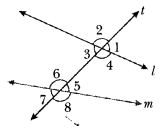
When a transversal intersects two lines (whether parallel or not), vertically opposite angles are always equal at each point of intersection. This is a basic geometric property and does not depend on whether the lines are parallel or not.
Question 10.
Two parallel lines are cut by a transversal. If ∠x = 65° and it corresponds to ∠y, what is the measure of ∠y?
(a) 115°
(b) 65°
(c) 125°
(d) cannot be determined
Solution:
(b) 65°
We know that when two parallel lines are cut by a transversal, the corresponding angles are always equal.
∴ ∠y = ∠x = 65°
Question 11.
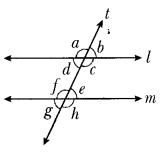
In the figure, if two lines l and m are parallel and ∠c = 110°, what is the measure of its alternate angle?
(a) 110°
(b) 70°
(c) 90°
(d) 100°
Solution:
(a) 110°
We know that when two parallel lines l and m are cut by a transversal t, the alternate interior angles are always equal. Here, ∠f is the alternate interior angle of ∠c.
Therefore, ∠f – ∠c = 110°.
Question 12.
Which of the following are true for adjacent angles?
(i) They share a common vertex.
(ii) They lie on different planes.
(iii) They have a common arm.
(iv) Their non-common arms lie on the same side of the common arm.
Choose the correct option from the following:
(a) (i) and (ii)
(b) (ii) and (iv)
(c) (i) and (iii)
(d) (ii) and (iii)
Solution:
(c) (i) and (iii)
We know that two angles in a plane are said to be adjacent angles if:
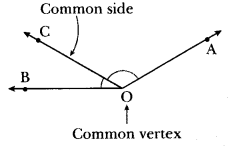
(1) they have a common vertex,
(2) they have a common arm, and
(3) their other arms lie on the opposite side of the common arm.
Thus, (i) and (iii) are true.
Question 13.
Which of the following statements about supplementary angles are correct?
(i) Two angles are supplementary if their measures add up to 180°.
(ii) Two obtuse angles can be supplementary.
(iii) A pair of right angles is always supplementary.
(iv) Supplementary angles must always be adjacent.
(v) If one angle is 65°, its supplement is 115°.
Choose the correct option from the following:
(a) Only (i) and (iii)
(b) (i), (ii) and (iv)
(c) (i), (ii) and (v)
(d) (i), (iii) and (v)
Solution:
(d) (i), (iii) and (v)
We know that if the sum of the measures of two angles is 180°, then the angles are called supplementary angles.
Two obtuse angles cannot be supplementary angles as the sum of these angles will be more than 180°.
A pair of right angles, i.e. two right angles are always supplementary angles as the sum of these angles is 180° and supplementary angles may or may not be adjacent.
As 65° + 115° = 180°, 65° and 115° are supplement of each other.
Thus, (i), (iii) and (v) are correct.
Parallel and Intersecting Lines Class 7 Assertion and Reason Questions
The following questions are Assertion and Reason based questions. Two statements are given, one labelled as Assertion (A) and the other is labelled as Reason (R). Select the correct answer to these questions from the codes (a), (b), (c) and (d) as given below.
(a) Both A and R are true and R is the correct explanation of A.
(b) Both A and R are true but R is not the correct explanation of A.
(c) A is true but R is false.
(d) A is false but R is true.
Question 1.
(A): Two right angles can be complementary.
(R): Complementary angles are those angles whose sum is 90°.
Solution:
(d) A is false but R is true.
We know that if the sum of the measures of two angles is 90°, then the angles are called complementary angles.
A right angle measures exactly 90°, so sum of two right angles = 90° + 90° = 180°.
Thus, two right angles cannot be complementary.
Thus, Assertion (A) is false, but Reason (R) is true.
Question 2.
(A): Two obtuse angles can never be supplementary.
(R): Supplementary angles are those angles whose sum is 180°.
Solution:
(a) Both A and R are true and R is the correct explanation of A.
We know that if the sum of the measures of two angles is 180°, then the angles are called supplementary angles.
An obtuse angle is more than 90°. So, two obtuse angles will always have a sum greater than 180°, and hence they cannot be supplementary.
Thus, both Assertion (A) and Reason (R) are true, and Reason (R) is the correct explanation of Assertion (A).
Question 3.
(A): Linear pair of angles are always supplementary.
(R): Linear pair angles are adjacent and lie on a straight line.
Solution:
(a) Both A and R are true and R is the correct explanation of A.
We know that linear pair of angles are adjacent angles formed on a straight line.
Since a straight line forms 180° angle, the two adjacent angles always add up to 180°.
Hence, they are supplementary.
Thus, both Assertion (A) and Reason (R) are true, and Reason (R) is the correct explanation of Assertion (A).
Question 4.
(A): Parallel lines never intersect even if extended infinitely.
(R): Parallel lines are always equidistant from each other.
Solution:
(a) Both A and R are true and R is the correct explanation of A.
We know that parallel lines stay the same distance apart and lie on the same plane.
So, they never intersect, no matter how far extended.
Thus, both Assertion (A) and Reason (R) are true, and Reason (R) is the correct explanation of Assertion (A).
Parallel and Intersecting Lines Class 7 Fill in the Blanks
Question 1.
When two lines on a plane do not meet even when extended infinitely, they are called __________ lines.
Solution: parallel
When two lines on a plane do not meet even when extended infinitely, they are called parallel lines.
Question 2.
When two lines intersect and all four angles formed are equal, each angle measures ________ degrees.
Solution: 90
We know that when two lines intersect, they form four angles.
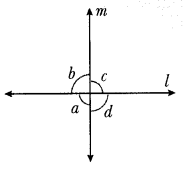
Given, all four angles formed are equal.
Let the four angles formed be ∠a, ∠b, ∠c and ∠d. Then,
∠a + ∠b + ∠c + ∠d = 360°
⇒ ∠a + ∠a + ∠a + ∠a = 360°
[∵ ∠a = ∠b = ∠c = ∠d]
⇒ 4∠a = 360° => ∠a = 90°
Thus, when two lines intersect and all four angles formed are equal, each angle measures 90 degrees.
Question 3.
Vertically opposite angles are always ________ .
Solution: equal
Vertically opposite angles are always equal.
Question 4.
________ lines always stay the same distance apart from each other.
Solution: Parallel
Parallel lines always stay the same distance apart from each other.