
Go through BSE Odisha Class 7 Science Solutions and Class 7 Science Chapter 4 The World of Metals and Non-metals Question Answer to understand textbook questions more clearly.
Class 7 Science Curiosity Chapter 4 Question Answer
Science Curiosity Class 7 Chapter 4 Question Answer
The World of Metals and Non-metals Class 7 Questions and Answers
Let Us Enhance Our Learning
Question 1.
Which metal is commonly used to make food packaging materials as it is cheaper, and its thin sheets can be folded easily into any shape?
(a) Aluminium
(b) Copper
(c) Iron
(d) Gold
Answer:
(a) Aluminium is commonly used in food packaging materials as it is malleable, cheaper, and easily available.

Question 2.
Which of the following metals catches fire when it comes in contact with water?
(a) Copper
(b) Aluminium
(c) Zinc
(d) Sodium
Answer:
(d) Sodium, being highly reactive, catches fire when it comes in contact with water.
Question 3.
State with reason(s) whether the following statements are True [T] or False [F].
(i) Aluminium and copper are examples of nonmetals used for making utensils and statues.
Answer:
False Aluminium and copper are examples of metals.
(ii) Metals form oxides when combined with oxygen, the solution of which turns blue litmus paper to red.
Answer:
False Metals form basic oxides when combined with oxygen, and thus, the solution turns red litmus paper blue.
(iii) Oxygen is a non-metal essential for respiration.
Answer:
True
(iv) Copper vessels are used for boiling water because they are good conductors of electricity.
Answer:
False Copper vessels are used for boiling water because they are good conductors of heat.
Question 4.
Why are only a few metals suitable for making jewellery?
Answer:
To make jewellery, the material used must be lustrous, malleable, ductile, and resistant to corrosion. Generally, metals are lustrous, malleable, ductile, but not all metals are resistant to corrosion. Metals like gold and silver are the most malleable as well as resistant to corrosion and are therefore suitable for making jewellery.
Question 5.
Match the uses of metals and non-metals given in Column I with the jumbled names of metals and non-metals given in Column II.
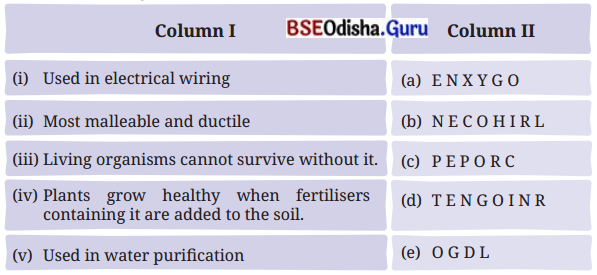
Answer:
| Column I | Column II |
| (i) Used in electrical wiring | (C) COPPER |
| (ii) Most malleable and ductile | (E) GOLD |
| (iii) Living organisms cannot survive without it. | (A) OXYGEN |
| (iv) Plants grow healthy when fertilisers containing it are added to the soil. | (D) NITROGEN |
| (v) Used in water purification | (B) CHLORINE |
Question 6.
What happens when oxygen reacts with magnesium and sulphur? What are the main differences in the nature of products formed?
Answer:
When oxygen reacts with magnesium (metal), a white ash of magnesium oxide is formed. When oxygen reacts with sulphur, sulphur dioxide gas is released.
Main difference: It is known that metals form basic oxides, while non-metals generally form acidic oxides. Hence, in the present case, the magnesium oxide is basic in nature, while sulphur dioxide is acidic in nature. This can also be confirmed via the litmus test. Magnesium oxide turns moist red litmus paper blue, while sulphur dioxide turns moist blue litmus paper red.
Question 7.
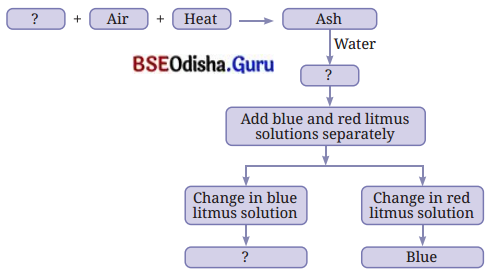
Complete the following flow chart:
Answer:
The answers from top to bottom in sequence are as follows:
- Magnesium
- Magnesium hydroxide (or solution of magnesium oxide)
- No change
Question 8.
You are provided with the following materials. Discuss which material would be your choice to make a pan that is most suitable for boiling water and why?

Answer:
Since metals are good conductors of heat, they are used to make utensils like a pan for boiling water or other cooking purposes. From the given materials, only iron and copper are metals. Here, copper is most suitable for making a pan because it does not react easily with water, and is a better conductor of heat.
Question 9.
You are provided with three iron nails, each dipped in oil, water and vinegar. Which iron nail will not rust, and why?
Answer:
The iron nail dipped in oil will not rust, as oil acts as a barrier that prevents the iron nail from coming in contact with air and water.
Question 10.
How do the different properties of metals and non-metals determine their uses in everyday life?
Answer:
Metals like copper and aluminium can be used to make electrical wires as these are ductile and good conductors of heat and electricity. Aluminium, being malleable, can be used to make foils to wrap food items. Gold and silver, being lustrous, are used to make jewellery.
Iron is strong and hard, and thus, used in construction to make buildings and tools like hammers, knives, and spades. Non-metals are also essential for life. For example, chlorine is used in water purification, nitrogen is used in the preparation of fertilisers, and oxygen is used for breathing.
Question 11.
One of the methods of protecting iron from getting rusted is to put a thin coating of zinc metal over it. Since sulphur does not react with water, can it be used for this purpose? Justify your answer.
Answer:
No, sulphur cannot be used to coat iron to prevent it from rusting. This is because sulphur reacts with oxygen to form sulphur dioxide gas which can easily leave the surface of iron and hence, cannot form a protective layer like zinc. Zinc forms a protective layer that prevents iron from coming in contact with air and moisture.
Question 12.
An ironsmith heats iron before making tools. Why is heating necessary in this process?
Answer:
It is important to heat the iron to make tools because heating makes the iron soft and easier to shape. Once it cools down, it becomes strong and hard again.
Class 7 Curiosity Chapter 4 Question Answer
InText Questions
Question 1.
Are all metals hard and solid (at room temperature)? Explain. [Page 43]
Answer:
No, some metals like sodium and potassium are so soft that they can be cut with a knife. Mercury is a metal that exists in its liquid state at room temperature.
Question 2.
Where do you find the use of metal wires? [Page 44]
Answer:
Metal wires are used in electrical fittings, fencing, ornaments like necklaces, and variety of stringed musical instruments such as veena, sitar, violin, and guitar.
Question 3.
Why can wires not be made up of coal or sulphur? [Page 45]
Answer:
Since ductility is mainly possessed by metals, while coal and sulphur are non-metals, they cannot be used to make wires.
Question 4.
How is the sound produced by a metallic object dropped on the floor different from the sound produced when a piece of coal or wood is dropped on the floor? [Page 45]
Answer:
A metallic object dropped on the floor produces a ringing sound, which is one of the characteristic properties of metals like sonority. Coal or wood produces a dull sound when dropped on the floor as they are non-sonorous.
Question 5.
What type of material is used for making the handle of a screwdriver, and why? [Page 47]
Answer:
A material that is a poor conductor of electricity is used to make the handle of a screwdriver to protect the electrician from electric shock.
Question 6.
When magnesium ribbon is burned in air, what can we observe? What effect does the aqueous solution of its product have on blue and red litmus papers? [Page 51]
Answer:
Magnesium ribbon burns in air with a dazzling white flame, and a white powder (magnesium oxide) is produced. The aqueous solution of it has no effect on the blue litmus paper, but it changes the colour of red litmus paper to blue.
Question 7.
Does sulphur behave in water the same way metals do? [Page 53]
Answer:
No, sulphur behaves differently from metals, as no reaction takes place when sulphur is added to water.