
Easy-to-read Ganita Prakash Class 7 Notes and Chapter 8 Working with Fractions Class 7 Notes save valuable study time during exam season.
Class 7 Maths Chapter 8 Working with Fractions Notes
Class 7 Working with Fractions Notes
Types of Fractions
| Type of Fraction | What it means | Example |
| Proper Fraction | Numerator < Denominator {Numerator less than Denominator} | \(\frac{1}{3}, \frac{4}{7}, \frac{2}{5},\) etc. |
| Improper Fraction | Numerator ≥ Denominator {Numerator equal to or greater than Denominator} | \(\frac{1}{1}, \frac{3}{2}, \frac{7}{4},\) etc. |
| Mixed Fraction | A whole number + a proper fraction | \(1 \frac{1}{4}, 3 \frac{2}{5}, 5 \frac{3}{7},\) etc. |
| Equivalent Fractions | Look different but have the same value | \(\frac{1}{2}=\frac{2}{4}=\frac{3}{6}\) etc. |
To multiply a whole number by a fraction, we simply multiply the numerator of the fraction by the whole number, keeping the denominator same.
For example, \(3 \times \frac{1}{2}=\frac{3 \times 1}{2}=\frac{3}{2}\)
Note: Fraction \(\frac{a}{b}\) is said to be in its lowest form, if a and b have no common factor other than 1.
Multiplication can be understood as repeated addition. It tells us how many times one number is added to itself.
For example, 3 × 4 = 12 because 4 + 4 + 4 = 12 (3 times).
This idea works with fractions too: \(3 \times \frac{1}{4}=\frac{3}{4}\) because \(\frac{1}{4}+\frac{1}{4}+\frac{1}{4}=\frac{3}{4}\).

Multiplication is the number that is to be multiplied by another number (called the multiplier).
For example, in \(8 \times \frac{3}{5}=\frac{24}{5},\) 8 is multiplier while \(\frac{3}{5}\) is multiplicand.
Sometimes ‘of’ means ‘multiplication’. For example, \(\frac{3}{4}\) of 20 = \(\frac{3}{4} \times 20\) = 15.
Unit fractions (like \(\frac{3}{n}\)) get smaller as the number in the bottom (denominator) gets bigger.
For example, \(\frac{1}{2}>\frac{1}{5}>\frac{1}{10}\)
Product ot two fractions = \(\frac{\text { Product of their numerators }}{\text { Product of their denominators }} \text {. For example, } \frac{2}{3} \times \frac{5}{11}=\frac{2 \times 5}{3 \times 11}=\frac{10}{33}\)
(i) When two proper fractions are multiplied, their product is less than each of the fractions.
For example, the product of \(\frac{1}{2} \text { and } \frac{3}{4} \text { is } \frac{3}{8} \text { and } \frac{3}{8}\) is less than both \(\frac{1}{2} \text { and } \frac{3}{4}\).
(ii) The product of a proper fraction and an improper fraction is greater than or equal to the proper fraction and less than the improper fraction.
For example, the product of \(\frac{5}{2} \text { and } \frac{1}{4} \text { is } \frac{5}{8} \text { and } \frac{1}{4}<\frac{5}{8}<\frac{5}{2}\).
(iii) When two improper fractions are multiplied, their product is greater than both the fractions or equal to either of them.
For example, the product of \(\frac{5}{2} \text { and } \frac{5}{4} \text { is } \frac{25}{8} \text { and } \frac{25}{8}\) is greater than both and \(\frac{5}{2} \text { and } \frac{5}{4}\).
The reciprocal of a fraction can be obtained by interchanging the numerator and denominator.
So, the reciprocal of a fraction \(\frac{a}{b} \text { is } \frac{b}{a}\).
Relation between the Area of a Rectangle and Multiplication of Fractions
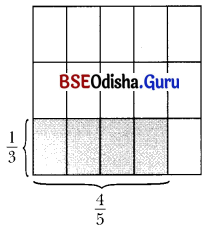
In the given figure, a square of area 1 square unit is divided into 15 equal rectangles. So, the area of each small rectangle = \(\frac{1}{15}\) square units
Number of shaded rectangles = 4
Therefore, total shaded area = \(4 \times \frac{1}{15}=\frac{4}{15}\) square units
Now, let’s verify this mathematically:
Length of shaded region = \(\frac{4}{5}\); Breadth of shaded region = \(\frac{1}{3}\)
Area of shaded region = Length × Breadth = \(\frac{4}{5} \times \frac{1}{3}=\frac{4 \times 1}{5 \times 3}=\frac{4}{15}\)
In general, if we want to find the product of two fractions, we can find the area of the rectangle formed with the two fractions as its sides.
The area of the rectangle remains the same even if the length and the breadth are interchanged,
i. e. the order of multiplication does not matter. Thus,
\(\frac{a}{b} \times \frac{c}{d}=\frac{c}{d} \times \frac{a}{b}\)
Division of Fractions
| Division of a Whole Number by a Fraction | Rule: \(a \div \frac{b}{c}=a \times \frac{c}{b}\) | For Example, \(5 \div \frac{5}{4}=5 \times \frac{4}{5}=4\) |
| Division of a Fraction by Another Fraction | Rule: \(\frac{a}{b} \div \frac{c}{d}=\frac{a}{b} \times \frac{d}{c}\) | For Example, \(\frac{3}{7} \div \frac{4}{7}=\frac{3}{7} \times \frac{7}{4}=\frac{3}{4}\) |
| Division of a Fraction by a Non-zero Whole Number | Rule: \(\frac{a}{b} \div c=\frac{a}{b} \times \frac{1}{c}\) | For Example, \(\frac{6}{13} \div 6=\frac{6}{13} \times \frac{1}{6}=\frac{1}{13}\) |
Note:
- When the divisor is greater than 1, the quotient is smaller than the dividend. For example, 15 ÷ 3 = 5. Here, 5 < 15 as 3 > 1.
- When the divisor is equal to 1, the quotient is the same as the dividend. For example, 8 ÷ 1 = 8.
- When the divisor is smaller than 1, the quotient is greater than the dividend. For example, 8 ÷ \(\frac{1}{2}\) = 16. Here, 16 > 8 as \(\frac{1}{2}\) < 1.
Important Points to Remember
- Smaller divisor → Bigger quotient
- Bigger divisor → Smaller quotient
- When the whole number 0 is divided by a fraction, we get 0 as the quotient.
Introduction
Proper Fraction: Numerator < Denominator. For example, \(\frac{2}{7}, \frac{5}{8},\) etc. Value of proper fraction is always less than 1. Improper Fraction: Numerator > Denominator.
For example, \(1, \frac{8}{5}, \frac{13}{5},\) etc.
Value of an improper fraction is always greater than or equal to 1.
Mixed Fraction: A whole number + A proper fraction.
For example, \(1 \frac{1}{4}, 3 \frac{1}{2},\) etc.
Equivalent Fractions: Look different but have the same value.
For example, \(\frac{1}{2}=\frac{2}{4}=\frac{3}{6}\)
Multiplication of Fractions
Product of two fractions = \(\frac{\text { Product of their numerators }}{\text { Product of their denominators }} \text {. For example, } \frac{3}{5} \times \frac{5}{9}=\frac{5 \times 3}{5 \times 9}\)
Based on above formula we can conclude the following result:
| Condition | Description of Product | Example | Comparison |
| Two Proper Fractions | The product is less than each of the fractions. | \(\frac{1}{3} \times \frac{5}{7}=\frac{5}{21}\) | \(\frac{5}{21}<\frac{1}{3} \text { and } \frac{5}{21}<\frac{5}{7}\) |
| Proper x Improper | The product is greater than or equal to the proper fraction but less than the improper fraction. | \(\frac{1}{3} \times \frac{7}{3}=\frac{7}{9}\) | \(\frac{1}{3}<\frac{7}{9}<\frac{7}{3}\) |
| Two Improper Fractions | The product is greater than both the fractions or equal to either of them. | \(\frac{7}{3} \times \frac{8}{5}=\frac{56}{15}\) | \(\frac{56}{15}>\frac{7}{3} \text { and } \frac{56}{15}>\frac{8}{5}\) |
Division of Fractions
The reciprocal of a fraction can be obtained by interchanging the numerator and denominator.
So, the reciprocal of a fraction \(\frac{a}{b} \text { is } \frac{b}{a}\)
| Whole Number ÷ Fraction | \(a \div \frac{b}{c}=a \times \frac{c}{b}\) For Example: \(5 \div \frac{3}{4}=5 \times \frac{4}{3}=\frac{20}{3}\) |
| Fraction ÷ Fraction | \(\frac{a}{b} \div \frac{c}{d}=\frac{a}{b} \times \frac{d}{c}\) For Example: \(\frac{3}{7} \div \frac{1}{5}=\frac{3}{7} \times \frac{5}{1}=\frac{15}{7}\) |
| Fraction ÷ Non-zero Whole Number | \(\frac{a}{b} \div c=\frac{a}{b} \times \frac{1}{c}\) For Example: \(\frac{1}{8} \div 3=\frac{1}{8} \times \frac{1}{3}=\frac{1}{24}\) |