Easy-to-read Ganita Prakash Class 7 Notes and Part 2 Chapter 4 Another Peek Beyond the Point Class 7 Notes save valuable study time during exam season.
Class 7 Maths Chapter 4 Another Peek Beyond the Point Notes
Class 7 Another Peek Beyond the Point Notes
Decimals are another way to show parts of a whole. Instead of writing fractions like \(\frac{1}{4}\) or \(\frac{1}{5}\), we use a point or period (‘.’) as a separator called a decimal point.
A decimal number has 3 parts.

A decimal point indicates where the whole number part ends and the fractional part begins in a decimal number.
Also, decimals such as 0.1 and 0.01 can be expressed in the form of fractions as \(\frac{1}{10}\) and \(\frac{1}{100}\), respectively.
Place Value in a Decimal: Each digit in a number denotes a value depending on where it is placed. This is called the place value.
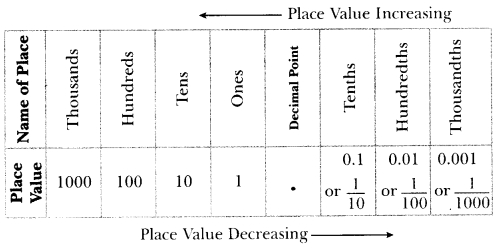
Place value chart for decimals is given in the figure.
For example,
137.85 = 1 × 100 + 3 × 10 + 7 × 1 + 8 × \(\frac{1}{10}\) + 5 × \(\frac{1}{100}\)
Converting Fractions to Decimals (When Denominators are 10, 100, 1000, …): A fraction represents the division of the numerator by the denominator.

Write the dividend as it is and put a decimal point at the end.
Count the zeroes in the divisor.
Move the decimal point left by the same number of places as the count of zeroes in the divisor. Add zeroes in front if needed.
Multiplication of a Decimal Number with a Whole Number
Repeated Addition Method: Multiplying a decimal by a whole number can be done by adding the decimals as many times as the whole number indicates.
For example, multiplying 6.5 by 7 is same as adding 6.5 seven times,
i. e. 6.5 × 7 = 6.5 + 6.5 + 6.5 + 6.5 + 6.5 + 6.5 + 6.5 = 45.5
Multiplication of Decimal by 10, 100 and 1000: When a decimal number is multiplied by 10, 100, or 1000, the decimal point shifts to the right by as many places as there are zeros in the multiplier.
For example, (i) 24.576 × 100 = 2457.6
(ii) 0.3251 × 1000 = 325.1
If there are not enough digits to shift the decimal point, zeroes are added to the right.
For example, 1.34 × 1000 = 1340.0 = 1340
Multiplication of a Decimal Number with a Decimal Number
Fraction Method (Converting Decimals to Fractions): Multiplication of decimals is same as multiplication of their corresponding fractions.
Step 1: Change decimals to corresponding fractions
Step 2: Multiply Numerator and Denominator, respectively
Step 3: Turn the final fraction back into a decimal
Decimal Shifting Method (Making them Whole Number)
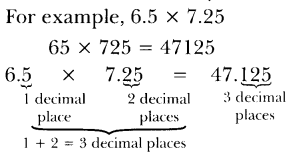
Step 1: Ignore the decimal points and multiply the numbers as whole numbers.
Step 2: Count the total number of digits after the decimal point in both numbers.
Step 3: From the right of the product, shift the decimal point to the left by the count obtained in step 2.
Relation between Product and Numbers
If both numbers are greater than 1 (e.g., 3.4 X 6.5), the product (22.1) is greater than both the numbers.
If both number are between 0 and 1 (e.g., 0.75 x 0.4), the product (0.3) is less than both the numbers.
If one number is between 0 and 1 and one number is greater than 1 (e.g., 0.75 X 5), the product (3.75) is less than the number greater than 1 and greater than the number between 0 and 1.
Division of Decimals by 10, 100, 1000, …: When a number is divided by 10, 100, 1000, and so
on, move the decimal point to the left by as many places as there are zeros in the divisor.
| Number | ÷10 | ÷100 | ÷1000 |
| 12.02 | 1.202 | 0.1202 | 0.01202 |
If we run out of digits while moving the decimal point, we add zeros at the start of the number.
Decimal Division Using Place Value
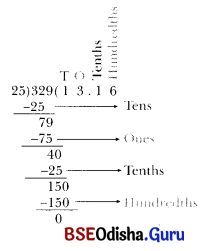
Step 1: Divide as you do with counting numbers, starting from the highest place value.
Step 2: If there is a remainder, regroup it into the next smaller place value digit and continue dividing.
Step 3: When you move from the Ones place to the Tenths place in the division, place a decimal point in the quotient.
Step 4: If necessary, add zeros to the right of the decimal point in the dividend and continue the division until the remainder becomes zero or the digits in the quotient begin to repeat.
When the divisor is a decimal, we can convert it into a counting number by suitably multiplying it by 10, 100, 1000, and so on. We must also multiply the dividend by the same number.
Once the divisor is converted into a counting number, we proceed with the division by following the same place-value procedure (long division) to find the quotient.
A recurring decimal is a decimal that follows a repeating pattern of digits after the decimal point.
For example, \(\frac{1}{3}\) = 0.333… and \(\frac{12}{99}\) = 0.121212…
Relation between Dividend, Divisor and Quotient
When the divisor is between 0 and 1.
For example, 135 ÷ 0.5 (0 < 0.5 <1) The quotient (270) is greater than the dividend (135). When the divisor is greater than 1. For example, 135 ÷ 2.5 (> 1)
The quotient (54) is smaller than the dividend (135).
When the divisor is exactly 1.
For example, 135 ÷ 1
The quotient (135) is equal to the dividend (135).
Leap Year
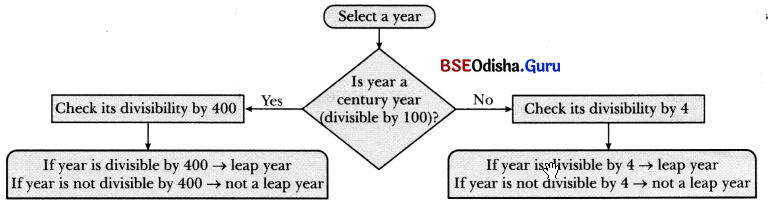
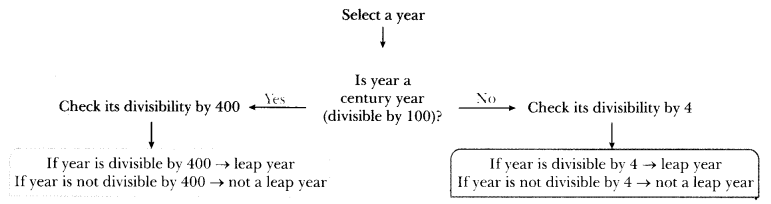
A leap year is a year with 366 days. In the Gregorian calendar, years divisible by 4 are leap years, but century years are leap years only if they are divisible by 400.
Process to determine whether a year is a leap year:
Multiplication of Decimal Numbers
For small whole numbers, multiplication can be viewed as adding the decimal number multiple times.
While multiplying a number by 10, 100, 1000, move the decimal point to the right by as many places as there are zeros in the multiplier.
If you run out of digits while moving the decimal point, add zeros at the end.
Multiplication of decimals is same as multiplication of their corresponding fractions.
Division of Decimal Numbers
When the divisor is a decimal, we can convert it into a counting number by suitably multiplying it by 10, 100, 1000, and so on. We must also multiply the dividend by the same number.
Once the divisor is converted into a counting number, we proceed with the division by following the same place-value procedure (long division) to find the quotient.
A recurring decimal is a decimal that follows a repeating pattern of digits after the decimal point.
Relationship between Dividend, Divisor and Quotient
When the divisor is between 0 and 1 [e.g., 135 ÷ 0.5 (0 < 0.5 <1)], the quotient (270) is greater than the dividend (135). When the divisor is greater than 1 [e.g., 135 ÷ 2.5 (> 1)], the quotient (54) is smaller than the dividend (135).
When the divisor is exactly 1 (e.g., 135 ÷ 1), the quotient (135) is equal to the dividend (135).
Relation between Product and Numbers
If both numbers are greater than 1 (e.g., 3.4 × 6.5), the product (22.1) is greater than both the numbers.
If both numbers are between 0 and 1 (e.g., 0.75 × 0. 4), the product (0.3) is less than both the numbers.
If one number is between 0 and 1 and one number is greater than 1 (e.g., 0.75 × 5), the product (3.75) is less than the number greater than 1 and greater I than the number between 0 and 1.
Leap Year
A leap year is a year with 366 days. In the Gregorian calendar, years divisible by 4 are leap years, but century years are leap years only if they are divisible by 400.
Process to determine whether a year is a leap year: