
Easy-to-read Ganita Prakash Class 7 Notes and Part 2 Chapter 2 Operations with Integers Class 7 Notes save valuable study time during exam season.
Class 7 Maths Chapter 2 Operations with Integers Notes
Class 7 Operations with Integers Notes
Integers are a set of numbers that include natural numbers, their additive inverses (negative integers) and zero.
Two numbers are said to be additive inverses of each other if their sum is zero.
For example, — 3 is the additive inverse of 3 and 5 is the additive inverse of – 5 as 3 + (— 3) = 0 and (— 5) + 5 = 0.
Addition and Substraction of Integers
Sum of two positive integers is always positive.
Sum of two negative integers is always negative.
When two integers with the same sign are added, their magnitudes are added and the sign of the result remains the same as the given integers.
When two integers with different signs are added, the result is obtained by finding the difference of their magnitudes (greater magnitude – smaller magnitude), and the sign of the answer is the sign of the integer with greater magnitude.
“Subtraction” is same as “adding the opposite” or “adding the additive inverse”.

Multiplication of Integers
In a × b = p, numbers a, b and p are called multiplier, multiplicand and product respectively.

The magnitude of the product does not change Multiplier Multiplicand with the change in the signs of both the multiplier and the multiplicand.
When both numbers (multiplier and multiplicand) are positive, the product is positive. When both numbers (multiplier and multiplicand) are negative, the product is positive.
When one of the multiplier or the multiplicand is positive and the other is negative, their product is negative.
Magic Grid of Integers
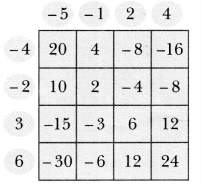
Each number in the grid is formed by multiplying one row factor and one column factor.
So, each cell contains the product of one row factor and one column factor.
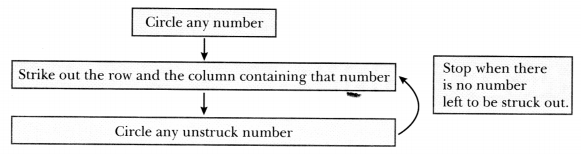
When a number is circled, its row and column are crossed out.
This ensures that no row or column is used more than once.
As a result, each row factor and each column factor is included exactly once in final multiplication.
No matter which valid numbers are chosen—provided only one number is selected from each row and each column—the product remains the same.
Division of Integers
The magnitude of the quotient does not change with the change in the signs of the dividend and the divisor.
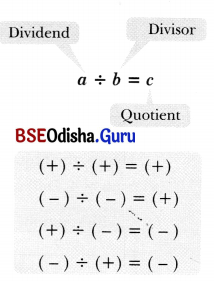
When a positive integer is divided by another positive integer, a positive result is obtained.
When a negative integer is divided by a positive integer, a negative result is obtained.
When a positive integer is divided by a negative integer, a negative result is obtained.
When a negative integer is divided by another negative integer, a positive result is obtained.
Properties Related to Multiplication and Division of Integers
Commutative Property of Multiplication (Swapping)
For any two integers, a and b, we can say that a × b = b × a
Associative Property of Multiplication (Grouping)
For any three integers, a, b and c, we can say that (a × b) × c = a × (b × c).
Distributive Property of Multiplication Over Addition
For any three integers, a, b and c, we can say that a × (b + c) = a × b + a × c
The sign of a product is positive if the number of negative integers in the product is even.
For example, (- 3) × (- 2) × (- 1) × (- 4) = 24 [Number of negative integers = 4 (even)]
The sign of a product is negative if the number of negative integers in the product is odd.
For example, (- 5) × (- 1) × (- 3) = – 15 [Number of negative integers = 3 (odd)]
Division of two numbers is not commutative. For example, 4 ÷ 2 ≠ 2 ÷ 4
Division of three numbers is not associative. For example, (16 ÷ 4) ÷ 2 ≠ 16 ÷ (4 ÷ 2)
Identify the Pattern
Imagine a “number machine” or “machine”, which performs a defined set of arithmetic operations on the numbers it receives as inputs.
The operations done by the machine are hidden, and our task is to identify the rule by carefully observing the relationship between the input numbers and the output number.
Inputs → Machine → Outputs
Multiplication of Integers
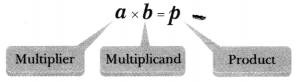
The magnitude of the product does not change with the change in the signs of the multiplier and the multiplicand.
For example, 3 × 2 = 6; 3 × (- 2) = – 6; – 3 × 2 = – 6; -3 × (-2) = 6
Quick Rules: Multiplication of integers
(+) × (+) = (+); (-) × (-) = (+)
(+) × (-) = (-); (-) × (+) = (-)
Division of Integers
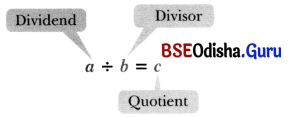
The magnitude of the quotient does not change with the change in the signs of the dividend and the divisor.
For example, 8 ÷ 4 = 2; 8 ÷ (- 4) = – 2;
– 8 ÷ 4 = – 2; – 8 ÷ (- 4) = 2
Quick Rules: Division of integers
(+) ÷ (+) = (+); (-) ÷ (-) = (+)
(+) ÷ (-) = (-); (-) ÷ (+) = (-)
Properties Related to Multiplication and Division
Commutative property of multiplication: a × b = b × a
Associative property of multiplication: (a × b) × c = a × (b × c)
Distributive property of multiplication over addition: a × (b + c) = a × b + a × c
The sign of a product is positive if the number of negative integers in the product is even.
For example, (- 3) × (- 2) × (- 1) × (- 4) = 24 [Number of negative integers = 4 (even)]
The sign of a product is negative if the number of negative integers in the product is odd.
For example, (-5) × (-1) × (-3) = – 15 [Number of negative integers = 3 (odd)]
Division of two numbers is not commutative. For example, 4 ÷ 2 ≠ 2 ÷ 4
Division of three numbers is not associative. For example, (16 ÷ 4) ÷ 2 ≠ 16 ÷ (4 ÷ 2)