
Easy-to-read Ganita Prakash Class 7 Notes and Part 2 Chapter 3 Finding Common Ground Class 7 Notes save valuable study time during exam season.
Class 7 Maths Chapter 3 Finding Common Ground Notes
Class 7 Finding Common Ground Notes
The Highest Common Factor (HCF) of a group of numbers is the greatest number that divides each number in the group completely, without leaving any remainder.
For example: HCF of 12 and 18 is 6.
We use HCF when we need to find the largest possible size that fits perfectly into different measurements, such as the largest tile for a floor.
A prime number is a number greater than 1 that has exactly two factors: 1 and the number itself. For example, 11 has only two factors 1 and 11, so it is a prime number.
Every number has a unique way of being broken down into its prime building blocks or prime factors. We call this process Prime Factorisation.
For example: 6 = 2 × 3; Here 2 and 3 are primes.
50 = 2 × 5 × 5; Here, 2 and 5 are primes.

Any composite number can be written as a product of prime numbers.
Methods of finding HCF
Prime Factorisation Method
Step 1: Find the prime factorisation of each of the given numbers.
Step 2: Identify the common factors in the prime factorisation of all the given numbers.
Step 3: Multiply the common factors to obtain the HCF.
For example: Consider numbers 36, 42 and 64. Their prime factorisation are:
36 = 2 × 2 × 3 × 3
42 = 2 × 3 × 7
64= 2 × 2 × 2 × 2 × 2 × 2
∴ HCF of 36, 42 and 64 = 2
Common Factor Method
Step 1: Arrange all the given numbers in a row, separated by commas, for which we need to find the HCF.
Step 2: Divide all the numbers by any factor i.e., common to all of the given numbers. ;
Step 3: If there are still any common factors, divide the quotients by them and keep dividing until there is no common factor for all the given numbers.
Step 4: The product of these common factors will give the highest common factor.
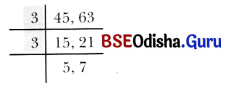
For example: Consider numbers 45 and 63. Using common factor method, we get
HCF of 45 and 63 = 3 × 3 = 9
Repeated Division Method
Step 1: Divide the larger number by the smaller number and find the remainder.
Step 2: Take the remainder as the new divisor and divisor of step 1 as the new dividend, then divide.
Step 3: Repeat until the remainder is 0. The last divisor thus obtained is the HCF.
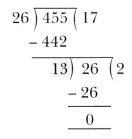
For example: Consider numbers 26 and 455. Using repeated division method, we get
HCF of 26 and 455 = 13
For numbers that share no common factors other than 1 (called co-primes, like 7 and 15), the F1CF is always 1. Therefore, the HCF of two co-prime numbers is always 1.
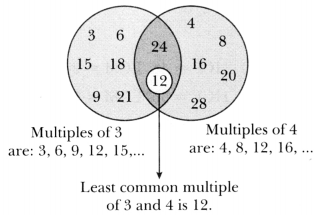
The Least Common Multiple (LCM) is the smallest non-zero number that is a multiple of all the given numbers.
For example, LCM of 15 and 20 is 60, as 60 is the smallest non-zero number that is a multiple of both 15 and 20.
We use LCM to find when events that happen at different intervals will align or meet again, like bells ringing or joggers crossing a start line.
Methods of finding LCM
Prime Factorisation Method
Step 1: Write the prime factorisation of each given number and list all the prime factors involved.
Step 2: For each prime factor, take the greatest number of times it appears in any of the numbers.
If two numbers are multiplied
Step 3: Multiply these factors to obtain the LCM.
For example: Consider numbers 36, 42 and 64. Their prime factorisation are:
36 = 2 × 2 × 3 × 3
42 = 2 × 3 × 7
64 = 2 × 2 × 2 × 2 × 2 × 2
∴ LCM of 36, 42 and 64 = 2 × 2 × 2 × 2 × 2 × 2 × 3 × 3 × 7 = 4032
Common Division Method
Step 1: Write the given numbers in a row, separated by commas.
Step 2: Divide these numbers by the least prime number which divides at least one of the numbers.
Step 3: Write the quotients below, and bring down the numbers that are not divisible by the prime number.
Step 4: Repeat Steps 2 and 3 with the new row. Continue until all numbers in a row become 1.
Step 5: Find the product of all the divisors used in the process. This gives the LCM.
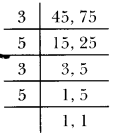
For example: Consider numbers 45 and 75. Using common division method, we get
LCM of 45 and 75 = 3 × 5 × 3 × 5 = 225
Properties of HCF and LCM
The HCF of a set of given numbers is always either smaller than all the numbers or equal to the smallest number.
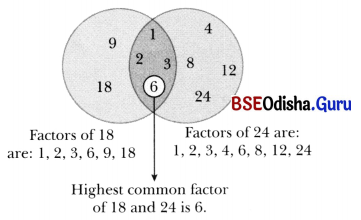
For example, HCF (18, 24) = 6 → smaller than both the numbers
Also, HCF (8, 16) = 8 → equal to the smallest number
The LCM of a set of given numbers is always either greater than all the numbers or equal to the greatest number.
For example, LCM (6, 8) = 24 → greater than both the numbers
Also, LCM (8, 16) = 16 → equal to the greatest number
The HCF of a set of co-prime numbers is 1 and the LCM of co-prime numbers is the product of the co-primes.
For example, 8 and 15 are co-prime numbers as their common factor is 1.
Here, LCM (8, 15) = 120 = 8 × 15 and HCF (8, 15) = 1
The HCF of a set of given numbers is a factor of their LCM. In other words, the LCM of given numbers is a multiple of their HCF.
For example, HCF and LCM of 12 and 18 are 6 and 36, respectively. Here, 6 is a factor 36.
If two numbers are multiplied by the same number, then both their HCF and LCM are also multiplied by that number.
If the HCF of two numbers a and b is H and their LCM is L, then for any number k:
HCF (ka, kb) = kH and LCM (ka, kb) = kL
For any two given numbers, if the first number is a factor of the second number, then the first number is their HCF and the second number is their LCM.
For example, consider the numbers 8 and 48. As 8 is a factor of 48,
HCF (8, 48) = 8 and LCM (8, 48) = 48
Relationship Between HCF, LCM and the Product of Two Numbers
The product of LCM and HCF of two numbers is equal to the product of the numbers, i.e.
For any two numbers a and b, LCM (a, b) × HCF (a, b) = a × b
Highest Common Factor (HCF)
The largest positive integer that divides two or more given numbers exactly.
Least Common Multiple (LCM)
The smallest positive integer that is a multiple of two or more given numbers.
Properties of HCF and LCM
The HCF of given numbers is always either smaller than all the numbers or equal to the smallest number.
The LCM of given numbers is always either greater than all the numbers or equal to the greatest number.
HCF of co-prime numbers is 1 and the LCM of co-prime numbers is the product of the co-primes.
The HCF of a set of given numbers is a factor of their LCM. In other words, the LCM of given numbers is a multiple of their HCF.
If two numbers are multiplied by the same number, then both their HCF and LCM are also multiplied by that number.
HCF(ka, kb) = kH and LCM(ka, kb) = kL, where, H and L are HCF (a, b) and LCM (a, b) respectively.
Given any two numbers, if the first number is a factor of the second number, then the first number is their HCF and the second number is their LCM.
The product of LCM and HCF of two numbers is equal to the product of the numbers, i.e. LCM × HCF = Product of two numbers.