
Go through BSE Odisha Class 7 Science Solutions and Class 7 Science Chapter 5 Changes Around Us: Physical and Chemical Question Answer to understand textbook questions more clearly.
Class 7 Science Curiosity Chapter 5 Question Answer
Science Curiosity Class 7 Chapter 5 Question Answer
Changes Around Us: Physical and Chemical Class 7 Questions and Answers
Let Us Enhance Our Learning
Question 1.
Which of the following statements are the characteristics of a physical change?
(i) The state of the substance may or may not change.
(ii) A substance with different properties is formed.
(iii) No new substance is formed.
(iv) The substance undergoes a chemical reaction.
(a) (i) and (ii)
(b) (ii) and (iii)
(c) (i) and (iii)
(d) (iii) and (iv)
Answer:
(c) In a physical change, no new substance is formed. Thus, properties of a substance remain the same. Also, no chemical reaction is involved in a physical change. The state of a substance may change in a physical change (like, the melting of ice), or may not change (like the breaking of a glass).

Question 2.
Predict which of the following changes can be reversed and which cannot be reversed. If you are not sure, you may write that down. Why are you not sure about these?
(i) Stitching cloth to a shirt
(ii) Twisting of straight string
(iii) Making idlis from a batter
(iv) Dissolving sugar in water
(v) Drawing water from a well
(vi) Ripening of fruits
(vii) Boiling water in an open pan
(viii) Rolling up a mat
(ix) Grinding wheat grains to flour
(x) Forming of soil from rocks
Answer:
The changes that can be reversed are as follows:
(ii) Twisting of a straight string: It can be straightened again.
(iv) Dissolving sugar in water: Dissolved sugar can be obtained again from sugar solution by evaporating the water.
(v) Drawing water from a well: Water can be poured back into the well.
(viii) Rolling up a mat: The process can be reversed by spreading the mat again.
In contrast, the changes that cannot be reversed are as follows:
(i) Stitching cloth to a shirt: To stitch a shirt, cloth is cut into pieces, and the original cloth cannot be obtained.
(iii) Making idlis from a batter: The batter cannot be obtained again from the cooked idlis. Hence, this process cannot be reversed.
(vi) Ripening of fruits: The raw fruits cannot be recovered again.
(vii) Boiling water in an open pan: Water vapour escapes into the air. Thus, the process cannot be reversed. However, if a lid is placed to cover the pan, the water vapour cools and condenses on the inner side of the lid, and hence, the water can be collected again.
(ix) Grinding wheat grains to flour: After grinding wheat grains into fine powder or flour, grains cannot be obtained back. Hence, this process cannot be reversed.
(x) Forming of soil from rocks: Soil is formed from rocks through weathering. Once rocks are broken into fine particles and mixed with organic matter and air/water, to form soil, they cannot turn back into solid rocks naturally. Hence, this process cannot be reversed.
Question 3.
State whether the following statements are True or False. In case a statement is False, write the correct statement.
(i) Melting of wax is necessary for burning a candle.
Answer:
True
(ii) Collecting water vapour by condensing involves a chemical change.
Answer:
False Collecting water vapour by condensation involves a physical change, as it only involves a state change from gas to liquid.
(iii) The process of converting leaves into compost is a chemical change.
Answer:
True
(iv) Mixing baking soda with lemon juice is a chemical change.
Answer:
True
Question 4.
Fill in the blanks in the following statements:
(i) Nalini observed that the handle of her cycle has got brown deposits. The brown deposits are due to …………, and this is a …………change.
Answer:
rusting, chemical
(ii) Folding a handkerchief is a …………change and can be ………….
Answer:
physical, reversed
(iii) A chemical process in which a substance reacts with oxygen with evolution of heat is called ……….., and this is a …………change.
Answer:
combustion, chemical
(iv) Magnesium, when burnt in air, produces a substance called …………. The substance formed is …………in nature. Burning of magnesium is a …………change.
Answer:
magnesium oxide, basic, chemical
Question 5.
Are the changes of water to ice and water to steam, physical or chemical? Explain.
Answer:
The changes of water to ice and water to steam only involve the change in state of water from liquid to solid and gas, respectively. Since no new substance is formed in any of these processes, these are classified as physical changes.
Question 6.
Is curdling of milk a physical or chemical change? Justify your statement.
Answer:
Curdling of milk is a chemical change as a new substance i.e., curd, with entirely different properties from those of milk is formed. The process cannot be reversed.
Question 7.
Natural factors, such as wind, rain, etc., help in the formation of soil from rocks. Is this change physical or chemical and why?
Answer:
Formation of soil from rocks involves both physical and chemical changes. Soil is formed from rocks through weathering. The breaking of rocks into smaller particles by wind, water and temperature changes is a physical change. The reaction of rocks with water, air and other substances causes changes in their chemical composition, which is a chemical change. Organic matter later mixes with these particles to form soil.
Question 8.
Read the following story titled ‘Eco-friendly Prithvi’, and tick the most appropriate option(s) given in the brackets. Provide a suitable title of your choice for the story.
Prithvi is preparing a meal in the kitchen. He chops vegetables, peels potatoes, and cuts fruits (physical changes/chemical changes). He collects the seeds, fruits, and vegetable peels into a clay pot (physical change/chemical change). The fruits, vegetable peels, and other materials begin to decompose due to the action of bacteria and fungi, forming compost (physical change/chemical change).
He decides to plant seeds in the compost and water them regularly. After a few days, he notices that the seeds begin to germinate and small plants start to grow, eventually blooming into colourful flowers (physical change/chemical change). His efforts are appreciated by all his family members.
Answer:
- Physical change
- Physical change
- Chemical change
- Chemical change
Suitable title – “Waste to Wonder”
Question 9.
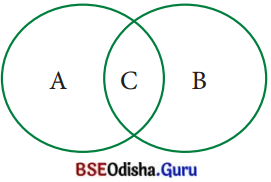
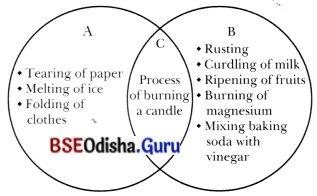
Some changes are given here. Write physical changes in the area marked ‘A’ and chemical changes in the area marked ‘B’. Enter the
changes which are both physical and chemical in the area marked ‘C’. Process of burning a candle; Tearing of paper; Rusting; Curdling of milk; Ripening of fruits; Melting of ice; Folding of clothes; Burning of magnesium and Mixing baking soda with vinegar.
Answer:
Question 10.
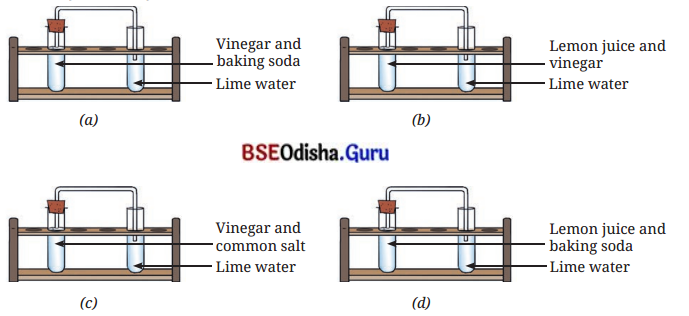
The experiments shown in figures (A), (B), (C), and (D) were performed. Find out in which case(s) did lime water turn milky and why?
Answer:
In cases (A) and (D), lime water turned milky. The reaction of baking soda with an acid present in vinegar and lemon juice results in the evolution of carbon dioxide gas, which turns lime water milky.
Class 7 Curiosity Chapter 5 Question Answer
InText Questions
Question 1.
Consider the following conversation between two students:
Student A: An ice cube that I placed on this plate half an hour ago has now become water.
Student B: This banana had a few brown spots on it yesterday; now it has more brown spots today and a strong smell.
What kind of changes are these students talking about? [Page 57]
Answer:
Student A is talking about the melting of ice, which is a physical change, as there occurs only a change in the state of water, from solid to liquid.
Student B is talking about the rotting of a banana, which is a chemical change.
Question 2.
Is there any similarity between the changes listed in A, B, and C?
A: Creating some objects by folding sheets of paper
B: Playing with a balloon by inflating and then déflating it
C: Crushing a piece of chalk [Page 59]
Answer:
All the given processes, A, B and C, represent physical changes as the original material remains the same; only a change in appearance, i.e., shape and size, takes place.
Question 3.
Vinegar and baking soda react with each other to evolve carbon dioxide, which turns lime water milky. Will water and baking soda react in the same way? Will it be a physical or a chemical change? [Page 61]
Answer:
No, water and baking soda do not react with each other to evolve carbon dioxide gas.
Mixing of baking soda with water is considered to be a physical change.
Question 4.
Explain whether burning of magnesium is a physical or a chemical change. [Page 62]
Answer:
Burning of magnesium is a chemical change because when magnesium ribbon is burnt in air, a new substance, i.e., magnesium oxide, is formed.
Question 5.
Why does a burning candle stop burning after some time, if covered with a glass tumbler?
Answer:
If a burning candle is covered with a glass tumbler, id does not have a continuous supply of oxygen. It utilises the oxygen present in the surrounding air under the glass tumbler, but after some time, when all the oxygen is utilised, the candle stops burning.
Question 6.
What changes take place when a candle is lit? Classify them as physical and chemical changes. [Page 65]
Answer:
When a candle is lit, processes such as melting of wax, its solidification (after some melted wax trickles down the sides), evaporation and burning of wax vapour takes place. Here, melting of wax, its solidification, and evaporation are physical changes. The burning of wax vapour in the flame is a chemical change. Therefore, burning of candle involves both physical and chemical changes.
Question 7.
Can all changes be considered desirable? If no, explain why. [Page 66]
Answer:
No, all changes cannot be considered desirable. Only the useful changes, such as cooking food and setting curd, are desirable. Changes like rusting of iron are not desirable.
Question 8.
List some desirable changes that you may have noticed happening around you [Page 66]
Answer:
The following desirable changes may happen around us in our daily livers
- Fermentation of dough
- Germination of seeds
- Composting of waste
- Decay of dead leaves and plants
- Boiling and freezing of water
- Baking a cake or bread
- Flowering of plants
- Water cycle (evaporation, condensation, rainfall)
- Drying of wet clothes
- Cutting and cooking of vegetables