
Go through BSE Odisha Class 7 Science Solutions and Class 7 Science Chapter 9 Life Processes in Animals Question Answer to understand textbook questions more clearly.
Class 7 Science Curiosity Chapter 9 Question Answer
Science Curiosity Class 7 Chapter 9 Question Answer
Life Processes in Animals Class 7 Questions and Answers
Let Us Enhance Our Learning
Question 1.
Complete the journey of food through the alimentary canal by filling up the boxes with appropriate parts:

Answer:
Food → Mouth → Oesophagus → Stomach → Small intestine → Large intestine → Anus

Question 2.
Sahil placed some pieces of chapati in test tube A. Neha placed chewed chapati in test tube B, and Santushti took boiled and mashed potato in test tube C. All of them added a few drops of iodine solution to their test tubes A, B, and C, respectively. What would be their observations? Give reasons.
Answer:
- Sahil will observe that the solution in test tube A turns blue-black because chapati contains starch, which reacts with iodine to give a blue-black colour.
- Neha will observe that the solution in test tube B does not turn blue-black because the saliva in the chewed chapati has broken down the starch into sugar, which does not react with iodine.
- Santushti will observe that the solution in test tube C turns blue-black because boiled and mashed potato contains starch, which reacts with iodine to give a blue-black colour.
Question 3.
What is the role of the diaphragm in breathing?
(a) To filter the air
(b) To produce sound
(c) To help in inhalation and exhalation
(d) To absorb oxygen
Answer:
(c) Diaphragm helps in inhalation and exhalation.
Question 4.
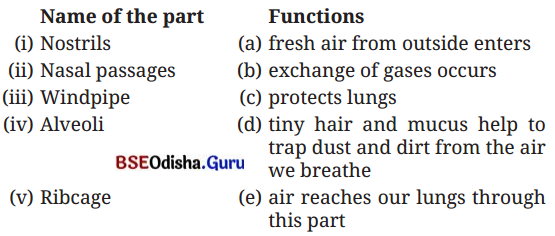
Match the following.
Answer:
| Name of the part | Functions |
| (i) Nostrils | A. Fresh air from outside enters |
| (ii) Nasal passages | D. Tiny hairs and mucus help to trap dust and dirt from the air we breathe |
| (iii) Windpipe | E. Air reaches our lungs through this part |
| (iv) Alveoli | B. exchange of gases occurs |
| (v) Rib cage | C. protects lungs |
Question 5.
Anil claims to his friend Sanvi that respiration and breathing are the same process. What question(s) can Sanvi ask him to make him understand that he is not correct?
Answer:
Sanvi can ask the following questions to Anil to help him understand the difference between breathing and respiration:
- “If we stop breathing for a few minutes, can the body still utilise energy?”
- “Can we say that moving air in and out of the lungs is the same as breaking down food in the presence of oxygen to produce energy?”
- “Is it possible to produce energy without using oxygen?”
Question 6.
Which of the following statements is correct and why?
Anu: We inhale air.
Shanu: We inhale oxygen.
Tanu: We inhale air rich in oxygen.
Answer:
- The correct statement is of Tanu.
- This is because, when we inhale, we take in air that contains 21% oxygen, along with other gases (air is a mixture of gases).
Question 7.
We often sneeze when we inhale a lot of dust-laden air. What can be possible explanations for this?
Answer:
When we inhale air containing dust particles, they get trapped in the tiny hair and mucus lining our nasal passages. This irritates the sensitive inner lining of the nose, and triggers sneezing. Sneezing helps expel the dust particles from our nasal passages, allowing clean, fresh air to enter the body.
Question 8.
Paridhi and Anusha of Grade 7 started running for their morning workout. After they completed their running, they counted their breaths per minute. Anusha was breathing faster than Paridhi. Provide at least two possible explanations for why Anusha was breathing faster than Paridhi.
Answer:
- Anusha might be less physically fit than Paridhi, so her body needs more oxygen to meet the energy demands, resulting in faster breathing.
- Anusha might have run faster or for a longer duration than Paridhi, increasing her breathing rate to supply more oxygen to keep up with the energy required.
Question 9.
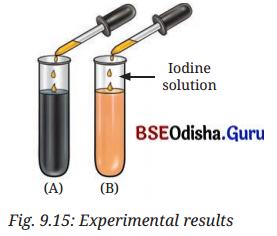
Yadu conducted an experiment to test his idea. He took two test tubes, A and B, and added a pinch of rice flour to the test tubes, half-filled with water and stirred them properly. To test tube B, he added a few drops of saliva. He left the two test tubes for 35-45 min. After that, he added iodine solution into both the test tubes. Experimental results are as shown in the figure given below. What do you think he wants to test?
Answer:
Yadu wants to test whether saliva can break down starch into sugar. Test tube A contains rice flour and water only, while test tube B contains rice flour, water, and saliva. By adding iodine to both test tubes, he can check if starch is still present. In the result of experiment, since iodine did not give a blue-black colour in test tube B, it confirms that saliva has broken down starch into sugar.
Question 10.
Rakshita designed an experiment taking two clean test tubes, A and B and filled them with lime water as shown in the figure. In test tube A, the surrounding air that we inhale was passed on by sucking air from the pipe, and in test tube B, the exhaled air was blown through the pipe. What do you think she is trying to investigate? How can she confirm her findings?
Answer:
- Rakshita is trying to investigate whether exhaled air contains carbon dioxide.
- Lime water turns milky in the presence of carbon dioxide.
- The lime water in test tube A will remain clear for a longer time because inhaled air has very little amount of carbon dioxide, whereas in test tube B, it will turn milky immediately because exhaled air contains carbon dioxide in higher amount.
Hence, she can confirm her findings by comparing the appearance of lime water in both the test tubes.
Class 7 Curiosity Chapter 9 Question Answer
InText Questions
Question 1.
How do different animals break down complex food molecules into simpler substances to be utilised by their bodies? Does this process work the same way in all animals? [Page 122]
Answer:
Complex food components like carbohydrates, proteins, and fats are broken down into simpler substances through digestion so the body can absorb and use them for growth and development. While all animals perform digestion, the process varies depending on their body structure and eating habits, for e.g., cows have a rumen, and birds have a gizzard to help in the digestion process.
Question 2.
Think about your favourite food. Does your mouth feel watery? [Page 122]
Answer:
Yes, the mouth feels watery when we think of our favourite food. This happens because more saliva is released when we recall or imagine our favourite food.
Question 3.
What role does the saliva play in the mouth? [Page 123]
Answer:
Saliva moistens the food, helps in chewing and swallowing, and begins the digestion of starch (complex carbohydrate) in the mouth.
Question 4.
Have you ever wondered why the taste of chapati becomes slightly sweet as you chew? [Page 123]
Answer:
Chapati tastes slightly sweet while chewing because saliva in the mouth breaks down the starch in chapati into simple sugars, which tastes sweet.
Question 5.
How does the food move down the food pipe? [Page 124]
Answer:
The walls of the food pipe contract and relax in a wave-like motion to push food down into the stomach. This movement continues throughout the alimentary canal, pushing the food forward.
Question 6.
How does the small intestine absorb nutrients from food? [Page 126]
Answer:
The small intestine absorbs nutrients through tiny finger-like projections which increase the surface area for absorption and transfer the digested nutrients into the blood, which carries them to different body parts.
Question 7.
After most of the nutrients are digested and absorbed in the small intestine, what happens to the undigested food? [Page 126]
Answer:
Undigested food passes into the large intestine, where water and minerals are absorbed and the remaining waste (in the form of stool) is stored in the rectum, and later expelled through anus by a process called egestion.
Question 8.
Why is the large intestine called ‘large’ even though it is shorter than the small intestine? [Page 126]
Answer:
It is called the large intestine because its diameter (width) is larger than that of the small intestine, even though it is shorter in length.
Question 9.
We have seen cows keep chewing the food even when they are not actively grazing or eating anything. Why? [Page 127]
Answer:
Cows are ruminants that chew partially digested food returned to the mouth through a process called rumination. This process helps in the proper digestion of food.
Question 10.
Is the process of respiration the same in all animals? [Page 128]
Answer:
No, respiration is different in different animals. Some use lungs (goat, lizard, etc.), some gills (tadpole and fish), and others breathe through skin (earthworm and adult frog underwater).