
Go through BSE Odisha Class 7 Science Solutions and Class 7 Science Chapter 10 Life Processes in Plants Question Answer to understand textbook questions more clearly.
Class 7 Science Curiosity Chapter 10 Question Answer
Science Curiosity Class 7 Chapter 10 Question Answer
Life Processes in Plants Class 7 Questions and Answers
Let Us Enhance Our Learning
Question 1.
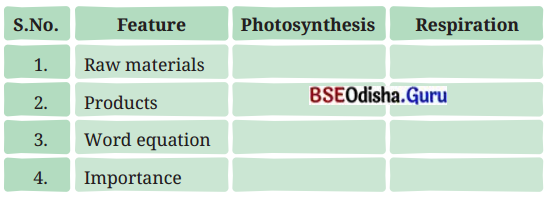
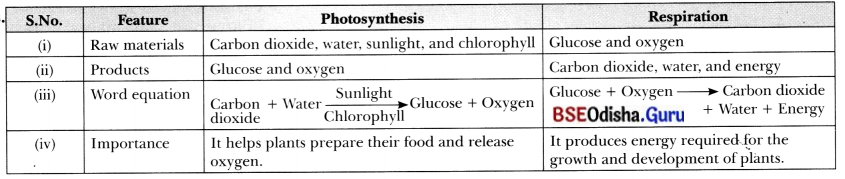
Complete the following table.
Answer:
Question 2.
Imagine a situation where all the organisms that carry out photosynthesis on the Earth have disappeared. What would be the impact of this on living organisms?
Answer:
If all photosynthesising organisms disappear, no food will be produced, because they are the only living beings that can make food using sunlight, carbon dioxide, and water. Without photosynthesis, oxygen will not be released into the air. As a result, there would be neither any source of food nor oxygen for other organisms, and life on Earth would not be able to continue.

Question 3.
A potato slice shows the presence of starch with iodine solution. Where does the starch in potatoes come from? Where is the food synthesised in the plant, and how does it reach the potato?
Answer:
The starch in a potato comes from the food made by the leaves of the potato plant through photosynthesis. This food is then transported from the leaves to other parts of the plant through the phloem. The potato, which is an underground storage part (a tuber), receives this transported food and stores it in the form of starch.
Question 4.
Does the broad and flat structure of leaves make plants more efficient for photosynthesis? Justify your answer.
Answer:
Yes, broad leaves make photosynthesis more efficient. In general, leaves are broad and flat, which allows them to capture more sunlight. Since sunlight is essential for photosynthesis, having a larger surface area helps maximise food production.
Question 5.
X is broken down using Y to release carbon dioxide, Z, and energy.
X+Y → Carbon dioxide +Z+ Energy
X, Y, and Z are three different components of the process. What do X, Y, and Z stand for?
Ans.
In the respiration equation,
- X = Glucose
- Z = Water
- Y = Oxygen
During respiration, plants use oxygen to break down glucose and release carbon dioxide, water, and energy.
Question 6.
Krishna set-up an experiment with two potted plants of same size and placed one of them in sunlight and the other in a dark room, as shown in the figure. Answer the following questions:
(i) What idea might she be testing through this experiment?
(ii) What are the visible differences in plants in both the conditions?
(iii) According to you, leaves of which plants confirm the iodine test for the presence of starch?
Answer:
(i) Krishna is testing whether sunlight is necessary for photosynthesis and production of food in plants.
(ii)
- The plant kept in sunlight looks healthy, green, and fresh with lot of green leaves.
- The plant kept in the dark room appears pale, yellowish, weak with wilted leaves because it could not prepare food without sunlight.
(iii) Only the leaves of the plant kept in sunlight will confirm the presence of starch by turning blue-black with iodine solution. This is because photosynthesis takes place only when sunlight is available.
Question 7.
Vani believes that ‘carbon dioxide is essential for photosynthesis’. She puts an experimental setup, as shown in the figure, to collect evidence to support or reject her idea. Answer the following questions:
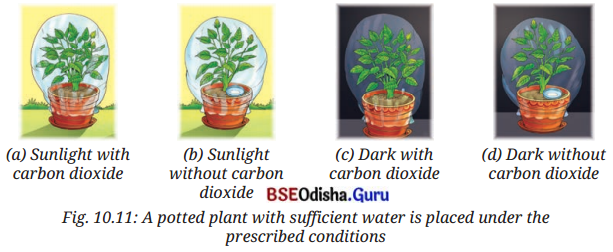
(i) In which plant(s) in the set-up(s) will starch be formed?
(ii) In which plant(s) in the set-up(s) will starch not be formed?
(iii) In which plant(s) in the set-up(s) will oxygen be generated?
(iv) In which plant(s) in the set-up(s) will oxygen not be generated?
Answer:
(i) Starch will be formed in the plant kept in sunlight with carbon dioxide, i.e., only setup (A) will form starch.
(ii) Plants cannot make starch if either sunlight or carbon dioxide is missing. So, starch will not be formed in:
- Set-up (B): Sunlight is present but no carbon dioxide
- Set-up (C): Carbon dioxide is present but no sunlight
- Set-up (D): Neither sunlight nor carbon dioxide is present
(iii) Oxygen is released only during photosynthesis, and for that, both sunlight and carbon dioxide must be present. Thus, oxygen will be generated only in set-up (A).
(iv) Oxygen will not be generated in the following set-ups as they will fail to perform photosynthesis:
- Set-up (B): No carbon dioxide is present
- Set-up (C): No sunlight is present
- Set-up (D): Neither sunlight nor carbon dioxide are present
Question 8.
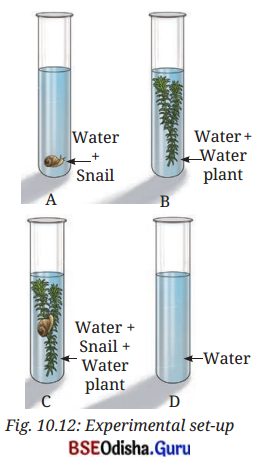
Ananya took four test tubes and filled three-fourth of each test tube with water. She labelled them A, B, C, and D. In test tube A, she kept a snail; in test tube B, she kept a water plant; in test tube C, she kept both a snail and a plant. In test tube D, she kept only water. Ananya added a carbon dioxide indicator to all the test tubes. She recorded the initial colour of water and observed if there are any colour changes in the test tubes after 2-3 hours. What do you think she wants to find out? How will she know if she is correct?
Answer:
Ananya wants to find out how living organisms affect the carbon dioxide level in water. She is checking whether plants or animals release or use carbon dioxide.
She will look for colour changes in the carbon dioxide indicator:
- If the indicator changes colour showing more carbon dioxide, it means the organism is releasing carbon dioxide (like the snail in test tube A).
- If the indicator shows less carbon dioxide, it means the organism is using carbon dioxide for photosynthesis (like the plant in test tube B).
- Test tube C (snail + plant) will show a balanced result depending on how much carbon dioxide is used or released.
- Test tube D (only water) will show no change in absence of any living organisms.
Thus, by comparing colour changes, she can confirm if her idea about carbon dioxide usage or release by plants and animals is correct.
Question 9.
Design an experiment to observe if water transportation in plants is quicker in warm or cold conditions.
Answer:
Objective: To demonstrate that temperature affects the speed of water movement (transpiration pull) in plants.
Materials required: Two similar fresh leafy stems, two beakers, water, red or blue ink (food colour can also be used), heat source (to boil water).
Procedure:
- Take two similar leafy stems of the same size and type.
- Fill two beakers with equal amounts of water mixed with coloured ink.
- Boil the water for one beaker and allow it to remain warm. Keep the water in the other beaker at room temperature.
- Place one leafy stem in each beaker.
- Leave the set-up undisturbed for some time.
- Observe the movement of coloured water upward through the stems.
Result: The stem placed in warm (boiled) water shows faster upward movement of coloured water compared to the stem in room-temperature water. This indicates that higher temperature increases the rate of transpiration pull and speeds up water transport in plants.
Question 10.
Photosynthesis and respiration are essential to maintain balance in nature. Discuss.
Answer:
Photosynthesis helps plants absorb carbon dioxide from the air and release oxygen. This oxygen is needed by all living beings for respiration. Respiration in plants and animals uses oxygen and releases carbon dioxide back into the air.
Because of these two processes, the amounts of oxygen and carbon dioxide in the atmosphere remain balanced. Thus, photosynthesis and respiration work together to maintain the natural balance of gases needed to support life on Earth.
Class 7 Curiosity Chapter 10 Question Answer
InText Questions
Question 1.
Observe a plant during its life span. Describe the changes that occur at different stages and explain the factors responsible for these changes. [Page 138]
Answer:
A plant grows from a seed into a seedling, then into a mature plant that produces flowers and fruits. These changes occur due to sunlight, water, air, nutrients, and suitable temperature.
Question 2.
How do plants obtain the food they need to grow? [Page 140]
Answer:
Plants prepare their own food by the process of photosynthesis using sunlight, carbon dioxide, water, and chlorophyll.
Question 3.
Why did we decolourise the leaf at the beginning of the activity to estimate the presence of starch? [Page 141]
Answer:
The leaf was decolourised to remove chlorophyll so that the colour change during the starch test could be clearly observed.
Question 4.
How does sunlight contribute in the production of starch in plants? [Page 141]
Answer:
Sunlight provides the energy required for photosynthesis, during which glucose is formed and later stored as starch in plants.
Question 5.
Apart from sunlight, what other factors are required by plants to prepare their food? [Page 143]
Answer:
Apart from sunlight, plants require water, carbon dioxide, and chlorophyll to prepare their food.
Question 6.
Which gas from the air is essential in the process of food preparation in plants? [Page 143]
Answer:
Carbon dioxide is the essential gas required for the preparation of food in plants.
Question 7.
Which part of the plant is involved in the synthesis of starch? [Page 144]
Answer:
The leaves are mainly involved in the synthesis of starch as they contain chlorophyll.
Question 8.
During the process of photosynthesis, do plants only take in substances from their surroundings, or do they also release any substances? [Page 145]
Answer:
Plants take in carbon dioxide and water from their surroundings, and release oxygen during photosynthesis.
Question 9.
Which part of the plant helps in the exchange of carbon dioxide and oxygen? [Page 146]
Answer:
Stomata present on the leaves help in the exchange of carbon dioxide and oxygen.
Question 10.
How do water and minerals taken up by the roots move to all parts of the plant? [Page 147]
Answer:
Water and minerals are transported to all parts of the plant through xylem.
Question 11.
How does food get transported from leaves to other parts of a plant? [Page 148]
Answer:
Food prepared in the leaves is transported to other parts of the plant through phloem.
Question 12.
Do plants respire as we do? [Page 149]
Answer:
Yes, plants also respire continuously to release energy, but the process is comparatively slower than in animals.