
Students can include Class 7 Curiosity Extra Questions and Class 7 Science Chapter 8 Measurement of Time and Motion Extra Question Answer in their daily self-study routine.
Class 7 Science Chapter 8 Measurement of Time and Motion Extra Questions
Class 7 Science Chapter 8 Extra Questions on Measurement of Time and Motion
Measurement of Time and Motion Class 7 Very Short Question Answer
Question 1.
Why were natural events like sunrise-sunset, seasons and Moon phases not enough for time measurement once people started travelling and working by strict schedules?
Answer:
Natural events like sunrise-sunset, seasons and Moon phases were not enough because they give only coarse time periods (day, month, season) and cannot measure small, exact intervals within a day. As travel and daily work began to follow fixed schedules, people needed devices that could mark shorter, more regular time intervals.
Question 2.
In an old monastery, monks used a candle clock and a sand clock (hourglass) during prayers inside the prayer hall, which was often exposed to winds. After a month, they found that the sand clock gave more consistent time than the candle clock. Why might the sand clock work more reliably than the candle clock in this situation?
Answer:
Wind affects the burning rate of a candle, making time measurement irregular, whereas sand flow in a sand clock is less affected by wind and remains more uniform.

Question 3.
Two groups are asked to make a model of an ancient water clock. One team says the “flowingout” type is more accurate, while the other team says the “sinking-bowl” type is better in accuracy. Which group is correct and why?
Answer:
The group supporting the sinking-bowl type is correct because each sinking represents a fixed time interval, while the flowing-out type becomes inaccurate as the water flow rate changes.
Question 4.
A simple pendulum completes 25 oscillations in one minute. Find its time period. If the length of the pendulum is doubled, what will happen to the time period?
Answer:
Time taken for 25 oscillations =1 minute = 60s
Time period = T= \(\frac{60}{25}\) = 2.4s
So, the time period is 2.4 s.
If the length of the pendulum is doubled, the time period increases (a longer pendulum takes more time for one oscillation).
Question 5.
How will you decide between two objects, which one is slow and which one is fast?
(i) If both travel equal distances in different times.
(ii) If both travel different distances in equal time.
Answer:
(i) The object taking less time is faster.
(ii) The object covering more distance is faster.
Question 6.
Answer the following questions.
(i) Amit and Jatin have to cover different distances to reach their tuition classes, but they take the same time to reach the classes. What can you say about their speed?
(ii) If Amit covers a certain distance in one hour and Jatin covers the same distance in two hours, who travels at a higher speed?
Answer:
(i) The one who covers the greater distance in the same time has the higher speed.
(ii) Amit travels at a higher speed because he covers the same distance in less time.
Question 7.
Three students start running from the starting point at the same time. The picture shows the position of the students on the path after a minute. Which student ran the fastest? Explain in your answer.

Answer:
Student 3 ran the fastest. The student farthest from the starting point ran the fastest because he covered the maximum distance in the same time.
Question 8.
A spaceship travels 36,000 km in one hour. Express its speed in km/s.
Answer:
Given, distance =36,000 km
Time =1 hour =60 × 60=3600 s
Speed = \(\frac{\text { Distance }}{\text { Time }}\)=\(\frac{36000}{3600}\) = 10 km/s
Question 9.
A cyclist covers 30 km in 2 hours. Find his speed. If he doubles the speed, how much time will he take to cover the same 30 km distance?
Answer:
Given: Distance (d)=30 km and time (t)=2 hours
Speed (S)= \(\frac{d}{t}=\frac{30 \mathrm{~km}}{2 \mathrm{~h}}\)=15 km/h
New speed, S’=2 × 15=30 km/ h
Time taken, t’=\( \frac{30 \mathrm{~km}}{30 \mathrm{~km} / \mathrm{h}}\) = 1h
So, if the cyclist doubles his speed, he will take 1 hour to cover the same distance.
Question 10.
A student calculates that a car travelled 50 km in 1 hour with an average speed of 50 km/h. In his notebook, he writes: “Time taken: 1 hrs, average speed =50 kmps.” Is this presentation correct? If not, write it properly.
Answer:
No, it is not correct. The correct SI symbols are h for hour and km/h for speed. Also, kmps is incorrect; it should be km/h (or m/s if needed).
Correct presentation: Time taken =1h; Average speed =50 km/ h.
Therefore, the speed of the spaceship is 10 km/s.
Measurement of Time and Motion Class 7 Short Question Answer
Question 1.
Rishi visits a museum where he sees a sundial, a Ghatika-yantra, a candle clock and a digital quartz clock.
(i) How does a sundial help in measuring time? Why does it not work at night?
Answer:
A sundial shows time by the position of the shadow formed by the Sun. As the Sun appears to move across the sky, the shadow changes its position on the dial and indicates time. It does not work at night because the Sun is not present, so no shadow is formed.
(ii) What is a candle clock and how does it measure time?
Answer:
A candle clock is a marked candle used to measure time. As the candle burns, its length decreases steadily. The amount of candle burnt (or the mark reached) indicates how much time has passed.
Question 2.
An hourglass or sand clock is a device where sand flows from one bulb to another at a uniform rate. Meena flipped a 3 -minute hourglass five times, and each time she observed that the sand took nearly the same time to empty.
(i) Why does the sand take almost the same time each time?
Answer:
Because the sand flows through the narrow opening at nearly a constant rate each time, so it empties in almost the same duration.
(ii) What is the main limitation of using an hourglass?
Answer:
It measures only a fixed time interval (e.g., 3 minutes). To measure longer durations, it must be turned over again and again.
(iii) Name one modern device that can measure a time interval more accurately than an hourglass.
Answer:
A digital quartz clock (or a stopwatch).
Question 3.
Answer the following questions.
(i) Why are quartz clocks more accurate than pendulum clocks?
Answer:
Quartz clocks use the vibrations of a quartz crystal to keep time. These vibrations are extremely regular and are not affected by external factors like temperature, air, or slight movements. Meanwhile, the oscillation of a pendulum can get affected by these factors. Therefore, quartz clocks are more accurate than pendulum clocks.
(ii) Which is the most accurate clock known today?
Answer:
The atomic clock is the most accurate clock known today. It measures time based on the vibrations of atoms (like caesium or rubidium).
Question 4.
The distance between Reema’s and Seema’s house is 12 km. Reema has to reach Seema’s place by 5:30 p.m. She started from her home at 4:30 p.m. on her scooter and covered 8 km in 30 minutes. On the way, she stopped at a shop for 10 minutes and then continued her journey. She finally reached Seema’s house exactly at 5:30 p.m.
(i) With what speed did she cover the second part of the journey?
Answer:
Second part distance =12-8=4 km
(i) Time taken for the second part = Total time – Time for first part – Time stopped at shop
=60-30-10=20 minutes = \(\frac{20}{60}h \)=\(\frac{1}{3}h\)
Speed for second part = \(\frac{4 \mathrm{~km}}{1 / 3 \mathrm{~h}}\)
= 4×3=12km/h
(ii) Calculate her average speed for the entire trip (including stoppage).
Answer:
Average speed = \(\frac{\text { Total distance }}{\text { Total time }}\)
Average speed = \(\frac{12 \mathrm{~km}}{1 \mathrm{~h}}=12 \mathrm{~km} / \mathrm{h}\)
Question 5.
Two toy cars, A and B, move along the same straight track.
(i) Car A travels 180 m in 30 s. Find its speed in m/s.
Answer:
For car A,
Speed =\(\frac{\text { Distance }}{\text { Time }}\)=\(\frac{180}{30}\)=6 m/s .
(ii) Car B travels 0.5 km in 50 s. Find its speed in m/s.
Answer:
For car B , distance =0.5 km=500 m and time =50 s
Speed = \(\frac{\text { Distance }}{\text { Time }}\)=\(\frac{500}{50}\)=10 m/s
(iii) If both cars continue to move with their respective speeds, which car will be ahead after 2 minutes, and by how much distance?
Answer:
Time =2 minutes =120 seconds
Distance covered by car A in 120 s
=(6m)× (120s)=720 m
Distance covered by car B in 120 s
=(10m/s) × (120s)=1200 m
Difference in distance: 1200-720=480 m
Hence, car B will be ahead by 480 m after 2 minutes.
Question 6.
(i) Meera jogs around a 400 m track. She completes 5 laps in 10 minutes. What is her average speed in m/s?
Answer:
One lap is 400 m, so 5 laps correspond to a total distance of 5 × 400=2000 m. The time taken is 10 minutes, which is 10 × 60 = 600 seconds. Hence, her average speed is
Average speed = \(\frac{\text { Total distance }}{\text { Total time }}\)=\(\frac{2000}{600}\) m/s
= \(\frac{10}{3}\) ≈ 3.3m/s
(ii) At this jogging speed, how much time (in minutes) will she take to cover a distance of 3 km?
Answer:
To cover 3 km, i.e., 3000 m, at the same speed, we can use
Time = \(\frac{\text { Distance }}{\text { Speed }}\)=\(\frac{3000}{10/3}\)
= 3000 × \(\frac{3}{10}\) =900s.
900 seconds is equal to \(\frac{900}{60}\)=15 minutes.
So, she will take 15 minutes to cover 3 km at this jogging speed.
Question 7.
The timetable of a train is shown below.
| Station | Arrival | Departure |
| New Delhi | …………. | 06:45 am |
| Meerut | 08:03 am | 08:05 am |
| Muzaffarnagar | 08:45 am | 08:47 am |
| Saharanpur | 09:50 am | 09:55 am |
| Roorkee | 10:30 am | ……….. |
(i) What is the total travel time of the train?
(ii) If the distance between New Delhi and Muzaffarnagar is about 120 km, then calculate the average speed of the train between them.
Answer:
(i) Total travel time of the train
- The train starts from New Delhi at 06:45 AM.
- It arrives at Roorkee at 10:30 AM. Time difference =3 hours 45 minutes
(ii) Average speed between New Delhi and Muzaffarnagar
- Distance =120km
- Departure from New Delhi = 06:45 AM
- Arrival at Muzaffarnagar = 08:45 AM So, travel time =08: 45-06: 45=2 hours. Now,
Average speed = \(\frac{\text { Distance }}{\text { Time }}\)=\(\frac{120}{2}\)=60 km/h
Question 8.
Two cyclists, A and B, start together from the same point on a straight road and ride in the same direction. Their distances from the starting point are noted every 5 minutes and recorded in the table:
| Time from start (min) | 0 | 5 | 10 | 15 | 20 |
| Distance of A (km) | 0 | 1 | 2 | 3 | 4 |
| Distance of B (km) | 0 | 0.8 | 1.7 | 2.7 | 3.6 |
(i) Which cyclist is in uniform motion and which cyclist is in non-uniform motion? Give a reason for your answer.
Answer:
Cyclist A is in uniform motion because A covers equal distances ( 1 km ) in equal time intervals of 5 minutes. Cyclist B is in non-uniform motion
(ii) Calculate the average speed of each cyclist for the 20 minutes and state who is faster for the whole trip.
Answer:
In 20 minutes, which is \(\frac{20}{60}\)=\(\frac{1}{3}\) hour, cyclist A covers 4 km.
Average speed of A = \(\frac{\text { Total distance }}{\text { Total time }}\)=\(\frac{4}{1/3}\) km/h = 12 km/h
Cyclist B covers 3.6 km in the same time.
Average speed of B=\(\frac{3.6}{1/3}\) km/h=10.8 km/h
Therefore, cyclist A is faster overall because A’s average speed (12 km/h) is greater than B’s average speed (10.8 km/h).
Measurement of Time and Motion Class 7 Long Question Answer
Question 1.
On a school ground, a teacher marks a straight track of 100 m. Three students, Riya, Kabir and Meena, run from the start line to the finish line. Their times are measured with a stopwatch. Recorded times are as follows Riya: 10 s, Kabir: 12 s, Meena: 15 s.
(i) Calculate the average speed of each runner.
Answer:
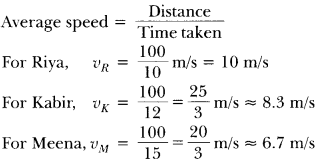
(ii) Who has the greatest average speed?
Answer:
Riya has the greatest average speed.
(iii) If Meena starts fast, slows down in the middle and then speeds up near the end, is her motion uniform or non-uniform?
Answer:
If Meena starts fast, then runs slowly in the middle and speeds up again near the end, her speed does not remain the same throughout the run and she does not cover equal distances in equal intervals of time. Therefore, Meena’s motion is non-uniform.
(iv) Suppose the stopwatch started a little late only for Kabir. How would this error affect the calculated speed for Kabir?
Answer:
If the stopwatch starts a little late for Kabir, the time recorded for him will be less than the actual time he took. Since speed =\(\frac{\text { distance }}{\text { time }}\), using a smaller time makes the calculated speed greater than his true speed, so Kabir’s speed will appear higher than it really is.
Question 2.
The following given table shows the distance travelled by an object at different times:
| Time (s) | 0 | 10 | 20 | 30 | 40 | 50 | 60 | 70 |
| Distance (m) | 0 | 12 | 25 | 39 | 55 | 68 | 82 | 105 |
(i) Is the motion of the object uniform or nonuniform? Give a reason using the data in the table.
Answer:
The motion is non-uniform. In each 10 s interval the distances covered are different (12 m, 13 m, 14 m, 16 m, 13 m, 14 m, 23 m), so the object does not cover equal distances in equal intervals of time.
(ii) Calculate the average speed of the object for the entire journey.
Answer:
In 70 s the total distance covered is 105 m Average speed = \(\frac{\text { Total distance }}{\text { Total time }}\)=\(\frac{105}{70}\)=1.5m/s
(iii) Find the speed between 20 s and 50 s.
Answer:
Between 20 s and 50 s, the distance changes from 25 m to 68 m.
Distance covered =68m – 25m=43m, time taken =30s.
Average speed between 20 s and 50 s= \(\frac{43}{30}\) m/s ≈ 1.43 m/s.
(iv) In which interval, 10-20 s, 30-40 s, or 60-70 s, does the object have the maximum speed?
Answer:
From 10 s to 20 s: Distance =25-12=13m
→ Speed = \(\frac{13}{10}\) = 1.3m/s
From 30 s to 40 s: Distance = 55 – 39 = 16m
→ Speed =\(\frac{16}{10}\)=1.6 m /s
From 60 s to 70 s: Distance =105-82=23m
→ Speed =\(\frac{23}{10}\)=2.3 m/s
Therefore, the greatest speed is 2.3 m/s, which occurs in the interval from 60 s to 70 s.
Measurement of Time and Motion Class 7 Case Based Questions
Read the following passages and answer the questions that follow:
Question 1.
Long ago, in the late 1500s, Galileo Galilei was sitting inside a church in Pisa. As he watched a big chandelier swinging gently, he noticed that no matter how wide or small the swing was, it seemed to take the same time to complete. This observation of a pendulum’s motion gave him the idea that pendulums could be used to measure time. Years later, in the 1600s, the Dutch scientist Christiaan Huygens turned Galileo’s idea into reality. He designed the first pendulum clock in 1656, which was far more accurate than earlier methods of time measurement.
(i) On what factor does the time period of a simple pendulum at a place depend?
Answer:
The time period of a simple pendulum at a place depends on the length of the pendulum. A longer pendulum takes more time to complete one oscillation than a shorter pendulum.
(ii) Which clocks later replaced pendulum clocks?
Answer:
Quartz clocks replaced pendulum clocks because they are more accurate and compact.
(iii) Name two methods used to measure time before the invention of the pendulum clock.
Answer:
- Sundials: Measured time using the shadow of the Sun.
- Water clocks: Measured time by the flow of water from one container to another.
OR
(iii) Why were pendulum clocks more accurate than earlier clocks?
Answer:
Pendulum has a regular, predictable motion and each oscillation takes nearly the same time, so equal time intervals could be measured more reliably than with earlier methods.
Question 2.
On a cool winter morning, Rehan boarded an express train from Lucknow to Kanpur, two cities 72 km apart. The train left Lucknow exactly at 7:00 AM.
- Within the city limits, the train moved at 36 km/h for the first 18 km. Then it travelled with a speed of 72 km/h for the next 36 km.
- Due to a signal, it had to halt for 6 minutes.
- Finally, it covered the remaining 18 km at 36 km /h.
(i) How much time did the train take to cover the first 18 km?
Answer:
Time taken for the first 18 km :
Time =\(\frac{\text { Distance }}{\text { Speed }}\)=\(\frac{18}{36}\)=\(\frac{1}{2}\) h=30 minutes
(ii) What will be the arrival time at Kanpur?
Answer:
Time for first 18 km at 36 km/h=30 minutes
Time for next 36 km at 72 km/h:
Time =\(\frac{36}{72}\)=30 minutes
Halt at signal =6 minutes
Time for last 18 km at 36 km/h:
Time =\(\frac{18}{36}\) h= \(\frac{1}{2}\) h=30 minutes
Total journey time is given as: 30+30+30+ 6=96 minutes =1h 36 minutes
The train starts at 7:00 AM, so the arrival time is approximately 8:36 AM.
OR
(ii) Calculate the average speed of the train for the whole journey.
Answer:
Total distance =72 km
Total time =96 minutes
96 min =\(\frac{96}{60}\) h=1.6 h
Average speed =\(\frac{\text { Total distance }}{\text { Total time }}\)=\(\frac{72}{1.6}\)
=45 km/h
(iii) Suppose the train did not have to stop at the signal and completed the same 72 km journey without the 6-minute halt. What would be its average speed then?
Answer:
If there is no 6 -minute halt, the total time becomes
96 min -6 min =90 min = \(\frac{90}{60}\) h=1.5 h
New average speed =\(\frac{72}{1.5}\) km/h=48 km/h
Measurement of Time and Motion Class 7 Picture Based Questions
Observe the given pictures and answer the questions that follow:
Question 1.
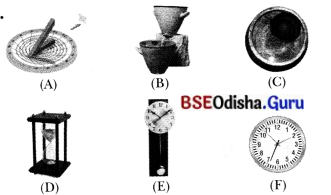
(i) Which of the given devices use a periodic and oscillatory motion as the basis of time measurement?
Answer:
The device that uses periodic and oscillatory motion is E (Pendulum clock).
(ii) Identify the time-measuring devices labelled A , B, C, D, E, and F.
Answer:
A – Sundial, B – Water-flowing-out-type water clock, C – Floating-bowl-type water clock, D – Hourglass, E – Pendulum clock, F – Quartz clock
OR
(ii) Classify the devices shown (A, B, C, D, E, F) into ancient and modern time-measuring devices.
Answer:
Ancient devices: A (Sundial), B (Water-flowing-out-type water clock),
C (Floating-bowl-type water clock), D (Hourglass)
Modern devices: E (Pendulum clock), F (Quartz wall clock)
(iii) A student says, “Among the devices shown, B and C both use water to measure time, but they do not work in exactly the same way.” Which of the following best explains this statement?
(a) In B, water flows out; in C, a floating bowl slowly sinks as water enters.
(b) In B, water evaporates; in C, water freezes.
(c) In B, water flows between bulbs; in C, sand flows between bulbs.
(d) In B, the water level stays fixed; in C, the water level never changes.
Answer:
(a) In B, water flows out at a steady rate from a container, whereas in C, a floating bowl gradually sinks as water enters it through a small hole.
Measurement of Time and Motion Class 7 Activity Based Questions
1. Objective: To determine whether the time period of a simple pendulum depends on its length and/or on the mass of its bob.
Materials required: A stand with a clamp, a strong thread, small metal bobs of different masses (or different coins wrapped carefully), a stopwatch, a ruler or a measuring tape, and a protractor (optional).
Procedure:
- Tie one metal bob to one end of the thread and fix the other end to the stand.
- Measure the length of the pendulum. Set the length to about 80 cm.
- Pull the bob gently to one side and release it.
- Start the stopwatch when the bob passes its central position. Measure the time taken for 10 complete oscillations.
- Repeat two more times for the same length and same bob and note all three readings.
- Now change the length of the pendulum to about 60 cm (same bob). Again, find the time for 10 oscillations, repeating three times.
- Next, keep the length fixed (for example, again 80 cm), but replace the bob with another bob of a different mass. Measure the time for 10 oscillations three times.
- Compare your readings for different lengths and different masses
(i) What is meant by the time period of a simple pendulum?
Answer:
The time period of a simple pendulum is the time taken by its bob to complete one full oscillation, i.e., one complete to-and-fro motion about the mean position.
(ii) For a simple pendulum of length 80 cm, the time taken for 10 complete oscillations is 18 s. Calculate the time period of this pendulum.
Answer:
Time period =\(\frac{Total time}{Number of oscillations}\) \(\frac{18 \mathrm{~s}}{10}\)= 1.8 s
(iii) When we change the bob to one of a different mass but keep the length of the pendulum the same, what do we observe about the time taken for 10 oscillations?
Answer:
On changing the bob to a different mass while keeping the length the same, the time taken for 10 oscillations remains nearly unchanged. This shows that, for a given length at a place, the time period does not depend on the mass of the bob.
OR
(iii) From your observations with the 80 cm and 60 cm pendulums, state how the time period of a simple pendulum depends on its length.
Answer:
The pendulum of greater length (80 cm) takes more time for the same number of oscillations than the pendulum of shorter length (60 cm). Hence, the time period increases with increase in length of the pendulum.
Measurement of Time and Motion Extra Questions for Practice
Question 1.
Two pendulums of equal length are set into motion at the same place. One bob is heavier. Their time periods will be
(a) larger for the heavier bob.
(b) smaller for the heavier bob.
(c) the same for both.
(d) unpredictable.
Answer:
(c) The time period of a simple pendulum at a given place depends on its length, not on the mass of the bob.
Question 2.
A cyclist moves with a speed of 18km/h for 40s. The distance covered is
(a) 100 m
(b) 200 m
(c) 150 m
(d) 250 m
Answer:
(b) First, convert the speed into m/s because time is given in seconds. 18km/h=18 ×\(\left(\frac{1000 \mathrm{~m}}{3600 \mathrm{~s}}\right)\) =18 × \((\frac{1000 \mathrm{~m}}{3600 \mathrm{~s}})\)=5m/s
Now,
Distance = Speed × Time.
Distance =5m/ s × 40s=200 m
So, the cyclist covers 200 m in 40 s.
Question 3.
A car travels equal distances in equal intervals of time. Which statements are correct?
(i) The speed of the car is constant.
(ii) The car shows uniform motion.
(iii) The car shows non-uniform motion.
(iv) Distance covered by the car is given by speed x time.
(a) (i) and (ii) only
(b) (i), (ii), and (iv)
(c) (ii) and (iii) only
(d) (i), (iii), and (iv)
Answer:
(b) (i), (ii), and (iv)
Question 4.
Two cyclists start at the same time from the same point and travel in the same direction. Which statements are correct?
(i) The cyclist covering more distance in the same time is faster.
(ii) Speed depends only on time.
(iii) Speed depends on both distance and time.
(iv) Both cyclists must have the same speed.
(a) (i) and (iii) only
(b) (ii) and (iv) only
(c) (i), (ii), and (iii)
(d) (i), (iii), and (iv)
Answer:
(a) (i) and (iii) only
Questions 5 and 6 consist of two statements – Assertion (A) and Reason (R). Answer these questions by selecting the correct option:
(a) Both A and R are true and R is the correct explanation of A.
(b) Both A and R are true but R is not the correct explanation of A.
(c) A is true but R is false.
(d) A is false but R is true.
Question 5.
Assertion (A): In uniform linear motion, the object moves with constant speed.
Reason (R): In uniform linear motion, an object covers equal distances in equal intervals of time.
Answer:
(a) Both A and R are true and R is the correct explanation of A.
Question 6.
Assertion (A): A candle clock cannot be used accurately on a windy day.
Reason (R): Wind affects the steady burning of the candle.
Answer:
(a) Both A and R are true and R is the correct explanation of A.
Question 7.
Define one oscillation of a pendulum.
Answer:
One oscillation of a pendulum is one complete to-and-fro motion of the bob from one extreme position to the other extreme position and back to the first extreme position.
Question 8.
A speedometer shows 40km/h for a moment. Does that mean the vehicle travelled 40 km ?
Answer:
No. A speedometer shows the speed of the vehicle at that particular instant. A reading of 40 km/h means the vehicle is moving at a speed that can cover 40 km in one hour if it continues at the same speed.
Question 9.
What are the two types of water clocks used in earlier times? Explain the basic difference.
Answer:
The two types are:
- Flowing-out type water clock: In this type, water was allowed to flow out of a container through a small hole. The level of water falling inside the container was used to measure time.
- Sinking-bowl type water clock: In this type, a small bowl with a tiny hole was placed on the surface of water. Water slowly entered the bowl, and after a fixed time interval, the bowl filled and sank. Each sinking represented a fixed interval of time, making this type more reliable.
Thus, the basic difference is that the flowing-out type measures time by the changing water level, while the sinking-bowl type measures time by the sinking of the bowl after a fixed duration.
Question 10.
A friend says, “If two objects travel for the same amount of time, they must have the same speed.” Correct this statement with an example-based explanation.
Answer:
The statement is incorrect because speed depends on both distance and time. For example, in 10 s, one object may travel 20m (speed =2m /s), and another may travel 50 m( speed =5 m/s). Even though the time is the same, the speeds are different.
Question 11.
A student notes the motion of a cyclist. In the first 10 minutes, the cyclist covers 2 km. In the next 10 minutes, he covers 3 km.
(i) Is the speed of the cyclist the same in both intervals?
Answer:
No, the speed is different in the two intervals, as in the equal duration of 10 minutes, the cyclist covers different distances, 2 km in the first 10 minutes and 3 km in the next. 10 minutes.
(ii) What type of motion does the cyclist show?
Answer:
The cyclist shows non-uniform motion as he covers unequal distances in equal intervals of time.
(iii) Which two quantities are needed to calculate speed?
Answer:
Speed is calculated using distance and time.
OR
(iii) If the cyclist covers more distance in less time, how does his speed change?
Answer:
Speed is distance covered divided by time taken to cover it. If the cyclist covers more distance in less time, his speed increases.
Question 12.
A student wants to find the time period of a simple pendulum using a stopwatch.
(i) Describe the correct method to measure the time period of a pendulum.
Answer:
Displace the bob slightly from its mean position and release it gently. Start the stopwatch when the bob is at an extreme position, count a fixed number of complete oscillations (such as 20), and stop the stopwatch when the bob completes that number of oscillations. Divide the total time by the number of oscillations to get the time period.
(ii) The student records the time for 20 complete oscillations as 36 s. Calculate the time period of the pendulum.
Answer:
Time period = \(\frac{\text { Total time for oscillations }}{\text { Number of oscillations }}\)
= \(\frac{36 \mathrm{~s}}{20}\)=1.8s
(iii) The student repeats the experiment in two different ways:
(a) by using a bob of the same size but different mass, keeping the length unchanged
(b) by using the same bob but increasing the length of the thread.
State what change (if any) the student will observe in the time period in each case.
Answer:
(a) On changing the bob to another of the same size but different mass, the time period will remain the same because the time period does not depend on the mass of the bob.
(b) On increasing the length of the thread, the time period will increase because the time period depends on the length of the pendulum.