
Combining textbook study with BSE Odisha Class 7 Science Notes and Class 7 Science Curiosity Chapter 10 Life Processes in Plants Notes can make exam preparation more effective.
Life Processes in Plants Notes Class 7
Class 7 Science Curiosity Chapter 10 Notes
Growth in Plants
- Growth in plants involves parameters, such as the emergence of new leaves and branches, elongation and thickening of stems and roots, and an increase in height.
- Water and sunlight are essential for healthy plant growth. Only plants that receive both water and sunlight grow healthy and strong. Lack of water or sunlight slows plant growth and may cause the plant to wilt (due to dehydration) or even die.

Food Preparation
Plants are autotrophs, i.e., they prepare their own food using resources from their surroundings. Leaves are the primary site for food preparation in plants.
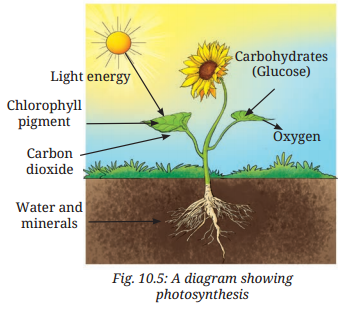
Leaves and Chlorophyll
- Leaves prepare food for the plant in the form of glucose, a simple carbohydrate.
- The green colour of leaves is due to a special pigment called chlorophyll, which traps sunlight.
- Leaves are usually broad and flat, which helps them receive maximum sunlight.
- The food prepared is stored in the form of starch, a complex carbohydrate.
- Presence of starch in leaves can be tested using iodine solution (blue-black colouration). Additionally, alcohol is used to decolourise or remove the chlorophyll pigments present in the leaf, which facilitates visualisation of the colour change during the iodine test.
- Other plant parts that contain chlorophyll can also perform photosynthesis, such as young stems; in desert plants, the stems are adapted to carry out this process.
- Leaves are not always green; they come in a variety of colours, like red, violet, and brown. Such plants also have chlorophyll and prepare food, but the green colour gets hidden as the proportion of other coloured pigments is greater.
Role of Sunlight
- Sunlight provides the energy required to prepare food.
- Leaves kept in sunlight produce starch, while those kept in darkness do not (negative iodine test), confirming sunlight’s indispensable role in this process.
- Photosynthesis stops at night; starch serves as the reserve food supply during night-time.
Role of Air
- Carbon dioxide is obtained from the air.
- In the absence of carbon dioxide, starch is not formed in leaves, even if a leaf is exposed to sunlight.
- Oxygen is produced during photosynthesis.
- This can be experimentally verified by observing the air bubbles released by a water plant placed under a funnel in a beaker of water (in sunlight).
- Oxygen is essential for respiration in living beings.
Photosynthesis: A Brief Account
The entire food preparation event is termed photosynthesis, a life process unique to plants.
Steps of Photosynthesis:
- Roots absorb water and minerals from the soil.
- Water is transported to the leaves through xylem (section 10.3.1).
- Leaves take in carbon dioxide from the air through stomata.
- Chlorophyll in leaves captures sunlight.
- Using sunlight, water, and carbon dioxide, food (glucose) is prepared in the leaves.
- Glucose serves as an instant energy source and later is converted into starch and stored in the plant.
- Oxygen is released into the air as a by-product.
Word equation:

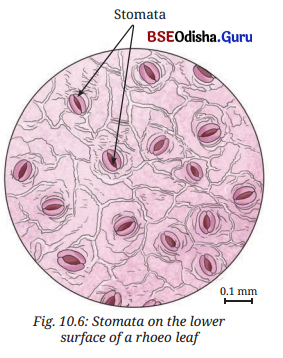
Stomata
- Leaves have tiny pores called stomata.
- Stomata help in the exchange of gases during photosynthesis (depicted here) and respiration.
Transport in Plants
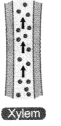
Transport of Water and Minerals
- Roots absorb water and minerals from the soil.
- Water and minerals move upward through xylem.
- Xylem is present in roots, stems, and leaves, forming a continuous channel. Transport occurs only upwards, from roots to all aerial plant parts.
Transport of Food
- Food prepared in leaves is transported to all parts of the plant.
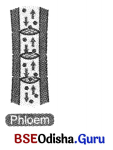
- Transport of food occurs through phloem.
- Food may be stored in roots, stems, fruits, or seeds.
- Both upward and downward movement of nutrients take place in the phloem.
Respiration in Plants
- Plants respire just like other living beings to obtain energy from the food they produce.
- This can be experimentally verified by placing germinating seeds in a sealed flask connected to a test tube containing lime water, which turns milky. The other test tube shows no change, confirming that germinating seeds release carbon dioxide during respiration.
- Respiration occurs in all parts of the plant, both day and night. During respiration, glucose is broken down (using oxygen), with the release of carbon dioxide, water, and energy.
Word equation: Glucose + Oxygen → Carbon dioxide + Water + Energy
Comparison between Photosynthesis and Respiration
| Photosynthesis | Respiration |
| Food (glucose) is prepared by plants. | Food is broken down to release energy for growth and life activities. |
| Occurs primarily in the leaves and other green parts of the plant. | Occurs in all parts of the plant. |
| Requires carbon dioxide and water, along with chlorophyll and the presence of sunlight. | Requires oxygen and glucose. |
| Produces glucose and oxygen. | Produces carbon dioxide, water, and energy. |
| Occurs mainly during the daytime. | Occurs day and night (does not require sunlight). |
Photosynthesis: The process by which plants prepare food in the presence of sunlight and chlorophyll.
Raw materials
- Sunlight
- Chlorophyll
- Carbon dioxide
- Water
Site of Photosynthesis
- Leaves are the primary site of photosynthesis.
- They contain a green pigment called chlorophyll, which captures sunlight.
- Chlorophyll helps in food preparation in the form of carbohydrates (glucose).
- As leaves prepare food, they are called the ‘food factories’ of plants.
- Other parts of the plants which have chlorophyll (e.g., young stems) also perform photosynthesis.
Products of Photosynthesis
- Glucose: The primary product; it is later converted into starch for storage (reserve food).
- Oxygen: A by-product that all living beings respire to stay alive.
Site of Gaseous Exchange
- Gaseous exchange occurs through tiny pores present on the surface of leaves called stomata.
- Carbon dioxide and oxygen are exchanged during photosynthesis and respiration.
Growth in Plants
- Growth involves the formation of new leaves, branches, stem thickening, and increase in height.
- Requires sunlight and water
Experimental Chemicals and their Uses Iodine solution
- Tests for the presence of starch in leaves (indicates whether photosynthesis has occurred in a leaf).
- Alcohol – Removes chlorophyll from the leaf to help visualise the colour change during the starch test.
- Caustic soda (sodium hydroxide) – Absorbs carbon dioxide (proves that carbon dioxide is necessary for photosynthesis).
- Lime water – Turns milky in the presence of carbon dioxide (confirms respiration in plants).
Transportation
Transport of water and Minerals
- Xylem transports water and minerals to leaves and other plant parts.
- Transport occurs only upwards, from roots to all aerial plant parts through these thin tubular structures.
- Water transported is used for various functions, like photosynthesis. Minerals are essential nutrients required for healthy growth of plants.
Transport of Food
- Phloem is another set of thin, tubular structure that transports food in plants.
- Transport occurs both upwards and downwards, from leaves to all plant parts.
- Food transported is stored in parts like seeds and roots.
Respiration
- Plants also respire like animals and human beings.
- The process of break down of glucose in the presence of oxygen to release energy.
Glucose + Oxygen → Carbon dioxide + Water + Energy
Raw Materials
- Oxygen
- Glucose
Site of Respiration
- All plant parts, green or non-green, perform respiration.
- Plants obtain the energy required for growth, development and performing other life processes through the breakdown of the food they produce.
Productof Respiration
- Carbon dioxide
- Water
- Energy