
Students can include Class 7 Curiosity Extra Questions and Class 7 Science Chapter 10 Life Processes in Plants Extra Question Answer in their daily self-study routine.
Class 7 Science Chapter 10 Life Processes in Plants Extra Questions
Class 7 Science Chapter 10 Extra Questions on Life Processes in Plants
Life Processes in Plants Class 7 Very Short Question Answer
Question 1.
For the synthesis of glucose, what are the raw materials required by a plant?
Answer:
For synthesis of glucose plants require carbon dioxide and water along with the presence of sunlight and chlorophyll in leaves.
Question 2.
How do plants store the energy captured from sunlight during photosynthesis, and how is this stored energy released during respiration?
Answer:
The energy captured from sunlight during photosynthesis is stored in the form of glucose by the plant. During respiration, this glucose is broken down in the presence of oxygen to release energy, which is then used for various life processes.

Question 3.
Sunlight, chlorophyll, carbon dioxide, water and minerals are raw materials essential for photosynthesis. Do you know where they are available? Fill in the blanks with the appropriate raw materials.
(i) Available in the plant: …………
Answer:
(ii) Available in the soil: …………
Answer:
Water and minerals
(iii) Available in the air: …………
Answer:
Carbon dioxide
(iv) Available during day: …………
Answer:
Sunlight
Question 4.
Which part/parts of a plant are involved in respiration?
Answer:
The process of respiration is performed by all living parts of a plant, as energy is required for various metabolic activities. Growing parts like floral buds, seeds of plants perform more respiration compared to other parts. Hence, all plant parts – green or non-green carry out respiration.
Question 5.
Study the given equation and answer the questions that follow.

(i) What does the equation depict?
Answer:
The equation depicts the process of photosynthesis.
(ii) Where does it occur?
Answer:
It occurs in the leaves.
(iii) What happens to the products?
Answer:
Glucose is broken down to release energy through respiration, while oxygen released is breathed in by other living organisms.
(iv) What are the requirements for this process?
Answer:
Water, chlorophyll, carbon dioxide, and sunlight.
Question 6.
During an experiment, Aman observed that lime water in a test tube connected to a flask containing germinating bean seeds turned milky. Explain his observation. Would the same result occur with boiled beans?
Answer:
- Germinating seeds were actively respiring and releasing carbon dioxide, which turned the lime water milky.
- No, if boiled beans are used, the lime water will not turn milky because boiled seeds are dead and do not respire (no carbon dioxide is released).
Question 7.
A goat eats away all the leaves of a small plant (balsam). However, in a few days, new leaves could be seen sprouting in the plant again. How did the plant survive without leaves?
Answer:
Plants store the food they produce by photosynthesis in the stems and roots. So, when the goat eats all the leaves, the plant fulfils its requirement by utilising the food stored in stems and roots.
Question 8.
Radhika wants to find out whether a purple plant can make its own food. She keeps a purple plant in sunlight for four days. Which other type of coloured plant should Radhika keep as part of her study to compare with the purple plant?

Answer:
Radhika should also keep a green plant as part of her study to compare with the purple plant. This comparison would make the experiment more reliable and accurate.
Question 9.
Potato and ginger are both underground parts that store food. Where is the food prepared in these plants?
Answer:
Food in potato and ginger plants is prepared in the leaves through photosynthesis and then transported via phloem to the underground parts for storage.
Question 10.
Shiv while changing ink for his pen, dropped the ink refill in a small flower vase kept on his study table. He noticed red colour in the stem of the flower kept in the vase after a few hours. What is the reason behind his observation?
Answer:
The red ink moved upwards through the stem due to the presence of xylem, which is responsible for the transport of water and minerals in plants. The xylem draws the coloured liquid (in this case, the ink mixed with water) from the vase up through the stem to the flower.
Question 11.
In our body, blood is the medium that transports nutrients from one place to another. What are the counterparts of blood, which transport nutrients in plants?
Answer:
Xylem and phloem are the tissues in plants for the transport of water and nutrients (food), respectively.
Life Processes in Plants Class 7 Short Question Answer
Question 1.
The following flowchart was given by Ashu’s teacher in homework. Help Ashu complete the flowchart.
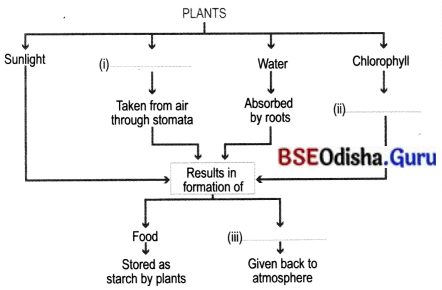
Answer:
(i) Carbon dioxide
(ii) Present in (green) leaves
(iii) Oxygen
Question 2.
Renu wanted to perform an experiment to show her brother Sunil the raw materials required for photosynthesis. She took two similar green plants- one of them she placed under shade and the other under sunlight.
(i) Which plant will show a positive result for the iodine test?
Answer:
The plant kept under sunlight will give a positive result for the iodine test.
(ii) Why will the plant you selected give a positive result for the iodine test, and the other not?
Answer:
Under sunlight, the green plant will perform photosynthesis, resulting in the production of starch. The other plant kept under shade will be unable to perform photosynthesis and produce starch without sunlight.
(iii) Will there be any differences in the appearance of both the potted plants? State your reason.
Answer:
Yes, the plant kept in sunlight will be healthy, green, with more number of leaves. The plant kept under shade will be weak, have paleyellowish leaves and show poor growth.
Question 3.
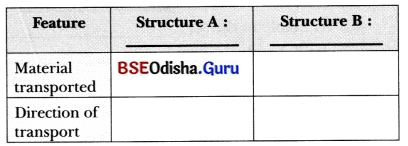
Name the two structures involved in the transportation of substances in plants, and compare them based on the following features:
Answer:
The two structures involved in the transportation of substances in plants are xylem and phloem.
| Feature | A: Xylem | B: Phloem |
| Material transported | Transports water and minerals | Transports food |
| Direction of transport | Upward (from roots to leaves) | Both upward and downward |
Question 4.
Sunita saw the picture given alongside in an encyclopedia and wondered what it is. Study the given diagram and answer the following questions:
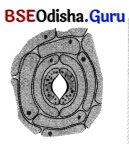
(i) Which structure is represented by the diagram?
(ii) Where can you find these structures in a plant?
(iii) What is the role of this structure?
Answer:
(i) The diagram represents stomata.
(ii) Stomata can be found on leaves, especially on the lower leaf surface.
(iii) Stomata facilitates exchange of gases during photosynthesis and respiration.
Question 5.
A student uprooted a rose plant from the soil. Most of the root tips, with root hair were left behind in the soil. She planted it in a pot with new soil and watered it regularly. Will the plant grow or die? Give reason for your answer.
Answer:
The following possibilities exist:
- Without the root hairs, the roots will not be able to absorb water and nutrients and the plant may die.
- The rose plant may grow new roots and the plant will live.
- The rose plant may not be able to survive in a different type of soil.
Question 6.
Observe the figures carefully and answer the following questions.
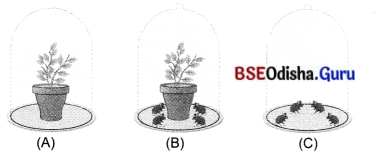
(i) In which jar, will the amount of carbon dioxide be the highest and why?
(ii) In which jar, will the amount of carbon dioxide be the lowest and why?
Answer:
(i) Jar (C) will have the highest amount of carbon dioxide because the mice inside the jar are continuously respiring, using up oxygen and releasing carbon dioxide. Since there is no plant inside the jar to absorb the carbon dioxide, its amount keeps increasing and becomes maximum.
(ii) Jar (A) will have the lowest amount of carbon dioxide because there are no mice inside the jar. The plant continuously uses carbon dioxide for photosynthesis, reducing its amount, while releasing oxygen.
Question 7.
Water transportation is said to form a oneway traffic, while the transport of food forms a two-way traffic in plants. Justify.
Answer:
Water transport is one-way because xylem carries water and minerals from the roots upwards to the leaves and other parts of the plant. In contrast, food transport is two-way because phloem carries food from the leaves, where it is produced, to all the parts that require it, such as the roots, developing flowers, or fruits, allowing movement in both upward and downward directions.
Question 8.
Mention the importance of respiration.
Answer:
Respiration involves the break down of glucose (food) and the release of energy; required for the growth and repair of various plant parts. Supporting growth and other life processes like preparing food, transportation, etc., require a lot of energy. Thus, respiration is essential for survival as it provides the energy required to carry out all such functions.
Question 9.
Two identical plants were kept under different conditions: [Scientific Temper and Critical Thinking Skill]
Plant A: Sunlight + water
Plant B: Sunlight + water + leaves coated with grease
After a few days, Plant B showed stunted growth.
(i) Which plant structure’s function do you think was affected?
(ii) Why did the greased plant show poor growth?
(iii) Mention any one life process that was impacted in Plant B.
Answer:
(i) The affected structure is stomata.
(ii) Grease blocked the stomata on the leaves, preventing the exchange of gases, thereby affecting food preparation and energy release.
(iii) Photosynthesis or respiration
Life Processes in Plants Class 7 Long Question Answer
Question 1.
Just as in human beings, the transport of water, minerals and food is also crucial for the growth and development of plants. Explain.
Answer:
Transport of water, minerals and food are essential for growth to take place. All activities utilise water and minerals. Synthesis of substances inside the body is a high energy consuming process. This energy is obtained by oxidation of food, i.e., glucose during respiration. This is why the transportation of food, water and minerals, all are essential for growth.
- Water and minerals are transported through xylem, and food is transported through phloem.
- Transport of water and minerals dissolved in it occurs only in one direction from the roots to upper plant parts; transport is unidirectional.
- Transport of food occurs from leaves to all growing parts of a plant; transport is bidirectional.
Question 2.
Plants have different mechanisms for synthesising, transporting, and utilising food to obtain energy. Discuss.
Answer:
Plants prepare food, distribute it, and use it to meet their energy needs through coordination between the following life processes:
- Synthesis of food: Plants prepare their own food by photosynthesis. Green leaves containing chlorophyll use sunlight, carbon dioxide, and water to make food in the form of glucose, which is stored as starch.
- Transport of food: The food prepared in the leaves is transported to all parts of the plant through the phloem. This process helps supply food to growing and storage parts like roots, stems, and fruits. Xylem transports water and minerals from the roots to the leaves, which are essential raw materials for photosynthesis. Thus, both xylem and phloem ensure that water, minerals, and food reach all parts of the plant for healthy growth.
- Utilisation of food: Plants use the transported food for obtaining energy through respiration. During respiration, food (glucose) is broken down using oxygen to release energy needed for growth, repair, and other life activities.
Question 3.
Discuss how photosynthesis and respiration are essential for the survival of various living organisms.
Answer:
For the survival of all living organisms, energy is required. Animals are incapable of capturing light energy. Hence, they depend upon plants for this energy. Plants capture light energy from the Sun during photosynthesis and convert it into chemical energy. This chemical energy is available in the form of glucose. During respiration, glucose is oxidised to liberate energy. This liberated energy is used for performing various metabolic activities. This is why both photosynthesis and respiration are essential for the survival of all living organisms.
Question 4.
Priya read that organisms breathe in oxygen and breathe out carbon dioxide, in a continuous manner. She wonders then there should have been less oxygen and more carbon dioxide in the atmosphere. Based on your understanding, help Priya clear her confusion. Also, compare the life processes involved.
Answer:
This balance is maintained by two life processes: photosynthesis and respiration. Green plants take in carbon dioxide from the atmosphere and release oxygen during photosynthesis, while plants, animals, and humans take in oxygen and release carbon dioxide during respiration. This natural cycle ensures that the gases in the atmosphere are continuously exchanged and maintained.
These two processes can be compared in the following manner:
| Feature | Photosynthesis | Respiration |
| Purpose | Food (glucose) is prepared by plants. | Food is broken down to release energy. |
| Location | Occurs primarily in the leaves and other green parts of the plant. | Occurs in all parts of the plant. |
| Raw materials | Requires carbon dioxide and water, along with chlorophyll and the presence of sunlight. | Requires oxygen and glucose |
| Products | Produces glucose and oxygen. | Produces carbon dioxide, water, and energy. |
| Time | Occurs mainly during the daytime. | Occurs day and; night (does not require sunlight). |
| Importance | Helps plants produce food. | Provides energy for growth and life activities through the breakdown of the food produced. |
Life Processes in Plants Class 7 Case Based Questions
Read the following passages and answer the questions that follow:
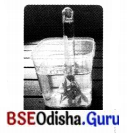
Question 1.
Ved believes that plants also give out something during the process of making their food. He puts up an experimental set-up, as shown in the figure given below to collect evidence for the release of a particular gas during photosynthesis. Based upon his observation, answer the following questions:
(i) Ved observed the formation of air bubbles. Explain his observation.
Answer:
The oxygen gas produced in this set-up caused bubbles to emerge and get accumulated in the inverted test tube.
(ii) What is the source of the gas released?
Answer:
The source of the oxygen gas released is photosynthesis performed by the aquatic plant in the experimental set-up.
(iii) How will the set-up behave if kept in a dark room?
Answer:
No air bubble formation will be observed in the set-up when kept in dark as no photosynthesis will occur in the absence of sunlight.
OR
(iii) Will the leaves of the aquatic plant form starch when kept in dark? How will Ved find out?
Answer:
No. Ved can confirm this with iodine test on a leaf plucked from the plant kept in the dark room. The leaf will not turn blue-black, indicating no starch formation.
Question 2.
Sara went on a vacation with her family for a few weeks and forgot to tell the caretaker to water the plant pots. When they returned, she noticed that the plants in their balcony appeared pale and unhealthy with wilted leaves, even though the plants were kept in sunlight. Sara wondered what may have caused this.
(i) Which life process in plants is mainly affected when water is not supplied?
Answer:
Photosynthesis
(ii) Name the structure through which water reaches the leaves.
Answer:
Xylem
(iii) Roots absorb minerals from the soil along with water. Can you tell why these minerals are important for the plant?
Answer:
Minerals are nutrients needed for healthy growth and proper functioning of the plant.
OR
(iii) Even though sunlight was available, why did the plants show poor growth?
Answer:
Plants showed poor growth even in the presence of sunlight because water is an essential raw material required for photosynthesis; food preparation cannot take place in its absence, thereby impacting the overall growth of the plant.
Life Processes in Plants Class 7 Picture Based Questions
Observe the given pictures and answer the questions that follow:
Question 1.
The given picture represents a microscopic view of a leaf peel with visible tiny pores on its surface.

(i) What are these tiny pores called?
Answer:
Stomata
(ii) Name the life process(es) for which these structures are essential.
Answer:
Photosynthesis and Respiration
(iii) Which atmospheric gases enter and exit the plant through them? Explain how the opening and closing of these pores help the plant survive.
Answer:
Carbon dioxide and oxygen. The opening and closing of these pores help the plant exchange gases with their surroundings and lose water for excretion, another important life process. They are thus essential for a plant’s survival.
OR
(iii) Predict what would happen if all these pores remained permanently closed.
Answer:
If all stomata remained permanently closed, the exchange of gases would stop. As a result, the plant would neither be able to make food nor respire, and would eventually die.
Question 2.
Sarla, a Class 7 science teacher, showed a diagram to explain plant transport systems to her students. Arrows in the image are indicating the direction of the movement of two different substances by two different pathways. Some arrows are labelled as ‘A’ and some are labelled as ‘B’.
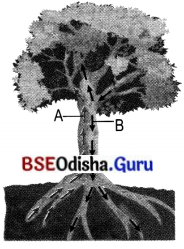
(i) The grey-coloured type A arrows in the picture depict the movement of which substance?
Answer:
Grey arrows, labelled as A depict the movement of water and minerals.
(ii) The black-coloured type B arrows in the picture depict the movement of which substance?
Answer:
Black arrows, labelled as B depict the movement of food.
(iii) Give correct names of the structures denoted by arrows A and B respectively.
Answer:
A – Xylem
B – Phloem
OR
(iii) How does the movement of substances through these two pathways differ?
Answer:
Movement of water, through xylem, is unidirectional, while movement of food, through phloem, is bidirectional.
Life Processes in Plants Class 7 Activity Based Questions
Read the following activity and answer the questions that follow:
1. Sarita, a Grade 7 science teacher, kept a healthy potted plant inside a dark room for thirty-six hours. On the third day, she plucked a leaf from the plant and demonstrated the starch test to her students during their practical class. Although the leaf was still green, it did not turn blue-black when tested with iodine solution.
(i) Why did the leaf not turn blue-black in this case?
Answer:
The leaf did not turn blue-black because no photosynthesis occurred in the absence of sunlight, and all the stored starch was utilised. As a result, no starch was left or formed to react with iodine.
(ii) Name one condition necessary for food preparation that was missing.
Answer:
Sunlight
(iii) Even in the absence of food preparation, which life process must have continued in the plant? Explain your answer.
Answer:
Respiration, because it is independent of sunlight.
OR
(iii) How will a leaf from this potted plant, exposed to 24 hours of sunlight, behave if half of it is inserted in a bottle containing caustic soda and the other half is exposed to air, before performing the iodine test?
Answer:
The part of the leaf inside the bottle will not turn blue-black, as no food will be made in that part, in the absence of carbon dioxide (absorbed by caustic soda), while the part exposed to air will turn blue-black because photosynthesis can occur there.
Life Processes in Plants Extra Questions for Practice
Question 1.
As part of a revision test, Shubham was asked to identify the correct statement regarding life processes in plants from the options given below. Which option should he choose?
(a) During photosynthesis and respiration, exchange of water takes place.
(b) Glucose, synthesised during photosynthesis serves as an instant source of energy.
(c) Stomata help in capturing sunlight during photosynthesis.
(d) Phloem transports water and minerals from roots to all parts of the plant.
Answer:
(b) Glucose, synthesised during photosynthesis serves as an instant source of energy.
Question 2.
Growth in plants is indicated by:
(a) Increase in number of leaves and emergence of new branches
(b) Increase in length and thickness of its stem
(c) Increase in the number of flowers only
(d) Both (a) and (b)
Answer:
(d) Both (a) and (b)
Question 3.
Ashi was instructed by her teacher to select the plant part that participates in both photosynthesis and respiration. Which part should she choose from the ones listed below?
(a) Xylem
(b) Stomata
(c) Flower
(d) Seed
Answer:
(b) Xylem does not participate in the exchange of gases; flower is the reproductive organ of the plant; seed is a dormant structure that respires at a low rate but is not involved in photosynthesis as it lacks chlorophyll.
Question 4.
If the xylem of a plant stem is damaged, which process(es) will be most directly affected?
(a) Synthesis of food
(b) Transport of food to roots
(c) Storage of food in plant parts
(d) Both (a) and (b)
Answer:
If the xylem is damaged, water supply to leaves is reduced, directly affecting the synthesis of food (photosynthesis), not the transport of food to roots (done by phloem).
Questions 5 and 6 consist of two statements – Assertion (A) and Reason (R). Answer these questions by selecting the correct option:
(a) Both A and R are true and R is the correct explanation of A.
(b) Both A and R are true but R is not the correct explanation of A.
(c) A is true but R is false.
(d) A is false but R is true.
Question 5.
Assertion (A): Food reaches from developing buds to leaves through the phloem.
Reason (R): Phloem can transport food in different directions depending on the needs of the plant.
Answer:
Food reaches from leaves to all plant parts, such as buds, through phloem.
Question 6.
Assertion (A): During the day, plants usually show a net release of oxygen.
Reason (R): The rate of photosynthesis is higher than the rate of respiration in the presence of sunlight.
Answer:
(a) Both A and R are true and R is the correct explanation of A.
Question 7.
Suman claims only water and sunlight are the raw materials used for photosynthesis. Is the claim made by her right?
Answer:
No, Suman is incorrect: the process of photosynthesis also requires carbon dioxide from air and chlorophyll pigment present in leaves, along with water and sunlight.
Question 8.
Mention the visible changes that occur in a plant when it is kept in dark for a long period of time.
Answer:
When a plant is kept in the dark for a long period of time, the leaves will gradually lose chlorophyll and become yellowish, and no new leaves will be formed. Overall growth of the plant will be stunted (no food production in absence of sunlight).
Question 9.
Why do non-green patches of leaves fail to provide a positive result for the iodine test? Also, state why broad leaves are more efficient in photosynthesis.
Answer:
The non-green leaf patches usually lack chlorophyll or may not have sufficient chlorophyll to prepare enough starch to be detected using the iodine test.
Broad leaves are more efficient in photosynthesis because they contain more chlorophyll and have a larger surface area to capture or absorb more sunlight.
Question 10.
Manoj, a farmer, observed that even when crops received enough sunlight, reduced rainfall during the growing season resulted in low crop yield compared to the previous year. He wondered what the reason could be. Do you think the internal processes of plants could have affected crop production under such conditions?
Answer:
Yes, the internal processes of plants like photosynthesis, respiration, and the transportation of water, minerals, and food are interdependent and together determine successful crop production. In the given situation:
- Reduced rainfall limited the water supply, which is an essential raw material needed for photosynthesis, so less food must have been prepared.
- Poor transport of water and food through xylem and phloem would have affected the supply of nutrients to all other parts of the plant.
- Respiration depends on the food prepared to release energy for growth and development.
With less food prepared. respiration released less energy, resulting in poor growth, weaker plants, and thus, a poor crop yield.
Question 11.
Joseph Priestley was a remarkable scientist of the 18th century. Priestley conducted an experiment in which he placed a mouse and a burning candle inside a sealed bell jar, but the mouse died. However, when he placed a mint plant along with the mouse in the bell jar with a burning candle, the mouse survived and the candle continued to burn. Based on this observation answer the following questions:
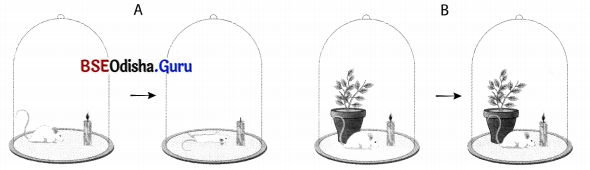
(i) Which feature of plants did Priestley interpret from his observations?
Answer:
Priestley interpreted that plants restore to the air whatever breathing animals and the burning candle remove.
(ii) Why did the mouse die in the first case, in the absence of the mint plant?
Answer:
The oxygen gas, within the bell jar, got consumed by the burning candle (burning requires oxygen) and the respiring mouse. In the absence of oxygen, the mouse could not respire and therefore died.
(iii) Identify the process responsible for the survival of the mouse in the second case. What are the products of this process?
Answer:
The mouse survived due to the availability of oxygen released during photosynthesis, by the mint plant. During photosynthesis, plants consume carbon dioxide, produce glucose, and release oxygen gas.
OR
(iii) Name the other life process that is occurring inside the bell jar. Out of scenarios A and B , in which jar will be the amount of carbon dioxide high and low respectively. Give reason.
Answer:
The process is respiration.
- In scenario A, the mouse will breathe out carbon dioxide, thereby increasing its amount inside the bell jar.
- In scenario B, the carbon dioxide released by the respiring mouse is used up by the mint plant in performing photosynthesis, hence the carbon dioxide concentration will be low.
Question 12.
Explore the consequences of the disappearance of photosynthetic organisms on the Earth.
Answer:
The disappearance of photosynthetic organisms would make the Earth uninhabitable for most living beings.
- Plants produce oxygen through photosynthesis, which is essential for animals to breathe and respire. Without plants, the oxygen level in the atmosphere would drop, causing difficulty in breathing and suffocation.
- Photosynthesis utilises and maintains the balance of carbon dioxide in the atmosphere. Without this process, carbon dioxide levels would increase, trapping more heat, which may lead to global warming and climate change.
- Plant roots help to hold soil in place. Without plants, soil would be easily washed or blown away, leading to soil erosion.