
For better exam readiness, students can include Class 7 Science MCQ and Curiosity Chapter 7 Heat Transfer in Nature MCQ in their daily study routine.
Class 7 Science Chapter 7 Heat Transfer in Nature MCQ
Heat Transfer in Nature MCQ Class 7
MCQ On Heat Transfer in Nature Class 7
Question 1.
While stirring hot soup, Sneha notices that the metal spoon in her hand also becomes hot after some time. By which mode of heat transfer does the spoon become hot?
(a) Convection
(b) Radiation
(c) Conduction
(d) Reflection
Answer:
(c) Conduction

Question 2.
A marble tile would feel cold as compared to a wooden tile on a winter morning, because the marble tile
(a) is a better conductor of heat than the wooden tile.
(b) is polished while wooden tile is not polished.
(c) reflects more heat than wooden tile.
(d) is a poor conductor of heat than the wooden tile.
Answer:
(a) Marble is a better conductor of heat than wood, so it draws heat away from your feet faster, making it feel colder. Wood is a poor conductor, so it does not take heat away quickly.
Question 3.
Meera notices that most of the cooking utensils at her home are made of metals like aluminium and steel. Curious, she asks her mother why utensils are not made of wood or plastic. What could be the most appropriate reason?
(a) Metals are cheap, while wood and plastic are expensive.
(b) Metals are poor conductors of heat, while wood and plastic are good conductors of heat.
(c) Metals are good conductors of heat, while wood and plastic are poor conductors of heat.
(d) Metals are easily available than wood or plastic.
Answer:
(c) Metals are good conductors of heat, while wood and plastic are poor conductors of heat.
Question 4.
A person wrapped himself with a few layers of newspaper on a cold winter night. This helped him stay warm because ……………..
(a) friction between the layers of newspaper produces heat.
(b) air trapped between the layers of newspaper is a poor conductor of heat.
(c) a newspaper is a good conductor of heat.
(d) the newspaper is at a higher temperature than the temperature of the surroundings.
Answer:
(b) The layers of newspaper trap air between them, and air is a poor conductor of heat, so less body heat escapes and the person stays warm.
Question 5.
A small metal pot and a clay pot filled with water are left outside in the Sun for the same duration. Later, the water in the metal pot felt warmer than the water in the clay pot. What could be the reason?
(a) Clay is a better conductor of heat than metal.
(b) Metal conducts heat quickly to the water, while clay loses heat through evaporation.
(c) Clay reflects sunlight better than metal.
(d) Metal radiates less heat to the surroundings than clay.
Answer:
(b) Clay is porous and allows some water to evaporate from its surface; evaporation causes cooling, so the water in the clay pot remains cooler.
Question 6.
In traditional rural houses in southern India, cooking areas are often under tall thatched roofs. Even without a chimney, smoke rises and escapes upward. Which principle allows the smoke to move up and out?
(a) Conduction of heat through air
(b) Convection currents in warm air
(c) Radiation of smoke particles
(d) Evaporation of smoke
Answer:
(b) Convection currents in warm air
Question 7.
In Kerala’s backwater regions, houses are often built with large windows facing the water. Which phenomenon helps this design keep homes cooler during the day?
(a) Sea breeze by convection
(b) Land breeze by conduction
(c) Heat radiation from water
(d) Evaporation cooling
Answer:
(a) Sea breeze by convection
Question 8.
Consider the following observations:
- When a candle is lit under a hanging inverted paper cup, the cup rises.
- Smoke from an incense stick always moves upward.
Which of the following best explains these observations?
(a) Hot air becomes heavier and sinks to the ground.
(b) Heating causes air to contract and occupy less space.
(c) Air expands on heating, becomes lighter, and rises upward.
(d) Smoke rises because it is pushed up by gravity.
Answer:
(c) Air expands on heating, becomes lighter, and rises upward.
Question 9.
In coastal areas, in the daytime, the air circulation between unevenly heated land and sea causes a sea breeze. Which natural processes are responsible for such air movements?
(a) Warm air from the sea is radiated upwards, and cold air rushes in, creating a sea breeze.
(b) Warm air from land rises by convection, and cold air fills its place, as a sea breeze.
(c) Warm air from the sea is conducted to the air, and cold air rushes in, creating a land breeze.
(d) Warm air from land and warm air from sea both rise and are cooled by insulation.
Answer:
(b) Warm air from land rises by convection, and cold air fills its place, as a sea breeze.
Question 10.
On a camping trip, Meera sits by a bonfire and feels warmth on her face even though the wind is blowing from behind her towards the fire. Which of the following statements could be the reason?
(a) The heat is reaching her primarily through convection.
(b) The heat is reaching her primarily through conduction.
(c) The heat is reaching her primarily through radiation.
(d) The heat is reaching her through a combination of conduction and convection.
Answer:
(c) The heat is reaching her primarily through radiation.
Question 11.
Ravi covers his lunch box with aluminium foil and keeps it in a sunny spot during winter. After an hour, the food inside is still warm. Which property of aluminium foil helped the most?
(a) Good absorption of sunlight
(b) High reflectivity, reducing heat loss by radiation
(c) Conduction of heat into the food
(d) Allowing convection to occur inside the box
Answer:
(b) All warm objects (like food) emit heat by radiation. The shiny surface of the foil reflects this heat back toward the food rather than letting it escape into the cold winter air.
Question 12.
During the water cycle, rainwater reaching an aquifer involves the sequence:
(a) evaporation → precipitation → infiltration → groundwater storage
(b) infiltration → evaporation → condensation → precipitation
(c) condensation → evaporation → infiltration → precipitation
(d) precipitation → condensation → evaporation → infiltration
Answer:
(a) evaporation → precipitation → infiltration → groundwater storage
Question 13.
Two areas receive the same amount of rain. Area X has sandy soil with more open spaces; Area Y has clayey soil with very fine particles. Groundwater recharge will be higher in:
(a) Area X
(b) Area Y
(c) Both X and Y equally
(d) Neither X nor Y
Answer:
(a) Area X because sandy soil has larger spaces, so water infiltrates faster and recharges more groundwater. Clay has very small spaces, so infiltration is slow.
Question 14.
A teacher places a heater in the corner of the classroom. After some time, it is noticed that it warms the entire room. Which of the following statements correctly explain this observation?
(i) Warm air moves upward as it becomes lighter, while cooler air sinks down and gets heated.
(ii) Warm air sinks and pushes cold air upward.
(iii) Heat spreads upward mainly by conduction.
(iv) Air circulates in a convection current.
(a) (i) and (iv)
(b) (ii) and (iii)
(c) (i) and (iii)
(d) (iii) and (iv)
Answer:
(a) The heater warms the air near it. This warm air expands, becomes lighter, and rises. Cooler air then moves down to take its place and gets heated. This continuous rising of warm air and sinking of cool air sets up convection currents, which spread heat throughout the room.
Question 15.
Two identical glasses, one painted black and the other transparent, are filled with equal amounts of water and placed in sunlight. After some time, it is observed that the water in the black painted glass becomes hotter than the water in the transparent glass.
Which of the following statements correctly explain this observation?
(i) Black surfaces absorb more heat.
(ii) Transparent surfaces allow most light to pass through, absorbing very little energy.
(iii) Transparent surfaces reflect all heat.
(iv) Black surfaces reflect radiation and remain cool.
(a) (i) and (ii) only
(b) (ii) and (iv) only
(c) (i), (ii), and (iii)
(d) (i) and (iii) only
Answer:
(a) (i) and (ii) only
Question 16.
Raj observes tiny water droplets forming outside a cold water bottle taken out of the fridge. Which of the following statements correctly explain this observation?
(i) Water vapour in the air condenses on the cold surface of the bottle.
(ii) The bottle cools the surrounding air.
(iii) Water seeps out of the bottle.
(iv) Water inside the bottle evaporates and condenses back on the outside of the bottle.
(a) (i), (iii), and (iv)
(b) (ii) and (iii) only
(c) (i) and (ii) only
(d) (i) and (iv) only
Answer:
(c) When the cold bottle is taken out, it cools the air near its surface. The water vapour present in this air condenses on the cold surface, forming tiny droplets. The water is not leaking out of the bottle, and it is not mainly coming from water inside the bottle evaporating and condensing outside.
Question 17.
A student heats water in a metal kettle over a flame. Three observations are made:
(i) The student’s face feels warm even without touching the kettle or the flame.
(ii) Water inside the kettle starts moving in a circulating manner and then boils.
(iii) The metal handle of the kettle becomes hot and needs a cloth to hold.
Which three processes do the three steps represent, in terms of heat transfer?
(a) Convection-(i), Conduction-(ii), Radiation-(iii)
(b) Conduction-(i), Radiation-(ii), Convection-(iii)
(c) Radiation-(i), Convection-(ii), Conduction-(iii)
(d) Radiation-(i), Conduction-(ii), Convection-(iii)
Answer:
(c) Radiation-(i), Convection-(ii), Conduction-(iii)
Question 18.
An object and a source of heat are placed in two different experimental setups.
Setup 1: Vacuum is present between the object and the source in a confined tube.
Setup 2: Metallic fibres are stuffed into the space between the source and object, in a confined tube. To achieve successful heating of the object, which modes of heat transfer must occur in the two setups?
(a) Setup 1: Radiation, Setup 2: Convection
(b) Setup 1: Radiation, Setup 2: Conduction
(c) Setup 1: Insulation, Setup 2: Conduction
(d) Setup 1: Insulation, Setup 2: Convection
Answer:
(b) Setup 1 (vacuum): Heat can reach the object only by radiation.
Setup 2 (metallic fibres): Heat is transferred mainly by conduction through the metal fibres.
Heat Transfer in Nature Class 7 Assertion and Reason Questions
The following questions consist of two statements – Assertion (A) and Reason (R). Answer these questions by selecting the correct option:
(a) Both A and R are true and R is the correct explanation of A.
(b) Both A and R are true but R is not the correct explanation of A.
(c) A is true but R is false.
(d) A is false but R is true.
1. (A): In solids, heat is transferred mainly by the process of convection.
(R) : Solids have a definite shape.
Answer:
(d) In solids, heat is transferred mainly by conduction, not convection.
2. (A): Ceramic utensils are preferred for cooking over metal ones.
(R): Metals are good conductors of heat.
Answer:
(d) Ceramic utensils are not preferred for cooking over metal ones. Metal utensils are preferred because they are good conductors of heat.
3. (A): Sea breeze helps keep coastal cities cooler during summer afternoons.
(R): During day, land heats up faster than sea water, so warm air above land rises and cooler air from the sea moves towards the land.
Answer:
(a) Both A and R are true and R is the correct explanation of A.
4. (A): Radiation does not require any medium for heat transfer.
(R): The Sun’s heat reaches the Earth through conduction and convection.
Answer:
(c) Sun’s heat reaches Earth by radiation, not conduction and convection.
5. (A): Wearing white clothes in summer helps keep the body cool.
(R): White clothes trap air and produce heat.
Answer:
(c) White (light-coloured) clothes keep us cooler because they reflect most of the heat that falls on them.
6. (A): Water infiltrates faster through gravel than through clay.
(R): Gravel has wider and more connected spaces between its particles than clay.
Answer:
(a) Both A and R are true and R is the correct explanation of A.
Heat Transfer in Nature Class 7 Fill in the Blanks
1. Heat is transferred in solids mainly by the process of …………
Answer: conduction
2. Materials that allow heat to pass through them easily are called ………… of heat.
Answer: good conductors
3. The process in which heat is transferred through the actual movement of particles is called …………
Answer: convection
4. Although space is a vacuum, the Sun’s heat still reaches the Earth because it travels by …………
Answer: radiation
5. The underground layers of sediments and rocks that store water in pore spaces are called …………
Answer: aquifers
Heat Transfer in Nature Class 7 True or False
Write true or false. Rewrite the false statements correctly.
1. Heat always flows from a colder body to a hotter body.
Answer:
False: Heat always flows from a hotter body to a colder body.
2. When you touch ice, you feel cold because heat moves from your hand into the ice.
Answer:
True
3. A woollen sweater keeps us warm because it generates heat.
Answer:
False: A woollen sweater keeps us warm because it traps air, and air is a poor conductor of heat, so it reduces heat loss from our body.
4. Convection can take place easily in solids.
Answer:
False: Convection takes place in liquids and gases, not in solids.
5. Hot air rises because it becomes denser.
Answer:
False: Hot air rises because it becomes less dense (lighter) on heating.
6. Radiation and convection can take place in a vacuum.
Answer:
False: Radiation can take place in a vacuum, but convection cannot because it needs a material medium.
7. All hot bodies radiate heat.
Answer:
True
8. Water infiltrates faster through clay than through gravel.
Answer:
False Water infiltrates faster through gravel than through clay.
Heat Transfer in Nature Class 7 Match the Following
Question 1.
Match column I with column II.
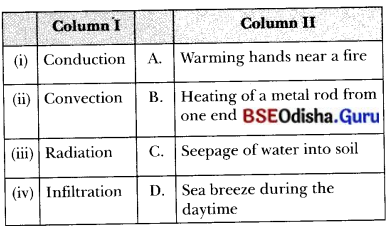
Answer:
| Column I | Column II | ||
| (i) | Conduction | B. | Heating of a metal rod from one end |
| (ii) | Convection | D. | Sea breeze during the daytime |
| (iii) | Radiation | A. | Warming hands near a fire |
| (iv) | Infiltration | C. | Seepage of water into soil |
Question 2.
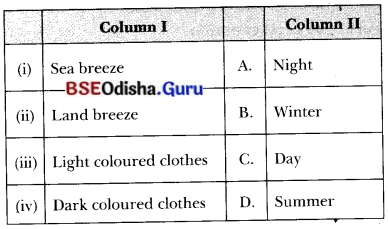
Answer:
| Column I | Column II | ||
| (i) | Sea breeze | C. | Day |
| (ii) | Land breeze | A. | Night |
| (iii) | Light coloured clothes | D. | Summer |
| (iv) | Dark coloured clothes | B. | Winter |