
Students can refer to BSE Odisha Class 7 Math Solution and Ganita Prakash Chapter 3 A Peek Beyond the Point Class 7 Question Answer to understand textbook questions step by step.
Class 7 Maths Chapter 3 A Peek Beyond the Point Solutions
Ganita Prakash Class 7 Chapter 3 Solutions
Class 7 Maths Ganita Prakash Chapter 3 Solutions A Peek Beyond the Point
Question 1.
Find the sums and differences:
(i) \(\frac{3}{10}+3 \frac{4}{100}\)
(ii) \(9 \frac{5}{10} \frac{7}{100}+2 \frac{1}{10} \frac{3}{100}\)
(iii) \(15 \frac{6}{10} \frac{4}{100}+14 \frac{3}{10} \frac{6}{100}\)
(iv) \(7 \frac{7}{100}-4 \frac{4}{100}\)
(v) \(8 \frac{6}{100}-5 \frac{3}{100}\)
(vi) \(12 \frac{6}{100} \frac{2}{100}-\frac{9}{10} \frac{9}{100}\)
Solution:
(i) \(\frac{3}{10}+3 \frac{4}{100}=\frac{3}{10}+3+\frac{4}{100}=3+\frac{30}{100}+\frac{4}{100}=3+\frac{34}{100}=3 \frac{34}{100}\)
(ii) \(9 \frac{5}{10} \frac{7}{100}+2 \frac{1}{10} \frac{3}{100}=(9+2)+\left(\frac{5}{10}+\frac{1}{10}\right)+\left(\frac{7}{100}+\frac{3}{100}\right)\)
= \(11+\frac{6}{10}+\frac{10}{100}=11+\frac{6}{10}+\frac{1}{10}=11+\frac{7}{10}=11 \frac{7}{10}\)
(iii) \(15 \frac{6}{10} \frac{4}{100}+14 \frac{3}{10} \frac{6}{100}=(15+14)+\left(\frac{6}{10}+\frac{3}{10}\right)+\left(\frac{4}{100}+\frac{6}{100}\right)\)
= \(29+\frac{9}{10}+\frac{10}{100}=29+\frac{9}{10}+\frac{1}{10}=29+\frac{10}{10}=29+1=30\)
(iv) \(7 \frac{7}{100}-4 \frac{4}{100}=\frac{707}{100}-\frac{404}{100}=\frac{707-404}{100}=\frac{303}{100}=3 \frac{3}{100}\)
(v) \(8 \frac{6}{100}-5 \frac{3}{100}=\frac{806}{100}-\frac{503}{100}=\frac{806-503}{100}=\frac{303}{100}=3 \frac{3}{100}\)
(vi) \(12 \frac{6}{100} \frac{2}{100}-\frac{9}{10} \frac{9}{100}=\left(\frac{1200}{100}+\frac{6}{100}+\frac{2}{100}\right)-\left(\frac{90}{100}+\frac{9}{100}\right)\)
= \(\frac{1208}{100}-\frac{99}{100}=\frac{1208-99}{100}=\frac{1109}{100}=11 \frac{9}{100}\)
Question 2.
Convert the following fractions into decimals:
(i) \(\frac{5}{100}\)
(ii) \(\frac{16}{1000}\)
(iii) \(\frac{12}{10}\)
(iv) \(\frac{254}{1000}\)
Solution:
(i) \(\frac{5}{100}\) = 0.05
(ii) \(\frac{16}{1000}=\frac{10}{1000}+\frac{6}{1000}\) = 0.01 + 0.006 = 0.016
(iii) \(\frac{12}{10}=\frac{10}{10}+\frac{2}{10}=1+\frac{2}{10}\) = 1 + 0.2 = 1.2
(iv) \(\frac{254}{1000}=\frac{200}{1000}+\frac{50}{1000}+\frac{4}{1000}=\frac{2}{10}+\frac{5}{100}+\frac{4}{1000}\) = 0.2 + 0.05 + 0.004 = 0.254

Question 3.
Convert the following decimals into a sum of tenths, hundredths and thousandths:
(i) 0.34
(ii) 1.02
(iii) 0.8
(iv) 0.362
Solution:
(i) 0.34 = 0.3 + 0.04 = \(\frac{3}{10}+\frac{4}{100}\)
(ii) 1.02 = 1 + 0.02 = \(\frac{100}{100}+\frac{2}{100}\)
(iii) 0.8 = \(\frac{8}{10}\)
(iv) 0.362 = 0.3 + 0.06 + 0.002 = \(\frac{3}{10}+\frac{6}{100}+\frac{2}{1000}\)
Question 4.
Will a decimal number with more digits be greater than a decimal number with fewer digits?
Solution:
No. It is not necessary as 0.9 > 0.123456789.
Question 5.
How many millimetres make 1 kilometre?
Solution:
We know that 1 km = 1,000 m and 1 m = 1,000 mm
Therefore, 1 km = 1000 × 1000 mm = 10,00,000 mm
Question 6.
Indian Railways offers optional travel insurance for passengers who book e-tickets. It costs 45 paise per passenger. If 1 lakh people opt for insurance in a day, what is the total insurance fee paid?
Solution:
The insurance fee paid for 1 passenger = 45 paise = ₹0.45
So, total insurance fee paid for 1 lakh passengers = ₹0.45 × 100000 = ₹45,000
Question 7.
Write the decimal forms of the following:
(i) 87 ones, 5 tenths and 60 hundredths
(ii) 12 tens and 12 tenths
(iii) 10 tens, 10 ones, 10 tenths, and 10 hundredths
(iv) 25 tens, 25 ones, 25 tenths, and 25 hundredths
Solution:
(i) 87 ones, 5 tenths and 60 hundredths = 87 × 1 + 5 × \(\frac{1}{10}\) + 60 × \(\frac{1}{100}\)
= 87 + \(\frac{5}{10}+\frac{60}{100}\) = 87 + 0.5 + 0.60 = 88.10
(ii) 12 tens and 12 tenths = 12 × 10 + 12 × \(\frac{1}{10}\) = 120 + \(\frac{12}{10}\)
= 120 + \(\frac{10}{10}+\frac{2}{10}\) = 120 + 1 + \(\frac{2}{10}\) = 121.2
(iii) 10 tens, 10 ones, 10 tenths, and 10 hundredths
= 10 × 10 + 10 × 1 + 10 × \(\frac{1}{10}+10 \times \frac{1}{100}\) = 100 + 10 + 1 + \(\frac{1}{10}\) = 111.1
(iv) 25 tens, 25 ones, 25 tenths, and 25 hundredths
= 25 × 10 + 25 × 1 + 25 × \(25 \times \frac{1}{10}+25 \times \frac{1}{100}\)
= 250 + 25 + \(\frac{20}{10}+\frac{5}{10}+\frac{20}{100}+\frac{5}{100}\)
= 275 + 2 + \(\frac{5}{10}+\frac{2}{10}+\frac{5}{100}=277+\frac{7}{10}+\frac{5}{100}\) = 277.75
Question 8.
Write the following fractions in decimal form:
(i) \(\frac{1}{2}\)
(ii) \(\frac{3}{2}\)
(iii) \(\frac{1}{4}\)
(iv) \(\frac{3}{4}\)
(v) \(\frac{1}{5}\)
(vi) \(\frac{4}{5}\)
Solution:
(i) \(\frac{1}{2} \times \frac{5}{5}=\frac{5}{10}\) = 0.5
(ii) \(\frac{3}{2} \times \frac{5}{5}=\frac{15}{10}=\frac{10}{10}+\frac{5}{10}=1+\frac{5}{10}\) = 1.5
(iii) \(\frac{1}{4} \times \frac{25}{25}=\frac{25}{100}=\frac{20}{100}+\frac{5}{100}=\frac{2}{10}+\frac{5}{100}\) =0.25
(iv) \(\frac{3}{4} \times \frac{25}{25}=\frac{75}{100}=\frac{70}{100}+\frac{5}{100}=\frac{7}{10}+\frac{5}{100}\) = 0.75
(v) \(\frac{1}{5} \times \frac{2}{2}=\frac{2}{10}\) = 0.2
(vi) \(\frac{4}{5} \times \frac{2}{2}=\frac{8}{10}\) = 0.8
InText Questions
Question 1.
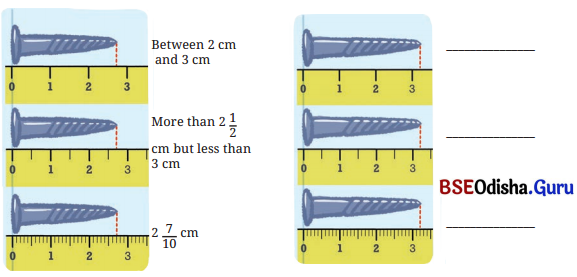
In the following figure, screws are placed above a scale. Measure them and write their length in the space provided.
(i) Which scale helped you measure the length of the screws accurately? Why?
(ii) Can you explain why the unit was
Solution:
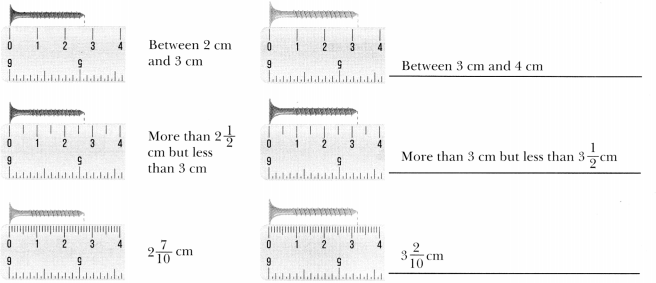
(i) The scale with the smallest divisions (marked in tenths of a centimetre, which are millimetres) allowed for the most accurate measurement. This is because the ends of the screws did not align perfectly with the whole or half centimetre marks, requiring finer divisions to determine the length more accurately.
(ii) The unit (centimetre) was divided into smaller parts (tenths, or millimetres) because the screws’ lengths were not exact whole numbers of centimeters. Smaller divisions are needed to measure lengths accurately that fall between the whole number marks.
Question 2.
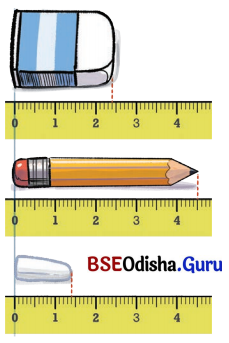
Write the measurements of the objects shown in the picture:
Solution:
Length of the eraser is \(2 \frac{4}{10}\)cm; Length of the pencil is \(4 \frac{5}{10}\)cm; Length of the chalk is \(1 \frac{4}{10}\)cm.
Question 3.
Arrange these lengths in increasing order:
(a) \(\frac{9}{10}\)
(b) \(1\frac{7}{10}\)
(c) \(\frac{130}{10}\)
(d) \(13\frac{1}{10}\)
(e) \(10\frac{5}{10}\)
(f) \(7\frac{6}{10}\)
(g) \(6\frac{7}{10}\)
(h) \(\frac{4}{10}\)
Solution:
The given fractions can be written as \(\frac{9}{10}\),
\(1 \frac{7}{10}=\frac{17}{10}, \frac{130}{10}, 13 \frac{1}{10}=\frac{131}{10}, 10 \frac{5}{10}=\frac{105}{10},\)
\(7 \frac{6}{10}=\frac{76}{10}, 6 \frac{7}{10}=\frac{67}{10} \text { and } \frac{4}{10} .\)
Comparing the given fractions and arranging in increasing order, we get
\(\frac{4}{10}<\frac{9}{10}<\frac{17}{10}<\frac{67}{10}<\frac{76}{10}<\frac{105}{10}<\frac{130}{10}<\frac{131}{10}\)
⇒ \(\begin{aligned}
\frac{4}{10}<\frac{9}{10} & <1 \frac{7}{10}<6 \frac{7}{10}<7 \frac{6}{10} \\
& <10 \frac{5}{10}<\frac{130}{10}<13 \frac{1}{10}
\end{aligned}\)
Question 4.
The lengths of the body parts of a honeybee are given. Find its total length.
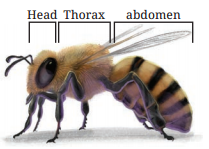
Head; \(2\frac{3}{10}\)units
Thorax: \(5\frac{4}{10}\) units
Abdomen: \(7\frac{5}{10}\) units
Solution:
Total length of the honeybee = Length of the head + Length of the thorax + Length of the abdomen
= \(2\frac{3}{10}\) units + \(5\frac{4}{10}\) units + \(7\frac{5}{10}\) units
= ( 2 + 5 +7) units + \(\left(\frac{3}{10}+\frac{4}{10}+\frac{5}{10}\right)\)units
= (14 + \(\frac{12}{10}\)) units
= (14 + \(\frac{10}{10}+\frac{2}{10}\)) units = (14 + 1 + \(\frac{2}{10}\)) units
= (15 + \(\frac{2}{10}\)) units = 15\(\frac{2}{10}\) units
Question 5.
Find the difference of \(12\frac{4}{10}\) and \(6\frac{7}{10}\) by converting both lengths to tenths.
Solution:
Converting to tenths:
\(12 \frac{4}{10}=12+\frac{4}{10}=\frac{120}{10}+\frac{4}{10}=\frac{124}{10}\) and
\(6 \frac{7}{10}=6+\frac{7}{10}=\frac{60}{10}+\frac{7}{10}=\frac{67}{10}\)
Required difference = \(\frac{124}{10}-\frac{67}{10}=\frac{57}{10}\)
= \(\frac{50}{10}+\frac{7}{10}=5+\frac{7}{10}=5 \frac{7}{10}\) units
Question 6.
A Celestial Pearl Danio’s length is \(2\frac{4}{10}\) cm and the length of a Philippine Goby is \(\frac{9}{10}\) cm. What is the difference in their lengths?

Solution:
Length of a Celestial Pearl Danio fish
= \(2 \frac{4}{10} \mathrm{~cm}=\frac{20}{10}+\frac{4}{10}=\frac{24}{10} \mathrm{~cm}\)
Length of a Philippine Goby fish = \(\frac{9}{10}\) cm
So, the difference in their lengths
= \(\frac{24}{10} \mathrm{~cm}-\frac{9}{10} \mathrm{~cm}=\frac{15}{10} \mathrm{~cm}=1 \frac{5}{10} \mathrm{~cm}\)
Question 7.
Observe the given sequences of numbers. Identify the change after each term and extend the pattern:
(i) \(4,4 \frac{3}{10}, 4 \frac{6}{10}\), _______, _______, ______
(ii) \(8 \frac{2}{10}, 8 \frac{7}{10}, 9 \frac{2}{10}\), _______, _______, ______
(iii) \(3 \frac{5}{10}, 13,12 \frac{5}{10}\), _______, _______, ______
(iv) \(11 \frac{5}{10}, 10 \frac{4}{10}, 9 \frac{3}{10}\), _______, _______, ______
Solution:
(i) The given sequence is \(4,4 \frac{3}{10}, 4 \frac{6}{10}\), …….
Here, \(4 \frac{3}{10}-4=\frac{3}{10} ; 4 \frac{6}{10}-4 \frac{3}{10}=\frac{3}{10}\)
1st term = 4, any other term = previous term + \(\frac{3}{10}\)
The further terms are:
\(4 \frac{6}{10}+\frac{3}{10}=4 \frac{9}{10} ; 4 \frac{9}{10}+\frac{3}{10}\)
= \(4 \frac{12}{10}=5 \frac{2}{10} ; 5 \frac{2}{10}+\frac{3}{10}\)
= \(5 \frac{5}{10} ; 5 \frac{5}{10}+\frac{3}{10}=5 \frac{8}{10}\)
Thus, the sequence is
\(4,4 \frac{3}{10}, 4 \frac{6}{10}, \mathbf{4} \frac{\mathbf{9}}{\mathbf{1 0}}, \mathbf{5} \frac{\mathbf{2}}{\mathbf{1 0}}, \mathbf{5} \frac{\mathbf{5}}{\mathbf{1 0}}, \mathbf{5} \frac{\mathbf{8}}{\mathbf{1 0}}\), …..
(ii) Since, the sequence is
\(\begin{aligned}
& 8 \frac{2}{10}+\frac{5}{10}=8 \frac{7}{10}, 8 \frac{7}{10}+\frac{5}{10} \\
& =8 \frac{12}{10}=8+1+\frac{2}{10}=9 \frac{2}{10}
\end{aligned}\)
1st = \(8 \frac{2}{10}\), any other term = previous term + \(\frac{5}{10}\)
The further terms are:
\(\begin{aligned}
& 9 \frac{2}{10}+\frac{5}{10}=9 \frac{7}{10} ; 9 \frac{7}{10}+\frac{5}{10} \\
& =9 \frac{12}{10}=10 \frac{2}{10} ; 10 \frac{2}{10}+\frac{5}{10} \\
& =10 \frac{7}{10} ; 10 \frac{7}{10}+\frac{5}{10}=10 \frac{12}{10}=11 \frac{2}{10}
\end{aligned}\)
Thus, the sequence is
\(8 \frac{2}{10}, 8 \frac{7}{10}, 9 \frac{2}{10}, \mathbf{9} \frac{7}{\mathbf{1 0}}, \mathbf{1 0} \frac{2}{\mathbf{1 0}}, \mathbf{1 0} \frac{7}{\mathbf{1 0}}, \mathbf{1 1} \frac{2}{\mathbf{1 0}}\), …..
(iii) Since \(13 \frac{5}{10}-\frac{5}{10}=13 ; 13-\frac{5}{10}\)
= \(12+1-\frac{5}{10}=12+\frac{10}{10}-\frac{5}{10}=12 \frac{5}{10}\), ….
1st = \(13 \frac{5}{10}\), any other term = previous term – \(\frac{5}{10}\)
The further terms are:
\(13 \frac{5}{10}, 13,12 \frac{5}{10}, \underline{\mathbf{1 2}}, \mathbf{1 1 \frac { \mathbf { 5 } } { \mathbf { 1 0 } }}, \underline{\mathbf{1 1}}, \mathbf{1 0} \frac{\mathbf{5}}{\mathbf{1 0}}\)
(iv) Since \(\begin{aligned}
11 \frac{5}{10}-1 \frac{1}{10}=10 & \frac{4}{10} \\
& 10 \frac{4}{10}-1 \frac{1}{10}=9 \frac{3}{10}
\end{aligned}\); ….
1st = \(11 \frac{5}{10}\), any other term = previous term – \(1\frac{1}{10}\)
The further terms are:
\(11 \frac{5}{10}, 10 \frac{4}{10}, 9 \frac{3}{10}, \mathbf{8} \frac{\mathbf{2}}{\mathbf{1 0}}, \mathbf{7} \frac{\mathbf{1}}{\mathbf{1 0}}, \mathbf{6}, \mathbf{4} \frac{\mathbf{9}}{\mathbf{1 0}}\), ….
Question 8.
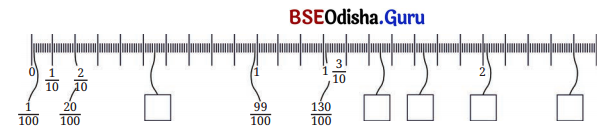
Observe the fiure below. Notice the markings and the corresponding lengths written in the boxes when measured from 0. Fill the lengths in the empty boxes.
Solution:
\(\frac{55}{100}, \frac{155}{100}, \frac{174}{100}, \frac{202}{100}, \frac{240}{100}\)
Question 9.
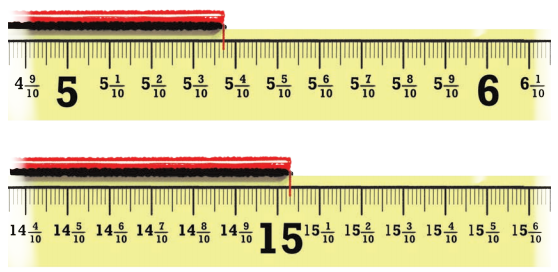
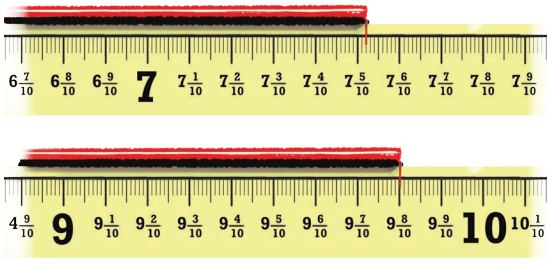
For the lengths shown below write the measurements and read out the measures in words.
Solution:
(a) \(5 \frac{3}{10} \frac{7}{100}\) Five and three-tenths and seven-hundredths
or \(5 \frac{37}{100}\) Five and thirty seven-hundredths
or \(\frac{537}{100}\) Five hundred and thirty seven-hundredths
(b) \(15 \frac{3}{100}\) Fifteen and three-hundredths
or \(\frac{1503}{100}\) One thousand five hundred and three-hundredths
(c) \(7 \frac{5}{10} \frac{2}{100}\) Seven and five-tenths and two-hundredths
or \(7 \frac{52}{100}\) Seven and fifty two-hundredths or \(\frac{752}{100}\) Seven hundred and fifty two-hundredths
(d) \(9 \frac{8}{10}\) Nine and eight-tenths
or \(9 \frac{8}{100}\) Nine and eights-hundredths
or \(\frac{980}{100}\) Nine hundred and eighty-hundredths
Question 10.
Solve the difference \(25 \frac{9}{10}-6 \frac{4}{10} \frac{7}{100}\) by converting to hundredths.
Solution:
Converting to hundredths:
\(25 \frac{9}{10}=25 \frac{90}{100}=\frac{2500}{100}+\frac{90}{100}=\frac{2590}{100} ; 6 \frac{4}{10} \frac{7}{100}=\frac{600}{100}+\frac{40}{100}+\frac{7}{100}=\frac{647}{100}\)
Now, \(25 \frac{9}{10}-6 \frac{4}{10} \frac{7}{100}=\frac{2590}{100}-\frac{647}{100}=\frac{(2590-647)}{100}=\frac{1943}{100}=19 \frac{43}{100}\)
Question 11.
Write these quantities in decimal form:
(i) 234 hundredths
(ii) 105 tenths.
Solution:
(i) 234 hundredths can be expressed in decimal form as follows
234 hundredths = \(\frac{234}{100}=\frac{200}{100}+\frac{30}{100}+\frac{4}{100}=2+\frac{3}{10}+\frac{4}{100}\) = 2.34
(ii) 105 tenths can be expressed in decimal form as follows:
105 tenths = \(\frac{105}{10}=\frac{100}{10}+\frac{0}{10}+\frac{5}{10}=10+0+\frac{5}{10}\) = 10.5
Question 12.
Name all the divisions between 1 and 1.1 on the number line.

Solution:
The divisions between 1 and 1.1 represent the decimal numbers 1.01, 1.02, 1.03, 1.04, 1.05, 1.06, 1.07, 1.08 and 1.09 on the number line.
Question 13.
Identify and write the decimal numbers against the letters.

Solution:
The letters marked on the given number line represent the decimal numbers as follows: A = 5.09, B = 5.13, C = 5.2, D = 5.31
Question 14.
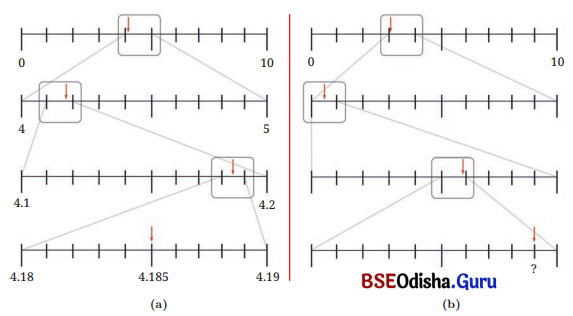
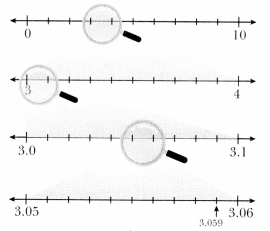
Identify the decimal number in the last number line in below figure denoted by ‘?’
Solution:
By labelling the visualised segment of the number line, we find that the decimal number 3.059 is denoted by ?’
Question 15.
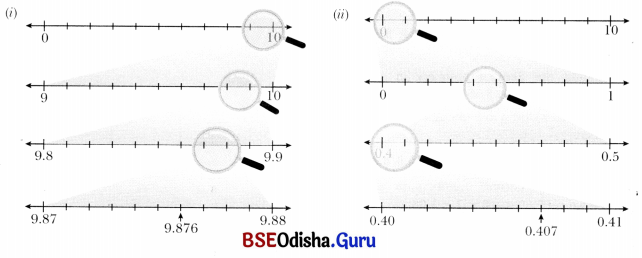
Locate the following decimal numbers on the number line:
(i) 9.876
(ii) 0.407
Solution:
Question 16.
Which decimal number is greater?
(i) 1.23 or 1.32
(ii) 3.81 or 13.800
(iii) 1.009 or 1.090
Solution:
(i) Using decimal place value chart, we find that:
| Tens | Ones | Decimal point | Tenths | Hundredths | Thousandths |
| 1 | . | 2 | 3 | ||
| 1 | . | 3 | 2 |
Both numbers have 1 unit but the first number has 2 tenths whereas the second number has 3 tenths.
Therefore, 1.23 < 1.32
(ii) Using decimal place value chart, we find that:
| Tens | Ones | Decimal point | Tenths | Hundredths | Thousandths |
| 3 | 8 | 1 | |||
| 1 | 3 | 8 | 0 | 0 |
Here, the first number has 3 units whereas the second number has 1 ten and 3 units.
Therefore, 3.81 < 13.800
(iii) Using decimal place value chart, we find that:
| Tens | Ones | Decimal point | Tenths | Hundredths | Thousandths |
| 1 | . | 0 | 0 | 9 | |
| 1 | . | 0 | 9 | 0 |
Both numbers have 1 unit and the 0 tenths but the first number has 0 hundredths whereas the second number has 9 hundredths.
Therefore, 1.009 < 1.090
Question 17.
Which among these is closest to 4: 3.56, 3.65, 3.099?
Solution:
Arranging the decimal numbers in ascending order, we get 3.099 < 3.56 < 3.65 < 4.
Clearly, 3.65 is closest to 4 among the given decimal numbers.
Question 18.
Which among these is closest to 1: 0.8, 0.69, 1.08?
Solution:
Arranging the decimal numbers in ascending order, we get 0.69 < 0.8 < 1 < 1.08.
Among the neighbours of 1, 0.8 is \(\frac{2}{10}\), i.e. \(\frac{2}{100}\) away from 1 whereas 1.08 is \(\frac{8}{100}\) away from 1. Therefore, 1.08 is closest to 1.
Question 19.
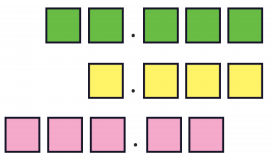
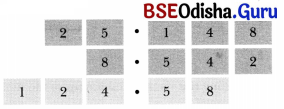
In each case below use the digits 4, 1, 8, 2 and 5 exactly once and try to make a decimal number as close as possible to 25.
Solution:
We can make a decimal number closest to 25 using the digits 4, 1, 8, 2 and 5 with the given conditions as follows:
Question 20.
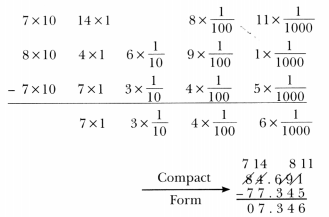
Write the detailed place value computation for 84.691 – 77.345, and its compact form.
Solution:
We can find the difference of 84.691 – 77.345 as follows:
A Peek Beyond the Point Class 7 Extra Questions
A Peek Beyond the Point Class 7 Very Short Question Answer
Question 1.
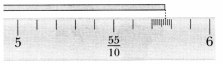
For the length shown below, write the measurement and read out the measure in words.
Solution:
From the figure, the strip covers 5 units, 7-tenths and 7-hundredths.
∴ The length of the strip is \(5 \frac{7}{10} \frac{7}{100}\) units.
It is read as “Five and seven-tenths and seven- hundredths”.
Question 2.
Find the value of \(8 \frac{6}{100}-4 \frac{5}{100}\).
Solution:
\(8 \frac{6}{100}-4 \frac{5}{100}=(8-4)+\left(\frac{6}{100}-\frac{5}{100}\right)=4+\frac{1}{100}\)
= \(4 \frac{1}{100}\)
Question 3.
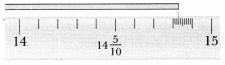
For the length shown below write the measurement and read out the measure in words.
Solution:
From the figure, the strip covers 14 units, 8-tenths and 3-hundredths.
∴ The length of the strip is \(14 \frac{8}{10} \frac{3}{100}\) units.
It is read as “Fourteen and eight-tenths and three- hundredths”.
Question 4.
Convert into the decimal:\(\frac{57}{10}\)
Solution:
The number of zeros in denominator after 1 is 1.
Thus, starting from the extreme right digit of the numerator, we insert the decimal point 1 place to the left.
Therefore, \(\frac{57}{10}\) = 5.7
Question 5.
Which decimal is greater, 0.71 or 0.071?
Solution:
The whole number parts of both the numbers are 0.
Comparing the digits in the tenths place, we get 7 > 0. So, 0.71 > 0.071.
Question 6.
Add the following:
(i) 3.9732 and 0.8
(ii) 12.16, 34 and 87.943
Solution:
(i) \(\begin{array}{r}
3.9732 \\
+0.8000 \\
\hline 4.7732 \\
\hline
\end{array}\)
(ii) \(\begin{array}{r}
12.160 \\
34.000 \\
+87.943 \\
\hline 134.103
\end{array}\)
Question 7.
Subtract:
(i) 18.25 from 24.05
(ii) 233.326 from 507
Solution:
(i) \(\begin{array}{r}
24.05 \\
-18.25 \\
\hline 5.80 \\
\hline
\end{array}\)
(ii) \(\begin{array}{r}
507.000 \\
-233.326 \\
\hline 273.674 \\
\hline
\end{array}\)
Question 8.
Find the sum:
(i) 0.007 + 8.5 + 30.089
(ii) 0.75 + 25.892 + 200.097
Solution:
(i) \(\begin{array}{r}
0.007 \\
8.500 \\
+30.089 \\
\hline 38.596 \\
\hline
\end{array}\)
(ii) \(\begin{array}{r}
0.750 \\
25.892 \\
+200.097 \\
\hline 226.739 \\
\hline
\end{array}\)
Question 9.
A shirt costs ₹ 355.50 and a sweater costs ₹ 536.50. Find the total cost of shirt and sweater.
Solution:
To find the total cost of the shirt and a sweater, we simply add the two amounts.
Thus, total cost = ₹355.50 + ₹536.50 = ₹892.00
A Peek Beyond the Point Class 7 Short Question Answer
Question 1.
The lengths of the body part of an ant are as follows:
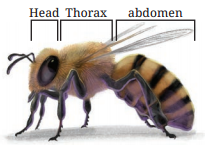
Head = \(\left(1 \frac{6}{10}\right)\) units; Throax = \(\left(2 \frac{3}{10}\right)\) units; Abdomen = \(\left(3 \frac{9}{10}\right)\) units.
Find the total length of the ant.
Solution:
Total length of the ant = Length of head + Length of thorax + Length of abdomen
= \(1 \frac{6}{10}+2 \frac{3}{10}+3 \frac{9}{10}\)
= ( 1 + 2 + 3) + \(\left(\frac{6}{10}+\frac{3}{10}+\frac{9}{10}\right)\)
= 6 + \(\frac{18}{10}=6+\frac{10}{10}+\frac{8}{10}\)
= 7 + \(\frac{8}{10}=7 \frac{8}{10}\) units
Thus, the total length of the ant is \(7 \frac{8}{10}\) units.
Question 2.
Write the following decimal numbers in ascending order:
5.64, 2.54, 3.05, 0.259 and 8.32
Solution:
As all the given decimal numbers have unequal whole number part, we can arrange the decimal numbers byjust comparing the whole number parts.
The whole number parts of given decimal numbers are 5, 2, 3, 0 and 8 respectively.
As 0 < 2 < 3 < 5 < 8
0.259 < 2.54 < 3.05 < 5.64 < 8.32
Question 3.
Among 1.95, 2.1, 2.05 and 1.99, which number is closest to 2?
Solution:
1.95 and 1.99 are smaller than 2. Thus,
2 – 1.95 = 0.05
2 – 1.99 = 0.01
2.1 and 2.05 are greater than 2. Thus,
2.1 – 2 = 0.1
2.05 – 2 = 0.05
Since 0.01 is the smallest difference, 1.99 is closest to 2.
Question 4.
Put the following decimal numbers in the appropriate boxes:
(a) 0.7
(b) 0.346
(c) 0.504
(d) 0.967
(e) 0.089
(f) 0.007
(g) 0.894
(h) 0.170
(i) 0.67
(j) 0.3
(k) 0.876
(l) 0.499
| Numbers less than 0.5 | Numbers greater than 0.5 |
Solution:
| Numbers less than 0.5 | Numbers greater than 0.5 |
| (b) 0.346 (e) 0.089 (j) 0.007 (h) 0.170 (j) 0.3 (j) 0.499 | (a) 0.7 (c) 0.504 (d) 0.967 (g) 0.894 (i) 0.67 (k) 0.876 |
Question 5.
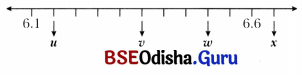
On the number line given below, what decimal numbers do the letters ‘w’, v, ‘w’ and ‘x’ represent?
Solution:
There are 10 divisions between 6.1 and 6.6
So, each division is a tenth part of 0.5 or \(\) i.e., \(\) = 0.05 units.
Therefore, the first division after 6.1, denoted by V represents the decimal number 6.15, while the 5th division, denoted by ‘v’ represents the number 6.35.
The 8th division denoted by ‘x’ represents 6.50 and the first division after 6.6, denoted by ‘x’, represents the number 6.65.
Question 6.
Arrange the following in the descending order:
(i) 10.98, 10.089, 10.809, 10.908, 10.981
(ii) 22.31, 22.13, 22.331, 22.313, 22.133
Solution:
(i) We can write the given decimal numbers as like decimals as:
10.980, 10.089, 10.809, 10.908, 10.981
By comparing the digits from left to right after the decimal point, the given decimal numbers can be written in descending order as follows:
10.981, 10.98, 10.908, 10.809, 10.089
(ii) We can write the given decimal numbers as like decimals as:
22.310, 22.130, 22.331, 22.313, 22.133
By comparing the digits from left to right after the decimal point, the given decimal numbers can be written in descending order as follows:
22.331, 22.313, 22.31, 22.133, 22.13
Question 7.
A runner completed a race in 1.75 hours. How many minutes did he take to finish the race?
Solution:
Time taken by runner to complete the race = 1.75 hours
We know that 1 hour = 60 minutes.
Now, 1.75 hours = 1 hour + 0.75 hours = 60 minutes + (0.75 x 60) minutes
= 60 minutes + 45 minutes = 105 minutes
Thus, the runner took 105 minutes to complete the race.
Question 8.
From a packet of sugar weighing 0.875 kilograms, 437 grams of sugar was used up for making dessert. How much sugar is left in the packet? Give the answer in kilograms.
Solution:
Total sugar in packet = 0.875 kg
Sugar used = 437 grams = 0.437 kg
Sugar left in the packet = 0.875 kg – 0.437 kg
= 0.438 kg
A Peek Beyond the Point Class 7 Long Question Answer
Question 1.
Represent the following decimal numbers in the decimal place value chart. Give their expanded form (both fractional and decimal) and write the numbers in words.
(i) 235.25
(ii) 10.05
(iii) 0.755
(iv) 43.007
Solution:
| Place Name | Thousands | Hundreds | Tens | Ones | • | Tenths | Hundredths | Thousandths | |
| Place value | 1000 | 100 | 10 | 1 | • | \(\frac{1}{10}\) | \(\frac{1}{100}\) | \(\frac{1}{1000}\) | |
| (i) | 235.25 | 2 | 3 | 5 | • | 2 | 5 | ||
| (ii) | 10.05 | 1 | 0 | • | 0 | 5 | |||
| (iii) | 0.755 | 0 | • | 7 | 5 | 5 | |||
| (iv) | 43.007 | 4 | 3 | • | 0 | 0 | 7 |
(i) 235.25 = 200 + 30 + 5 + 0.2 + 0.05 = 200 + 30 + 5 + \(\frac{2}{10}+\frac{5}{100}\)
= 235 + \(\frac{20}{100}+\frac{5}{100}=235+\frac{25}{100}=235 \frac{25}{100}\)
In words: Two hundred thirty five point two five
(ii) 10.05 = 10 + 0.05 = 10 + 0 + \(\frac{0}{10}+\frac{5}{100}=10+\frac{5}{100}=10 \frac{5}{100}\)
In words: Ten point zero five
(iii) 0.755 = 0.7 + 0.05 + 0.005 = \(\frac{7}{10}+\frac{5}{100}+\frac{5}{1000}=\frac{700}{1000}+\frac{50}{1000}+\frac{5}{1000}=\frac{755}{1000}\)
In words: Zero point seven five five
(iv) 43.007 = 40 + 3 + 0.007 = 40 + 3 + \(\frac{7}{1000}=43+\frac{7}{1000}=43 \frac{7}{1000}\)
In words: Forty three point zero zero seven
Question 2.
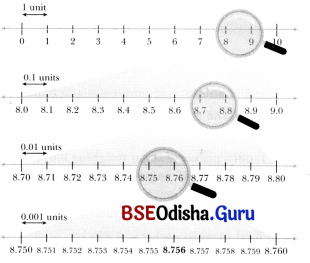
Represent the decimal number, 8.756 on number line (use multiple number lines to show subsequent magnifications).
Solution:
Question 3.
Ravi delivers 3.5 kg, 3.2 kg and 7.1 kg of vegetables to a store in the first three days. In 7 days, he delivers 20 kg of vegetables. What is the total quantity of vegetables delivered in the last four days?
Solution:
The total quantity of vegetables delivered in the
first 3 days = 3.5 kg + 3.2 kg + 7.1 kg = 13.8 kg
Given, total quantity of vegetables delivered in 7 days is 20 kg.
∴ Quantity of vegetables delivered in the last 4 days
= Quantity of vegetables delivered in 7 days – Quantity of vegetables delivered in 3 days
= 20- 13.8 = 6.2 kg
Hence, Ravi delivered 6.2 kg of vegetables in the last 4 days.
A Peek Beyond the Point Class 7 Case Based Questions
The Matki Phod game is a popular event during Janmashtami. In this game, a clay pot (called a Matki) filled with curd, butter or other milk- based food is tied at a height, and players form a multi-level human pyramid to reach and break it.
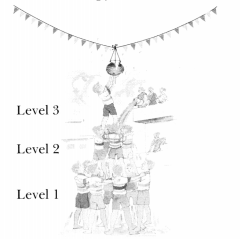
In one such event, the matki is tied at a height of \(13 \frac{5}{10}\) units from the ground. Each person in the pyramid is \(3 \frac{2}{10}\) units tall.
Based on the given information, answer the following questions:
(i) What is the total height of 3 such levels?
(ii) How many levels are needed to reach or cross the height of the matki?
Solution:
(i) Total height of three levels
= \(3 \frac{2}{10}+3 \frac{2}{10}+3 \frac{2}{10}=9 \frac{6}{10}\) units
(ii) We need to find the smallest number of levels such that:
Height > \(13 \frac{5}{10}\) units
Height of each level = \(3 \frac{2}{10}\) units Total height of 4 levels
= \(3 \frac{2}{10}+3 \frac{2}{10}+3 \frac{2}{10}+3 \frac{2}{10}=12 \frac{8}{10}\)units
Total height of 4 levels is less than \(13 \frac{5}{10}\) units,
so players will not reach upto the Matki.
Now, total height of 5 levels = Total height of 4 levels + \(3 \frac{2}{10}=12 \frac{8}{10}+3 \frac{2}{10}\) = 16 units.
On increasing one level, the height of Matki can be reached.
Hence, minimum 5 levels are required to cross the height of the Matki.
Question 2.
The table displays the rainfall (in cm) recorded in various months in delhi in year 2024.

| Month | Rainfall (in cm) | Month | Rainfall (in cm) |
| January | 6.2 | July | 3.84 |
| February | 7 | August | 2.4 |
| March | 7.55 | September | 4.1 |
| April | 8.2 | October | 6 |
| May | 7.45 | November | 5.9 |
| June | 5.7 | December | 6.3 |
Based on the above information, answer the following questions:
(i) Find the total rainfall recorded in the first three months of the year.
(ii) Find the total rainfall recorded in the last three months of the year.
(iii) How much total rainfall was recorded during the three wettest months?
Solution:
(i) The total rainfall recorded in the first three months, i.e. January, February and March
= (6.2 + 7 4 – 7.55) cm = 20.75 cm
(ii) The total rainfall in the last three months of the year, i.e. October, November and December
= (6 + 5.9 + 6.3) cm = 18.2 cm
(iii) Comparing the rainfalls in all months, we find that the three wettest months are March, April and May with rainfall of 7.55 cm, 8.2 cm and 7.45 cm, respectively.
Thus, total rainfall recorded during three wettest months = (7.55 + 8.2 + 7.45) cm
= 23.2 cm.