
Regular revision with Class 6 Maths MCQ with Answers and Ganita Prakash Class 6 Maths Chapter 7 Fractions MCQ improves accuracy in objective exams.
MCQ on Fractions Class 6
Fractions MCQ Class 6
Class 6 Maths Fractions MCQ
Question 1.
If a watermelon is shared among 4 children equally, then the share of each child is:
(a) 4
(b) \(\frac{1}{2}\)
(c) \(\frac{1}{4}\)
(d) \(\frac{1}{8}\)
Solution:
(c) \(\frac{1}{4}\)
One watermelon is shared among 4 children equally.
So, share of each child
= \(\frac{\text { Number of watermelon }}{\text { Number of children }}=\frac{1}{4}\)
Question 2.
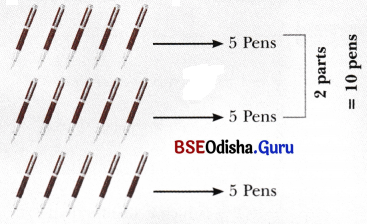
\(\frac{2}{3}\) of a collection of 15 pens is equal to:
(a) 5 pens
(b) 8 pens
(c) 10 pens
(d) 12 pens
Solution:
(c) 10 pens
In order to find \(\frac{2}{3}\) of a collection of 15 pens, we divide the collection of 15 pens in 3 equal parts and take 2 such parts.
Question 3.
The fraction of vowels in the English alphabet is:
(a) \(\frac{21}{26}\)
(b) \(\frac{5}{26}\)
(c) \(\frac{26}{5}\)
(d) \(\frac{26}{21}\)
Solution:
(b) \(\frac{5}{26}\)
Total number of English alphabets = 26
Number of vowels = 5
So, the required fraction
= \(\frac{\text { Number of vowels }}{\text { Total number of alphabets }}=\frac{5}{26}\)

Question 4.
Fraction representing 15 minutes of an hour is:
(a) \(\frac{1}{4}\)
(b) \(\frac{1}{6}\)
(c) \(\frac{1}{3}\)
(d) \(\frac{1}{2}\)
Solution:
(a) \(\frac{1}{4}\)
We know, there are 60 minutes in 1 hour.
So, fraction representing 15 minutes of an hour = \(\frac{15}{60}\) = \(\frac{1}{4}\)
Question 5.
What fraction of the natural numbers from 2 to 30 are multiples of 2 and 3?
(a) \(\frac{3}{19}\)
(b) \(\frac{5}{29}\)
(c) \(\frac{4}{19}\)
(d) \(\frac{4}{29}\)
Solution:
(b) \(\frac{5}{29}\)
Number of natural numbers from 2 to 30 = 30 – 2 + 1 = 29
Multiples of 2 and 3 from 2 to 30 are 6, 12, 18, 24 and 30.
Number of multiples of 2 and 3 from 2 to 30 = 5
∴ Required fraction = \(\frac{5}{29}\)
Question 6.
Which of the following fractions is a proper fraction?
(a) \(\frac{3}{4}\)
(b) \(\frac{3}{2}\)
(c) \(\frac{4}{3}\)
(d) \(\frac{5}{2}\)
Solution:
(a) \(\frac{3}{4}\)
We know, a fraction whose numerator is less than the denominator is called proper fraction.
So, \(\frac{3}{4}\) is a proper fraction.
Question 7.
Which of the following fractions is not an improper fraction?
(a) 4
(b) \(\frac{5}{5}\)
(c) \(\frac{4}{5}\)
(d) \(\frac{5}{4}\)
Solution:
(c) \(\frac{4}{5}\)
We know, fractions with the numerator either equal to or greater than the denominator are called improper fractions.
So, \(\frac{4}{5}\) is not an improper fraction.
Question 8.
If \(\frac{5}{13}=\frac{x}{65}\) then x =
(a) 26
(b) 39
(c) 15
(d) 25
Solution:
(d) 25
Given, \(\frac{5}{13}=\frac{x}{65}\)
As they are equivalent fractions and 13 × 5 = 65, so we multiply the numerator by 5 as well.
Thus, \(\frac{5 \times 5}{13 \times 5}=\frac{x}{65}\)
⇒ \(\frac{25}{65}=\frac{x}{65}\) ⇒ x = 25
Question 9.
Which of the following fractions corresponds to the mixed fraction \(7 \frac{2}{15}\)?
(a) \(\frac{107}{15}\)
(b) \(\frac{29}{15}\)
(c) \(\frac{103}{15}\)
(d) \(\frac{44}{15}\)
Solution:
(a) \(\frac{107}{15}\)
\(7 \frac{2}{15}=7+\frac{2}{15}=\frac{7 \times 15+2}{15}\)
= \(\frac{105+2}{15}=\frac{107}{15}\)
Question 10.
The equivalent fraction of \(\frac{7}{12}\) is:
(a) \(\frac{14}{26}\)
(b) \(\frac{21}{36}\)
(c) \(\frac{26}{48}\)
(d) \(\frac{34}{60}\)
Solution:
(b) \(\frac{21}{36}\)
We can write.
\(\frac{7}{12}=\frac{7 \times 2}{12 \times 2}=\frac{7 \times 3}{12 \times 3}=\frac{7 \times 4}{12 \times 4}=\frac{7 \times 5}{12 \times 5}\)
⇒ \(\frac{7}{12}=\frac{14}{24}=\frac{21}{36}=\frac{28}{48}=\frac{35}{60}\)
Question 11.
If \(\frac{21}{27}\) is equivalent to \(\frac{7}{x}\), then x is:
(a) 3
(b) 9
(c) 6
(d) 5
Solution:
(b) 9
Given, \(\frac{21}{27}=\frac{7}{x}\)
⇒ \(\frac{21 \div 3}{27 \div 3}=\frac{7}{x}\) ⇒ \(\frac{7}{9}=\frac{7}{x}\)
⇒ x = 9
Question 12.
Mixed fraction corresponding to fraction \(\frac{39}{4}\) is:
(a) \(9\frac{1}{4}\)
(b) \(10\frac{3}{4}\)
(c) \(9\frac{3}{4}\)
(d) \(10\frac{1}{4}\)
Solution:
(c) \(9\frac{3}{4}\)
\(\frac{39}{4}=9+\frac{3}{4}=9 \frac{3}{4}\)

Question 13.
\(\frac{1}{4 \frac{1}{2}}+\frac{1}{2 \frac{1}{4}}\) =
(a) \(\frac{2}{3}\)
(b) \(\frac{1}{2}\)
(c) \(\frac{3}{2}\)
(d) \(\frac{1}{3}\)
Solution:
(a) \(\frac{2}{3}\)
We have, \(\frac{1}{4 \frac{1}{2}}+\frac{1}{2 \frac{1}{4}}=\frac{1}{4+\frac{1}{2}}+\frac{1}{2+\frac{1}{4}}\)
= \(\frac{1}{\frac{4 \times 2+1}{2}}+\frac{1}{\frac{2 \times 4+1}{4}}\)
= \(\frac{1}{\frac{8+1}{2}}+\frac{1}{\frac{8+1}{4}}=\frac{1}{\frac{9}{2}}+\frac{1}{\frac{9}{4}}\)
= \(\frac{2}{9}+\frac{4}{9}=\frac{2+4}{9}=\frac{6}{9}=\frac{2}{3}\)
Question 14.
If \(\frac{1}{3}+\frac{1}{2}+\frac{1}{x}\) = 3, then x =
(a) \(\frac{5}{13}\)
(b) \(\frac{4}{9}\)
(c) \(\frac{6}{13}\)
(d) \(\frac{5}{7}\)
Solution:
(c) \(\frac{6}{13}\)
We have, \(\frac{1}{3}+\frac{1}{2}+\frac{1}{x}=3\)
⇒ \(\frac{1}{x}=3-\frac{1}{3}-\frac{1}{2}\)
⇒ \(\frac{1}{x}=\frac{3 \times 6}{6}-\frac{1 \times 2}{3 \times 2}-\frac{1 \times 3}{2 \times 3}\)
⇒ \(\frac{1}{x}=\frac{18}{6}-\frac{2}{6}-\frac{3}{6} \Rightarrow \frac{1}{x}=\frac{18-2-3}{6}\)
⇒ \(\frac{1}{x}=\frac{13}{6}\) ⇒ 13 × x = 1 × 6
⇒ x = \(\frac{1 \times 6}{13}=\frac{6}{13}\)
Question 15.
Which of the following fractions can be written as mixed fraction?
(i) \(\frac{5}{4}\)
(ii) \(\frac{8}{3}\)
(iii) \(\frac{3}{4}\)
(iv) \(\frac{5}{8}\)
Choose the correct option from the following:
(a) Only (i)
(b) (ii) and (iii)
(c) (i) and (iv)
(d) (i) and (ii)
Solution:
(d) (i) and (ii)
We know that only those fractions, which are greater than 1, can be converted into mixed fractions. Here, \(\frac{5}{4}\) and \(\frac{8}{3}\) are greater than 1 as numerator is greater than denominator in each case.
Question 16.
Consider the following fractions:
(i) \(\frac{7}{2}\)
(ii) \(\frac{8}{3}\)
(iii) \(\frac{13}{4}\)
(iv) \(\frac{17}{6}\)
Which of the following fractions are greater than 3?
(a) (i) and (iii)
(b) (i) and (iv)
(c) (ii) and (iii)
(d) (ii) and (iv)
Solution:
(a) (i) and (iii)
\(\frac{7}{2}=3 \frac{1}{2}\) (which is greater than 3)
\(\frac{8}{3}=2 \frac{2}{3}\) (which is smaller than 3)
\(\frac{13}{4}=3 \frac{1}{4}\) (which is greater than 3)
\(\frac{17}{6}=2 \frac{5}{6}\) (which is smaller than 3)
Fractions Class 6 Fill in the Blanks
Question 1.
Five apples together weigh 1 kg. If they are of the same size, each apple will weigh ______ kg.
Solution: \(\frac{1}{5}\)
Given, weight of five apples = 1 kg
∴ Weight of one apple = \(\frac{1}{5}\) kg
Question 2.
\(\frac{2}{5}\) is _____ than \(\frac{4}{5}\).
Solution: smaller
\(\frac{2}{5}\) means 2 parts out of 5 and \(\frac{4}{5}\) means 4 parts
out of 5.
∴ \(\frac{2}{5}\) is smaller than \(\frac{4}{5}\).
Question 3.
Seven friends ordered 4 glasses of orange juice and shared it equally among themselves. Each one drank ________ glass of orange juice.
Solution: \(\frac{4}{7}\)
Given, 7 friends ordered 4 glasses of orange juice and shared it equally.
∴ Each one drank \(\frac{4}{7}\) glasses of orange juice.
Question 4.
The number of whole units in \(\frac{9}{2}\) is ________ .
Solution: 4
We can write, \(\frac{9}{2}\) = 4 + \(\frac{1}{2}\)
∴ The number of whole units in \(\frac{9}{2}\) is 4.
Question 5.
4 glasses of juice shared equally among 3 friends is the same as _______ glasses of juice shared equally among 9 friends.
Solution: 12
Let x be the required number of glasses of juice.
So, \(\frac{4}{3}=\frac{x}{9}\) ⇒ \(\frac{4 \times 3}{3 \times 3}=\frac{x}{9}\)
⇒ \(\frac{12}{9}=\frac{x}{9}\) ⇒ x = 12
So, 4 glasses of juice shared equally among 3 friends is the same as 12 glasses of juice shared equally among 9 friends.
Question 6.
The simplest form of \(\frac{225}{135}\) is _________ .
Solution: \(\frac{5}{3}\)
We have, 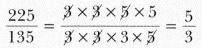
∴ The simplest form of \(\frac{225}{135}\) is \(\frac{5}{3}\).
Question 7.
In all the fractions that are less than 1 unit, the _______ is smaller than the _________ .
Solution: numerator, denominator
In all the fractions that are less than 1 unit, the numerator is smaller than the denominator.
Question 8.
In all the fractions that are more than 1 unit, the numerator is _______ than the denominator.
Solution: greater
In all the fractions that are more than 1 unit, the numerator is greater than the denominator.
Question 9.
150 rupees distributed equally among _________ students is the same as 750 rupees distributed equally among 25 students.
Solution: 5
Let x be the required number of students.
So, \(\frac{150}{x}=\frac{750}{25}\) ⇒ x = 150 × \(\frac{25}{750}\)
⇒ x = 150 × \(\frac{1}{30}\) ⇒ x = 5
So, 150 rupees distributed equally among 5 students is the same as 750 rupees distributed equally among 25 students.
Question 10.
Use >, =, < to fill the boxes:

Solution: <
(i) When the denominator is same, the Fraction with greater numerator is larger.
∴ \(\frac{19}{6}<\frac{23}{6}\)
(ii) The least common multiple of 9 and 8 is 72.
We can write \(\frac{4}{9}=\frac{4 \times 8}{9 \times 8}=\frac{32}{72}\)
and \(\frac{13}{8}=\frac{13 \times 9}{8 \times 9}=\frac{117}{72}\)
We know, 32 < 117
⇒ \(\frac{32}{72}<\frac{117}{72}\) ⇒ \(\frac{4}{9}<\frac{13}{8}\)