
Students can include Class 7 Curiosity Extra Questions and Class 7 Science Chapter 7 Heat Transfer in Nature Extra Question Answer in their daily self-study routine.
Class 7 Science Chapter 7 Heat Transfer in Nature Extra Questions
Class 7 Science Chapter 7 Extra Questions on Heat Transfer in Nature
Heat Transfer in Nature Class 7 Very Short Question Answer
Question 1.
On a cold morning, why does a metal chair feel colder than a wooden chair kept in the same room?
Answer:
A metal chair feels colder because metal is a good conductor of heat. It quickly takes heat away from our body, so it feels cold. Wood is a poor conductor of heat, so it does not draw heat from our body quickly and feels less cold.
Question 2.
Raj stirs hot soup with a metal spoon and soon feels the handle getting hot, even though the handle never touched the soup directly. Explain how the heat reached the handle.
Answer:
Heat reached the handle by conduction. The part of the metal spoon in the hot soup became hot first, and then heat travelled through the metal spoon from the hot part to the cooler handle, making the handle hot even though it did not touch the soup.

Question 3.
Give examples of materials that are good conductors of heat and materials that are poor conductors (insulators) of heat.
Answer:
Good conductors of heat: Aluminium, iron, copper, and steel (metals allow heat to pass through them easily).
Poor conductors (insulators) of heat: Wood, plastic, glass, rubber, clay, porcelain, and air (they do not allow heat to pass through them easily).
Question 4.
A woollen sweater is not warm by itself, yet it keeps us warm. Explain.
Answer:
A woollen sweater does not produce heat. Our body continuously gives out heat. Woollen fabric has many tiny pores that trap air. Since air is a poor conductor of heat, the trapped air reduces the flow of heat from our body to the cold surroundings. Therefore, less body heat is lost, and we feel warm.
Question 5.
When you light a bonfire, in which direction does the smoke move? Explain.
Answer:
Smoke moves in an upward direction. Smoke is actually hot gases mixed with tiny particles that are produced during burning. As smoke contains hot gases, it is lighter than the surrounding air, and hence, it rises upward.
Question 6.
What happens when a partially inflated balloon is kept in the Sun? Explain the reason.
Answer:
When a partially inflated balloon is kept in the Sun, it becomes more inflated and expands. This happens because the air inside the balloon gets heated. On heating, air expands and occupies more space, so it pushes the balloon outward and the balloon becomes larger.
Question 7.
Explain how convection transfers heat from the land surface to the air above it on a hot day.
Answer:
On a hot day, the land heats up and warms the air above it. The warm air becomes lighter and rises, while cooler air moves in to take its place. This continuous movement of air carries heat upward and is called convection.
Question 8.
What is the direction of the sea breeze during the day? Explain why it changes at night.
Answer:
During the day, the sea breeze blows from the sea towards the land. At night, the direction changes because land cools faster than the sea. The air above the sea remains relatively warmer and rises, so cooler air from the land moves towards the sea. This is called land breeze.
Question 9.
What is infiltration? Name the underground layers that store water in their pore spaces.
Answer:
Infiltration is the process by which surface water seeps through soil and rocks and moves down into the ground. These underground layers of sediments and rocks that store water in pore spaces are called aquifers.
Question 10.
Two cities receive the same amount of rainfall. Can one city still have a much higher groundwater level than the other? Give one reason.
Answer:
Yes. A city with more open soil and vegetation allows rainwater to seep into the ground and recharge groundwater, while a city with more concrete surfaces has less seepage, resulting in a lower groundwater level.
Heat Transfer in Nature Class 7 Short Question Answer
Question 1.
In winter, Dev notices that frost forms faster on metal pipes than on plastic pipes outside his home. Explain why.
Answer:
Frost forms when water vapour in the air comes in contact with a very cold surface, condenses and then freezes into tiny ice crystals. Metal pipes become cold faster because metal is a good conductor of heat and loses heat quickly to the cold surroundings. Therefore, the metal surface reaches the freezing temperature sooner and frost forms on it earlier. Plastic is a poor conductor of heat, so it does not lose heat quickly, stays comparatively warmer, and frost forms on it more slowly.
Question 2.
The picture shows a person stirring food in a metal pan using a wooden spatula.

(i) Why do you think the spatula is made of wood instead of metal?
Answer:
Wood is a poor conductor of heat. It does not become hot quickly. So, it prevents the person’s hand from burning while stirring food in the hot pan.
(ii) How does heat transfer occur from the metal pan to the water that is used for cooking?
Answer:
Heat transfer from the pan to the water happens through conduction. The metal pan directly transfers heat energy to the water particles on the pan’s surface. This heat is further transferred to the entire water primarily through convection.
Question 3.
For setting curd, a small amount of curd is added to warm milk. The microbes present help in setting if the mixture remains between about 35°C and 40°C. In places where the room temperature is much lower, setting curd becomes difficult. Suggest a way to set curd in such a situation.
Answer:
To set curd in a cold place, the milk and starter curd mixture must be kept warm so that its temperature remains around 35°C to 40°C. This can be done by covering the container and wrapping it in a woollen cloth or any other insulating material so that heat loss is reduced. The container may be kept in a warm place, such as near the cooking area or in mild sunlight. Another effective method is to keep the mixture in an insulated casserole or a thermos so that it remains warm for enough time for the microbes to set the curd.
Question 4.
(i) Name two design features that help keep a house warm in winter.
Answer:
Two design features that help keep a house warm in winter are double-layered walls filled with insulating material such as mud or cow dung, and outer walls made using hollow bricks that trap air and reduce heat loss.
(ii) Which would keep us warmer at night: a single thick blanket or two thin blankets? Give a reason.
Answer:
Two thin blankets would keep us warmer than a single thick blanket because air trapped between the two blankets acts as an insulator and reduces the loss of body heat to the surroundings.
Question 5.
A solar cooker is kept facing the Sun with its lid closed. It is painted black.
(i) How do both of these features help in cooking food?
Answer:
Facing the Sun allows the cooker to receive maximum sunlight. The black surface absorbs more heat from sunlight, so the temperature inside rises and food cooks. The closed lid reduces heat loss to the surroundings and helps trap the heat inside.
(ii) What would happen if it were painted white instead of black?
Answer:
If it were painted white, it would reflect more sunlight and absorb less heat. The cooker would become less hot, so cooking would be slower or may not occur properly.
Question 6.
At a campsite there are tents of two shades – one made with black fabric and the other with white fabric. Which one will you prefer for resting on a hot summer afternoon? Give a reason for your choice. Would you like to prefer the same tent during winter?
Answer:
On a hot summer afternoon, the white tent is preferred because white fabric reflects most of the heat falling on it, so the tent remains comparatively cooler inside. In winter, the same tent would not be preferred. A black tent is more suitable because black fabric absorbs more heat and helps keep the tent warmer.
Question 7.
Answer the following questions.
(i) After a heavy rain, the handpump in a village starts giving more water than before. Which natural process in the water cycle explains this change?
Answer:
After heavy rain, more rainwater infiltrates into the ground and recharges the groundwater/ aquifer. This increases the water level, so the handpump gives more water.
(ii) If the villagers keep extracting large amounts of water from the handpump without allowing the aquifers to recharge, what problem might they face in the long run?
Answer:
If water is extracted continuously without recharge, the groundwater level will fall. Over time, the handpump may give less water or dry up, leading to water shortage in the village.
Heat Transfer in Nature Class 7 Long Question Answer
Question 1.
Explain conduction, convection, and radiation by describing how each method of heat transfer works. Give one real-life example for each mode of heat transfer and briefly justify why the example represents that particular method.
Answer:
Conduction is the transfer of heat through a material from the hotter part to the cooler part without the particles leaving their positions. Heat passes from one particle to the next, so it is most common in solids, especially metals. Example: When a metal spoon is kept in hot soup, the handle becomes hot after some time. This happens because heat is conducted through the metal spoon from the hot end to the cooler handle.
- Convection is the transfer of heat in liquids and gases by the actual movement of the particles. On heating, the liquid/gas expands, becomes lighter and rises, while cooler and heavier liquid/gas moves down to take its place, forming convection currents.
Example: Smoke rises above a bonfire. The air arid smoke get heated, become lighter and move upward, showing heat transfer by convection. - Radiation is the transfer of heat without the help of any material medium. Heat travels in the form of radiation and can pass through empty space.
Example: We feel warmth from the Sun or from a bonfire, even from a distance. This is because heat reaches us directly through radiation, without needing any other medium.
Question 2.
In our daily lives, the idea that hot air rises and expands while cold air settles is frequently applied. In this context, respond to the following questions:
(i) Why are exhaust fans installed close to the ceiling in homes?
Answer:
Hot air inside a room becomes lighter and rises upward. Exhaust fans near the ceiling allow this hot, stale air to escape, keeping the room cool and well-ventilated.
(ii) Explain the phenomenon of sea breeze during the day and land breeze at night.
Answer:
During the day, the land becomes hotter more rapidly than the water of the sea. Hot air above the land rises, and cool air from the sea moves in, forming a sea breeze. At night, the reverse phenomenon occurs as the land cook down more quickly than the water of the sea. The air above the surface of the sea remains relatively warmer and rises up. To occupy the space, cold air from the land rushes and causes a land breeze.
(iii) Why is the air conditioner’s cooling unit placed close to the room’s ceiling?
Answer:
An air conditioner’s cooling unit is placed high because cool air from it sinks downward, pushing warm air upward. This rising warm air is cooled again, creating continuous circulation that evenly cools the entire room efficiently.
Question 3.
Describe the water cycle and explain how it helps in the redistribution of water on Earth.
Answer:
The water cycle is the continuous circulation of water between the Earth’s surface and the atmosphere. Heat from the Sun causes water from water bodies to evaporate and change into water vapour. Water vapour is also added to the air by transpiration from plants. As the water vapour rises to higher levels of the atmosphere, it cools and condenses to form tiny droplets of water.
These droplets collect to form clouds. When the droplets become large and heavy, they fall to the Earth as precipitation in the form of rain, snow or hail. The water cycle helps in the redistribution of water on Earth by moving water from one place to another. Rain and snowfall supply fresh water to land areas, filling rivers, lakes and ponds. The water collected on land flows back to seas and oceans through rivers. Some of the rainwater also seeps into the ground and becomes groundwater.
Question 4.
In many villages, people use wells and handpumps for water. After rains, the water level rises, but during dry periods, it falls. This is linked to how rainwater seeps into the ground and recharges aquifers.
(i) Explain how infiltration helps in recharging aquifers.
Answer:
Infiltration is the process by which rainwater slowly seeps through the soil and layers of rock to reach underground water reserves called aquifers.
(ii) Why does the rate of water seepage differ in gravel, sand, and clay soils?
Answer:
The rate of seepage depends on the size of spaces between soil particles. It is fastest in gravel because of the presence of large pores between the gravel particles; moderate in sand, and slowest in clay due to very tiny pores.
(iii) State the importance of aquifers in the water cycle and for human use.
Answer:
Aquifers play an essential role in the water cycle by storing fresh water, supplying water to rivers and lakes, and serving as a reliable source for drinking, irrigation, and other human activities, especially during dry periods.
Heat Transfer in Nature Class 7 Case Based Questions
Read the following passages and answer the questions that follow:
1. In a science class, the teacher heats one end of a metal rod using a flame. At the same time, she boils water in a pan on a stove. The students observe different ways in which heat is transferred in these two situations.
(i) State one main difference between conduction and convection in terms of the movement of particles.
Answer:
| Conduction | Convection |
| Particles do not move from place to place; they only pass on heat to neighbouring particles. | Particles move from one place to another, carrying heat with them. |
(ii) Give one natural example of convection.
Answer:
Sea breeze and land breeze in coastal areas are natural examples of convection.
(iii) When the teacher heats one end of the metal rod with a flame, name the method of heat transfer by which heat travels from the heated end to the cooler end of the rod. Explain briefly.
Answer:
The method of heat transfer is conduction. The end of the metal rod near the flame becomes hot first. The particles at this hot end transfer heat to neighbouring particles, and in this way heat travels along the rod from the hot end to the cooler end.
OR
(iii) When water is boiled in a pan on the stove, name the different methods of heat transfer involved in
(a) transferring heat from the stove to the pan and then to the water, and
Answer:
Heat is transferred from the stove to the pan, and from the hot pan to the water in contact with it, mainly by conduction, because these parts are in direct contact.
(b) spreading heat throughout the water.
Answer:
Heat spreads throughout the water by convection, as hot water rises and cooler water sinks, forming convection currents.
Question 2.
A new township is built with many houses, concrete roads, parking areas, and tiled pavements. Within two years, residents report that wells and handpumps are drying up. A scientific survey reveals that most rainwater flows away through drains rather than seeping into the ground. The soil under the township has a tiny exposed surface area for water to infiltrate and recharge the groundwater.
(i) Why is infiltration reduced in the township?
(a) Concrete surfaces increase soil pores.
(b) Tiled pavements prevent water from entering the soil.
(c) Rainfall has completely stopped in the area.
(d) Wells have become deeper.
Answer:
(b) Tiled pavements prevent water from entering the soil.
(ii) How does reduced infiltration affect groundwater levels in wells and handpumps?
Answer:
Reduced infiltration means less rainwater seeps into the ground to recharge groundwater. As a result, the groundwater level falls, so wells and handpumps start giving less water and may dry up.
(iii) Suggest some method the township can adopt to recharge groundwater.
Answer:
The township can adopt rainwater harvesting by allowing rainwater to infiltrate (seep) into the ground through recharge pits, open soil patches, or soak pits.
OR
(iii) Explain why soil with larger pore spaces improves infiltration.
Answer:
Soil with larger pore spaces has more gaps for water to pass through, so water seeps down more easily and faster, increasing infiltration and groundwater recharge.
Heat Transfer in Nature Class 7 Picture Based Questions
Observe the given pictures and answer the questions that follow:
Question 1.
Processes involved in the water cycle are marked as A – E.
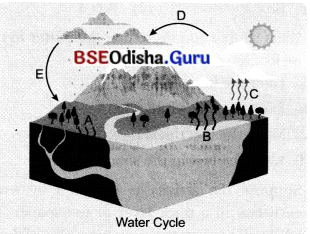
(i) Which among A – E represent evaporation?
Answer:
Process B represents evaporation, as water is shown to rise up as vapour from the river.
(ii) Which among A – E represent transpiration?
Answer:
Process C represents transpiration, as water is shown to rise up as vapour from the trees.
(iii) What do the processes A, D, and E represent?
Answer:
A: Infiltration, D: Condensation, E: Precipitation
OR
(iii) Explain how clouds are formed in the atmosphere.
Answer:
Water from rivers, lakes and seas changes into water vapour due to Sun’s heat. This water vapour rises upward and, at higher altitudes, it cools down and condenses into tiny water droplets. A large number of these tiny droplets together form clouds.
Question 2.
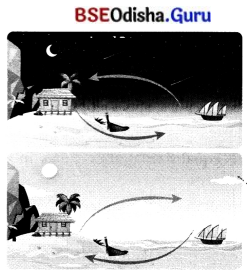
Study the two diagrams showing air movement during night and day.
(i) With the help of the diagrams, complete the following sentences:
(a) During night, cool air moves from ………… to ………….
Answer:
During night, cool air moves from the land to the sea.
(b) During day, cool air moves from ………… to ………….
Answer:
During day, cool air moves from the sea to the land.
(ii) Identify what type of breeze is shown in the first diagram (night) and also explain how the air moves in this case.
Answer:
First diagram (night): At night, the land cools faster than the sea. The air above the sea remains warmer and rises. Cooler air from the land moves towards the sea to take its place. This circulation is called land breeze.
OR
(ii) Identify what type of breeze is shown in the second diagram (day), and also explain how the air moves in this case.
Answer:
Second diagram (day): During the day, the land heats up faster than the sea. The air above the land becomes warm and rises. Cooler air from the sea moves towards the land to occupy the space. This circulation is called sea breeze.
(iii) If water heated up and cooled down faster than land, how would the direction of the coastal breeze change?
Answer:
If water heated up and cooled down faster than land, the direction of sea and land breezes would get reversed. During the day, wind would blow from land to sea, and during the night, wind would blow from sea to land.
Heat Transfer in Nature Class 7 Activity Based Questions
Read the following activity and answer the questions that follow:
Question 1.
Objective: To compare how effectively different materials absorb heat from sunlight.
Materials required: Four boxes of identical shape and size made of different materials, four equal-sized butter cubes, and a stopwatch or clock.
Procedure:
- Place equal-sized butter cubes in each of the four boxes.
- Keep all the boxes under direct sunlight at the same time.
- Note the time taken for the butter cube in each box to melt.
Observations:
| Box | Time the butter cubes take to melt |
| Box 1 Box 2 Box 3 Box 4 |
12 minutes 16 minutes 7 minutes 8 minutes |
(i) Which box absorbs heat from sunlight most effectively?
(a) Box 1
(b) Box 2
(c) Box 3
(d) Box 4
Answer:
(c) Box 3 has the least melting time (7 minutes), so it absorbs heat from sunlight most effectively.
(ii) What should you do so that the butter in the box melts even faster?
(a) Paint the box black
(b) Paint the box white
(c) Make the box thicker
(d) Keep the box in the shade
Answer:
(a) A black surface absorbs more heat from sunlight, so the butter will melt faster.
(iii) Suppose the activity is repeated by wrapping each box in a thick layer of newspaper. Predict what will happen to the melting time of the butter cubes in all the boxes and give a reason for your answer.
Answer:
If all the boxes are wrapped in a thick layer of newspaper, the melting time will increase in all the boxes. Newspaper traps air and acts as a poor conductor of heat, so less heat reaches the butter and it melts more slowly.
OR
(iii) Suppose the activity is repeated by wrapping all the boxes with shiny aluminium foil. Predict what will happen to the melting time of the butter cubes in all the boxes and give a reason for your answer.
Answer:
When all the boxes are wrapped with shiny aluminium foil, the melting time of butter cubes in all the boxes will increase. This is because shiny aluminium foil reflects most of the sunlight and heat, so less heat is absorbed by the boxes, causing the butter to melt more slowly.
Heat Transfer in Nature Extra Questions for Practice
Question 1.
A student makes the following statements after observing daily examples of heat transfer. Which statement is incorrect?
(a) Radiation can occur in vacuum.
(b) Conduction requires direct contact between particles.
(c) Convection occurs in solids.
(d) Air acts as an insulator.
Answer:
(c) Convection needs the actual movement of particles from one place to another. In solids, particles are fixed in position and can only vibrate, so heat in solids is transferred mainly by conduction, not convection.
Question 2.
Which factor most directly controls the rate of infiltration of rainwater into the ground?
(a) Temperature of soil.
(b) Colour of soil.
(c) Size and connectivity of pore spaces.
(d) Amount of sunlight.
Answer:
(c) Rainwater seeps into the ground faster when the spaces between soil and rock particles are wide, open and interconnected. Larger and better-connected pore spaces allow water to pass through more casily, increasing the rate of infiltration.
Question 3.
Which situations show heat transfer by radiation?
(i) Feeling warmth from the Sun.
(ii) Heating of air above a fire.
(iii) Feeling heat near a bonfire.
(iv) Heat passing through a metal rod.
(a) (i) and (iii) only
(b) (i), (ii), and (iii) only
(c) (i), (iii), and (iv) only
(d) (i), (ii), (iii), and (iv)
Answer:
(a) Heating of air above a fire is caused by convection. Heat passes through a metal rod by conduction.
Question 4.
A metal rod is heated at one end. Which statements are correct?
(i) Heat travels from the hot end to the cold end.
(ii) Heat transfer takes place without the movement of particles.
(iii) The process involved is convection.
(iv) The process involved is conduction.
Answer:
(a) (i) and (iii) only
(b) (i), (ii), and (iii)
(c) (i), (ii), and (iv)
(d) (i) and (iv) only
Answer:
(c) (i), (ii), and (iv)
Questions 5 and 6 consist of two statements – Assertion (A) and Reason (R). Answer these questions by selecting the correct option:
(a) Both A and R are true and R is the correct explanation of A.
(b) Both A and R are true but R is not the correct explanation of A.
(c) A is true but R is false.
(d) A is false but R is true.
Question 5.
Assertion (A): Conduction and convection cannot take place in a vacuum.
Reason (R): Both conduction and convection require a medium whose particles help in heat transfer.
Answer:
(a) Both A and R are true and R is the correct explanation of A.
Question 6.
Assertion (A): During the day, sea breeze blows from sea to land.
Reason (R): Land heats up faster than water, so the warm air over land rises and is replaced by cooler air from the sea.
Answer:
(a) Both A and R are true and R is the correct explanation of A.
Question 7.
A hot utensil kept away from the flame cools down after some time. Why?
Answer:
A hot utensil kept away from the flame cools down because it continuously gives out heat to its surroundings, mainly by radiation. As heat is radiated out, the utensil’s temperature gradually falls.
Question 8.
Why does smoke from burning wood rise upwards?
Answer:
Air near the burning wood gets heated, expands, and becomes lighter than the surrounding cooler air. This hot air rises upward and carries the smoke particles with it. This upward movement is due to convection.
Question 9.
Answer the following questions.
(i) Why double-layered paper cups keep coffee hot longer than single-layered cups?
Answer:
A double-layered cup has air trapped between the two layers. This air reduces heat loss from the hot coffee to the outside as air is poor conductor of heat. Hence, the coffee stays hot for a longer time compared to a single-layered cup.
(ii) Why does a metal spoon feel hotter than a wooden spoon when both are kept in hot soup for the same time?
Answer:
A metal spoon feels hotter because metal is a good conductor of heat and transfers heat quickly from the hot soup to the handle and then to the hand. Wood is a poor conductor of heat, so much less heat reaches the hand in the same time, making it feel less hot.
Question 10.
How will convection currents differ if a beaker of water is heated at the centre of the base versus near one side?
Answer:
If the beaker is heated at the centre, hot water rises mainly in the middle, and cooler water comes down along the sides, giving a nearly symmetrical circulation. If heated near one side, hot water rises along that side, and cooler water sinks mostly on the opposite side, producing a more uneven, onesided circulation.
Question 11.
Read the passage given below and answer the questions that follow: During the daytime, people living near the coast feel a cool wind. As night falls, the wind direction gradually changes. This change happens due to the difference in the way land and sea get heated and cooled, which leads to movement of air between them.
(i) Name the breeze that blows from sea to land during the day.
Answer:
The breeze that blows from the sea towards the land during the day is called sea breeze.
(ii) Which mode of heat transfer is responsible for the movement of air in breezes?
Answer:
The movement of air in breezes occurs due to convection, in which warm air rises and cooler air moves in to take its place.
(iii) Why do coastal areas experience a change in wind direction between day and night? Explain briefly.
Answer:
Coastal areas experience a change in wind direction because land heats up and cools down faster than the sea. In the day, air moves from sea to land (sea breeze). At night, air moves from land to sea (land breeze).
OR
(iii) Explain why a cool wind blows from the sea towards land during the day in coastal regions.
Answer:
During the day, the land becomes hot quickly. The warm air above it rises, and cooler air from the sea moves towards the land. This cool wind from sea to land is called a sea breeze.
Question 12.
Answer the following questions.
(i) Explain how the Sun drives the water cycle.
Answer:
Due to the Sun’s heat, water in occans, rivers and lakes changes into water vapour by evaporation. This water vapour rises, cools and condenses to form clouds, which bring precipitation such as rain, snow or hail, completing the water cycle.
(ii) What is groundwater and what are aquifers?
Answer:
Groundwater is the water that seeps into the ground and gets stored below the Earth’s surface in pore spaces of sediments and openings in rocks. The underground layers of sediments and rocks that store this water are called aquifers.
(iii) Mention method used to recharge groundwater.
Answer:
Groundwater can be recharged by rainwater harvesting and by making recharge pits to allow more rainwater to seep into the ground.