
For better exam readiness, students can include Class 7 Science MCQ and Curiosity Chapter 9 Life Processes in Animals MCQ in their daily study routine.
Class 7 Science Chapter 9 Life Processes in Animals MCQ
Life Processes in Animals MCQ Class 7
MCQ On Life Processes in Animals Class 7
Choose the correct option.
Question 1.
At the school fitness camp, the trainer asked students to observe the movement of their ribs during a breathing exercise. The students noticed that during inhalation, the ribs move:
(a) Down and inwards
(b) Up and inwards
(c) Down and outwards
(d) Up and outwards
Answer:
(d) Up and outwards

Question 2.
The enzyme present in the saliva converts
(a) fats into fatty acids and glycerol.
(b) starch into simple sugars.
(c) proteins into amino acids.
(d) complex sugars into simple sugars.
Answer:
(b) starch into simple sugars.
Question 3.
The image shows a frog acquiring its food with the help of its tongue. A student observed the image and claimed that the frog takes its food by sucking. Is the claim made by the student correct?

(a) No, the frog is eating food as a whole, so its mode of feeding is swallowing.
(b) No, the frog is using teeth to break its food, so its mode of feeding is chewing.
(c) Yes, the frog is pulling in the insect as is done for liquids, so its mode of feeding is sucking.
(d) Yes, the frog is using its body to grind up the insect, so its mode of feeding is sucking.
Answer:
(a) A frog catches an insect with its sticky tongue and then swallows it whole without chewing or sucking. Therefore, the student’s claim that the frog takes its food by sucking is incorrect.
Question 4.
In the given diagram of the human respiratory system, what is the function of the part labelled A?
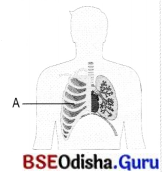
(a) Pumps blood
(b) Protects the lungs
(c) Absorbs nutrients
(d) Exchange of oxygen and carbon dioxide
Answer:
(b) The labelled part A is ribs, which help to protect the lungs.
Question 5.
Sheetal was asked to select the incorrect statement about the given image as part of a revision exercise in the class. Which option would she choose?

(a) Site of gaseous exchange
(b) Thin-walled and surrounded by blood vessels
(c) Thick-walled and surrounded by intercellular spaces
(d) Increase the surface area for respiration
Answer:
(c) Alveoli are thin-walled, not thick-walled, to allow efficient gaseous exchange.
Question 6.
The table shows the constituents of four different solutions.
| Solution | Water (mL) | Raw material added |
| A | 5 | Crushed boiled potato |
| B | 5 | Boiled potato that was chewed for 2 seconds |
| C | 5 | Boiled potato that was chewed for 4 seconds |
| D | 5 | Boiled potato that was chewed for 6 seconds |
What solution is likely to have the highest amount of starch?
(a) Solution A
(b) Solution B
(c) Solution C
(d) Solution D
Answer:
(a) Solution A will have the highest starch content. Solutions B, C, and D were chewed, initiating the digestion of starch by the digestive juice present in saliva. The longer the chewing, the more starch is broken down into sugars.
Question 7.
Grass-eating animals such as cows and buffalo have a special sac-like structure present between the oesophagus and small intestine, which helps them to digest cellulose. Can you identify the structure and the characteristic that enables cellulose digestion?
(a) Rumen; the presence of certain bacteria that are absent in humans.
(b) Large intestine; the presence of certain proteins that are present in humans.
(c) Stomach; the presence of certain bacteria that are absent in humans.
(d) Gizzard; the presence of certain proteins that are present in humans.
Answer:
(a) Grass-eating animals have a special chamber called rumen, where cellulose-digesting bacteria are present. These bacteria help break down cellulose; they are absent in humans.
Question 8.
While revising for her biology test, Meera came across a question about the end products of respiration. Help Meera identify the substance that is not produced during this process.
(a) Oxygen
(b) Water
(c) Carbon dioxide
(d) Energy
Answer:
(a) Oxygen
Question 9.
The swallowed food moves downwards in the alimentary canal because of…………….
(a) force provided by the muscular tongue.
(b) the flow of water taken with the food.
(c) gravitational pull.
(d) the contraction of muscles in the wall of the food pipe.
Answer:
(d) the contraction of muscles in the wall of the food pipe.
Question 10.
Rina’s elder sister, Hina, often removes nose hair using trimmer and other methods to maintain a cleaner look. After some time, she began experiencing breathing discomfort and consulted her doctor, Mrs. Sheetal, who advised her to discontinue the practice. What is the most likely concern related to removing nose hair?
(a) It may affect the sensitivity of the nose for odour.
(b) The amount of inhaled oxygen will be affected.
(c) Germs and foreign particles will enter the body easily.
(d) It may lead to excessive mucus production.
Answer:
(c) Nose hair trap dust, germs, and other foreign particles during inhalation and prevent them from entering the lungs.
Question 11.
Which part of the digestive system absorbs nutrients into the blood?
(a) Large intestine
(b) Oesophagus
(c) Stomach
(d) Small intestine
Answer:
(d) Small intestine
Question 12.
What is the main function of the large intestine?
(a) Absorbs nutrients
(b) Breaks down proteins
(c) Absorbs water from the undigested food
(d) Produces digestive juices
Answer:
(c) Absorbs water from the undigested food
Question 13.
The table lists two essential parts that are involved in the process of digestion in humans.
| p | Q |
| Increases the surface area for the absorption of food | Secretes a digestive juice which is basic in nature and helps neutralise the acid present in the food |
Identify P and Q.
(a) P is liver and Q is large intestine.
(b) P is small intestine and Q is pancreas.
(c) P is stomach and Q is liver.
(d) P is large intestine and Q is stomach.
Answer:
(b) P is small intestine and Q is pancreas.
Question 14.
Humans chew the food only when they have food in their mouths, but buffaloes chew continuously even when they are not eating grass. What could be the reason behind this fact?
(a) Buffaloes chew continuously because they store undigested grass in their mouth.
(b) Buffaloes chew continuously to remove the stuck food particles from their mouthparts.
(c) Buffaloes chew continuously because cud, the partially digested food, returns to their mouth in small lumps.
(d) Buffaloes chew continuously to collect saliva in their mouth so that more bacteria can be formed in their mouth.
Answer:
(c) Buffaloes are ruminants and they re-chew partially digested food to aid digestion.
Question 15.
Lime water turns milky when it reacts with …………
(a) Oxygen
(b) Nitrogen
(c) Carbon dioxide
(d) Hydrogen
Answer:
(c) Carbon dioxide
Question 16.
While learning about respiration, Rohan wondered where exactly does the exchange of oxygen and carbondioxide takes place in the lungs. Help him identify the part.
(a) Nostrils
(b) Alveoli
(c) Windpipe
(d) Rib cage
Answer:
(b) Alveoli
Question 17.
Rashmi was investigating how to identify the presence of starch in her practical class. The teacher gave her the following food items and asked her to identify which of them would give a blue-black colour when tested with iodine solution.
Can you help her identify the correct food items?
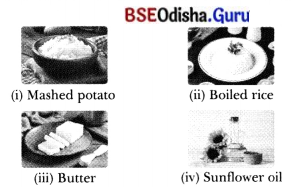
(a) (i) and (ii) only
(b) (i), (iii) and (iv)
(c) (i) only
(d) (ii) and (iii) only
Answer:
(a) Butter and sunflower oil contain fats, not starch, so they do not react with iodine to produce blue-black colour.
Question 18.
Read the following statements with reference to the finger-like projections of the small intestine.
(i) They have very thin walls.
(ii) They have a network of thin and small blood vessels close to the surface.
(iii) They have small pores through which food can easily pass.
(iv) They have thick walls.
Identify the features that enable these structures to absorb digested food.
(a) (i), (ii), and (iv)
(b) (ii) (iii), and (iv)
(c) (iii) and (iv) only
(d) (i) and (ii) only
Answer:
(d) The finger-like projections are thin-walled and do not have pores. Instead, they have a network of blood vessels that allows them to absorb nutrients from the food.
Question 19.
Prashant was learning about the different systems of the human body. He wants to identify the components of the circulatory system.
(i) Heart
(ii) Blood vessels
(iii) Diaphragm
(iv) Blood
Which of the following options should he choose?
(a) (i), (ii) and (iii)
(b) (i), (ii) and (iv)
(c) (ii), (iii) and (iv)
(d) (i) and (ii) only
Answer:
(b) Diaphragm is a part of the respiratory system.
Question 20.
Breathing is a process that
(i) provides oxygen to the body.
(ii) breaks down food to release energy.
(iii) helps the body to get rid of carbon dioxide.
(iv) produces water in the cells.
Which of the following gives the correct combination of functions of breathing?
(a) (i) and (ii)
(b) (ii) and (iii)
(c) (i) and (iii)
(d) (ii) and (iv)
Answer:
(c) Respiration is the process through which the body produces energy by breaking down food using oxygen. Water is one of the by-products of respiration.
Question 21.
Which of the following statements about the large intestine are correct?
(i) It is about 1.5 m in length.
(ii) It is longer than the small intestine.
(iii) It absorbs water from the undigested food.
(iv) It is wider than the small intestine.
(a) (i), (ii), and (iii)
(b) (i), (iii), and (iv)
(c) (ii) and (iii) only
(d) (ii) and (iv) only
Answer:
(b) Small intestine is the longest part of the alimentary canal.
Life Processes in Animals Class 7 Assertion and Reason Questions
The following questions consist of two statements – Assertion (A) and Reason (R). Answer these questions by selecting the correct option:
(a) Both A and R are true and R is the correct explanation of A.
(b) Both A and R are true but R is not the correct explanation of A.
(c) A is true but R is false.
(d) A is false but R is true.
1. (A): Boiled potato and rice contain starch, which is a type of carbohydrate.
(R): Both the food items will give a blue-black colour when tested with iodine.
Answer:
(a) Both A and R are true and R is the correct explanation of A.
2. (A): During breathing, we inhale oxygen and exhale carbon dioxide.
(R): The exchange of gases ensures that each segment of our body gets enough oxygen to produce energy.
Answer:
(b) Both A and R are true but R is not the correct explanation of A.
3. (A): Digestion of starch begins in the mouth.
(R): Saliva breaks down starch into protein.
Answer:
(c) Saliva breaks down starch into sugar. The digestion of protein starts in the stomach.
4. (A): Aquatic animals like fish and frogs respire through gills.
(R): Exchange of respiratory gases dissolved in water takes place across the gills as they are richly supplied with blood vessels.
Answer:
(d) Fish respire through gills, but adult frogs respire through lungs and moist skin.
5. (A): The walls of the food pipe gently contract and relax in a wave-like motion to push the food down into the stomach.
(R): This movement takes place throughout the alimentary canal and pushes the food backwards.
Answer:
(c) Wave-like motion takes place throughout the alimentary canal and pushes the food forward.
Life Processes in Animals Class 7 Fill in the Blanks
1. In birds, food is broken down by the contraction and relaxation of the walls of ………….
Answer: gizzard
2. During inhalation the ribs move ………… and …………, and the diaphragm moves.
Answer: up, outwards, downwards
3. ………… protects the lining of stomach from the acid.
Answer: Mucus
4. Tadpoles breathe through …………, while adult frogs use ………… for breathing on land and ………… for exchange of gases under water.
Answer: gills, lungs, skin
5. ………… neutralises the acid from the stomach and breaks down ………… into tiny droplets, making digestion easier.
Answer: Bile juice, fats
6. ………… solution turns blue-black when it reacts with ………….
Answer: Iodine, starch
Life Processes in Animals Class 7 True or False
1. All clocks and watches, whether digital or analogue, ultimately use some process that repeats irregularly.
Answer:
False: All clocks and watches, whether digital or analogue, use some process that repeats regularly to mark equal intervals of time.
2. A sand clock can tell the time of the day.
Answer:
False: A sand clock (hourglass) measures a fixed time interval; it cannot tell the exact time of the day.
3. For a fixed distance, if the time taken for a journey increases, the speed of the object decreases.
Answer:
True
4. The resting position of the bob of a pendulum is called the mean position.
Answer:
True
5. The symbols of all SI units are written in plural.
Answer:
False: Symbols of SI units are not written in plural; they remain the same in singular and plural (e.g., m, s, kg).
6. Two runners cover the same distance. The one who takes more time is slower.
Answer:
True
7. In a floating-bowl water clock, making a larger hole at the bottom of the bowl will make the bowl take a longer time to sink.
Answer:
False In a floating-bowl water clock, making a larger hole makes the bowl sink faster (in a shorter time).
Life Processes in Animals Class 7 Match the Following
Question 1.
Match column I with column II.
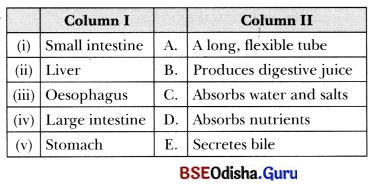
Answer:
| Column I | Column II | ||
| (i) | Small intestine | D. | Absorbs nutrients |
| (ii) | Liver | E. | Secretes bile |
| (iii) | Oesophagus | A. | A long, flexible tube |
| (iv) | Large intestine | C. | Absorbs water and salts |
| (v) | Stomach | B. | Produces digestive juice |
Question 2.
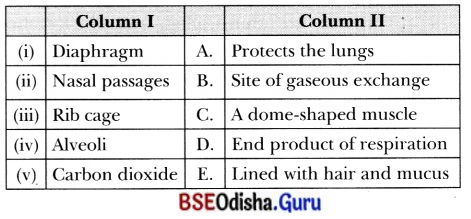
Answer:
| Column I | Column II | ||
| (i) | Diaphragm | C. | A dome-shaped muscle |
| (ii) | Nasal passages | E. | Lined with hair and mucus |
| (iii) | Rib cage | A. | Protects the lungs |
| (iv) | Alveoli | B. | Site of gaseous exchange |
| (v) | Carbon dioxide | D. | End product of respiration |