
Go through BSE Odisha Class 7 Science Solutions and Class 7 Science Chapter 11 Light: Shadows and Reflections Question Answer to understand textbook questions more clearly.
Class 7 Science Curiosity Chapter 11 Question Answer
Science Curiosity Class 7 Chapter 11 Question Answer
Light: Shadows and Reflections Class 7 Questions and Answers
Let Us Enhance Our Learning
Question 1.
Which of the following are luminous objects?
Mars, Moon, Pole Star, Sun, Venus, Mirror
Answer:
The Sun and the Pole Star are luminous objects because they emit their own light.

Question 2.
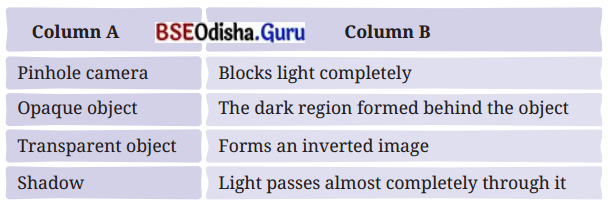
Match the items in Column I with those in Column II.
Answer:
| Column I | Column II |
| (i) Pinhole camera | C. Forms an inverted image |
| (ii) Opaque object | A. Blocks light completely |
| (iii) Transparent object | D. Light passes almost completely through it |
| (iv) Shadow | B. The dark region formed behind the object |
Question 3.
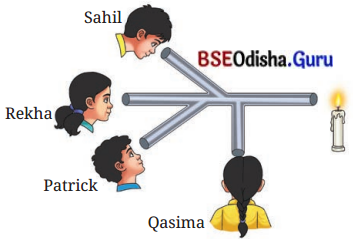
Sahil, Rekha, Patrick, and Qasima are trying to observe the candle flame through the pipe as shown in the figure alongside. Who can see the flame?
Answer:
Rekha can see the candle flame. Light travels in a straight line. Only Rekha’s line of sight through the straight pipe is directly aligned with the candle flame, allowing light to reach her eyes. Sahil, Patrick, and Qasima cannot see the flame because the light cannot bend around corners.
Question 4.
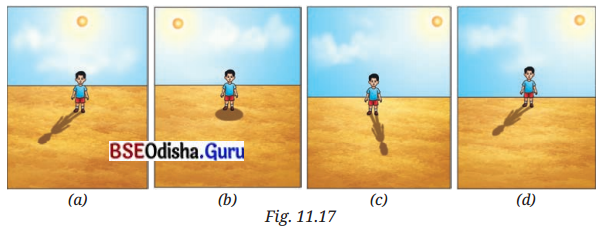
Look at the images shown in the following figure, and select the correct image showing the shadow formation of the boy.
Answer:
(d) The boy’s shadow forms on the side opposite to the Sun, as light travels in a straight line and cannot pass through opaque objects. Hence, figure (d) correctly shows the shadow formation.
Question 5.
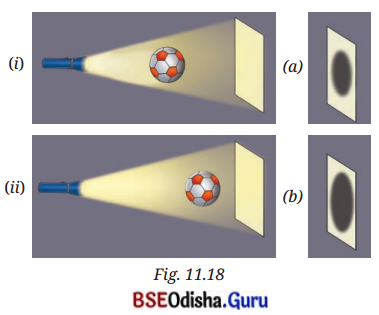
The shadow of a ball is formed on a wall by placing the ball in front of a fixed torch as shown in the figure given. In scenario (i) the ball is closer to the torch, while in scenario (ii) the ball is closer to the wall. Choose the most accurate representation of the shadows formed in both scenarios from the options provided (A and B).
Answer:
(i)-(B). The ball is placed closer to the torch and farther from the wall, so the shadow formed on the wall appears larger and blurrier.
(ii)-(A). The ball is closer to the wall and farther from the torch, so the shadow appears smaller and sharper.
Question 6.
Based on above figures in question, match the position of the torch in Column I with the characteristics of the ball’s shadow in Column II.
Answer:
| Column A | Column B |
| (i) If the torch is close to the ball | B. The shadow would be larger |
| (ii) If the torch is far away | A. The shadow would be smaller |
| (iii) If the ball is removed from the set-up | D. A bright spot would appear on the screen |
| (iv) If two torches are present in the set-up on the left side of the ball | C. Two shadows would appear on the screen |
Question 7.
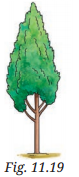
Suppose you view the tree shown in the alongside figure, through a pinhole camera. Sketch the outline of the image of the tree formed in the pinhole camera.
Answer:
The image of the tree formed in the pinhole camera will be inverted (upside down).
Question 8.
What difference do you notice? Explain the reason for the difference.
Answer:
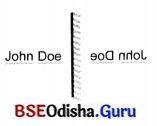
When the paper with the name written on it is held in front of a plane mirror, the image of the name, along with the letters, appears reversed from left to right. This happens because a plane mirror produces a laterally inverted image. In lateral inversion, the left side of the object appears on the right side of the image, and the right side of the object appears on the left side of the image.
Question 9.
Measure the length of your shadow at 9 AM, 12 PM, and 4 PM with the help of your friend. Write down your observations:
(i) At which of the given times is your shadow the shortest?
(ii) Why do you think this happens?
Answer:
(i) The shadow is the shortest at 12 PM (noon).
(ii)At noon, the Sun is almost directly overhead. When the Sun is high in the sky, the light rays fall almost vertically on us, so the shadow formed is short and close to our feet.
Question 10.
On the basis of following statements, choose the correct option.
Statement A: Image formed by a plane mirror is laterally inverted.
Statement B: Images of alphabets T and O appear identical to themselves in a plane mirror.
(a) Both statements are true
(b) Both statements are false
(c) Statement A is true, but statement B is false
(d) Statement A is false, but statement B is true
Answer:
(a) A plane mirror produces an image that is laterally inverted, which means the left side of the object appears on the right side in the image and vice versa. However, certain letters, such as T and O, appear identical to themselves even after lateral inversion, because their shapes are symmetrical about the vertical axis.
Question 11.
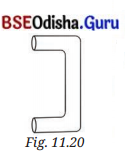
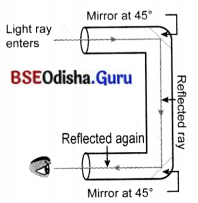
Suppose you are given a tube of the shape shown in the figure alongside, and two plane mirrors smaller than the diameter of the tube. Can this tube be used to make a periscope? If yes, mark where you will fix the plane mirrors.
Answer:
Yes, the given tube can be used to make a periscope. To do so, two plane mirrors should be fixed inside the tube at 45° angles to its length, facing each other, one at the top bend and the other at the bottom bend of the tube, as shown in the figure alongside.
Question 12.
We do not see the shadow on the ground of a bird flying high in the sky. However, the shadow is seen on the ground when the bird swoops near the ground. Think and explain why it is so.
Answer:
When a bird flies high in the sky, it is very far from the ground, and the light rays from the Sun falling on it are almost parallel. The shadow formed at such a large distance becomes extremely faint and spreads over a very large area, making it invisible to our eyes. However, when the bird flies close to the ground, the distance between the bird and the ground is small. The bird blocks the same amount of light, but now in a concentrated area, so a clear and distinct shadow is formed on the ground.
Class 7 Curiosity Chapter 11 Question Answer
InText Questions
Question 1.
When a shiny steel plate is used in a shadow experiment, why does it form a shadow on the screen and a bright spot on the opposite wall? [Page 159]
Answer:
The steel plate is opaque, so it forms a shadow. However, its smooth, shiny surface also reflects the incident light, creating a bright spot on the opposite wall.
Question 2.
When a person looks into a mirror, they can see their face. Name and explain the responsible phenomenon. [Page 160]
Answer:
A person can see the image of their face in a mirror due to reflection of light. When light from a source falls on the face, it is reflected and scattered in many directions. Light rays from the face strike the smooth, reflective surface of the mirror and bounce back to the eyes, allowing one to see an image of the face.
Question 3.
Can we see an image of an object only in a mirror? [Page 162]
Answer:
No. Images can be seen in any reflecting surface like polished metal or water, and also in a pinhole camera.
Question 4.
Why is “ЯОИАЛШЯМА” written on an ambulance? [Page 162]
Answer:
It appears as “AMBULANCE” when viewed in the rear-view mirrors of the vehicles ahead of the ambulance. This helps the drivers see it properly and give way to the ambulance.