
Combining textbook study with BSE Odisha Class 7 Science Notes and Class 7 Science Curiosity Chapter 4 The World of Metals and Non-metals Notes can make exam preparation more effective.
The World of Metals and Non-metals Notes Class 7
Class 7 Science Curiosity Chapter 4 Notes
Properties of Materials
- Materials around us can be classified based on various properties, such as appearance, hardness, etc.
- These properties help us understand how materials behave and why they are used for particular purposes. For example, certain materials can be used for making wires, utensils, and machines, while others cannot.
- Studying the properties of materials helps us choose the appropriate material for a particular purpose.
- Substances can be classified as pure and impure. Pure substances can be further classified as elements and compounds.

Element
- An element is a pure substance that cannot be broken down or separated into simpler substances.
- Elements are the basic building blocks of all materials.
- There are 118 elements discovered so far. Among them, some are naturally found on Earth, and some are artificially synthesised in the laboratory.
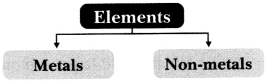
- Elements are broadly classified into metals and non-metals based on their physical and chemical properties.
Physical Properties of Metals
- Physical properties are the characteristics of a substance that can be observed, or measured without changing the chemical identity of the substance.
- Some physical properties of metals are discussed as follows:
Uses of Metals- Iron: Used in construction and making tools.
- Copper: Used in electrical wires and cooking utensils.
- Aluminium: Used in cooking utensils and packaging (foils).
- Gold and Silver: Used in jewellery.
- Zinc: Used in galvanising iron to prevent it from rusting.
Appearance
Metals have a shiny appearance called metallic lustre, and therefore, metals are said to be lustrous.
- Most metals shine when freshly cut. This is why gold and silver jewellery look so attractive.
- Due to metallic lustre, the mirrors made of glass are coated with silver or aluminium.
Hardness
The hardness of a material is its ability to resist being scratched or compressed.
- Metals are generally hard and exist in solid state at room temperature.
- However, there are certain exceptions. Some metals, like sodium and potassium, are soft and can be cut with a knife. Mercury metal used in thermometers exists in its liquid state at room temperature.
Malleability
Malleability is the ability of a material to be deformed or shaped into thin sheets by hammering, without breaking.
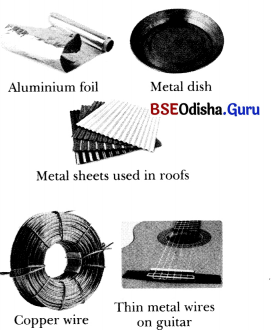
- Metals are generally malleable. Due to this propeston of metals, they can be used as sheets to form shades and roofs. The aluminium foil used for wrapping of food items and the metal plates used as dishes, etc. are formed due to this property of metals.
- Gold and silver are the most malleable metals.
Ductility
The property of a material that enables it to be drawn into thin wires is called ductility.
- Metals like gold, silver, copper, and aluminium are ductile.
- Copper and aluminium are commonly used for making electrical wires.
- Whereas, gold, silver, etc. are used to make different ornaments. Copper wire on guitar a Musical instruments, like the veena, ektam, sitar, violin, and guitar, use thin metal wires to produce a variety of sounds when plucked.
Sonority
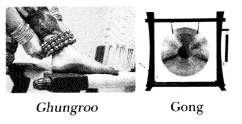
The property of metals by which they produce a ringing sound when struck against a hard surface is called sonority.
- Metals are sonorous. This is why, bells, made of metals, produce a ringing sound.
- Due to this property, metals are used in making ghungroos, and musical instruments like gongs, strings in guitar, sitar, veena, etc.
Conduction of Heat
The process by which heat moves from one part of a material to another is called conduction of heat.
- Materials that allow heat to pass through them are called good conductors of heat, while those that do not, are called poor conductors of heat.
- Metals such as, aluminium and copper, are good conductors of heat. Thus, they are used for making cooking utensils.
Conduction of Electricity
The process by which certain materials allow electricity to pass through them is called conduction of electricity.
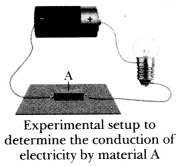
- Materials that allow electricity to pass through them easily are called good conductors of electricity.
- For example, in the experimental setup showm alongside, the bulb will glow only if the material A is a good conductor of electricity.
- Metals possess this property and thus, are used in electrical circuits, wiring, and other electrical equipments.
- Materials that do not allow electricity to pass through them are called poor conductors of electricity or insulators. For example, wood, plastic, rubber, etc.
Chemical Properties of Metals
Chemical properties of substances tell us how they behave when they interact with other substances under different conditions.
Effect of Air and Water on Metals
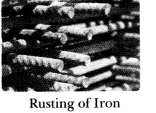
Rusting of Iron: Rusting is a slow process in which a brownish substance (called rust) is formed on the surface of an iron object when it is left exposed to moist air.
- The presence of both air and water is needed for the rusting of iron to take place.
- Rusting is a serious problem as it leads to the deterioration of iron objects.
- It can be prevented by painting, oiling, greasing, or coating iron surface with a thin layer of zinc, in a process known as galvanisation.
Corrosion
- The gradual degradation of metals due to the action of air, water, or other substances in their surroundings is called corrosion.
- Metals other than iron also undergo change in their appearance when left open in moist air. For example, copper objects gradually develop a green coating, and silver objects also acquire a black coating when exposed to air, water or other substances.
Alloy: An alloy is a mixture of two or more metals or a metal and a non-metal. They are formed to enhance the properties of metals such as strength, hardness, or resistance to corrosion. For example, steel, an alloy consisting of iron (metal) and carbon (non-metal) is used to make cooking utensils.
Formation of Metal Oxides
Metals react with oxygen to form metal oxides. Most metal oxides are basic in nature.
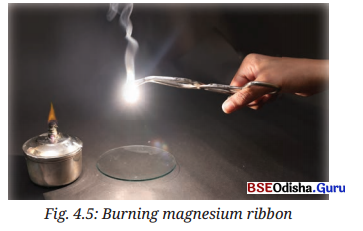
Magnesium ribbon burns in the presence of oxygen with a dazzling white flame to produce a white powder called magnesium oxide.
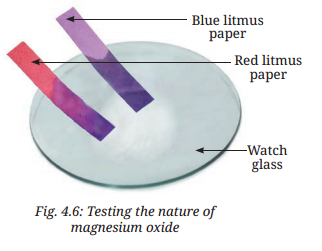
When dissolved in water, the solution of magnesium oxide turns red litmus paper blue.
Sodium and potassium react vigorously with oxygen and water and generate a lot of heat, often resulting in fire. Thus, they are stored in kerosene to prevent contact with air and moisture.
Physical Properties of Non-metals
Non-metals show properties that are different from those of metals. Examples of non-metals include oxygen, hydrogen, nitrogen, carbon, and sulphur.
- Appearance: Non-metals are generally dull in appearance (non-lustrous).
- Hardness: Most non-metals are soft.
- Malleability and Ductility: Non-metals are neither malleable nor ductile. They are brittle in nature, i.e., they break easily when hammered.
- Conductivity: Non-metals are generally poor conductors of heat and electricity.
- Sonority: Non-metals do not produce a ringing sound when struck on a hard surface. Thus, they are non-sonorous.
Uses of Non-metals
- Oxygen: Essential for breathing and burning purposes.
- Carbon: Used in pencils (graphite), as fuel (coal), in making steel and forms the basis of all living beings.
- Nitrogen: Used in making fertilisers.
- Chlorine: Used in water purification.
- Iodine: A solution of iodine can be used as an antiseptic to apply on wounds.
Chemical Properties of Non-metals:
- Formation of non-metal (acidic) oxide: Non-metals react with oxygen to form non-metal oxides, which are acidic in nature. Sulphur burns in air to produce sulphur dioxide gas. This gas, when dissolved in water, forms sulphurous acid, which turns blue litmus red.
- Reaction with Water: Non-metals generally do not react with water. Phosphorus is always stored under water, as it catches fire quickly if exposed to air.
Materials are the substances with specific properties, that make up objects. These can be pure or impure. Elements are a sub-category of pure substances.
Properties of Materials
- The ability of a material to be beaten into thin sheets.
- Metals like copper and aluminium show this property, while non-metals like coal and sulphur break when hammered.
Ductility
- The property of materials to be drawn into thin wires. For example, copper and aluminium wires.
- Materials like coal and sulphur cannot be made into wires.
Sonority
The ability of a material to produce a ringing sound when struck against a hard surface.
Conduction of Heat
- Materials that allow easy transfer of heat from one point to another are good conductors of heat. For example, a metal rod becomes hot when placed on a flame.
- Materials that do not allow heat transfer are poor conductors of heat. For example, wood and plastic.
Conduction of Electricity
- Materials that allow electricity to pass through them easily are called good conductors of electricity. For example, copper, gold, etc.
- Materials that do not allow electricity to pass through them are poor conductors of electricity. For example, wood, plastic, etc.
Elements:
An element is a pure substance that cannot be broken down into simpler substances.
Metals
Physical Properties: Metals are usually hard, lustrous, malleable, ductile, sonorous and good conductors of heat and electricity.
Chemical Properties: Metals form basic oxides when burned in air (oxygen).
Uses:
- Iron: in construction, tools
- Copper: in electrical wires, cooking utensils
- Aluminium: as foils to wrap food items
- Gold and silver: in ornaments
Non-metals
Physical Properties: Non-metals are usually soft, dull, brittle, and poor conductors of heat and electricity. These are not malleable, ductile or sonorous.
Chemical Properties: Most of the non-metals form acidic oxides when burned in air (oxygen).
Uses:
- Oxygen: for breathing
- Carbon: building block of all life forms; necessary for growth and energy
- Nitrogen: in fertilisers which are essential for plant growth
- Chlorine: in purification of water
- Iodine: as an antiseptic
Corrosion:
The process of gradual deterioration of metal surfaces caused by air, water, or other substances is called corrosion. For example, the formation of green coating on the surface of copper objects and black coating on the surface of silver objects.
Rusting:
When iron is exposed to both air and water, brown deposits are formed called rust, are formed on its surface and the process is called rusting.
Prevention Methods
- Oiling
- Painting
- Greasing
- Applying a protective layer of zinc metal (galvanisation)