
Go through BSE Odisha Class 8 Science Solutions Chapter 9 The Amazing World of Solutes, Solvents, and Solutions Question Answer to understand textbook questions more clearly.
Class 8 Science Curiosity Chapter 9 Question Answer
Class 8 Science Ch 9 The Amazing World of Solutes, Solvents, and Solutions Question Answer
Class 8 Science Chapter 9 The Amazing World of Solutes, Solvents, and Solutions Question Answer
Probe and Ponder Questions
Question 1.
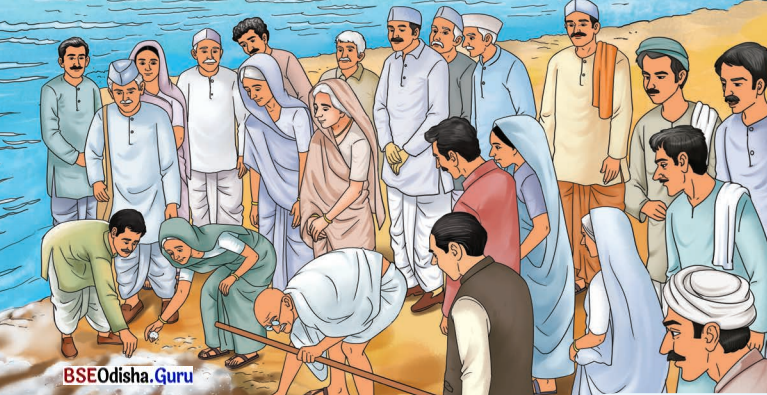
What do you think is happening in the picture given below?
Answer:
- The picture shows Mahatma Gandhi obtaining salt from the sea during the Salt March, accompained by followers.
- This illustrates the historical process of extracting salt from seawater through evaporation, where seawater acts as a natural solution with salt as the solute and water as the solvan, highlighting concepts of solubility and traditional salt production.

Question 2.
What happens when you add too much sugar to your tea and it stops dissolving? How can you solve this problem?
Answer:
- When too much sugar is added, the tea becomes a saturated solution and excess sugar settles at the bottom as it can no longer dissolve at that temperature.
- To solve this, heat the tea to increase the solubility of sugar, allowing more to dissolve, as solubility generally increases with temperature for solids in liquids.
Question 3.
Why do sugar and salt dissolve in water but not in oil? Why is water considered a good solvent?
Answer:
Sugar and salt dissolve in water because water mixes evenly with many with many substances and can break them down into smaller particles forming uniform solution. They do not dissolve in oil because oil cannot mix well with them. Water is considered a good solvent because it can dissolve a large number of substances, so it is often called a universal solvent.
Question 4.
Why are water bottles usually tall and cylindrical in shape instead of spherical?
Answer:
- Water bottles are tall and cylindrical as they are easy to hold, store and use efficiently.
- They provide better grip, stability and use less material for the same volume compared to spheres, which would roll and be harder to handle.
Question 5.
Share your questions …………
Answer:
Based on the chapter, potential questions could include:
- How does temperature affect the solubility of gases differently from solids?
- Why does ice float on water despite being a solid?
- What role does density play in everyday phenomena like hot air balloons?
InText Questions
Question 1.
We know air is a mixture. Would a mixture of gases also be considered a solution? (Page 135)
Answer:
Yes, just like liquid solution where water act as a solvent, gases can also form solution – with air being a common example. Air is a gaseous solution. Since nitrogen is present in the largest amount in the air, it is considered as the solvent, while oxygen, argon, carbon dioxide, and other gases are considered as solutes.
Question 2.
What will happen if we keep on adding more salt in a given amount of water? (Page 136)
Answer:
A stage comes when the added salt does not dissolve completely and undissolved salt settles at the bottom.
Question 3.
Do gases also dissolve in water ? (Page 139)
Answer:
Yes, many gases, including oxygen dissolve in water. All aquatic life like fishes, even plants utilises these dissolved oxygen to sustain.
Question 4.
How many types of mixture are there? What special name is given to uniform mixture? How would you able to see their components?
Answer:
Now I understand that the mixtures we use can be of two types-uniform and nonuniform. Uniform mixtures are called solutions, and their components are not visible separately. In non-uniform mixtures, the components can be seen either with the naked eye or with a magnifying device.
Question 5.
I observed that in some nonuniform mixtures, such as sawdust in water, the sawdust floats, whereas in the mixture of sand and water, the sand sinks. I wonder why that happens? (Page 139)
Answer:
This happens because sawdust is lighter than water but sand is heavier than water. In other words, density of sawdust is less than water but density of sand is more than water.
Question 6.
Why are measuring cylinders always designed narrow and tall instead of wider and short like a beaker? (Page 144)
Answer:
A measuring cylinder is designed to be narrow and tall to improve the accuracy and precision of liquid volume measurements. It also minimizes the distortion of the liquid’s curved surface (the meniscus), making it easier for a person to read the volume consistently at eye level.
Question 7.
I wonder how the level of a coloured liquid is measured? (Page 145)
Answer:
For coloured liquids take reading from the top of the meniscus.
Question 8.
What is the maximum amount of solute which a fixed amount of solvent can dissolve ?
Answer:
It is called the solubility.
The Amazing World of Solutes, Solvents, and Solutions Class 8 Questions and Answers
Keep the Curiosity Alive (Pages 149-151)
Question 1.
State whether the statements given below are True [T] or False [F]. Correct the false statement(s).
(i) Oxygen gas is more soluble in hot water rather than in cold water.
Answer:
False: Oxygen is more soluble in cold water.
(ii) A mixture of sand and water is a solution.
Answer:
False: A Mixture of sand and water is not a solution. Sand does not dissolve in water but settles down.
(iii) The amount of space occupied by any object is called its mass.
Answer:
False: The amount of space occupied by any object is called its volume
(iv) An unsaturated solution has more solute dissolved than a saturated solution.
Answer:
False: A saturated solution has more solute dissolved than an unsaturated solution.
(v) The mixture of different gases in the atmosphere is also a solution.
Answer:
True.
Question 2.
Fill in the blanks:
(i) The volume of a solid can be measured by the method of displacement, where the solid is ……… in water and the ………… in water level is measured.
Answer:
placed; rise
(ii) The maximum amount………… dissolved in ………… of……….. at a particular temperature is called solubility at that temperature.
Answer:
solute, solvent
(iii) Generally, the density ………… with increase in temperature.
Answer:
decrease
(iv) The solution in which glucose has completely dissolved in water, and no more glucose can dissolve at a given temperature, is called a ………… solution of glucose.
Answer:
saturated
Question 3.
You pour oil into a glass containing some water. The oil floats on top. What does this tell you?
(i) Oil is denser than water.
(ii) Water is denser than oil.
(iii) Oil and water have the same density.
(iv) Oil dissolves in water.
Answer:
(ii) Water is denser than oil.
Oil floats because its density is lower than water’s, causing less dense substances to float on denser ones.
Question 4.
A stone sculpture weighs 225 g and has a volume of 90cm3. Calculate its density and predict whether it will float or sink in water.
Answer:
Density of stone =\(\frac{225}{90}\)=2.5 g/cm3
Since this is greater than water’s density ( 1g/cm3 )the sculpture will sink in water.
Question 5.
Which one of the following is the most appropriate statement, and why are the other statements not appropriate?
(i) A saturated solution can still dissolve more solute at a given temperature.
(ii) An unsaturated solution has dissolved the maximum amount of solute possible at a given temperature.
(iii) No more solute can be dissolved into the saturated solution at that temperature.
(iv) A saturated solution forms only at high temperatures.
Answer:
Statement (iii) is most appropriate.
(i) It is not appropriate as a saturated solution cannot dissolve more solute at a given temperature.
(ii) An unsaturated solution can have more solute dissolved at a given temperature.
(iii) Correct.
(iv) A Saturated solution can be formed at all temperatures.
Question 6.
You have a bottle with a volume of 2 litres. You pour 500 mL of water into it. How much more water can the bottle hold?
Answer:
The bottle of 2 litres capacity can hold 1500 mL more of water besides 500 mL.
Question 7.
An object has a mass of 400 g and a volume of 40cm3. What is its density?
Answer:
Density = \(\frac{\text { mass }}{\text { volume }}\)=\(\frac{400}{40}\)=10 g/cm3
Question 8.
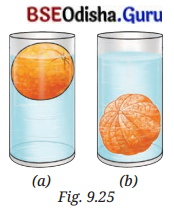
Analyse Figures (a) and (b). Why does the unpeeled orange float, while the peeled one sinks? Explain.
Answer:
An unpeeled orange displaces more water, and so it floats. Peeled orange displaces less water than its weight, so it sinks.
Question 9.
Object A has a mass of 200 g and a volume of 40 cm3. Object B has a mass of 240 g and a volume of 60 cm3. Which object is denser?
Answer:
Density of object A=\(\frac{200}{40}\)= 5g/cm3
Density of object B= \(\frac{240}{60}\)=4g /cm3
Conclusion: Object A is denser, having more density than B.
Question 10.
Reema has a piece of modeling clay that weighs 120 g. She first moulds it into a compact cube that has a volume of 60 cm3. Later, she flattens it into a thin sheet. Predict what will happen to its density.
Answer:
The density of flattened clay will decrease as it displaces more liquid.
Question 11.
A block of iron has a mass of 600 g and a density of 7.9g/cm3. What is its volume?
Answer:
We know density =\(\frac{\text { mass }}{\text { volume }}\)
∴ Volume = \(\frac{\text { mass }}{\text { density }} \)
= \(\frac{600 \mathrm{~g}}{7.9 \mathrm{~g} / \mathrm{cm}^3}\)=75.94 cm}3
Question 12.
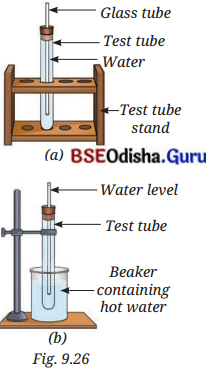
You are provided with an experimental setup as shown in Figures (a) and (b). On keeping the test tube (Figure b) in a beaker containing hot water ∼70°C, the water level in the glass tube rises. How does it affect the density?
Answer:
The density of water in setup (b) will decrease.
Class 8 Science Chapter 9 Question Answer
Activity 1
Let us investigate
Aim: To find the capacity of water to dissolve solutes.
Materials Required: A glass tumbler, salt.
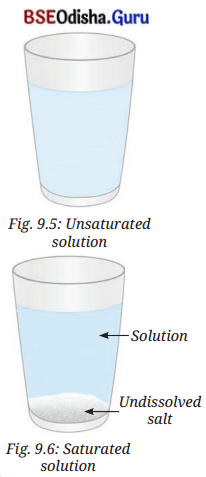
Procedure:
- Take a clean glass tumbler and half filled with water.
- Now add one spoonful of salt into it and stir it untill it dissolves completely (see figure).
- Continue adding a spoonful of salt into the glass tumbler and stir. Observe how many spoons of salt you can add before it stops dissolving completely.
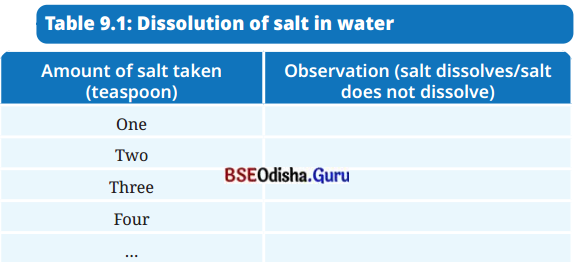
- Note down your observations in table given below.
Observations:
Table: Dissolution of salt in water
Answer:
| Amount of salt taken (teaspoon) | Observation (salt dissolves/salt does not dissolve) |
| One | Salt dissolves |
| Two | Salt dissolves |
| Three | Salt dissolves |
| Four | Salt dissolves with difficulty |
| Five | Salt does not dissolve and settle at the bottom |
Inferences:
- After adding a few more spoons of salt, a stage comes when the added salt does not dissolve completely and the undissolved salt settles at the bottom.
- This indicates water reaches a limit and cannot dissolve more salt. This is called saturated solution.
Activity 2.
Let us experiment (Demonstration activity)
Aim: To show that solubility of substances increases with increase in temperature.
Materials Required: Baking soda (sodium hydrogen carbonate), a glass beaker.
Procedure:
- First of all we will take about 50 mL of water in a glass beaker and measure its temperature using a laboratory thermometer, say 20°C.
- Now, add a spoonful of baking soda (sodium hydrogen carbonate) to the water and stir until it dissolves. Continue adding small amounts of baking soda while stirring, till some solid baking soda is left undissolved at the bottom of the beaker.
- Heat the mixture to 50°C while stirring.
- Observe the undissolved baking soda dissolving.
- Add more baking soda until undissolved solid remains again.
- Heat further to 70°C while stirring and observe again.
Observations:
- At 20°C: Limited baking soda dissolves; excess remains undissolved.
- At 50°C: Previously undissolved baking soda dissolves; more can be added before saturation.
- At 70°C: Even more baking soda dissolves, showing increased capacity.
Inference: Water at 70°C dissolves more baking soda than at 50°C and much more than at 20°C.
Activity 3.
Let us measure
Aim: To measure the mass of objects.
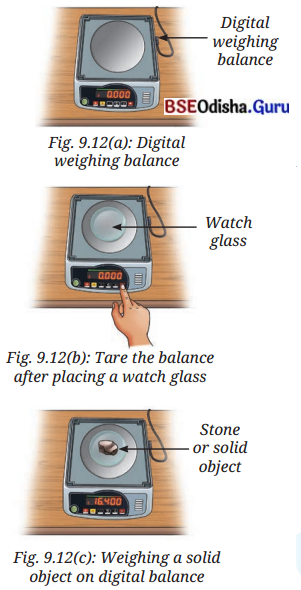
Materials Required: Digital weighing balance, a watch glass, stone or solid objects.
Procedure:
- Switch ON the digital weighing balance.
- Observe the initial reading on the digital weighing balance display.
- The balance should show a zero reading initially. If not, then we must bring it to zero by pressing the tare or reset button (Figure (a).
- Now, put a dry and clean watch glass or butter paper on the pan.
- Note down the reading on the digital weighing balance.
- Reset the digital weighing balance reading to zero by pressing the tare or reset button as shown in figure (b).
- Now, carefully place the solid object, such as stone, on the watch glass [Figure (c)].
- Note the reading displayed on the balance, which gives the mass of the stone, say 15.400 g.
- Repeat the experiment with different objects like an apple, orange etc.
- You can use any other type of balance available in your school.
Observations: Mass of different objects are different.
Inference: A digital weighing balance or a balance give the measurement of mass. e.g., Mass of stone =15.400 g
Mass of an apple =150 g
Activity 4.
Let us observe and calculate
Aim: (i) To measure the maximum volume of liquid using a measuring cylinder.
(ii) To find the smallest value that a measuring cylinder can read.
Materials Required: A measuring cylinder.
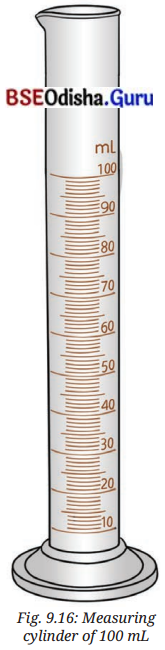
Procedure: Take a measuring cylinder of 100 mL.
Observations:
- There are 10 smaller divisions between 10 mL and 20 mL or between 40 mL and 50 mL.
- 10 small divisions =10 mL
So, one small division = \(\frac{10}{10}\)=1 mL - It can measure volume upto 100 mL.
Inference:
1. What is the maximum volume it can measure?
Answer: The cylinder is marked as 100 mL; therefore, it can measure volume up to 100 mL.
2. What is the smallest volume it can measure?
3. How much is the volume difference indicated between the two bigger marks (for example, between 10 mL and 20 mL )?
Answer: 10 mL
4. How many smaller divisions are there between the two bigger marks?
Answer: 10 smaller divisions
Fig: Measuring cylinder of 100 m L
5. How much volume does one small division indicate?
Answer: 1mL
Activity 5.
Let us measure 50 mL of water
Aim: To measure 50 mL of water.
Materials Required: A dry measuring cylinder, a droper.
Procedure:
- Take a clean and dry measuring cylinder on a flat surface and pour water slowly to the mark. [see figure (a)]
- Use a dropper to add or remove water for exact level.
- If you observe carefully then you will findthat the water inside the measuring cylinder forms a curved surface. This curved surface is called the meniscus [see figure (b)].
- Keep eyes at level with the bottom of the meniscus for accurate reading.
- As soon as it reaches the required level-that is, 50 mL – transfer this water to the required container.
- For coloured liquids read the top of the meniscus.
Observations: Reading of the bottom of the meniscus is observed 50 mL.
Inference: The volume of water is 50 mL.
Determining Volume of Solid Objects with Regular Shapes
- For cuboid shapes (e.g., notebook, shoe box, dice), measure length (l), width (w), height (h) with a scale.
- Formula: Volume = l ×w ×h.
Activity 6.
Let us calculate
Aim: To determine volume of solid objects with regular shapes (like cube, cuboid).
Materials Required: For cuboid shapes (e.g., notebook, shoe box), For cube: a dice, scale.
Procedure:
- Take various objects with a cuboid shapes, such as a notebook, a shoe box, or a dice.
- Now, measure the length (l), width (w), and height (h) of the objects with the help of a scale. Suppose the length of the notebook is 25 cm, the width is 18 cm, and the height is 2 cm.
Observations:
| Note book | dice | shoe box | |
| length (l) width or breadth (w) height |
25 cm 18 cm 2 cm |
1 cm 1 cm 1 cm |
10 cm 5 cm 3 cm |
Demonstration:
Volume of cuboid =l × w × h
Volume of cube = a3 or (side)3
∴ Volume of Note book =25 × 18 × 2= 900cm3
Volume of a dice =1cm × 1 cm × 1 cm = 1 cm3
Volume of a shoe box =10 × 5 × 3 = 150 cm3
Inference:
Volume of a cuboid = l times w times h
Volume of cube = side × side × side
Note: The values of volume are obtained in units of mL, which can be written in the equivalent unit cm3 for solids.
Activity 7.
Let us measure
Aim: To determine the volume of objects with irregular shapes.
Materials Required: A measuring cylinder, various objects such as a stone, metal keys etc.
Procedure:
- Take some objects from your surroundings, like stone, metal keys, and so on.
- Now, pour water in a measuring cylinder up to any desired volume, say 50 mL [Figure (a)] and record the initial volume taken in table.
- Now, tie the object, say a stone, with the help of a thread and slowly lower it down into the measuring cylinder.
- Note down your observation.
- Now, record the final volume after the level rises, say 55 mL, as shown in [Figure (b)].
- Subtract the initial volume from the final volume after the object is put into the measuring cylinder. This is the volume of the object.
Observations:
Table: Volume of irregular solids
| S.No. | Object | Initial volume of water in the measuring cylinder (mL) (A) | Final volume of water in the measuring cylinder (mL) (B) | Volume of water displaced in the measuring cylinder (mL) (B-A) | Volume of the object ( cm3) |
| 1. 2. 3. |
Stone Metal key Any other |
50 mL | 55 mL | 5 mL | 5cm3 |
Inference:
Volume of object = Final volume of water – Initial volume of water
∴ Volume of stone =55 mL-50 mL
= 5mL = 5 cm3
The Amazing World of Solutes, Solvents, and Solutions Class 8 Extra Questions and Answers
Short Answer Type Questions
Question 1.
How do you decide which liquid is the solute and which is the solvent when two liquids mix ?
Answer:
The component present in the smaller amount is the solute and the component in the larger amount is the solvent.
Question 2.
Why does sugar dissolve in water but sand does not form a solution?
Answer:
Sugar particles interact with water and disperse evenly to form a clear solution, while sand does not dissolve and settles at the bottom.
Question 3.
What does it mean when a solution becomes saturated ?
Answer:
A saturated solution has dissolved the maximum amount of solute at that temperature, so any extra solute remains undissolved.
Question 4.
How can heating turn a saturated solution into an unsaturated one ?
Answer:
Heating usually increases wi bility for many solids, so the solvent can cassolve more solute and the previously saturated solution becomes unsaturated.
Question 5.
Floating of ice is an important phenomenon. How does it helps animals living in lakes and oceans?
Answer:
This is important for animals living in lakes and oceans because ice floats, it forms a layer on top, keeping the water underneath warm enough for fish and other creatures to survive, even in extremely cold weather.
Question 6.
If mass of an object is 16.400 g and its volume is 5cm3, then calculate the density of object.
Answer:
Mass of object =16.400 g
Volume of object =5 cm3
∴ Density = \(\frac{\text { Mass }}{\text { Volume }}\)= \(\frac{16.4 \mathrm{~g}}{5 \mathrm{~cm}^3}\) 5cm3 =3.28 g/cm3
Question 7.
Why hot air balloons rises in the sky ?
Answer:
As temperature increases the volume of gases filled inside the balloons increases and its density decreases. So, density of gases inside the balloon is less than the cool air around it and hence it rises.
Long Answer Type Questions
Question 1.
Explain with an example how the same substances can form different types of mixtures depending on proportion and how to identify them.
Answer:
(a) Oil and water usually form a non-uniform mixture with separate layers when oil is added in ordinary amounts, so it is not a solution.
(b) However, a very small amount of acetic acid in water forms vinegar, which is a true solution because it is uniform and clear.
(c) To identify them, look for clarity, absence of layers, and particles that do not settle on standing. If the mixture is cloudy or separates, it is not a true solution. If it remains clear and uniform, it is a solution.
Question 2.
Explain how relative density helps predict floating and sinking better than mass alone, using two same-sized objects made of different materials.
Answer:
(a) Mass alone can be misleading because it does not consider volume, but relative density compares a material’s density to water. If a same-sized wooden block and an iron block are placed in water, the wood floats and iron sinks because wood’s density is less than water’s, while iron’s is greater.
(b) Relative density less than 1 means it will float in water; greater than 1 means it will sink. Thus, relative density accurately predicts behavior in a liquid
Case-Study Based Questions
1. Read the following passage carefully and answer the questions that follow : At a picnic, friends make lemonade by stirring sugar into water. After adding too much sugar, they notice some grains settle at the bottom of the glass. They realise no more sugar can dissolve at that temperature, no matter how much they stir.
(a) What does it mean when sugar settles at the bottom and does not dissolve further?
Answer:
It means the solution is saturated; no more sugar can dissolve at that temperature.
(b) What type of solution is formed before and after the sugar settles?
Answer:
Before settling, the solution is unsaturated; after settling, it is saturated.
(c) How can temperature changes affect how much sugar dissolves in water in this scenario?
Answer:
Increasing temperature usually increases solubility; thus, more sugar can dissolve in warmer water, while decreasing temperature may cause sugar to crystallise out.
Picture Based Questions
I. Look at the picture and answer the following questions:
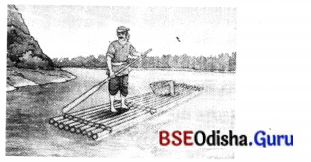
(a) Identify the picture.
(a) Bamboo raft
(b) Wooden raft
(c) Kayaka
(d) None of these
Answer:
(a) Bamboo raft
(b) Why it floats on water ?
Answer:
It floats on water because it is lighter than water.
(c) Why Bamboo was used in it ? Write its uses also?
Answer:
Bamboo was used because it is light, hollow and floats easily on water. People tied bamboo poles together to make rafts and small boats for fishing, trading and crossing water bodies.
The Amazing World of Solutes, Solvents, and Solutions Class 8 MCQ
Multiple Choice Questions (Mcqs)
Question 1.
Which of the following is an example of solution?
(a) Sugar in water
(b) Sand in water
(c) Muddy water
(d) Oil and water
Answer:
(a) Sugar in water
Question 2.
Which of the following is a characteristic of solute ?
(a) It is present in the largest quantity.
(b) It dissolved in the solvent
(c) Both (c) and (d)
(d) It is present in smallest quantity
Answer:
(c) Both (c) and (d)
Question 3.
A solution that contains the maximum amount of solute that can be dissolved at a given temperature is called :
(a) Unsaturated Solution
(b) Saturated Solution
(c) Supersaturated Solution
(d) Dilute Solution
Answer:
(b) Saturated Solution
Question 4.
If a solution has a high concentration of solute, it is considered :
(a) Dilute
(b) Concentrated
(c) Saturated
(d) Unsaturated
Answer:
(b) Concentrated
Question 5.
The SI unit of density is: ………….
(a) gram/cm3
(b) kg/m3
(c) cubic metre
(d) g/L
Answer:
(b) kg/m3
Assertion and Reasoning
These questions consist of two statements, each printed as Assertion (A) and Reason (R). While answering these questions, you are required to choose any one of the following four responses.
(a) Assertion (A) and Reason (R) both are correct and reason is correct explanation for assertion.
(b) Assertion (A) and Reason (R) both are correct and reason is not correct explanation for assertion.
(c) Assertion (A) is correct but the Reason (R) is wrong.
(d) Assertion (A) is wrong but the Reason (R) is correct.
1. Assertion (A): Mass is the amount of matter contained in body.
Reason (R): Mass is measured in newton (N) unit.
Answer:
(c) Assertion (A) is correct but the Reason (R) is wrong.
2. Assertion (A): SI unit of density is kg/m
Reason (R): Relative density has no unit.
Answer:
(b) Assertion (A) and Reason (R) both are correct and reason is not correct explanation for assertion.
Fill in the blanks
1. The concentration of a solution is the amount of ………… present per unit volume or per unit mass of the solution/solvent.
Answer:
solute
2. A homogeneous mixture of two or more substances is called ………….
Answer:
solution
3. ………… is the maximum amount of the solute that can be dissolved in a given solution at a given temperature.
Answer:
solubility
4. SI unit of density is ………….
Answer:
kg/m3
5. Relative density is the ratio of the density of the substance to the density of ………….
Answer:
water.
True or False
1. The maximum amount of solute that dissolves in a fixed quantity of the solvent is called its solubility.
Answer:
True
2. Relative density do not have any units.
Answer:
True
3. Volume of liquids cannot be measured by a measuring cylinder.
Answer:
False
4. Volume of a solid object with regular shapes are calculated with the help of formulas.
Answer:
True
5. The unit of density is cubic metre.
Answer:
True