
Regular revision with Class 7 Maths MCQ with Answers and Ganita Prakash Class 7 Maths Part 2 Chapter 4 Another Peek Beyond the Point MCQ improves accuracy in objective exams.
MCQ on Another Peek Beyond the Point Class 7
Another Peek Beyond the Point MCQ Class 7
Class 7 Maths Another Peek Beyond the Point MCQ
Question 1.
Which digit is in the thousandths place in the number 48.50736?
(a) 5
(b) 0
(c) 7
(d) 3
Solution:
(c) 7
In 48.50736, on the right side of the decimal point, the place values of digits are tenths (5), hundredths (0), thousandths (7) and so on.
Question 2.
Which of the following is the correct expansion of 32.406?
(a) 30 + 2 + 0.4 + 0.006
(b) 30 + 2 + 0.04 + 0.006
(c) 30 + 2 + 0.4 + 0.06
(d) 30 + 0.4 + 0.006
Solution:
(a) 30 + 2 + 0.4 + 0.006
The expanded form of 32.406 is given as
32.406 = 3 × 10 + 2 × 1 + 4 × \(\frac{1}{10}\) + 0 × \(\frac{1}{100}\) + 6 × \(\frac{1}{1000}\)
= 30 + 2 + 4 × 0.1 + 0 × 0.01 + 6 × 0.001
= 30 4- 2 + 0.4 + 0.006
Question 3.
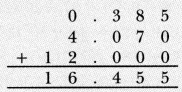
The value of 0.385 + 4.07 + 12 is:
(a) 16.455
(b) 16.450
(c) 16.40
(d) 15.455
Solution:
(a) 16.455
Adding after aligning the decimal points in given numbers:

Question 4.
Which of the following is equal to 4.8 × 2.5?
(a) 10.2
(b) 12.0
(c) 11.75
(d) 9.5
Solution:
(b) 12.0
Multiplying the decimal numbers after converting them into fractions:
48 × 25 = \(\frac{48}{10} \times \frac{25}{10}=\frac{48 \times 25}{10 \times 10}=\frac{1200}{100}\) = 12
Question 5.
Cost of a pencil is ₹7.25. What is the cost of 12 pencils?
(a) ₹87
(b) ₹88.50
(c) ₹90
(d) ₹72.50
Solution:
(a) ₹87
Cost of one pencil = ₹7.25
∴ Cost of 12 pencils = 12 × 7.25
= (12 × 7) + (12 × 0.25)
= 84 + 12 × \(\frac{1}{4}\) = ₹87
Question 6.
7 + \(\frac{5}{10}+\frac{3}{100}+\frac{1}{1000}\) =
(a) 0.7531
(b) 75.31
(c) 7.531
(d) 0.7531
Solution:
(c) 7.531
7 + \(\frac{5}{10}+\frac{3}{100}+\frac{1}{1000}\)
= 7 + 0.5 + 0.03 + 0.001 = 7.531
Question 7.
A car covers a distance of 14.75 km in one litre of petrol. How much distance will it cover in 10 litres of petrol?
(a) 147.5 km
(b) 1475 km
(c) 1.475 km
(d) 14.075 km
Solution:
(a) 147.5 km
The distance covered by car in one litre of petrol = 14.75 km
The distance covered by car in 10 litres of petrol = 14.75 × 10 = 147.5 km
Question 8.
A shop packs sugar in 0.375 kg packets. If one full box contains 24 such packets, then the total weight of one full box is:
(a) 9.0 kg
(b) 8.75 kg
(c) 9.100 kg
(d) 8.25 kg
Solution:
(a) 9.0 kg
Weight of 1 packet of sugar = 0.375 kg
Since a box contains 24 packets of sugar,
Weight of one box = 0.375 kg × 24
= \(\frac{375}{1000} \times 24=\frac{9000}{1000}\)
= 9.0 kg
Question 9.
48.6 ÷ 10 =
(a) 4.86
(b) 0.486
(c) 48.06
(d) 486
Solution:
(a) 4.86
48.6 ÷ 10 = \(\frac{486}{10} \div 10=\frac{486}{10} \times \frac{1}{10}=\frac{486}{100}\) = 4.86
Question 10.
Which of the following division gives a quotient less than the dividend?
(a) 12.5 ÷ 0.5
(b) 7.29 ÷ 9
(c) 4.8 ÷ 0.08
(d) 18.6 ÷ 0.3
Solution:
(b) 7.29 ÷ 9
We know that in decimal division, if divisor is greater than 1, the quotient is less than the dividend.
Now, 9 > 1, so on dividing 7.29 by 9 we will get a quotient (0.81) less than 7.29.
Question 11.
Which of the following statements are correct with respect to the multiplication of the decimal number 8.879 by 89?
(i) 8.879 × 89 = 8.87 × 89 + 0.009 × 89
(ii) 8.879 × 89 = 8 × 89 + 0.8 × 89 + 0.79 × 89
(iii) 8.879 × 89 = 8 × 89 + 0.8 × 89 + 0.07 × 89 + 0.009 × 89
(iv) 8.879 × 89 = 8 × 89 + 0.879 × 89
Choose the correct option from the following:
(a) Only (i), (ii) and (iii)
(b) Only (iii)
(c) Only (i), (iii) and (iv)
(d) All of the above
Solution:
(c) Only (i), (iii) and (iv)
The expanded form of 8.879 is:
8.879 = 8 × 1 + 8 × \(\frac{1}{10}\) + 7 × \(\frac{1}{100}\) + 9 × \(\frac{1}{1000}\)
= 8 + 0.8 + 0.07 + 0.009
Now, 8.879 × 89 = (8 + 0.8 + 0.07 + 0.009) × 89 = 8 × 89 + 0.8 × 89 + 0.07 × 89 + 0.009 × 89
or 8.879 × 89 = (8 + 0.8 + 0.07 + 0.009) × 89 = (8.87 + 0.009) × 89 = 8.87 × 89 + 0.009 × 89
or 8.879 × 89 = (8 + 0.8 + 0.07 + 0.009) × 89 = (8 + 0.8 + 0.079) × 89 = 8 × 89 + 0.8 × 89 + 0.079 × 89
or 8.879 × 89 = (8 + 0.8 + 0.07 + 0.009) × 89 = (8 + 0.879) × 89 = 8 × 89 + 0.879 × 89
∴ The statements (i), (iii) and (iv) are correct.
Question 12.
Which of the following multiplications of decimal numbers are correct?
(i) 0.5 × 0.05 = 0.025
(ii) 1.2 × 100 = 1200
(iii) 2.5 × 4 = 10
(iv) 0.1 × 0.1 = 0.1
Choose the correct option from the following:
(a) (i) and (iii) only
(b) (ii) and (iv) only
(c) (i), (ii) and (iii)
(d) (ii), (iii) and(iv)
Solution:
(a) (i) and (iii) only
Statements (i) and (iii) are correct as 25
0.5 × 0.05 = \(\frac{5}{10} \times \frac{5}{100}=\frac{25}{1000}\) = 0.025 and
2.5 × 4 = 2 × 4 + 0.5 × 4 = 8 + 2 = 10
But statements (ii) and (iv) are incorrect as 1.2 ×x 100 = 120 and 0.1 × 0.1 = 0.01
Question 13.
Which of the following years are not leap years?
(i) 2024
(ii) 2100
(iii) 2000
(iv) 1800
Choose the correct option from the following:
(a) (ii) and (iv)
(b) (i) and (iv)
(c) (ii) and (iii)
(d) (i) and (iii)
Solution:
(a) (ii) and (iv)
A year divisible by 4 is a leap year; a year divisible by 100 is not a leap year; however, a year divisible by 400 is a leap year.
The year 2024 is divisible by 4 and not divisible by 100, so it is a leap year.
The year 2100 is divisible by 100 but not divisible by 400, so it is not a leap year.
The year 2000 is divisible by 400, so it is a leap year.
The year 1800 is divisible by 100 but not divisible by 400, so it is not a leap year. Therefore, the years that are not leap years are 2100 and 1800.
Another Peek Beyond the Point Class 7 Assertion and Reason Questions
The following questions are Assertion and Reason based questions. Two statements are given, one labelled as Assertion (A) and the other is labelled as Reason (R). Select the correct answer to these questions from the codes (a), (b), (c) and (d) as given below.
(a) Both A and R are true and R is the correct explanation of A.
(b) Both A and R are true but R is not the correct explanation of A.
(c) A is true but R is false.
(d) A is false but R is true.
Question 1.
(A): 32 × 3 tenths = 32.3
(R): Moving the decimal point to the right makes the number bigger.
Solution:
(d) A is false but R is true.
32 × 3 tenths = 32 × \(\frac{3}{10}=\frac{32 \times 3}{10}\)
= \(\frac{96}{10}\) = 9.6
So, Assertion (A) is false.
We know that multiplying a number by 10 shifts the decimal point one place to the right, making the number bigger.
For example, 1.2 × 10 = 12
So, Reason (R) is true.
Question 2.
(A): When 56.3 is multiplied by 1000, the result is 56300.
(R): When multiplying a decimal number by 10, 100, or 1000, the decimal point shifts to the left by as many places as there are zeroes in the multiplier.
Solution:
(c) A is true but R is false.
We know that, when multiplying a decimal number by 10, 100, or 1000, the decimal point shifts to the right (not left) by as many places as there are zeroes with one.
By using the above logic, when 56.3 is multiplied by 1000, the result is 563,00.
∴ Assertion (A) is true, but Reason (R) is false.
Question 3.
(A): The area of a square with a side length of 0.5 cm is 2.5 sQuestion cm.
(R): The area of a square of side a is calculated using the formula a × a.
Solution:
(d) A is false but R is true.
We know that the area of a square of side a is calculated using the formula a × a.
So, if the side length, a = 0.5 cm, then
area = a × a = 0.5 cm × 0.5 cm = 0.25 sq. cm
∴ Assertion (A) is false, but Reason (R) is true.
Question 4.
(A): The year 3100 is a leap year.
(R): A century year that is not divisible by 400 is not a leap year.
Solution:
(d) A is false but R is true.
Since 3100 is a century year, it must be divisible by 400 to be a leap year.
But 3100 is not divisible by 400, so it is not a leap year
Therefore, Assertion (A) is false, but Reason (R) is true.
Another Peek Beyond the Point Class 7 Fill in the Blanks
Question 1.
In the blanks below, fill ‘<’, ‘>’ or ‘ = ’ after analysing the expressions on the LHS and RHS.
(i) 17.89 × 5.9 ______ 185.2 × 0.57
(ii) 5.6 × 12.72 _____ 89.04 × 0.8
Solution: <, =
(i) LHS = 17.89 × 5.9
= \(\frac{1789}{100} \times \frac{59}{10}=\frac{105551}{1000}\) = 105.551
RHS = 185.2 × 0.57 = \(\frac{1852}{10} \times \frac{57}{100}=\frac{105564}{1000}\)
= 105.564
The whole number parts of both are equal i.e. 105.
Also, the digit in the tenths place is the same for both i.e. 5.
However, the digit in the hundredths place of the LHS i.e. 5 is less than that of the RHS i.e. 6.
Since 5 < 6, we conclude:
105.551 < 105.564
So, 17.89 × 5.9 < 185.2 × 0.57.
(ii) LHS = 56 × 12 72 = \(\frac{56}{10} \times \frac{1272}{100}=\frac{71232}{1000}\)
= 71.232
RHS = 8904 × 08 = \(\frac{8904}{100} \times \frac{8}{10}=\frac{71232}{1000}\)
= 71.232
Since all digits match, we conclude:
5.6 × 12.72 = 89.04 × 0.8
Question 2.
When a decimal number is multiplied by 10000, the decimal point shifts to the right by ______ places.
Solution: four
We know that the number of zeroes in the multiplier (10, 100, 1000, …) determines how many places the decimal point shifts to the right.
Since the multiplier (10000) hag 4 zeroes, the decimal point shifts four places to the right.
Question 3.
6.7 × 10 + 6.7 × 100 + 0.67 × 1000 = _______
Solution: 1407
6.7 × 10 + 6.7 × 100 + 0.67 × 1000
= 67 + 670 + 670 = 1407
Question 4.
Evaluate the following using the information 256 × 12 = 3072.
(i) 25.6 × 1.2 = _______
(ii) 307.2 ÷ 1.2 = _______
(iii) 30.72 ÷ 25.6 = ______
(iv) 0.256 × 0.12 = _____
Solution: 30.72, 256, 1.2, 0.03072
(i) 25.6 × 1.2 = \(\frac{256}{10} \times \frac{12}{10}\)
= \(\frac{256 \times 12}{100}=\frac{3072}{100}\) = 30.72
(ii) 307.2 ÷ 1.2 = \(\frac{3072}{10} \div \frac{12}{10}\)
= \(\frac{3072}{10} \times \frac{10}{12}=\frac{256 \times 12}{12}\) = 256
(iii) 30.72 ÷ 25.6 = \(\frac{3072}{100} \div \frac{256}{10}\)
= \(\frac{256 \times 12}{100} \times \frac{10}{256}=\frac{12}{10}\) = 1.2
(iv) 0.256 × 0.12 = \(\frac{256}{1000} \times \frac{12}{100}\)
= \(\frac{256 \times 12}{100000}=\frac{3072}{100000}\) = 0.03072
Question 5.
Fill in the blanks:
(i) 5.5 km = _____ m
(ii) 125.5 mL = _________ L
(iii) 14.5 cm = ______ mm
(iv) 68 g = _______ kg
Solution: 5500, 0.1255, 145, 0.068
(i) As 1 km = 1000 m
∴ 5.5 km = 5.5 × 1000 = 5500 m
(ii) As 1 mL = \(\frac{1}{1000}\) L
∴ 125.5 mL = \(\frac{125.5}{1000}\) = 0.1255 LHS
(iii) As 1 cm = 10 mm
∴ 14.5 cm = 14.5 × 10 = 145 mm
(iv) As 1 g = \(\frac{1}{1000}\) kg
∴ 68 g = \(\frac{68}{1000}\) = 0.068 kg