
Easy-to-read Ganita Prakash Class 7 Notes and Chapter 1 Large Numbers Around Us Class 7 Notes save valuable study time during exam season.
Class 7 Maths Chapter 1 Large Numbers Around Us Notes
Class 7 Large Numbers Around Us Notes
Large numbers appear often in our surroundings: in population figures, distances, weights, and more. Understanding them helps us to appreciate the scale of things in the world around us.
To understand and read such big numbers easily, we use number systems.
Indian Number System: In this system, a number is split up into groups or periods named Ones, Thousands, Lakhs and Chores as shown in the table. (Read from right to left)
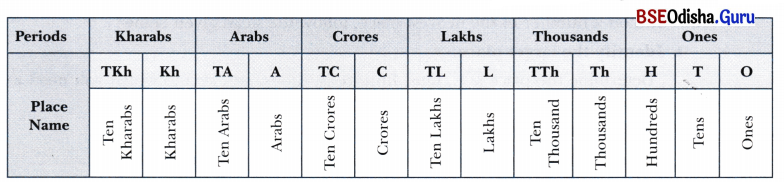
When writing large numbers, we use above place value chart to avoid skipping any digits.
The periods are separated by commas after 3 digits from the right, then after every 2 digits.
International (American) Number System: In this system, starting from the right, the first three places form the ones period, the next three places form the thousands period, the next three places form the millions period, the next three places form the billions period and so on.
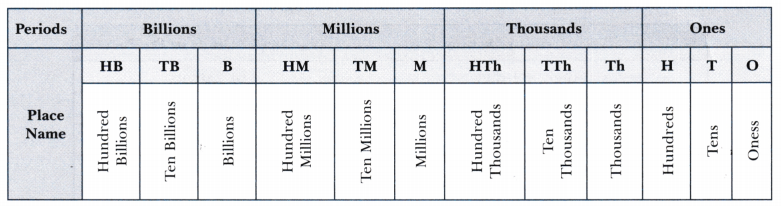
The various periods are separated by commas after every 3 digits from the right.

In any number, the face value of a digit is simply the digit itself. It does not change, no matter which position the digit holds in the number.
The place value is value a digit represent depending on the place or position in a number.
For example, ‘2’ in the number 523 represents the value 20 (2 x 10) as it occupies the tens place.
Similarly, ‘2’ in the number 234159 represents the value 2,00,000 (2 X 1,00,000) as it occupies the lakh place.
Large Numbers:
- 1 lakh = 1,00,000
- 1 crore= 1,00,00,000= 100 lakh
- 1 million = 1,000,000 = 10 lakh
- 1 billion = 1,000,000,000 = 1,000 million
- Greatest 5-digit number = 99,999
- Smallest 6-digit number = Greatest 5-digit number + 1 = 1,00,000
- Greatest 6-digit number = 9,99,999
- Smallest 7-digit number = Greatest 6-digit number + 1 = 10,00,000
Rounding means changing a number to its nearest place value — like the nearest tens, hundreds, thousands, lakhs, or even crores to make it simpler to understand or work with.
To round off a number to the nearest place, follow the steps given below:
Identify the target place.
Determine the place (e.g., tens, hundreds, thousands, etc.) to which you need to. round the number.
Look at the next digit.
Find the digit located immediately to the right of your target place.
Decide whether to round up or down.
Round up: If the digit to the right is 5, 6, 7, 8 or 9 (i.e. 5 or greater than 5), you round
the digit in the target place up by one.
Round down: If the digit to the right is 0, 1, 2, 3 or 4 (i.e. less than 5), you keep the digit in the target place the same.
Adjust the number.
Change all the digits to the right of the target place into zeros.
Without calculating, we can guess the number of digits in a product as follows:
|
Type of Multiplication |
Number of Digits in Product |
| 1-digit × 1-digit | 1 or 2 digits |
| 2-digit × 1-digit | 2 or 3 digits |
| 2-digit × 2-digit | 3 or 4 digits |
| 3-digit × 3-digit | 5 or 6 digits |
| 4-digit × 2-digit | 5 or 6 digits |
| 5-digit × 5-digit | 9 or 10 digits |
Indian Number System
Periods: Ones, Thousands, Lakhs, Crores and so on.
Comma placement: 3-2-2… pattern, starting from right
For example, the number 123456789 in Indian Number System is written as 12,34,56,789.
Number name: Twelve crore thirty four lakh fifty six thousand seven hundred eighty nine
|
Crores |
Lakhs |
Thousands |
Ones |
|||||
| TC C | TL | L | TTh | Th | H | T | O | |
| 1 2 | 3 | 4 | 5 | 6 | 7 | 8 | 9 | |
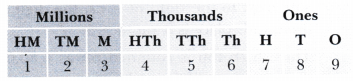
International Number System
Periods: Ones, Thousands, Millions, Billions and so on.
Comma placement: 3-3-3… pattern, starting from right
For example, the number 123456789 in International Number System is written as 123,456,789.
Number name: One hundred twenty three million four hundred fifty six thousand seven hundred eighty nine
Rounding Numbers
Rounding is adjusting a number to its nearest place value to make it easier to read or use.
Algorithm for Rounding Numbers
Step I: Identify the target place.
Step II: Look at the next digit immediately to the right of the target place.
Step III: Decide whether to round up or down:
- If the digit to the right is 5 or greater than 5, round the digit in the target place up by 1.
- If the digit to the right is less than 5, keep the digit in the target place the same.
Step IV: Adjust the number by changing all the digits to the right of the target place to zeros.
Place Value & Face Value
Face Value = digit itself
For example, in the number 5234, the face value of 2 is 2.
Place Value = digit × position value
For example, in the number 6789,
Place value of 9 is 9 × 1 =9.
Place value of 8 is 8 × 10 = 80.
Large Numbers
1 lakh = 1,00,000
1 crore = 1,00,00,000
= 100 lakh
1 million = 1,000,000
= 10 lakh
1 billion = 1,000,000,000
= 1,000 million
Multiplication Trick
To make calculations easier with numbers like 5, 25, and 125 remember these helpful shortcuts:
5 = 10 ÷ 2; 25 = 100 ÷ 4; 125 = 1000 ÷ 8