
Easy-to-read Ganita Prakash Class 7 Notes and Chapter 3 A Peek Beyond the Point Class 7 Notes save valuable study time during exam season.
Class 7 Maths Chapter 3 A Peek Beyond the Point Notes
Class 7 A Peek Beyond the Point Notes
Decimals are another way to show parts of a whole. Instead of writing fractions like \(\frac{1}{2}\) or \(\frac{3}{4}\), we use a point or period (V) as a separator called a decimal point.
For example, 0.5 means the same as \(\frac{1}{2}\) and 0.75 means the same as \(\frac{3}{4}\).
In a decimal number:
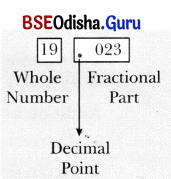
The number before the decimal point is the whole number part,
The number after the decimal point is the fractional part.
For example, in decimal number 19.023, we have
- Whole number part = 19
- Fractional part = 0.023
Adding zeros after the last non-zero digit in the fractional part of a decimal number does not change its value. For example, 0.3, 0.30 and 0.300 are all equal as they represent the same quantity, i.e. 3 tenths.
When reading decimal numbers, say each digit after the decimal point separately. For example, 8.05 is read as “eight point zero five”.
Decimal numbers which have the same number of digits after the decimal point are called Like Decimals. For example, 1.23, 22.63 and 100.56 are ‘Like Decimals as they all have 2 digits after the decimal point.

Decimal numbers which have different number of digits after the decimal point are called Unlike Decimals. For example, 6.3 and 6.25 are ‘Unlike Decimals’ as number of digits after the decimal point in the given two numbers are f and 2, respectively.
Unlike decimals can be converted to like decimals by adding zeros to the extreme right of the fractional part after the last non-zero digit. For example, ‘Unlike Decimals’ 6.3 and 6.25 are converted to ‘Like Decimals’ as 6.30 and 6.25.
Some most frequently used conversions (from decimals to fraction) are as follows:
| 1 | \(\frac{1}{2}\) | \(\frac{1}{3}\) | \(\frac{1}{4}\) | \(\frac{1}{5}\) | \(\frac{1}{8}\) | \(\frac{2}{3}\) | \(\frac{3}{4}\) |
| 1 | 0.5 | 0.333 | 0.25 | 0.20 | 0.125 | 0.67 | 0.75 |
 |
 |
 |
 |
 |
 |
 |
 |
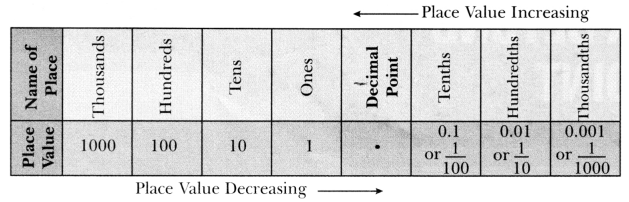
The decimal point separates the whole number part and fractional part. With the help of a decimal place value chart, we can easily understand the value of digits in both parts of a decimal number.
Just like fractions, we can also represent decimal numbers on the number line.
Consider the decimal number 1.8. It is equal to 1 unit and 8 tenths. This means that the unit between 1 and 2 is divided into 10 equal parts and 8 such parts are taken. Hence, 1.8 lies between 1 and 2.

Comparing two decimal numbers:
The decimal number with the greater whole number part is greater. For example: 6. 12 > 4.3
If whole number parts mere same, compare digit by digit, from left to right, until a difference is found. For example: 2.593 > 2528
Addition and subtraction of decimals:
Convert the given decimal numbers into like decimals.
Arrange the decimal numbers vertically with all the digits in the correct places according to the place value of the digits. This will result in the decimal point of the decimal numbers falling in one vertical line. Then add or subtract, as the case may be.
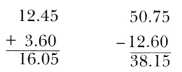
The sum of two decimal numbers will always be greater than the sum of their whole number parts. but less than 2 more than that sum, For example, the sum of 15.245 and 18.847 is greater than 33 and less than 35.
The difference of two decimal numbers will always lie between one iess than and one more than the difference of their whole number parts. For example, the difference of 25.89 and 13.42 is greater than 11 and less than 13.
When we change a measurement from one unit to another, we call it unit converstion.
The common units are as follows:
Length: km, m, cm, mm
Weight: kg, g, mg
Capacity: kl, l, ml
Decimal Numbers
In a decimal number, the number before the decimal point is the whole number part.
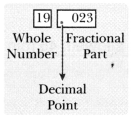
The number after the decimal point is the fractional part.
Decimal fractions: Fractions with denominators 10, 100, 1000, etc.
Tenths: One part out of 10 is known as tenths.
Hundredths: One part out of 100 is known as hundredths.
Decimal numbers which have the same number of digits after the decimal point are called Like Decimals.
Decimal numbers which have different number of digits after the decimal point are called Unlike Decimals.
Adding zeros after the last non-zero digit in the fractional part of a decimal number does not change its value.
When reading decimal numbers, say each digit after the decimal point separately. For example, 8.05 is read as “eight point zero five”.
A decimal place value chart shows the value of digits in both whole and fractional parts of a number.
A decimal number with a greater whole number part is larger, and if the whole number parts are equal, compare digits from left to right until a difference is found.
Addition and Subtraction of decimals
- Convert the given decimal numbers into like decimals.
- Arrange the decimal numbers vertically with all the digits in the correct places according to the place value of the digits. This will result in the decimal points of the decimal numbers falling in one vertical line. Then add or subtract, as the case may be.
Note:
The sum of two decimal numbers w ill always be greater than the sum of their whole number parts, but less than 2 more than that sum.
The difference of two decimal numbers will always lie between one less than and one more than the difference of their whole number parts.
Conversion of Units
When we change a measurement from one unit to another, we call it unit conversion.
The common units are as follow’s: Length: km, m, cm, mm Weight: kg, g, mg Capacity: kl, l, ml
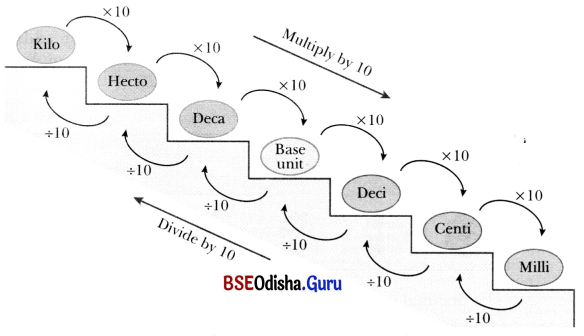
Memory Aid:
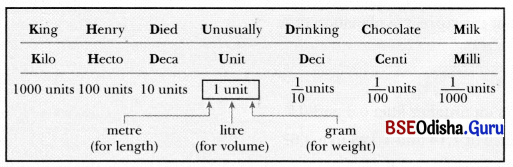
For example, 10 mm = 1 cm, 100 cm = 1 m, 1000 g = 1 kg, 1000 ml = 1l
Remember:
Larger unit → Smaller unit: Multiply by 10 for each step
Smaller unit → Larger unit: Divide by 10 for each step