Easy-to-read Ganita Prakash Class 6 Notes and Chapter 9 Symmetry Class 6 Notes save valuable study time during exam season.
Class 6 Maths Chapter 9 Symmetry Notes
Class 6 Symmetry Notes
Symmetry
Symmetry means a shape or an object looks identical after being transformed by a specific operation, such as being divided by a line or rotated.
A figure has reflection symmetry if it can be folded (or divided) along a line and both halves match exactly.
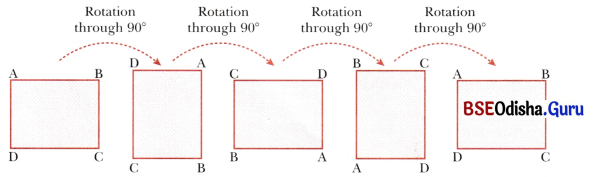
A figure has rotational symmetry if it looks the same after being turned around a centre by a certain angle.
Reflection Symmetry
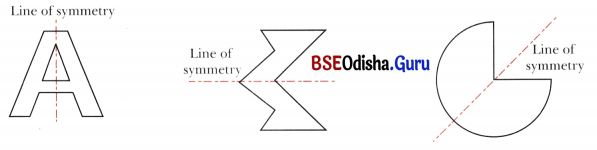
An object or a shape displays reflection symmetry, if on drawing a (vertical, horizontal or inclined) line through the middle of the object or the shape, the portions on either side of the line are identical.
Reflection symmetry is also called mirror symmetry or mirror-image symmetry because one half of the shape looks exactly like the other half when reflected across a line, just like an image seen in a mirror.
A line that divides a figure into two equal parts, such that both parts completely overlap when folded along that line, is called a line of symmetry. The two identical parts are called mirror halves.

A line of symmetry may be vertical, horizontal, or even slanting (inclined).
Lines of Symmetry of some Geometric Figures
| Equilateral triangle | 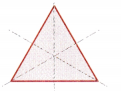 |
3 lines of symmetry |
| Isosceles triangle | 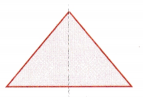 |
1 line of symmetry |
| Scalene triangle | 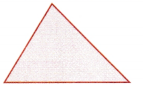 |
0 line of symmetry |
| Square | 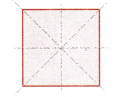 |
4 lines of symmetry |
| Rectangle | 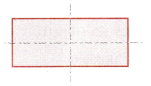 |
2 lines of symmetry (Does not have its diagonals as lines of symmetry) |
| Kite |  |
1 line of symmetry |
| Rhombus | 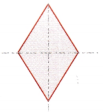 |
2 lines of symmetry |
| Isosceles Trapezium | 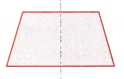 |
1 line of symmetry |
| Parallelogram | 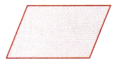 |
No line of symmetry |
| Circle | 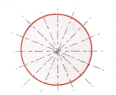 |
Infinite lines of symmetry |
Rotational Symmetry
Rotational symmetry occurs when a figure appears unchanged after being rotated around a fixed point (the centre of rotation) by specific angles.
The fixed point around which the rotation of figure occurs is called the centre of rotation.
An angle of rotational symmetry or angle of symmetry is the angle at which a figure looks the same after rotation.
The number of times a figure fits into itself in one full turn is called the order of rotational symmetry.
Order of rotational symmetry = 
A square has rotational symmetry at 90°, 180°, 270° and 360°. The order of rotational symmetry is 4 (number of times it matches its original shape in one full rotation).

A rectangle has rotational symmetry at 180° and 360°. The order of rotational symmetry is 2 (number of times it matches its original shape in one full rotation).
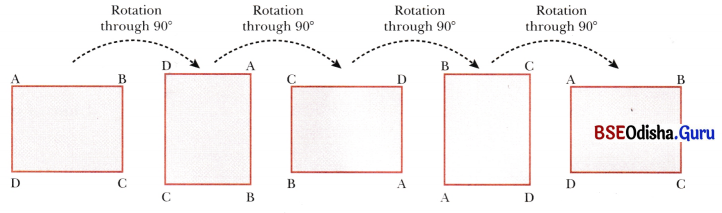
A figure that only looks the same after 360° rotation has no rotational symmetry (order = 1).
If the smallest angle of symmetry is a natural number (in degrees), it is a factor of 360.
The angles of symmetry are always multiples of the smallest angle of symmetry.
Figures with radial arms can be designed to have a specific number of angles of symmetry by ensuring equal spacing between arms:
- For 4 arms: angles are 90°, 180°, 270° and 360°.
- For 3 arms: angles are 120°, 240° and 360°.
- For 2 arms: angles are 180° and 360°.
Angle between two consecutive arms =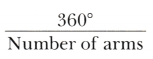
A circle has infinite angles of rotational symmetry, i.e. any angle of rotation maps it onto itself.
Line of Symmetry
A line that cuts plane figure into two parts that exactly overlap when folded along that line is called a line of symmetry or axis of symmetry of the figure.
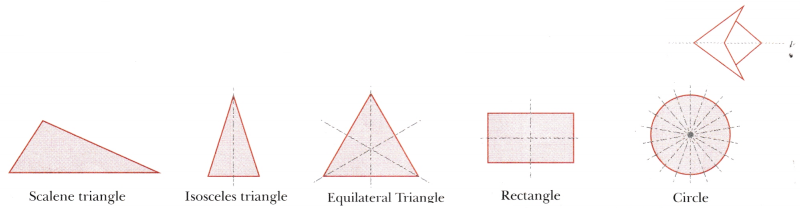
Note: A plane figure through which no axis of symmetry can be drawn is said to be asymmetric.
Reflection Symmetry
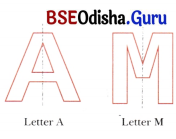
An object or a shape displays reflection symmetry, if on drawing a line (vertical, horizontal or inclined) through the middle of the object or the shape, the portions on either side of the line are identical.
Reflection symmetry is also called mirror symmetry or mirror-image symmetry because one half of the shape looks exactly like the other half when reflected across a line, just like an image seen in a mirror.
Rotational Symmetry
The process of turning an object around a fixed point is called rotation. The fixed point is called the centre of rotation.
Objects or figures which can be rotated about a point by less than a complete turn to obtain the exact same shape are said to have rotational symmetry.
The angle through which the figure must be rotated to get the original figure is called the angle of rotation or the angle of symmetry.
The number of times a figure fits into itself in one full turn is called the order of rotational symmetry.
(a) Order of ratational symmetry = 
(b) Smallest angle of ratational symmetry = 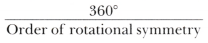
For example, a rectangle has angle of rotational symmetry at 180° and 360°. The order of rotational symmetry is 2 (number of times it matches its original shape in one full rotation).